 How to resolve AdBlock issue?
News
- Details
- Written by: Janet M. Davis, The University of Texas at Austin College of Liberal Arts

Every summer on the Discovery Channel, “Shark Week” inundates its eager audiences with spectacular documentary footage of sharks hunting, feeding and leaping.
Debuting in 1988, the television event was an instant hit. Its financial success wildly exceeded the expectations of its creators, who had been inspired by the profitability of the 1975 blockbuster film “Jaws,” the first movie to earn US$100 million at the box office.
Thirty-three years later, the enduring popularity of the longest-running programming event in cable TV history is a testament to a nation terrified and fascinated by sharks.
Journalists and scholars often credit “Jaws” as the source of America’s obsession with sharks.
Yet as a historian analyzing human and shark entanglements across the centuries, I argue that the temporal depths of “sharkmania” run much deeper.
World War II played a pivotal role in fomenting the nation’s obsession with sharks. The monumental wartime mobilization of millions of people placed more Americans into contact with sharks than at any prior time in history, spreading seeds of intrigue and fear toward the marine predators.
America on the move
Before World War II, travel across state and county lines was uncommon. But during the war, the nation was on the move.
Out of a population of 132.2 million people, per the 1940 U.S. Census, 16 million Americans served in the armed forces, many of whom fought in the Pacific. Meanwhile, 15 million civilians crossed county lines to work in the defense industries, many of which were in coastal cities, such as Mobile, Alabama; Galveston, Texas; Los Angeles; and Honolulu.
Local newspapers across the country transfixed civilians and servicemen alike with frequent stories of bombed ships and aircraft in the open ocean. Journalists consistently described imperiled servicemen who were rescued or dying in “shark-infested waters.”
Whether sharks were visibly present or not, these news articles magnified a growing cultural anxiety of ubiquitous monsters lurking and poised to kill.
The naval officer and marine scientist H. David Baldridge reported that fear of sharks was a leading cause of poor morale among servicemen in the Pacific theater. General George Kenney enthusiastically supported the adoption of the P-38 fighter plane in the Pacific because its twin engines and long range diminished the chances of a single-engine aircraft failure or an empty fuel tank: “You look down from the cockpit and you can see schools of sharks swimming around. They never look healthy to a man flying over them.”
‘Hold tight and hang on’
American servicemen became so squeamish about the specter of being eaten during long oceanic campaigns that U.S. Army and Navy intelligence operations engaged in a publicity campaign to combat fear of sharks.
Published in 1942, “Castaway’s Baedeker to the South Seas” was a “travel” survival guide, of sorts, for servicemen stranded on Pacific islands. The book emphasized the critical importance of conquering such “bogies of the imagination” as “If you are forced down at sea, a shark is sure to amputate your leg.”
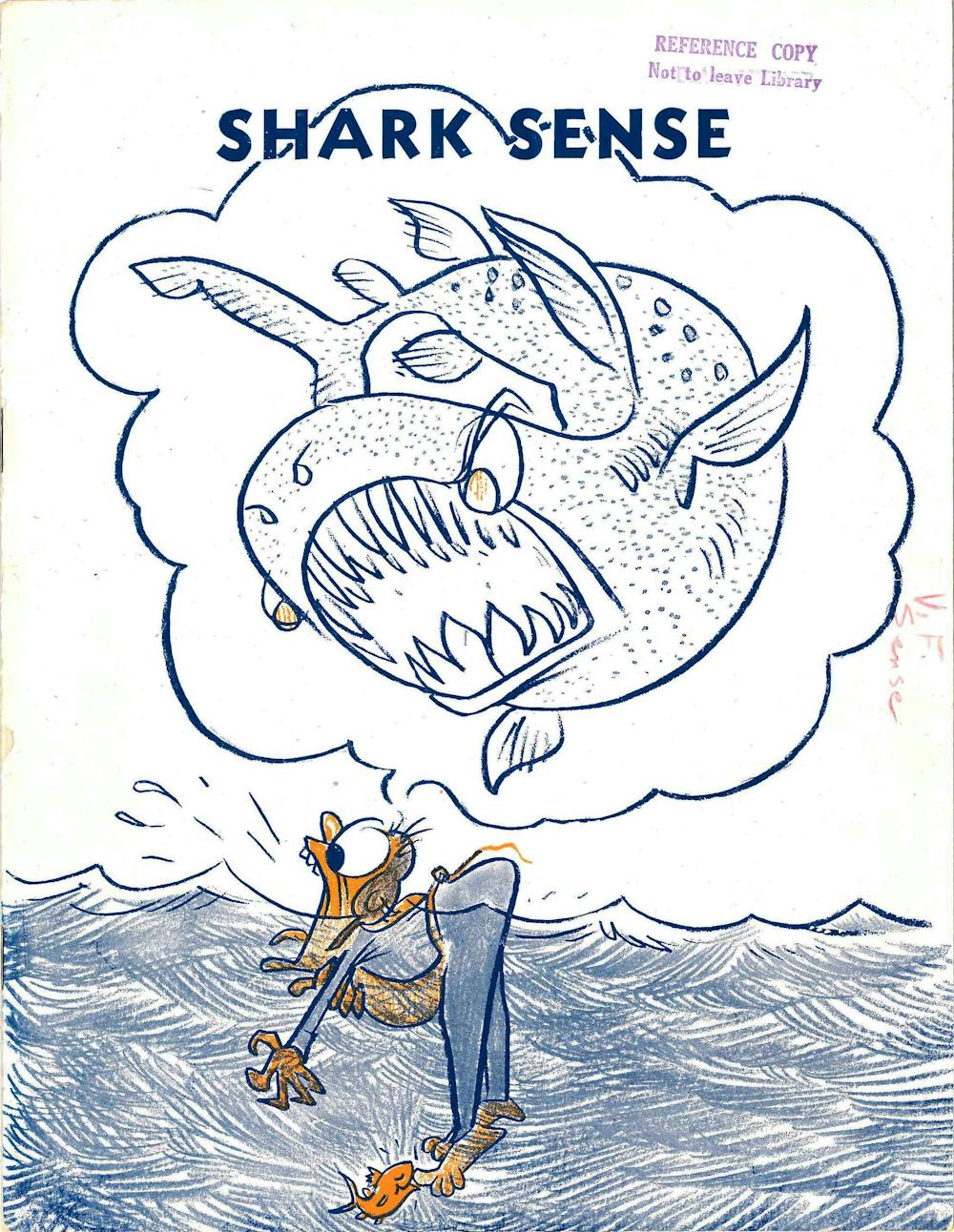
Similarly, the Navy’s 1944 pamphlet titled “Shark Sense” advised wounded servicemen stranded at sea to “staunch the flow of blood as soon as you disengage the parachute” to thwart hungry sharks. The pamphlet helpfully noted that hitting an aggressive shark on the nose might stop an attack, as would grabbing a ride on the pectoral fin: “Hold tight and hang on as long as you can without drowning yourself.”
The Department of the Navy also worked with the Office of Strategic Services, the wartime precursor to the Central Intelligence Agency, to develop a shark repellent.
Office of Strategic Services executive assistant and future chef Julia Child worked on the project, which tested various recipes of clove oil, horse urine, nicotine, rotting shark muscle and asparagus in hopes of preventing shark attacks. The project culminated in 1945, when the Navy introduced “Shark Chaser,” a pink pill of copper acetate that produced a black inky dye when released in the water – the idea being that it would obscure a serviceman from sharks.
Nonetheless, the U.S. military’s morale-boosting campaign was unable to vanquish the glaring reality of wartime carnage at sea. Military media correctly observed that sharks rarely attack healthy swimmers. Indeed, malaria and other infectious diseases took a far greater toll on U.S. servicemen than sharks.
But the same publications also acknowledged that an injured person was vulnerable in the water. With the frequent bombing of airplanes and ships during World War II, thousands of injured and dying servicemen bobbed helplessly in the ocean.
One of the worst wartime disasters at sea occurred on July 30, 1945, when pelagic sharks swarmed the site of the shipwrecked USS Indianapolis. The heavy cruiser, which had just successfully delivered the components of the Hiroshima atomic bomb to Tinian Island in a top-secret mission, was torpedoed by a Japanese submarine. Out of a crew of 1,196 men, 300 died immediately in the blast, and the rest landed in the water. As they struggled to stay afloat, men watched in terror as sharks feasted on their dead and wounded shipmates.
Only 316 men survived the five days in the open ocean.

‘Jaws’ has an eager audience
World War II veterans possessed searing lifelong memories of sharks – either from direct experience or from the shark stories of others. This made them an especially receptive audience for Peter Benchley’s taut shark-centered thriller “Jaws,” which he published in 1974.
Don Plotz, a Navy sailor, immediately wrote to Benchley: “I couldn’t put it down until I had finished it. For I have rather a personal interest in sharks.”
In vivid detail, Plotz recounted his experiences on a search and rescue mission in the Bahamas, where a hurricane had sunk the USS Warrington on Sept. 13, 1944. Of the original crew of 321, only 73 survived.
“We picked up two survivors who had been in the water twenty-four hours, and fighting off sharks,” Plotz wrote. “Then we spent all day picking up the carcasses of those we could find, identifying them and burying. Sometime only rib cages … an arm or leg or a hip. Sharks were all around the ship.”
Benchley’s novel paid little attention to World War II, but the war anchored one of the movie’s most memorable moments. In the haunting, penultimate scene, one of the shark hunters, Quint, quietly reveals that he is a survivor of the USS Indianapolis disaster.
“Sometimes the sharks look right into your eyes,” he says. “You know the thing about a shark, he’s got lifeless eyes, black eyes, like a doll’s eyes. He comes at you, he doesn’t seem to be living until he bites you.”
The power of Quint’s soliloquy drew upon the collective memory of the most massive wartime mobilization in American history. The oceanic reach of World War II placed greater numbers of people into contact with sharks under the dire circumstances of war. Veterans bore intimate witness to the inevitable violence of battle, compounded by the trauma of seeing sharks circle and feed opportunistically on their dead and dying comrades.
Their horrifying experiences played a pivotal role in creating an enduring cultural figure: the shark as a mindless, spectral terror that can strike at any moment, a haunting artifact of World War II that primed Americans for the era of “Jaws” and “Shark Week.”
[Get the best of The Conversation, every weekend. Sign up for our weekly newsletter.]
Janet M. Davis, University Distinguished Teaching Professor of American Studies, The University of Texas at Austin College of Liberal Arts
This article is republished from The Conversation under a Creative Commons license. Read the original article.
- Details
- Written by: DENNIS FORDHAM

Having a broadly drafted power of attorney can enable an agent to act in a representative capacity in a multitude of situations.
If authorized, the agent can act to provide for the principal’s personal care, manage the principal’s assets, engage in estate planning, support dependents, make gifts (such as to qualify for Medi-Cal), and more.
Let us discuss.
If the principal needs personal care at home, at a hospital, or at a nursing care facility then an authorized agent can sign the personal care contracts and use the principal’s financial resources to pay the expenses.
The agent represents the principal's interests and pays for the health care expenses authorized by the agent under the principal’s advance health care directive. Oftentimes, one and the same person is the agent acting in both capacities.
Managing and using bank and brokerage accounts, including retirement accounts, depends on the financial institution accepting the power of attorney. Often they are reluctant to do so unless the power is on their own form, drafted by their own legal department.
Such powers are limited to managing accounts at the one institution only, and are limited in duration. They are necessary supplements to the generally applicable durable power of attorney.
A power of attorney can also be used for estate planning. It can authorize the agent to establish a trust and to transfer the principal’s assets into a trust on behalf of the principal to avoid probate. Avoiding probate is especially important to the family of anyone receiving Medi-Cal where estate recovery only applies if there is a probate.
Moreover, the power can also authorize — or not authorize — an agent to execute death beneficiary forms to name beneficiaries to pay on death bank accounts, transfer on death brokerage accounts and retirement plans (e.g., IRA’s and 401(k)’s).
If the principal financially supports someone the agent can be authorized to continue such support. This is especially relevant to supporting dependent adult children or parents.
For example, continuing to pay a child’s car insurance and a stipend while attending college. Also, for example, to pay utility expenses of a dependent parent.
Nowadays, with digital (online) financial assets, it is important to authorize an agent to access such online accounts in the event that the agent does not know the principal’s log-on username and password.
The same consent language can authorize access to email and social media accounts that become inaccessible.
Express limitations and prohibitions can be included to prevent the misuse of a power of attorney. For example, the document may prohibit an agent from changing death beneficiaries to accounts.
A power of attorney can either become effective immediately upon signing or later upon incapacity of the principal. Powers of attorney terminate, amongst other ways, upon revocation (if the principal has the capacity to revoke) or upon death of the principal.
Without a power of attorney, an expensive, time consuming and aggravating court supervised conservatorship proceeding is often necessary in order to manage an incapacitated person’s legal, financial and property affairs. Conservatorships can be contested, resulting in expensive and time consuming litigation.
The foregoing is a general discussion and is not legal advice. If needing guidance on such issues, consult a qualified attorney.
Dennis A. Fordham, attorney, is a State Bar-Certified Specialist in estate planning, probate and trust law. His office is at 870 S. Main St., Lakeport, Calif. He can be reached at
- Details
- Written by: Katherine Kretke

In the 1970s four spacecraft began their one-way trips out of our Solar System. As the first human-built objects to ever venture into interstellar space, NASA chose to place plaques on Pioneer 10 and 11 and golden records on Voyager 1 and 2 spacecraft to serve as messages to any alien spacefarers that may someday encounter these spacecraft.
Continuing this legacy, NASA’s Lucy spacecraft will carry a similar plaque.
However, because Lucy will not be venturing outside of our Solar System, Lucy’s plaque is a time-capsule featuring messages to our descendants.
As the first-ever mission to the Trojan asteroids, Lucy will survey this enigmatic population of small bodies that orbit the Sun beyond the main asteroid belt — trapped by Jupiter and the Sun so that they have led and followed Jupiter in its orbit.
As these never before explored asteroids are in many ways “fossils” from the formation and evolution of the planets, the Lucy spacecraft is named in honor of the fossilized human ancestor discovered the year after Pioneer 11 began its journey out of the Solar System.
Lucy’s name was inspired by the Beatles’ song “Lucy in the Sky with Diamonds.”
After Lucy finishes visiting a record number of asteroids for a single mission in 2033 (eight asteroids on six independent orbits around the Sun) the Lucy spacecraft will continue to travel between the Trojan asteroids and the orbit of the Earth for at least hundreds of thousands, if not millions of years.
It is easy to imagine that someday in the distant future our descendants will find Lucy floating among the planets.
Therefore, the Lucy team chose to put a time-capsule aboard the Lucy spacecraft in the form of a plaque, messages this time not for unknown aliens, but for those that will come after us.
The plaque was installed on the spacecraft in a ceremony at Lockheed Martin Space in Littleton, Colorado, on July 9.
This time-capsule contains messages from prominent members of our society; individuals who have asked us to contemplate the state of the human condition as well as our place in the universe.
These thoughtful leaders were asked to provide words of advice, words of wisdom, words of joy, and words of inspiration to those who may read this plaque in the distant future.
These messages were solicited from Nobel Laureates in literature, United States Poet Laureates, and other inspirational figures including the members of the band that indirectly inspired the Lucy mission’s name.
To date this time-capsule, the plaque also includes a depiction of the Solar System on the day of Lucy’s anticipated launch of Oct. 16.
The original trajectory of the Lucy spacecraft, traveling between the Trojan swarms and the Earth’s orbit, is shown as well.
NASA places this plaque with the hope that space exploration continues and someday astro-archeologists may travel among the planets and retrieve this spacecraft as an artifact of the early days when humanity took its first steps to explore our Solar System.
Southwest Research Institute in Boulder, Colorado is the principal investigator institution. NASA’s Goddard Space Flight Center in Greenbelt, Maryland provides overall mission management, systems engineering and safety and mission assurance. Lockheed Martin Space in Littleton, Colorado is building the spacecraft.
Lucy is the 13th mission in NASA’s Discovery Program. NASA’s Marshall Space Flight Center in Huntsville, Alabama, manages the Discovery Program for the agency’s Science Mission Directorate in Washington, D.C.
For more information on the Lucy mission visit https://www.nasa.gov/lucy.
For more information about the plaque participants visit http://lucy.swri.edu/lucy-plaque.
Katherine Kretke works for the Southwest Research Institute.
- Details
- Written by: Elizabeth Larson
In a unanimous vote, the council on Thursday evening approved a proposal to sell a 2.5-acre parcel to MLI Associates LLC for the development of a 75-room Fairfield Inn by Marriott.
MLI Associates also is considering adding a small conference center and possibly some retail to the plan, according to City Manager Alan Flora.
The property is located at 6356 Armijo Ave. and is a portion of the city’s former Pearce Field airport site. Flora said the site is on the far northern part of the property, at the end of what was once the runway.
The sale price is $305,000, with the city to hold the note during the construction process. The proposal calls for the city to forgive portions of the note if the company meets specific deadlines.
Flora went over the deadlines, explaining that the first one is 14 months after closing, when the company needs to complete the process of getting all of the necessary entitlements.
At the 20-month mark, MLI Associates must begin construction, he said. The new hotel is proposed to be opened within 36 months of the closing of the sale.
If each deadline is met, Flora said the remaining payment on the note would be forgiven.
It’s the first tangible project at the airport site, so there is increased risk to the developer, said Flora, adding there are other projects the city is excited about that staff will be bringing to the council soon.
Flora said the plan includes the city installing road and utility infrastructure at the site, which over the years the city has attempted to market for a shopping center.
MLI Associates owner Matt Patel attended the meeting via Zoom.
“It’s been a pleasure working with Alan and the rest of the team over the last few months,” Patel said.
He said Marriott has approved the site for the hotel project.
Patel said he’s looking forward to developing the hotel and having a long-term relationship with the city.
He said he’s working with local companies and individuals on the project, including Bridges Construction.
During public comment, City Clerk Melissa Swanson read an email from a community member questioning the sales price and the process.
Councilwoman Joyce Overton said many cities give away property for development if it will provide taxes and jobs, and Flora also noted that the property has been for sale “for way too long.”
Flora said the existing parcel is 200 feet wide and the Fairfield Inn plan requires a 240-foot-wide parcel. There are paper roads on both sides of the site, so the agreements with MLI Associations envision the city abandoning those rights of way. There will be a public hearing in the future to finalize the road abandonment.
Councilman Russ Cremer moved to approve the agreement, with Overton seconding and the council voting 5-0.
A ‘significant’ addition
There are more than 1,100 Fairfield Inns in the United States, with nearly 70 in California, according to the company’s website.
Flora told Lake County News that the new hotel project will be a “significant” addition to the city’s hotel inventory.
“Some of the existing hotels are very dated with a lot of travelers choosing to stay in other locations around the county. Lake County in general has a deficit of quality rooms,” Flora said.
Flora said the city of Clearlake has five properties that are considered hotels, and a total of 12 properties that currently offer lodging, including campgrounds, vacation rentals and hotels.
Flora said he didn’t have a total number of rooms that he trusts very much, but he estimated the total number of rooms in the city now is at about 150, with the Best Western having the most at 68.
A year ago this month, the city had begun negotiations with King Management over the Armijo Avenue site and later entered negotiations with the firm for a hotel development on a portion of Redbud Park that’s currently the site of the ball fields, which the city plans to move to a newly purchased property on Burns Valley Road behind Safeway.
In January, the council approved extending the negotiations.
Flora said MLI Associates is a completely different company than King Management.
“King was interested in the airport as well as Redbud, but MLI was willing to do the airport much more quickly,” he said.
“The Redbud project is moving very slowly, but we still hope to keep that deal alive too. We have other folks that are interested if King doesn’t come through. There are a couple of legal things we are working through at Redbud in order to finalize a deal,” Flora said.
Email Elizabeth Larson at