 How to resolve AdBlock issue?
News
- Details
- Written by: Lake County News reports
The first order requires workers in health care settings to be fully vaccinated or receive their second dose by Sept. 30.
This order builds on Gov. Newsom’s recent announcement requiring state workers and workers in health care and high-risk congregate settings to either demonstrate proof of full vaccination or be tested at least once per week.
Following the governor’s announcement, businesses and local governments have implemented similar measures for their employees.
“As we continue to see an increase in cases and hospitalizations due to the Delta variant of COVID-19, it’s important that we protect the vulnerable patients in these settings,” said Dr. Tomás J. Aragón, CDPH director and State Public Health officer, said Thursday. “Today’s action will also ensure that health care workers themselves are protected. Vaccines are how we end this pandemic.”
This order applies to workers in hospitals, skilled nursing facilities, and in most other health care settings.
The second public health order directs hospitals, skilled nursing facilities and intermediate care facilities to verify that visitors are fully vaccinated or have tested negative for COVID-19 in the prior 72 hours before indoor visits.
Updates to guidance for visitors to other long-term care facilities is expected in the near future.
Health care facilities are high-risk settings where COVID-19 outbreaks can have severe consequences for vulnerable populations including hospitalization, severe illness, and death. By requiring health care workers to be fully vaccinated and visitors to acute care facilities to demonstrate they are fully vaccinated or have tested negative for COVID-19, California is protecting the most vulnerable individuals, while also protecting workers in these settings.
Employees may have options for compensated time off to get vaccinated, including COVID Supplemental Paid Sick Leave.
Access to PPE, worker training and education, and other infection control policies are still important tools in preventing transmission.
The state encourages facilities to make available resources that can help answer questions about vaccines and provide culturally sensitive advice.
The state’s goal is to ensure that vaccine sites are easily accessible for these workers.
California is leading the nation in vaccinations, with more than 45 million doses administered and 76.7% of the eligible population having received at least one dose.
However, the state is seeing increasing numbers of individuals — overwhelmingly unvaccinated — contracting COVID-19 and being admitted to the hospital and ICU. This increase is primarily due to the Delta variant.
California remains committed to increasing vaccination rates and urges businesses and local communities to encourage vaccination.
Health officials said COVID-19 vaccines are safe, effective and free. Unvaccinated Californians age 12 and up can go to http://myturn.ca.gov or call 833-422-4255 to schedule an appointment or go to http://myturn.ca.gov/clinic to find a walk-in clinic in their county.
- Details
- Written by: Lake County News reports
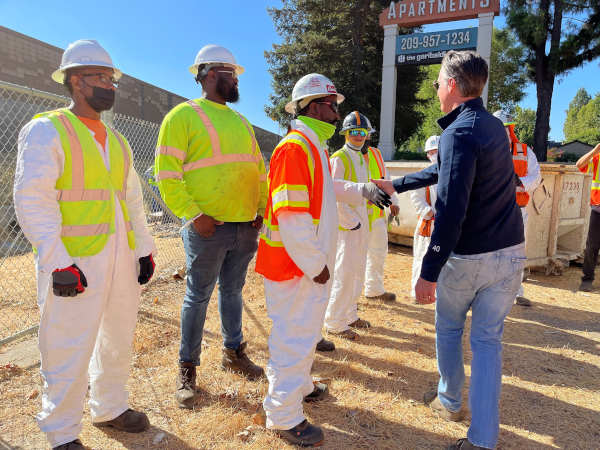
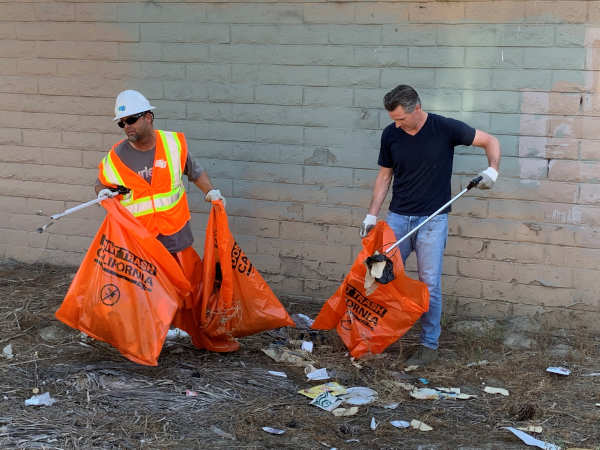
During a visit to a Clean California site in Long Beach on Thursday, Gov. Gavin Newsom outlined his plan for record investments in mental health services and behavioral health housing as part of a comprehensive approach to tackling the state’s homelessness crisis.
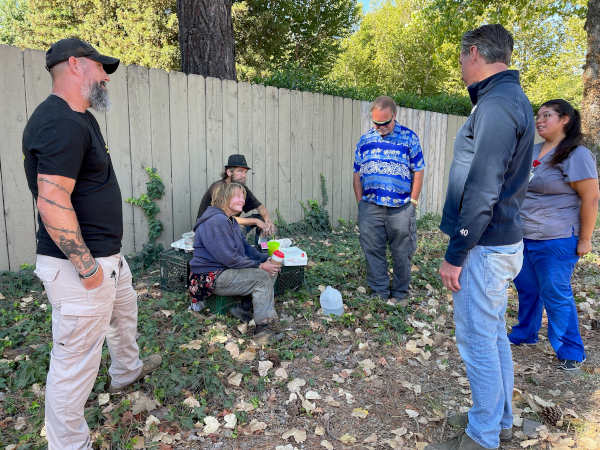
Earlier in the day, the governor met with residents, outreach workers and Caltrans clean-up crew members at an encampment in Stockton where unhoused individuals were offered options to move out of tents and into safer, more stable shelter and housing.
“We have to get to the root issues of why people end up on the street in the first place – and for many, that’s due to deteriorating mental health conditions,” said Newsom. “For too long, California has had a piecemeal response to homelessness. When officials shut one site down, another one was likely to pop up. We’re changing that mindset and working to remove encampments by treating the root causes — lack of housing and lack of mental health resources — by investing $3 billion for behavioral health and conservatorship housing.”
The plan includes a $12 billion investment over two years to confront the homelessness crisis, helping the most unwell individuals move off the streets and into housing with wrap-around services.
As part of this investment, Gov. Newsom led the charge for a $3 billion behavioral health housing initiative — the largest investment in California history for rebuilding the behavioral health pipeline.
The $3 billion plan is expected to create 22,000 new beds and treatment slots, a component of the 42,000 new homeless housing units that will be created under the California Comeback Plan.
Newsom last year signed legislation to strengthen Laura’s Law and expand funding for the treatment of substance abuse.
AB 1976 makes county participation in Assisted Outpatient Treatment (i.e. Laura’s Law) automatic unless a county opts out.
As of June 2021, a total of 31 counties in California have not opted out and will implement Laura’s Law, covering 80 percent of the state’s population. AB 2265 expands the kinds of services Mental Health Services Act funds can pay for, specifically addiction treatment.
In addition, the Department of Health Care Services has leveraged over $260 million in federal opioid funding to support the Medication Assisted Treatment Expansion Project, allowing easy access to opioid addiction treatment in emergency departments and hospitals, primary care clinics, drug treatment programs, jails and prisons, and other health care settings.
“Let me be blunt: it is unacceptable to not provide proper care to those struggling the most, who’ve found themselves homeless due to mental health and addiction challenges,” said Newsom. “We cannot continue to tolerate the open drug use on our streets — we can no longer just look the other way.”
The governor’s plan also advances CalAIM, a once-in-a-generation reform of our Medi-Cal system that will better manage risk and improve outcomes through whole person care approaches and addressing social determinants of health. This will better serve California’s most vulnerable residents: the homeless, our children and people cycling in and out of the criminal justice system.
To ensure that local governments fulfill their obligation to provide services to people experiencing homelessness and to create safe and clean streets for all Californians, the California Comeback Plan includes $147 million for encampment resolution and clean-up efforts.
In addition, the governor has launched the $1.1 billion Clean California initiative to hire people exiting homelessness, at-risk youth, formerly incarcerated individuals and others to support state and local litter abatement efforts, providing them with a steady income to get back on their feet and lower the rate of recidivism.
Caltrans will match local investments, focusing on the needs of more severely underserved communities, with the goal of funding 300 local projects throughout California over the three-year program.
- Details
- Written by: Elizabeth Larson
The newest dog is at the top.
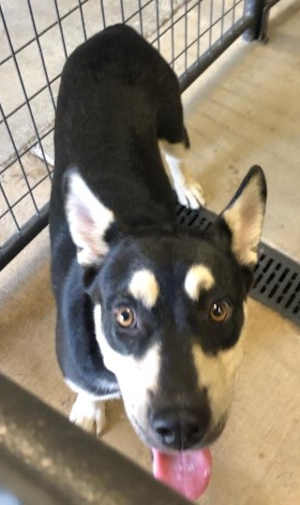
‘Trixie’
“Trixie” is a female German shepherd mix with a short black and tan coat.
She is dog No. 5056.

‘Bear’
“Bear” is a male American Staffordshire terrier mix with a short brown coat.
He has been neutered.
He is dog No. 3476.

‘Blue Eyed Jack’
“Blue Eyed Jack” is a male German shepherd mix.
He is dog No. 5046.
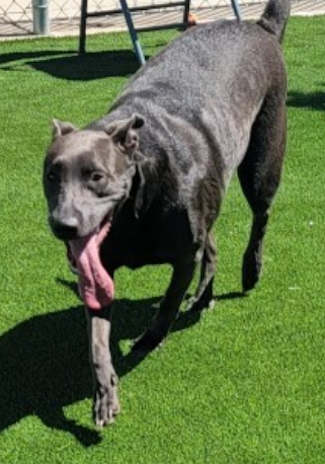
‘Cleo’
“Cleo” is a female Doberman pinscher mix with a short gray coat who is new to the shelter.
She has been spayed.
She is dog No. 4865.
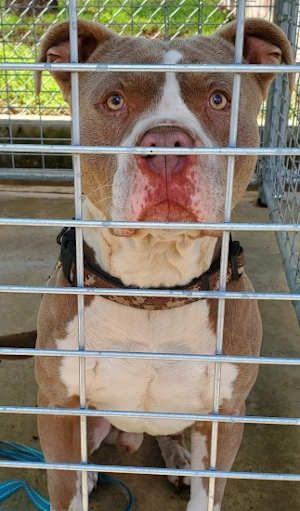
‘Dusty’
“Dusty” is a male American Pit Bull Terrier with a tan and white coat.
He is dog No. 4750.
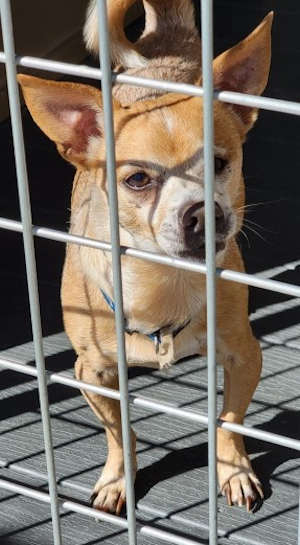
‘Gizmo’
“Gizmo” is a senior male Chihuahua mix with a short tan and white coat.
He is dog No. 4902.

‘Mara’
“Mara” is a female Rottweiler mix.
She has a short black and tan coat.
He is house-trained.
She is dog No. 4628.

‘Mary J’
“Mary J” is a female pit bull terrier mix.
She has a white and tan coat.
She is house-trained.
She is dog No. 4927.
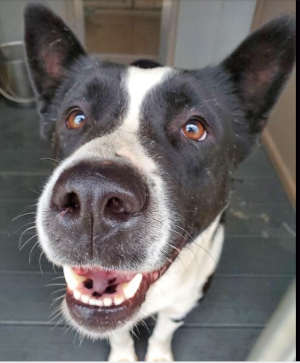
‘Mitzy’
“Mitzy” is a female shepherd mix with a medium-length black and white coat.
She is dog No. 4648.

‘Mojo’
“Mojo” is a male Chihuahua mix with a short black and tan coat.
He has been neutered.
He is dog No. 4881.
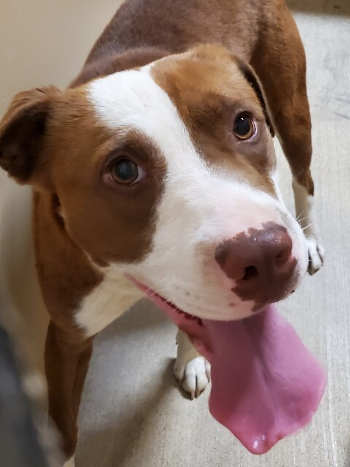
‘Oakley’
“Oakley” is a male pit bull terrier mix.
He has a short red and white coat.
He is dog No. 4934.
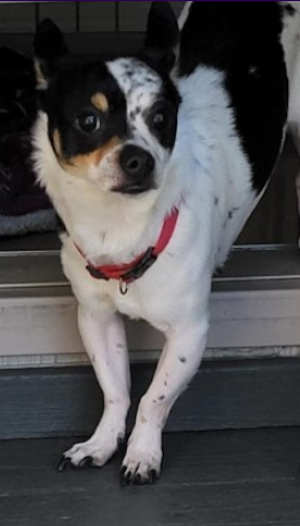
‘Patches’
“Patches” is a male Chihuahua mix with a short tricolor coat.
He is dog No. 4903.
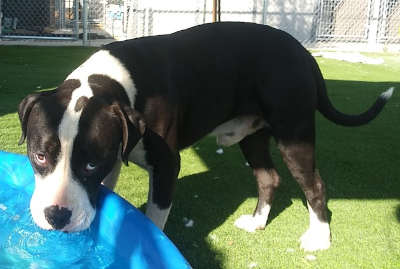
‘Petey’
“Petey” is a male American Staffordshire terrier mix with a black and white coat.
He is dog No. 4963.
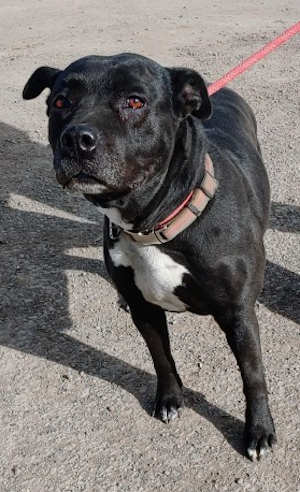
‘Sassy’
“Sassy” is a female American bully mix with a short black coat.
She has been spayed.
She is dog No. 4602.
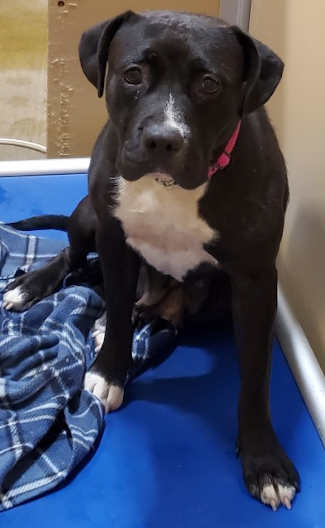
‘Sissy’
“Sissy” is a female American Staffordshire terrier mix with a black coat.
She is dog No. 4964.

‘Tanisha’
“Tanisha” is a female shepherd mix with a short orange and white coat.
She is dog No. 4647.
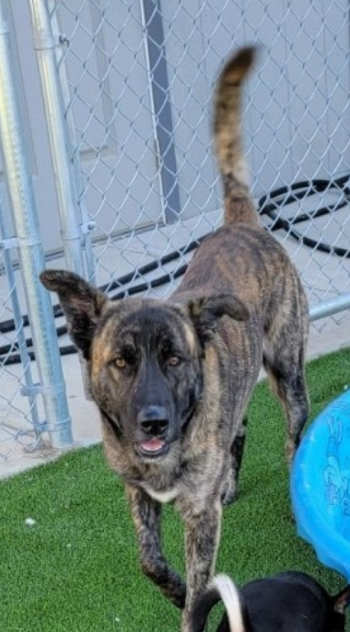
‘Terry’
“Terry” is a male Dutch shepherd mix with a smooth brindle coat.
He is dog No. 4880.
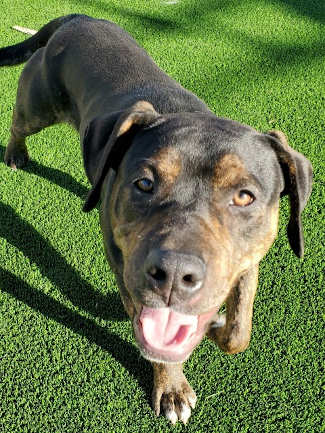
‘Tinsel’
“Tinsel” is a female American pit bull terrier mix with a short brindle and brown coat.
She is dog No. 4433.

‘Yule’
“Yule” is a male husky with a medium-length black and white coat.
He is dog No. 4432.
Call the Clearlake Animal Control shelter at 707-273-9440, or email
Visit Clearlake Animal Control on Facebook or on the city’s website.
Email Elizabeth Larson at
- Details
- Written by: Elizabeth Larson
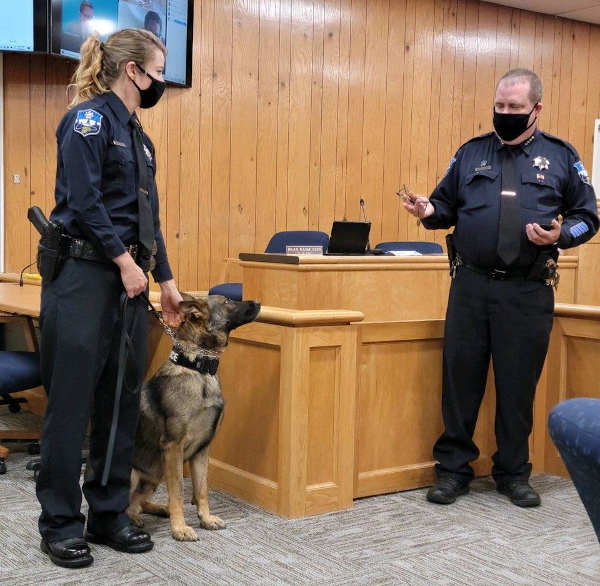
LAKE COUNTY, Calif. — The Lakeport City Council on Tuesday welcomed the city’s first police K-9 in more than a decade.
Lakeport Police Chief Brad Rasmussen introduced K-9 Olin to the council at the start of the Tuesday night meeting.
Olin is a year-and-a-half-old sable German shepherd born in Europe, where Rasmussen said most police dogs come from now.
In June, he was paired with his handler, Officer Kaylene Strugnell.
The Lakeport Police Department hasn’t had a K-9 since Max, a Belgian Malinois, retired in 2009.
It’s long been a goal of Rasmussen’s to reestablish a K-9 program.
In 2018, Rasmussen and his department received the council’s approval to apply to the United States Department of Agriculture for $38,000 through its Community Facilities Grant to start the K-9 Unit.
The city received those funds, which paid for a state-of-the-art K-9 patrol vehicle with protection for the dog built into it.
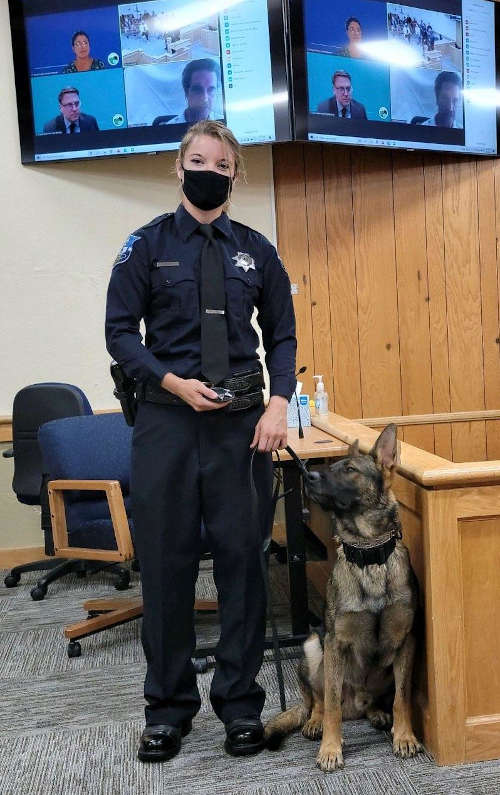
Rasmussen said Lakeport Police needed community partnerships to satisfy the USDA grant guidelines, and it took time to put it all together, with Strugnell selected to be the handler before they had the program.
One of the key partnerships was with the Lucerne Area Revitalization Association, or LARA, which offered to be the fiscal sponsor, Rasmussen said.
LARA was created by the founders of Lake County News to work on community projects. The organization stepped forward in 2020 to take on the fiscal sponsor role when the group originally set to be the fiscal sponsor did not end up forming.
Rasmussen also recognized the critical partnership of the Sean M. Walsh K-9 Memorial Foundation, which awarded Lakeport Police $10,000 to purchase Olin.
The organization was created in 2012 by Cheryl Walsh in memory of her son, Sean Walsh, a military police soldier in the California National Guard serving in Operation Enduring Freedom who was killed in action in the Khost province of Afghanistan on Nov. 16, 2011.
He had wanted to be a K-9 handler when he left the military, a dream inspired in part by his adoption of an abandoned German shepherd named Lena when he was 12 years old.
Olin is the 32nd dog the organization has purchased for law enforcement in the United States, Rasmussen said.
He acknowledged many other businesses that have stepped up to help with the ongoing fundraising that will be needed to support the program. That includes Bruno’s Shop Smart, whose All Access Rewards program allows customers to choose a local charity or nonprofit to receive 1% of qualified purchases. That program already has contributed several hundred dollars toward the K-9 program.
Susie Q’s Donuts & Espresso in Lakeport also is working on a fundraiser for the program, Rasmussen said.
“We’ve gotten a lot of community support,” and that’s what a program like this takes, said Rasmussen.
“So far it’s been pretty phenomenal,” he said, adding they’ve not started serious outreach yet.

Rasmussen presented Olin with his badge, which is just like his human counterparts wear. As K-9 badge No. 1 was presented to Strugnell, Rasmussen asked the young shepherd if he was going to be a good dog and catch a lot of bad guys.
“Olin loves his work. He’s super excited to be here,” said Strugnell, who had scratched his ears and given him head pats during the presentation. She noted he is very happy.
Cheryl Walsh spoke during the meeting via Zoom, thanking Rasmussen for his hard work over two years to raise the $117,000 necessary to put the K-9 program together.
“A lot of times we step in and we’re the tipping point,” Walsh said, explaining that the dog is often a K-9 program’s first piece.
She thanked the community for understanding the dog’s value. It has nothing to do with bite, it’s the sense of smell and ability to understand people, she explained.
While Olin is the 32nd dog the organization has placed, Strugnell is only the fifth female handler their efforts have supported, with Walsh noting that only a very small percentage of K-9 handlers are female.
Walsh noted her organization has assisted several other law enforcement agencies around the region with their K-9 programs, including Sonoma County, Cotati, San Rafael and St. Helena.
She congratulated the city for the new program.
Mayor Kenny Parlet, also attending via Zoom, in turn thanked Walsh. “We’re the ones who should be grateful,” he said.
Learn more about Olin here.
In other business during Tuesday’s three-and-a-half-hour-long meeting, the council received a report on the first phase of a study on a possible recreation center and voted in support of moving forward with the study’s second phase, which will look more closely at possible locations, design, the capital cost estimate and funding sources.
The estimated price tag of about $22 million gave Parlet pause, but community members urged the council to continue studying the proposal.
Ultimately the council voted unanimously to conduct the study’s phase two, also approving the necessary $31,000 budget adjustment.
The Clearlake City Council agreed to move forward on the study’s second phase at its July 15 meeting and the Board of Supervisors is set to get an update on the study on Aug. 10. The three governments had shared the costs of the first study phase and it’s anticipated they will do the same with the next phase.
Also on Tuesday, Jeff Warrenburg, representing the Lake County Chamber of Commerce, and Carlos Fagundes, manager of Bruno’s Shop Smart, presented checks to the city to go toward the July 4 fireworks show. The chamber’s check was for $3,275, while Bruno’s presented a $2,243.51 raised from customers.
The council also received updates on the All Children Thrive Youth Governance Council and on cyanobacteria from Lake County Health Services; held a public hearing and adopted the resolution to confirm and approve the utility billing delinquency list and the associated resolution and direct staff to submit the list to the Lake County auditor-controller for inclusion on the property tax roll; and discussed with Rasmussen the council current procedures for release of a vicious animal after an abatement order and seizure by the Animal Care and Control director.
Email Elizabeth Larson at