 How to resolve AdBlock issue?
News
- Details
- Written by: Bill Steigerwald
Shortly after it formed, the Moon was covered in a global ocean of molten rock (magma).
As the magma ocean cooled and solidified, dense minerals sank to form the mantle layer, while less-dense minerals floated to form the surface crust.
Later intense bombardment by massive asteroids and comets punched through the crust, blasting out pieces of mantle and scattering them across the lunar surface.
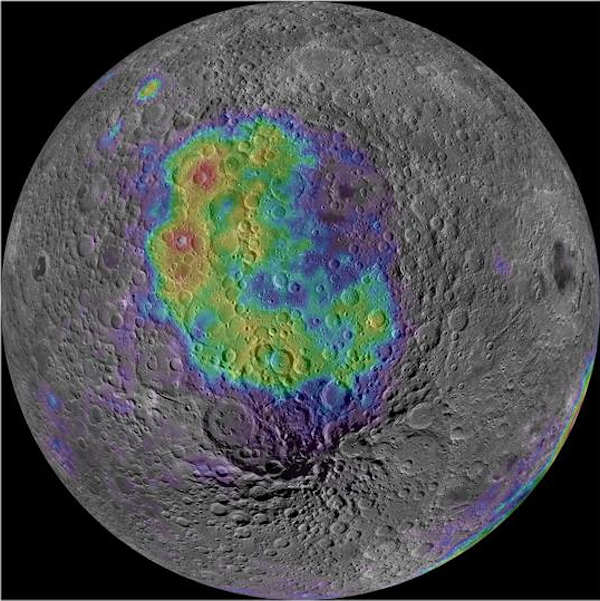
Recently, a pair of NASA studies identified the most likely locations to find pieces of mantle on the surface, providing a map for future lunar sample return missions such as those under NASA’s Artemis program.
If collected and analyzed, these fragments from deep within the Moon can provide a better understanding of how the Moon, the Earth, and many other solar system worlds evolved.
Map of mantle locations on Moon's surface
“This is the most up-to-date evaluation of the evolution of the lunar interior, synthesizing numerous recent developments to paint a new picture of the history of the mantle and how and where it may have been exposed on the lunar surface,” said Daniel Moriarty of NASA’s Goddard Space Flight Center, Greenbelt, Maryland and the University of Maryland, College Park.
Magma oceans evolve as they cool down and dense materials sink while light materials rise. The formation of magma oceans and their evolution are thought to be common processes among rocky planets and moons throughout our solar system and beyond. Earth’s Moon is the most accessible and well-preserved body to study these fundamental processes.
“Understanding these processes in more detail will have implications for important follow-up questions: How does this early heating affect the distribution of water and atmospheric gases of a planet? Does water stick around, or is it all boiled away? What are the implications for early habitability and the genesis of life?” adds Moriarty, lead author of the papers, published August 3 in Nature Communications and January 2021 in the Journal of Geophysical Research.
Large rocky objects such as planets, moons, and large asteroids can form magma oceans with the heat generated as they grow. Our solar system formed from a cloud of gas and dust that collapsed under its own gravity.
As this happened, dust grains smacked into each other and stuck together, and over time this process snowballed into larger and larger conglomerations, eventually forming asteroid and planet-sized bodies. These collisions generated a tremendous amount of heat.
Also, the building blocks of our solar system contained a variety of radioactive elements, which released heat as they decayed. In larger objects, both processes can release enough heat to form magma oceans.
However, the details of how magma oceans evolve as they cool and how the various minerals in them crystalize are uncertain, which affects what scientists think mantle rocks may look like and where they could be found on the surface.
“The bottom line is that the evolution of the lunar mantle is more complicated than originally thought,” said Moriarty. “Some minerals that crystallize and sink early are less dense than minerals that crystallize and sink later. This leads to an unstable situation with light material near the bottom of the mantle trying to rise while heavier material closer to the top descends. This process, called ‘gravitational overturn’, does not proceed in a neat and orderly fashion, but becomes messy, with lots of mixing and unexpected stragglers left behind.”
The team reviewed the most recent laboratory experiments, lunar sample analysis, and geophysical and geochemical models to develop their new understanding of how the lunar mantle evolved as it cooled and solidified.
They used this new understanding as a lens to interpret recent observations of the lunar surface from NASA’s Lunar Prospector and Lunar Reconnaissance Orbiter spacecraft, and NASA’s Moon Mineralogy Mapper instrument on board India’s Chandrayaan-I spacecraft.
The team generated a map of likely mantle locations using Moon Mineralogy Mapper data to assess mineral composition and abundance, integrated with Lunar Prospector observations of elemental abundances, including markers of the last remaining liquid at the end of lunar magma ocean crystallization, and imagery and topography data from Lunar Reconnaissance Orbiter.
At around 1,600 miles across, the South Pole – Aitken Basin is the largest confirmed impact structure on the Moon, and therefore is associated with the deepest depth of excavation of all lunar basins, so it’s the most likely place to find pieces of mantle, according to the team.
For years, scientists have been puzzled by a radioactive anomaly in the northwest quadrant of the South Pole – Aitken Basin on the lunar farside.
The team’s analysis demonstrates that the composition of this anomaly is consistent with the “sludge” that forms in the uppermost mantle at the very end of magma ocean crystallization.
Because this sludge is very dense, scientists have previously assumed that it should completely sink into the lower mantle early in lunar history.
“However, our more nuanced understanding from recent models and experiments indicates that some of this sludge gets trapped in the upper mantle, and later excavated by this vast impact basin,” said Moriarty. “Therefore, this northwest region of the South Pole – Aitken Basin is the best location to access excavated mantle materials currently on the lunar surface. Interestingly, some of these materials may also be present around the proposed Artemis and VIPER landing sites around the lunar South Pole.”
More about the missions and partners
The research was funded by NASA’s Center for Research and Exploration in Space Science and Technology II program under a cooperative agreement with the University of Maryland.
The Lunar Reconnaissance Orbiter, or LRO, is managed by NASA's Goddard Space Flight Center in Greenbelt, Maryland, for the Science Mission Directorate at NASA Headquarters in Washington.
Launched on June 18, 2009, LRO has collected a treasure trove of data with its seven powerful instruments, making an invaluable contribution to our knowledge about the Moon.
Launched Oct. 22, 2008, Chandrayaan-1, India’s first deep-space mission, played a crucial role in the discovery of water molecules on the Moon. Among its suite of instruments, it carried NASA's Moon Mineralogy Mapper, an imaging spectrometer that helped confirm the discovery of water locked in minerals on the Moon.
NASA's Jet Propulsion Laboratory, Pasadena, California, designed and built the Moon Mineralogy Mapper. Lunar Prospector, Launched Jan. 8, 1998, was designed to collect data to compile the first complete compositional and gravity maps of the Moon during its planned one-year mission in lunar polar orbit.
The mission was managed by NASA’s Ames Research Center at Moffett Federal Airfield in California's Silicon Valley.
Bill Steigerwald works for NASA Goddard Space Flight Center, Greenbelt, Maryland.
- Details
- Written by: Elizabeth Larson
As the Clearlake City Council meeting was winding down on Thursday night, Clearlake Mayor Dirk Slooten used his report to make the request of staff.
Slooten’s wife, Karen, recently contracted COVID-19 despite the fact that they both had been vaccinated against the virus, he said.
He explained that his wife has immune deficiency issues. Her doctor told her that had she not been vaccinated, he believed she would have died.
That spurred Dirk Slooten to begin talking to city staff and encouraging those who weren’t vaccinated to get the vaccine.
“Please do. It’s very near to my heart,” he said.
Slooten said at Thursday night’s meeting that he had been talking to City Manager Alan Flora and City Clerk/Administrative Services Director Melissa Swanson about how to help get more city employees vaccinated.
He said they would be sending out a memo to staff and that he wants to offer every city employee who has not been vaccinated yet but gets vaccinated by Sept. 1 a $100 “just to emphasize the necessity for getting vaccinated.”
Slooten added, “It’s important, very important to end the spread of this pandemic.”
If the city doesn’t cover the cost, Slooten said he will.
“If we hadn’t done it, I’d be a widower,” Slooten said of he and his wife getting vaccinated.
In a Friday interview with Lake County News, Slooten said he was finishing up the memo to staff and wife Karen was helping him look it over before sending it to Swanson to distribute to staff.
He said his wife had tested positive with a breakthrough infection after July 4.
She was not hospitalized, but Dirk Slooten said she’s not yet fully recovered. “She’s slowly getting better.”
Karen Slooten had pain in her lungs and shortness of breath, and horrible headaches. Her husband said she didn’t experience one of the notable symptoms, loss of smell.
Her doctor made it clear that being vaccinated prevented her from having a much worse case of the virus. “It really started hitting home. You wouldn't be around if you weren’t vaccinated,” Dirk Slooten said.
Also on Friday, he said they received word that one of his wife’s cousins, a reasonably healthy individual who wasn’t vaccinated, contracted the virus, was in the hospital and then released, only to die.
Dirk Slooten said city administrative staff can decide to cover the vaccination bonus without council action.
However, he reiterated that if the city doesn’t fund his proposal, he’ll pay for the bonuses for employees who get the shots himself in an effort to protect more people and limit the virus’ spread.
Email Elizabeth Larson at
- Details
- Written by: Lake County News reports
LAKE COUNTY, Calif. — Public Health officials reported that Lake County’s COVID-19 case rate is continuing to climb and is nearly three times the state average, which is why they are urging people to get vaccinated, wear masks and practice social distancing.
For the period from June 12 to June 18, Lake County’s daily case rate was 0.7 per 100,000 and test positivity stood at 0.7%.
Universal masking in California ended June 15. Although unvaccinated individuals were still required to wear face coverings, many had a sense the pandemic was “over,” and relaxed their commitment to the precautions that had brought Lake County’s COVID-19 cases to low levels.
Then, in late June, Lake County documented its first cases of the Delta variant, a hyper-transmissible strain that has truly been game-changing.
Now, a month and a half post the June 12 to 18 low, the state is reporting Lake County’s Case Rate as 58 per 100,000, nearly three times the state average. Lake County’s test positivity is 17.4%, more than double the statewide rate.
Over the past month, Lake County has had the highest case rate statewide, however, on Friday, Del Norte topped Lake County with a case rate of 59 per 100,000, according to the California Department of Public Health.
Public Health said Friday that 15 Lake County residents are hospitalized due to COVID-19, with five of those individuals in the ICU. These numbers do not include those currently receiving hospital-based care outside of Lake County. No local ICU beds are available.
Public Health said the Delta variant is the type of strain they expected in winter, when vaccination efforts were in their infancy and people were questioning whether minor symptoms were COVID-19 or the common cold.
However, with 40% of those eligible (age 12+) and nearly half of all Lake County residents still unvaccinated, the virus has an opportunity to spread and mutate, Public Health reported.
As a result, Public Health said that during the month of July, unvaccinated individuals were six times more likely to become infected in Lake County.
Public Health said masking and maintaining physical distancing are key right now. If you visit high-foot-traffic areas where maintaining social distancing is difficult, or attend events with people from many households, the risk of COVID-19 is there.
With the Delta variant, aerosol spread is more common. Tiny, free-flowing virus particles that can linger in the air for minutes to hours are causing new infections.
The Centers for Disease Control and Prevention is recommending even fully vaccinated people wear masks, especially indoors.
UC Davis explains the Delta variant here.
The Lake County Board of Supervisors acted Tuesday to require universal masking in all county-operated facilities.
Public Health said California counties with case rates one-third as high as Lake County’s have imposed stronger mandates because face coverings work.
If you are concerned you may have been exposed, Public Health urges you to get tested.
Health officials also urge community members to get vaccinated, noting that COVID-19 vaccines have proved highly protective against severe illness and death.
Areas all around the country are reporting 90% of hospitalized patients are unvaccinated. Many people remain hesitant, some because of side effects that are less common than severe complications from COVID-19. If you have questions, please reach out to your treating doctor. If you want to get vaccinated, but are facing barriers, call 707-263-8174.
In its ongoing effort to understand COVID-19 transmission and improve outcomes in our communities, Lake County Public Health tracks demographic, geographic and clinical information about confirmed COVID-19 cases.
This data is presented at http://health.co.lake.ca.us/Coronavirus/COVID-19_Data.htm.
Public Health said substantial revisions to this page are now live, and offer more information and more frequent updates.
- Details
- Written by: Lake County News reports
On June 9, 2020, the Lakeport Police Department and Clearlake Police Department were awarded a $24,975 grant from the California Alcoholic Beverage Control, or ABC, to enforce alcohol-related crime and educate their communities on alcohol-related laws.
On July 21, 2020, the Lakeport City Council approved a resolution to accept the grant funding and go into partnership with ABC.
During the course of the grant, because of the ongoing COVID-19 pandemic, grant funds awarded to the departments were cut in half to $12,478.
The grant funds remaining were used to conduct a total of four Informed Merchants Preventing Alcohol-Related Crime Tendencies, or IMPACT, operations as well as several other grant-related enforcement operations including alcohol-related crime and DUI saturation patrols.
In total, 34 IMPACT Inspections were completed over the course of the four operations. Of the 34 businesses inspected, 13 businesses were found to be out of compliance and were educated on how to come into compliance with California law.
During the other operations conducted with grant funds, a total of eight individuals were arrested or criminally cited for various crimes ranging from DUI, to purchasing alcohol for a minor to felony warrants.
During these operations, the agencies also found that theft of alcohol by both adults and minors is a major continuing problem leading to other criminal offenses.
In particular, one Lakeport location is a regular target of these thefts. Police said they will be following up on this problem with business locations in an effort to eliminate alcohol theft.
On June 26, during an alcohol-involved crime/DUI saturation operation, an officer assigned to the operation responded to and was first on the scene of a reported opioid overdose. Police said the officer was able to quickly provide the overdose victim with lifesaving Narcan. In that incident, the victim was resuscitated and recovered.
“The Lakeport Police Department and our partners at the Clearlake Police Department are committed to fighting alcohol-related criminal activity and working with our communities to prevent alcohol-related crimes from occurring,” the department said in a statement.
This project was part of the Department of Alcoholic Beverage Control’s Alcohol Policing Partnership Program.
A primary goal was community outreach and public education to reduce alcohol-related crime in our communities.
The Lakeport Police Department thanked the California Department of Alcoholic Beverage Control for awarding these grant funds, providing assistance in educating communities and enforcing alcohol-related laws.