 How to resolve AdBlock issue?
News
- Details
- Written by: Elizabeth Larson
The City of Clearlake Animal Association is asking for wet food and long lasting treats such as bully sticks for dogs, and wet food for mama cats and kittens as well as disposable litter boxes.
A wish list has been posted at Amazon and on Chewy. For those who wish to shop local and drop off items, call 707-273-9440 to schedule a delivery or donate at the association’s Facebook page.
Here are this week’s adoptable dogs.

‘Dusty’
“Dusty” is a male American Pit Bull Terrier with a tan and white coat.
He is dog No. 4750.

‘Bear’
“Bear” is a male American Staffordshire terrier mix with a short brown coat.
He has been neutered.
He is dog No. 3476.

‘Blue Eyed Jack’
“Blue Eyed Jack” is a male German shepherd mix.
He is dog No. 5046.

‘Cleo’
“Cleo” is a female Doberman pinscher mix with a short gray coat who is new to the shelter.
She has been spayed.
She is dog No. 4865.

‘Gizmo’
“Gizmo” is a senior male Chihuahua mix with a short tan and white coat.
He is dog No. 4902.

‘Mara’
“Mara” is a female Rottweiler mix.
She has a short black and tan coat.
He is house-trained.
She is dog No. 4628.

‘Mary J’
“Mary J” is a female pit bull terrier mix.
She has a white and tan coat.
She is house-trained.
She is dog No. 4927.

‘Mitzy’
“Mitzy” is a female shepherd mix with a medium-length black and white coat.
She is dog No. 4648.

‘Mojo’
“Mojo” is a male Chihuahua mix with a short black and tan coat.
He has been neutered.
He is dog No. 4881.

‘Oakley’
“Oakley” is a male pit bull terrier mix.
He has a short red and white coat.
He is dog No. 4934.

‘Patches’
“Patches” is a male Chihuahua mix with a short tricolor coat.
He is dog No. 4903.

‘Petey’
“Petey” is a male American Staffordshire terrier mix with a black and white coat.
He is dog No. 4963.

‘Sassy’
“Sassy” is a female American bully mix with a short black coat.
She has been spayed.
She is dog No. 4602.

‘Sissy’
“Sissy” is a female American Staffordshire terrier mix with a black coat.
She is dog No. 4964.

‘Tanisha’
“Tanisha” is a female shepherd mix with a short orange and white coat.
She is dog No. 4647.

‘Terry’
“Terry” is a male Dutch shepherd mix with a smooth brindle coat.
He is dog No. 4880.

‘Tinsel’
“Tinsel” is a female American pit bull terrier mix with a short brindle and brown coat.
She is dog No. 4433.

‘Trixie’
“Trixie” is a female German shepherd mix with a short black and tan coat.
She is dog No. 5056.

‘Yule’
“Yule” is a male husky with a medium-length black and white coat.
He is dog No. 4432.
Call the Clearlake Animal Control shelter at 707-273-9440, or email
Visit Clearlake Animal Control on Facebook or on the city’s website.
Email Elizabeth Larson at
- Details
- Written by: Lake County News reports
The Glass fire started in Napa County on Sept. 27, 2020, at 3:48 a.m., and burned a total of 67,484 acres and destroyed 1,555 structures in Napa and Sonoma counties.
Cal Fire said its investigators were immediately dispatched to the Glass fire and began working to determine the origin and cause of the fire.
“After a very meticulous and thorough investigation, which included months of follow-up on information provided by the public, not enough evidence was available to conclusively identify the cause,” Cal Fire said in the Friday statement.
Cal Fire said the fire’s cause is currently undetermined pending any additional information or evidence that could lead to the determination of the cause.
Tinder dry vegetation and strong winds combined with low humidity and warm temperatures contributed to extreme rates of fire spread which contributed to the difficulty in determining the cause of the fire, Cal Fire said.
- Details
- Written by: Lake County News reports

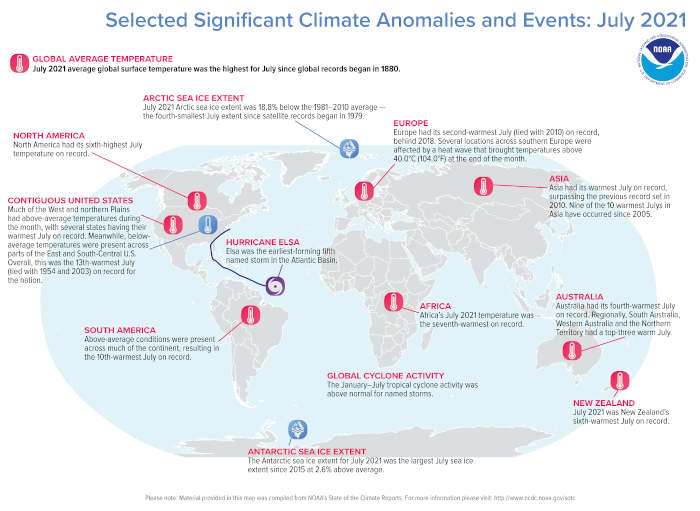
July 2021 has earned the unenviable distinction as the world’s hottest month ever recorded, according to new global data released Friday by the National Oceanic and Atmospheric Administration’s National Centers for Environmental Information.
“In this case, first place is the worst place to be,” said NOAA Administrator Rick Spinrad, Ph.D. “July is typically the world’s warmest month of the year, but July 2021 outdid itself as the hottest July and month ever recorded. This new record adds to the disturbing and disruptive path that climate change has set for the globe.”
July 2021 by the numbers
— Around the globe: the combined land and ocean-surface temperature was 1.67 degrees F (0.93 of a degree C) above the 20th-century average of 60.4 degrees F (15.8 degrees C), making it the hottest July since records began 142 years ago. It was 0.02 of a degree F (0.01 of a degree C) higher than the previous record set in July 2016, which was then tied in 2019 and 2020.
— The Northern Hemisphere: the land-surface only temperature was the highest ever recorded for July, at an unprecedented 2.77 degrees F (1.54 degrees C) above average, surpassing the previous record set in 2012.
— Regional records: Asia had its hottest July on record, besting the previous record set in 2010; Europe had its second-hottest July on record — tying with July 2010 and trailing behind July 2018; and North America, South America, Africa and Oceania all had a top-10 warmest July.
Extreme heat and global climate change
With last month’s data, it remains very likely that 2021 will rank among the world’s 10-warmest years on record, according to NCEI’s Global Annual Temperature Rankings Outlook.
Extreme heat detailed in NOAA’s monthly NCEI reports is also a reflection of the long-term changes outlined in a major report released this week by the Intergovernmental Panel on Climate Change.
“Scientists from across the globe delivered the most up-to-date assessment of the ways in which the climate is changing,” Spinrad said in a statement. “It is a sobering IPCC report that finds that human influence is, unequivocally, causing climate change, and it confirms the impacts are widespread and rapidly intensifying.”
Other notable highlights from NOAA’s July global climate report
— Sea ice coverage varied by hemisphere: The Arctic sea ice coverage (extent) for July 2021 was the fourth-smallest for July in the 43-year record, according to analysis by the National Snow and Ice Data Center. Only July 2012, 2019 and 2020 had a smaller sea ice extent. Antarctic sea ice extent was above average in July — the largest July sea ice extent since 2015 and the eighth highest on record.
— The tropics were busier than average: In the Atlantic basin, the season’s earliest fifth-named storm, Elsa, formed on July 1. The Eastern North and Western Pacific basins each logged three named storms. Overall, global tropical cyclone activity this year so far (through July) has been above-normal for the number of named storms.
- Details
- Written by: National Aeronautics and Space Administration
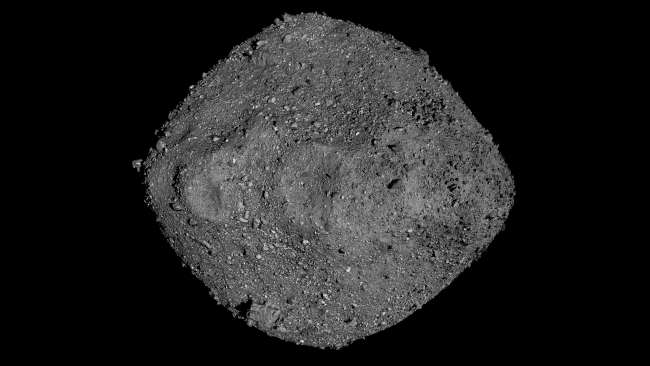
In a study released Wednesday, NASA researchers used precision-tracking data from the agency’s Origins, Spectral Interpretation, Resource Identification, Security-Regolith Explorer, or OSIRIS-REx, spacecraft to better understand movements of the potentially hazardous asteroid Bennu through the year 2300, significantly reducing uncertainties related to its future orbit, and improving scientists’ ability to determine the total impact probability and predict orbits of other asteroids.
The study, titled “Ephemeris and hazard assessment for near-Earth asteroid (101955) Bennu based on OSIRIS-REx data,” was published in the journal Icarus.
“NASA’s Planetary Defense mission is to find and monitor asteroids and comets that can come near Earth and may pose a hazard to our planet,” said Kelly Fast, program manager for the Near-Earth Object Observations Program at NASA Headquarters in Washington. “We carry out this endeavor through continuing astronomical surveys that collect data to discover previously unknown objects and refine our orbital models for them. The OSIRIS-REx mission has provided an extraordinary opportunity to refine and test these models, helping us better predict where Bennu will be when it makes its close approach to Earth more than a century from now.”
In 2135, asteroid Bennu will make a close approach with Earth. Although the near-Earth object will not pose a danger to our planet at that time, scientists must understand Bennu’s exact trajectory during that encounter in order to predict how Earth’s gravity will alter the asteroid’s path around the Sun – and affect the hazard of Earth impact.
Using NASA’s Deep Space Network and state-of-the-art computer models, scientists were able to significantly shrink uncertainties in Bennu’s orbit, determining its total impact probability through the year 2300 is about 1 in 1,750 (or 0.057%). The researchers were also able to identify Sept. 24, 2182, as the most significant single date in terms of a potential impact, with an impact probability of 1 in 2,700 (or about 0.037%).
Although the chances of it hitting Earth are very low, Bennu remains one of the two most hazardous known asteroids in our solar system, along with another asteroid called 1950 DA.
Before leaving Bennu May 10, 2021, OSIRIS-REx spent more than two years in close proximity to the asteroid, gathering information about its size (it is about one-third of a mile, or 500 meters, wide), shape, mass, and composition, while monitoring its spin and orbital trajectory. The spacecraft also scooped up a sample of rock and dust from the asteroid’s surface, which it will deliver to Earth on Sept. 24, 2023, for further scientific investigation.
“The OSIRIS-REx data give us so much more precise information, we can test the limits of our models and calculate the future trajectory of Bennu to a very high degree of certainty through 2135,” said study lead Davide Farnocchia, of the Center for Near Earth Object Studies (CNEOS), which is managed by NASA’s Jet Propulsion Laboratory in Southern California. “We’ve never modeled an asteroid’s trajectory to this precision before.”
Gravitational keyholes
The precision measurements on Bennu help to better determine how the asteroid’s orbit will evolve over time and whether it will pass through a “gravitational keyhole” during its 2135 close approach. These keyholes are areas in space that would set Bennu on a path toward a future impact with Earth if the asteroid were to pass through them at certain times, due to the effect of Earth’s gravitational pull.
To calculate exactly where the asteroid will be during its 2135 close approach – and whether it might pass through a gravitational keyhole – Farnocchia and his team evaluated various types of small forces that may affect the asteroid as it orbits the Sun. Even the smallest force can significantly deflect its orbital path over time, causing it to pass through or completely miss a keyhole.
Among those forces, the Sun’s heat plays a crucial role. As an asteroid travels around the Sun, sunlight heats up its dayside. Because the asteroid spins, the heated surface will rotate away and cool down when it enters the nightside. As it cools, the surface releases infrared energy, which generates a small amount of thrust on the asteroid – a phenomenon called the Yarkovsky effect. Over short timeframes, this thrust is minuscule, but over long periods, the effect on the asteroid’s position builds up and can play a significant role in changing an asteroid’s path.
“The Yarkovsky effect will act on all asteroids of all sizes, and while it has been measured for a small fraction of the asteroid population from afar, OSIRIS-REx gave us the first opportunity to measure it in detail as Bennu travelled around the Sun,” said Steve Chesley, senior research scientist at JPL and study co-investigator. “The effect on Bennu is equivalent to the weight of three grapes constantly acting on the asteroid – tiny, yes, but significant when determining Bennu’s future impact chances over the decades and centuries to come.”
The team considered many other perturbing forces as well, including the gravity of the Sun, the planets, their moons, and more than 300 other asteroids, the drag caused by interplanetary dust, the pressure of the solar wind, and Bennu’s particle-ejection events.
The researchers even evaluated the force OSIRIS-REx exerted when performing its Touch-And-Go, or TAG, sample collection event Oct. 20, 2020, to see if it might have slightly altered Bennu’s orbit, ultimately confirming previous estimates that the TAG event had a negligible effect.
“The force exerted on Bennu’s surface during the TAG event were tiny even in comparison to the effects of other small forces considered,” said Rich Burns, OSIRIS-REx project manager at NASA’s Goddard Space Flight Center in Greenbelt, Maryland. “TAG did not alter Bennu’s likelihood of impacting Earth.”
Tiny risk, huge gain
Although a 0.057% impact probability through the year 2300 and an impact probability of 0.037% on Sept. 24, 2182, are low, this study highlights the crucial role that OSIRIS-REx operations played in precisely characterizing Bennu’s orbit.
“The orbital data from this mission helped us better appreciate Bennu’s impact chances over the next couple of centuries and our overall understanding of potentially hazardous asteroids – an incredible result,” said Dante Lauretta, OSIRIS-REx principal investigator and professor at the University of Arizona. “The spacecraft is now returning home, carrying a precious sample from this fascinating ancient object that will help us better understand not only the history of the solar system but also the role of sunlight in altering Bennu’s orbit since we will measure the asteroid’s thermal properties at unprecedented scales in laboratories on Earth.”