 How to resolve AdBlock issue?
News
- Details
- Written by: Elizabeth Larson

LAKEPORT, Calif. — Authorities said they took a woman into custody last weekend for arson after she set a fire on a city-owned property.
Janis Lynn Martinez, 38, a transient from the Lakeport area, was taken into custody on the morning of Saturday, Aug. 28, the Lakeport Police Department reported.
At 9:15 a.m. that day, Lakeport Police, with the assistance of the Lake County Sheriff's Office and Lakeport Fire Protection District, arrested Martinez for arson after witnesses identified her as having started a fire against the structure known as the old Natural High School.
The building is in the city’s parklands on North Main Street, and next to the new Lakefront Park development.
Authorities said Martinez is believed to have also started a nearby fire just minutes beforehand.
Both fires were extinguished before any significant damage resulted, officials said.
Martinez was booked into the Lake County Jail on a felony charge of arson of a structure, with bail set at $50,000. Jail records show that she also is being held on a misdemeanor charge of trespassing.
She remained in custody on Saturday, according to booking records.
Martinez is scheduled to appear in Lake County Superior Court on Sept. 27.
Email Elizabeth Larson at
- Details
- Written by: Lake County News reports
California gained an average of 105,500 nonfarm jobs per month during the 15-month recovery from April 2020 to July 2021 — a level of job growth not seen since the current tracking method was introduced in 1990.
Before the pandemic, the largest monthly job gain on record was 98,500 in April 2016.
Growth has averaged over 111,000 jobs gained per month this year.
The department also analyzed thousands of job postings across California to identify the most in-demand occupations.
Registered nurses and general and operations managers top the list of high-skill occupations that are in demand — with just over 20,000 recent job postings for nurses and over 8,000 job postings for managers.
Truck driving has also seen steady growth with 8,400 job postings statewide. Demand for bookkeeping, accounting, and auditing clerks also remains strong with 4,400 job ads posted.
Retail salespersons, laborers, and freight and stock workers are among the entry-level jobs requiring a high school diploma or less that are in high demand.
California hit a peak unemployment rate of 16% (April 2020) during the pandemic, which was quickly followed by unemployment falling in every region of the state.
California’s recovery, which turned 15 months old in July 2021, has featured rapidly falling unemployment and robust job growth.
Leisure and hospitality posted the largest industry sector job gain from April 2020 to July 2021, adding 558,500 jobs.
Statewide, regional employment also strengthened, with every region showing year-over job gains as of July 2021.
Los Angeles had the largest year-over gain (242,800 jobs), followed by Orange (116,400) and Bay-Peninsula (98,600).
- Details
- Written by: Jeffrey Kucik, University of Arizona and Don Leonard, The Ohio State University
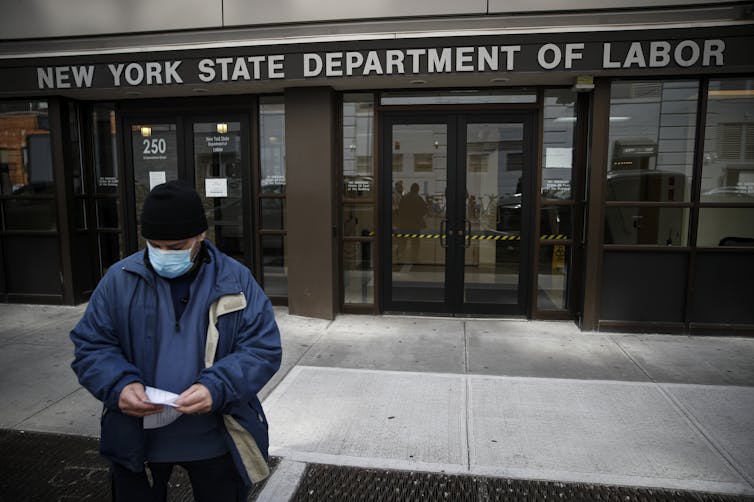
Millions of unemployed Americans are set to lose pandemic-related jobless benefits after Labor Day – just as surging cases of coronavirus slow the pace of hiring.
In all, an estimated 8.8 million people will stop receiving unemployment insurance beginning on Sept. 6, 2021. An additional 4.5 million will no longer get the extra US$300 a week the federal government has been providing to supplement state benefits.
But with the pandemic still raging thanks to the rise of the delta variant, particularly in Southern states, the expiration of these benefits seems ill-timed. While some claim that the aid is no longer needed and doing more harm than good, we believe that the data tell another story.
Benefits lost
Three federal programs created to support workers hurt by the COVID-19 pandemic and related lockdowns expire on Sept. 6:
-
The Pandemic Extended Unemployment Compensation program offers 13 additional weeks in state unemployment benefits. An estimated 3.3 million people who were getting benefits through this program are set to lose them.
-
Pandemic Unemployment Assistance provides aid to gig workers and others not normally eligible for unemployment benefits. About 5.5 million people were receiving aid because of this program – including those who just joined the rolls in the second half of August.
-
The Federal Pandemic Unemployment Compensation program supplements state benefits with an additional $300 in aid per week – down from $600 when it began in April 2020.
All told, the end of these programs may affect 35 million people when you include families of the unemployed.
Dropping aid didn’t boost jobs growth
Critics of these federal supplemental benefits claim they reward Americans for not working by offering more in aid than they’d get from a job. This is why many Republican governors opted to drop out of one or more of the federal programs in recent months.
“We see ‘Help Wanted’ signs everywhere,” Idaho Republican Gov. Brad Little said on May 11, 2021. “We do not want people on unemployment. We want people working.”
But the data we have so far simply doesn’t back up these claims.
We compared employment growth in the 25 states that decided to drop the federal $300 supplement with those that kept it.
Total job creation in states that kept offering the federal supplement was 35% higher than in the ones that ended the program, according to the Bureau of Labor Statistics, suggesting the benefits aren’t keeping workers on the sidelines.
The same pattern holds for sectors of the economy hit hardest by COVID-19. Leisure and hospitality jobs, such as waitstaff and cooks, accounted for roughly 1 in 4 of all jobs lost in 2020. Hiring in those areas was 39% higher in July 2021 in states that kept the federal benefit.
This is consistent with a growing number of studies that show no correlation between the higher unemployment payments during the pandemic and lagging job growth.
We won’t know whether the trend continued until the state-by-state employment breakdown is released in mid-September. But for now, the evidence doesn’t support the claim that benefits keep folks at home.
Jobless Americans still need support
But we do know that people who want to work are still being prevented from doing so because of COVID-19.
The latest jobs report, released on Sept. 3, 2021, showed that 5.6 million people were unable to work in August because their employer closed or lost business because of the pandemic, up from 5.2 million in July.
That may help explain why companies hired only 235,000 in August – a third of what economists had expected. And there were no gains in leisure and hospitality, which pay some of the lowest wages of any industry.
As recently as late May, before the delta variant began causing caseloads to climb, pandemic-related unemployment claims were falling across all 50 states. Then, over June and July, claims spiked again as COVID-19 cases rippled across the country.
All this shows why all three programs are still so important.
The extended benefits give unemployed people more time to find a job while helping them cover basic expenses. Gig workers, like Uber drivers and other independent contractors, need unemployment benefits too, especially as 60% of them lost income during the pandemic and many continue to struggle as business activity remains subdued. These workers are also less likely to receive employer-sponsored benefits like health care.
And the $300 federal supplement is important because pre-pandemic state benefits – which are typically about $340 a week – replaced only 30% to 50% of lost earnings. Even with the supplement, for most people, it’s still less than what they were earning from their job.
Tough choices ahead
That’s why the expiring benefits mean so much to lower-income families, especially now that the Supreme Court has struck down the Centers for Disease Control and Prevention’s ban on evictions.
For many, losing the benefit could be the difference between choosing to pay for food or rent, or forgoing a doctor’s visit because of the high costs of health care.
But after the benefits expire on Labor Day, making ends meet and staying in their homes will be significantly harder for millions of American families.
[Over 110,000 readers rely on The Conversation’s newsletter to understand the world. Sign up today.]
Jeffrey Kucik, Associate Professor of Political Science, University of Arizona and Don Leonard, Assistant Professor of Practice in City and Regional Planning, The Ohio State University
This article is republished from The Conversation under a Creative Commons license. Read the original article.
- Details
- Written by: Preston Dyches
What's up for September? Moving fast in the cosmos with planet Mercury, and stars Arcturus and Altair.
You'll have to be quick to catch a glimpse of Mercury this month, as the innermost and fastest-moving planet — namesake of the fleet-footed, mythological messenger — appears low in the west for a short time following sunset.
But those with a clear view toward the horizon will be rewarded with some nice planetary groupings in the first week and a half of September.
You'll find Mercury just a few degrees above the western horizon about half an hour after the Sun sets, with much brighter Venus higher and slightly farther to the south. On the 9th and 10th look for the pair to be joined by the crescent Moon.
In between the two planets is the bright star Spica, which is actually two stars orbiting each other at a distance 3 times closer than Mercury orbits our Sun!
Mercury should be visible for you from mid-northern latitudes on south. The farther south you are, the longer Mercury will be above the horizon for you before it sets.
In addition to Spica, two other bright stars you can easily spot early in the evening in September are Arcturus and Altair.
Arcturus is the brightest star in the northern sky. It owes this status largely to the fact that it's relatively closeby, at about 37 light years from our solar system.
You can find Arcturus in the west in the first couple of hours after it gets dark.
Look for the Big Dipper and follow its handle over toward the south about the width of an outstretched hand. It's easy to remember with the phrase "arc to Arcturus."
One interesting thing about Arcturus is that, compared to other stars, it's moving extremely fast with respect to our solar system. In fact, the discovery of the star's motion was a huge moment in astronomy. Before that, the positions of stars were thought to be fixed and unchanging. After Edmund Halley's discovery, the understanding that the stars move around as independent objects began to take hold.
After you've found orange-colored Arcturus, spin yourself toward the south-southeast to find Altair. You'll spy it hanging right above Saturn all month – in fact it's about as high above Saturn as Saturn is from the horizon.
Altair is a bright white-colored star, which makes for a nice color comparison with Arcturus and nearby Antares. At just 17 light years away, it's definitely one of the closest bright stars to our solar system.
One of the coolest things about Altair is that it rotates so fast that it's flattened into an oval shape. Since it's so closeby, astronomers have actually been able to image this fast-spinner's flattened shape directly.
So look for Altair and Arcturus in the September sky – two bright, nearby stars that, along with Mercury, each have their own spin on what it means to be fast.
You can catch up on all of NASA's missions to explore the solar system and beyond at www.nasa.gov.
Preston Dyches works for NASA's Jet Propulsion Laboratory.