 How to resolve AdBlock issue?
News
- Details
- Written by: Elizabeth Larson

LUCERNE, Calif. — Two structures sustained damage in a fire in Lucerne on Saturday night.
The fire in the 6000 block of Second Ave. was first dispatched just after 9 p.m.
Initial reports said one structure was well involved and there were several others threatened.
Northshore Fire arrived minutes after dispatch, with Cal Fire requested shortly before 9:10 p.m. The Northshore Fire Support Team also responded.
Utility lines also were reported to be down, although Pacific Gas and Electric did not report any outages.
The California Highway Patrol also responded to close Second Avenue from Highway 20 to Highland Avenue while firefighters were at work, according to radio traffic.
Officials at the scene told Lake County News after the fire was brought under control that one house and another structure were damaged.
Red Cross was asked to respond to help displaced residents.
Radio traffic indicated that firefighters remained on scene for mop up for several hours.
Email Elizabeth Larson at
- Details
- Written by: Lynée Turek-Hankins, University of Miami and Katharine Mach, University of Miami

The summer of 2021 was devilishly hot across much of the U.S. Just five minutes in an attic guest room with no air conditioning could be enough to leave a person drenched in sweat and lightheaded, as one of us discovered during a heat wave in Washington state. It’s the kind of heat where it’s impossible to move, to think, to do anything.
In parts of the U.S., people work in heat and then go home to heat all summer long. Research shows that chronic heat exposure is a growing threat to health and productivity, yet it’s often overlooked by employers.
A new federal initiative to combat unhealthy heat exposure for vulnerable populations, including workers, could finally provide some relief. By bringing multiple agencies together to solve the problem of heat, the Biden administration has the opportunity to help workers avoid dangerous acute and chronic heat exposure at work and at home.
But the plan has some important gaps and ambiguities that, as infrastructure and policy researchers, we believe should be addressed to keep people safe.

Who’s at risk
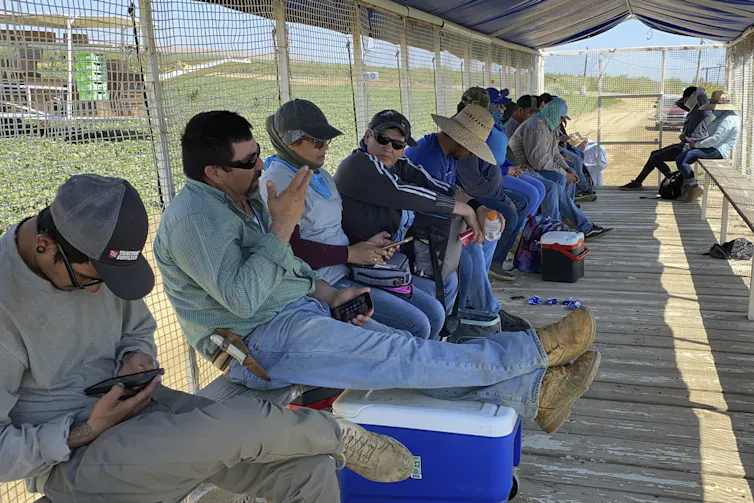
Heat is not a health and safety issue if you’re sitting in a well-constructed, air-conditioned building. But people who work primarily outside, whether in agriculture, construction or mining, in military training or on a utility or wildfire crew, may have limited access to a cool environment on hot days, and that can raise their risks.
Heat indoors can also be a threat to workers, such as cooks in a steamy kitchen or factory workers on an assembly line without adequate airflow. Personal protective equipment and clothing like hazmat suits can also intensify the impact of excessive heat.
When heat combines with other hazards, like humidity, particulate matter or ozone in the air, the health risks increase. Even if none of the hazards on its own is considered “extreme,” combined they may pose a threat. At many points in the day, a worker may face a large cumulative burden of environmental hazards that add up, with few options for adequately dealing with them.
Workers who are exposed to excess heat on the job are more likely than average Americans to be low-income, to be immigrants, to have chronic health problems, to lack health insurance or to live in poor-quality housing without air conditioning. That suggests they may also lack a cool environment at home and may be at higher risk.

How the body responds to heat
Cool night temperatures are important for the body to recover from daytime heat exposure. Research has shown that hot nights can reduce the body’s capacity to rehydrate and negatively affect sleep, potentially leading to more workplace injuries the following day.
A severe heat episode may also permanently harm internal organs. One study linked hospitalization from acute heat illness to an increased risk of early death later in life.
People have different thresholds for heat exposure. Preexisting health conditions, such as those affecting the heart or lungs, can increase the likelihood that extreme heat will harm the person’s health.
Whether a person is acclimatized, meaning they have adjusted to the heat, is also important. One hundred degrees Fahrenheit in Seattle (38 Celsius) is different from 100 F in Las Vegas. However, getting used to a climate can only take you so far. The body’s ability to cool itself off diminishes significantly beyond 95 F (35 C). Hence, there are upper limits to acclimatization. Likewise, acclimatization may not prevent health effects from chronic heat exposure.

Adapting workers for the increasing extreme heat
There are many strategies for reducing occupational exposure to heat. A workplace may require breaks and offer water; implement technologies that keep workers cool, such as cooling vests; reduce expected rates of productivity when temperatures climb; or even stop work.
Some of these strategies, however, will likely become less effective under intensifying climate change. Some locations may face high temperatures combined with humidity levels that exceed thresholds for workability.
The Biden administration’s new efforts, announced in late September 2021, provide direction for adapting to extreme heat in and out of the workplace. Some of the proposed strategies include creating standards for heat exposure at work, improving enforcement and inspections for the heat safety of workers, increasing opportunities to direct federal funds to household cooling assistance and technologies, and transforming schools into locations with free air conditioning access.
As presented, the strategies for workers are isolated to the workplace and hot days. However, chronic heat exposure, whether from living in a hot home or a habitually hot climate, is an emerging risk. Worker-specific responses that target social determinants of health and chronic exposure may be necessary, such as improving access to cooling among itinerant workers in temporary housing.
Rapidly reducing emissions of heat-trapping greenhouse gases is also essential to reduce climate change that will bring more frequent exposure to dangerous temperatures.
Other gaps in the plan
The proposal for addressing the most pressing heat risks across America also has important gaps.
First, other environmental threats like air pollution exacerbate heat-related health impacts but aren’t currently factored in with high temperatures and humidity when developing workplace health and safety standards and heat-health policies. From emergency responders exposed to toxic dust at the Surfside Condo collapse to farmworkers facing wildfire smoke in Fresno, California, addressing heat and poor air quality together is a critical need.
Second, the proposal doesn’t address heat risk in other facilities, including prisons and migration detention centers. Here, heat protections and proper enforcement of those protections are critical for both the workers and the people in those facilities.
[Over 110,000 readers rely on The Conversation’s newsletter to understand the world. Sign up today.]
Third, in addition to increasing federal spending on cooling assistance, utilities could be required to stop residential utility shut-offs during extreme heat events. Although many utilities provide such protections to people with medical waivers, this process can be arduous.
Solutions should consider what influences a person’s vulnerability to heat, as well as their threat of chronic exposure. Ambitious heat safety policies are critical in a rapidly warming world.
Lynée Turek-Hankins, Ph.D. Student in Environmental Science & Policy, University of Miami and Katharine Mach, Associate Professor of Environmental Science and Policy, University of Miami
This article is republished from The Conversation under a Creative Commons license. Read the original article.
- Details
- Written by: Elizabeth Larson
Dogs available for adoption this week include mixes of American bulldog, beagle, border collie, cattle dog, Chihuahua, Doberman, German shepherd, husky, pit bull, pug, Rottweiler, shepherd and terrier.
Dogs that are adopted from Lake County Animal Care and Control are either neutered or spayed, microchipped and, if old enough, given a rabies shot and county license before being released to their new owner. License fees do not apply to residents of the cities of Lakeport or Clearlake.
The following dogs at the Lake County Animal Care and Control shelter have been cleared for adoption (additional dogs on the animal control website not listed are still “on hold”).
Call Lake County Animal Care and Control at 707-263-0278 or visit the shelter online at http://www.co.lake.ca.us/Government/Directory/Animal_Care_And_Control.htm for information on visiting or adopting.

‘Ace’
“Ace” is a 1-year-old male shepherd and Doberman mix with a short black and tan coat.
He is in kennel No. 6, ID No. LCAC-A-1731.

Male border collie
This 1-year-old male border collie has a short black and white coat.
He’s in kennel No. 13, ID No. LCAC-A-1723.

Female German shepherd mix
This 2-year-old female German shepherd mix has a short black and tan coat.
She’s in kennel No. 20, ID No. LCAC-A-1660.

‘Oscar’
“Oscar” is a 6-year-old pug-beagle mix — or a puggle — with a short tan coat.
He is in kennel No. 21, ID No. LCAC-A-1709.

‘Groover’
“Groover” is a 1-year-old male German shepherd-cattle dog mix with a short black and tan coat.
He’s in kennel No. 25, ID No. LCAC-A-1659.

‘LuLu’
“LuLu” is a 1-year-old female Rottweiler with a short black and tan coat.
She is in kennel No. 27, ID No. LCAC-A-1658.

Male shepherd mix
This 2-year-old male shepherd mix has a short black and tan coat.
He is in kennel No. 28, ID No. LCAC-A-1743.

Male pit bull
This young male pit bull has a short black and white coat.
He is in kennel No. 29, ID No. LCAC-A-1699.

Female pit bull
This 1-year-old female pit bull mix has a short gray coat with white markings.
She is in kennel No. 31, ID No. LCAC-A-1683.

‘Cookie’
“Cookie” is a 1-year-old female husky mix with a long red and white coat.
She is in kennel No. 32, ID No. LCAC-A-1682.

‘Dozer’
‘Dozer’ is a 5-year-old American pit bull terrier mix with a short brindle coat.
He is in kennel No. 33, ID No. LCAC-A-1483.

‘Milo’
“Milo” is a 3-year-old male American bulldog-pit bull mix with a short white coat.
He is in kennel No. 34, ID No. LCAC-A-1657.
Email Elizabeth Larson at
- Details
- Written by: NATIONAL AERONAUTICS AND SPACE ADMINISTRATION

NASA has tested the functions of Lucy, the agency’s first spacecraft to study Jupiter’s Trojan asteroids, filled it with fuel, and is preparing to pack it into a capsule for launch Saturday, Oct. 16.
Named after characters in Greek mythology, these asteroids circle the Sun in two swarms, with one group leading ahead of Jupiter in its path, the other trailing behind it. Lucy will be the first spacecraft to visit these asteroids.
By studying these asteroids up close, scientists hope to hone their theories on how our solar system’s planets formed 4.5 billion years ago and why they ended up in their current configuration.
“With Lucy, we’re going to eight never-before-seen asteroids in 12 years with a single spacecraft,” said Tom Statler, Lucy project scientist at NASA Headquarters in Washington. “This is a fantastic opportunity for discovery as we probe into our solar system’s distant past.”
Following all pandemic protocols, Lucy team members have spent the past eight weeks at NASA’s Kennedy Space Center in Florida, preparing the spacecraft for flight.
Engineers have tested the spacecraft’s mechanical, electrical, and thermal systems and practiced executing the launch sequence from the mission operations centers at Kennedy and Lockheed Martin Space in Littleton, Colorado.
In early August, engineers installed the spacecraft’s high-gain antenna, its second most prominent feature after the expansive solar arrays, which will allow the spacecraft to communicate with Earth.
“There has been a lot of hands-on work,” said Donya Douglas-Bradshaw, Lucy project manager at NASA’s Goddard Space Flight Center in Greenbelt, Maryland. “This summer has gone by so fast; it’s hard to believe we’re nearly at launch.”
On Sept. 18, propulsion engineers finished filling Lucy’s fuel tanks with approximately 1,600 pounds of liquid hydrazine and liquid oxygen, which make up 40% of the mass of the spacecraft.
The fuel will be used for precise maneuvers that will propel Lucy to its asteroid destinations on schedule, while the solar arrays — each the width of a school bus — will recharge the batteries that will power spacecraft instruments.
The Lucy spacecraft will soon be packed into the two halves of the launch vehicle fairing, which will close around it like a clamshell. After the spacecraft is encapsulated, the Lucy team will be able to communicate with it electrically through an “umbilical cord.”
“Launching a spacecraft is almost like sending a child off to college — you’ve done what can for them to get them ready for that next big step on their own,” said Hal Levison, the principal investigator of the Lucy mission, based at the Southwest Research Institute in Boulder, Colorado.
In early October, the encapsulated spacecraft will be transported to the Vehicle Integration Facility at the Cape Canaveral Space Force Station, where it will be “mated” with the United Launch Alliance Atlas V 401 rocket.
The Atlas V will lift off from Space Launch Complex 41.The rocket will carry Lucy outside Earth’s atmosphere to begin the long journey to the Trojan asteroids.
A few days prior to launch, engineers will power up the Lucy spacecraft in preparation for the mission. This process will take about 20 minutes.
“The spacecraft will sit in launch configuration and the engineering team will continuously monitor its health and status to make sure Lucy is ready to go,” said Jessica Lounsbury, the Lucy project systems engineer at Goddard. “And then it’s launch day.”
Lucy’s first launch attempt is scheduled for 5:34 a.m. EDT on Oct. 16. That day, the team will be “called to stations” at 1 a.m., which is when everyone is expected to arrive at mission control and other stations to monitor the spacecraft and run through the full launch countdown procedures. If weather or any other issues prohibit a launch that day, the team will have additional launch opportunities beginning the following day.
Lucy’s principal investigator is based out of the Boulder, Colorado, branch of Southwest Research Institute, headquartered in San Antonio, Texas. Goddard provides overall mission management, systems engineering, and safety and mission assurance. Lockheed Martin Space in Littleton, Colorado, built the spacecraft. Lucy is the 13th mission in NASA’s Discovery Program. NASA’s Marshall Space Flight Center in Huntsville, Alabama, manages the Discovery Program for the agency’s Science Mission Directorate in Washington. The launch is managed by NASA’s Launch Services Program based at Kennedy.
For more information about NASA's Lucy mission, visit https://www.nasa.gov/mission_pages/lucy/overview/index.