 How to resolve AdBlock issue?
News
- Details
- Written by: Elizabeth Larson
Dogs available for adoption this week include mixes of American bulldog, American Staffordshire terrier, border collie, Doberman, German shepherd, Great Pyrenees, hound, husky, Labrador retriever, mastiff, pit bull and Rottweiler.
Dogs that are adopted from Lake County Animal Care and Control are either neutered or spayed, microchipped and, if old enough, given a rabies shot and county license before being released to their new owner. License fees do not apply to residents of the cities of Lakeport or Clearlake.
The following dogs at the Lake County Animal Care and Control shelter have been cleared for adoption (additional dogs on the animal control website not listed are still “on hold”).
Call Lake County Animal Care and Control at 707-263-0278 or visit the shelter online at http://www.co.lake.ca.us/Government/Directory/Animal_Care_And_Control.htm for information on visiting or adopting.

‘Luna’
“Luna” is a 3-year-old female German shepherd-Great Pyrenees mix with a white coat.
She is in kennel No. 2, ID No. LCAC-A-1906.

‘Lucy’
“Lucy” is a female German shepherd-Great Pyrenees mix puppy with a white coat.
She is in kennel No. 3, ID No. LCAC-A-1909.

‘George’
“George” is a 1-year-old male American bulldog mix with a short gray coat.
He is in kennel No. 4, ID No. LCAC-A-1430.

Male German shepherd
This 1-year-old male German shepherd has a black and tan coat.
He is in kennel No. 6, ID No. LCAC-A-1892.

Female shepherd-husky
This female shepherd-husky has a short tan coat with black markings and blue eyes.
She is in kennel No. 9, ID No. LCAC-A-1745.

Female shepherd-husky
This 1-year-old female shepherd-husky mix has a short tricolor coat and blue eyes.
She’s in kennel No. 10, ID No. LCAC-A-1746.

Female American Staffordshire terrier
This 7-year-old female American Staffordshire terrier has a short gray coat and white markings.
She is in kennel No. 11, ID No. LCAC-A-1890.

‘Einstine’
“Einstine” is a young Labrador retriever-pit bull mix with s short black coat with white markings.
He is in kennel No. 12, ID No. LCAC-A-1860.

Labrador-pit bull mix
This 5-year-old female chocolate Labrador retriever-pit bull mix has a short chocolate-colored coat.
She is in kennel No. 13, ID No. LCAC-A-1769.

Female mastiff
This 3-year-old female mastiff has a short brindle coat.
She is in kennel No. 15, ID No. LCAC-A-1868.

German shepherd mix pup
This male German shepherd mix puppy has a short tan coat.
He is in kennel No. 17b, ID No. LCAC-A-1849.

German shepherd mix pup
This male German shepherd mix puppy has a short black and tan coat.
He is in kennel No. 17c, ID No. LCAC-A-1850.

‘Cynthia’
“Cynthia” is a 1-year-old female Doberman pinscher-hound mix.
She is in kennel No. 18, ID No. LCAC-A-1891.

Female Rottweiler
This 5-year-old female Rottweiler has a short black and tan coat.
She is in kennel No. 20, ID No. LCAC-A-1833.

Male mastiff
This 2-year-old male mastiff has a short tan coat.
He is in kennel No. 21, ID No. LCAC-A-1869.

Female American Staffordshire mix
This 3-year-old female American Staffordshire mix has a short black coat with white markings.
She is in kennel No. 23, ID No. LCAC-A-1727.

Male German shepherd
This 2-year-old male German shepherd has a black and tan coat.
He is in kennel No. 26, ID No. LCAC-A-1903.

Male shepherd mix
This 2-year-old male shepherd mix has a short black and tan coat.
He is in kennel No. 28, ID No. LCAC-A-1743.

Labrador-border collie mix
This 12-year-old male Labrador retriever-border collie mix has a short black and white coat.
He is in kennel No. 30, ID No. LCAC-A-2101.

Female border collie
This 12-year-old female border collie has a long black and white coat.
She is in kennel No. 31, ID No. LCAC-A-2100.

‘Canela’
“Canela” is a 1-year-old male husky mix with a tricolor coat.
He is in kennel No. 32, ID No. LCAC-A-1855.

Male pit bull mix
This 3-year-old male pit bull mix has a short tan coat.
He is in kennel No. 34, ID No. LCAC-A-2119.
Email Elizabeth Larson at
- Details
- Written by: Karen W. Gavigan, University of South Carolina
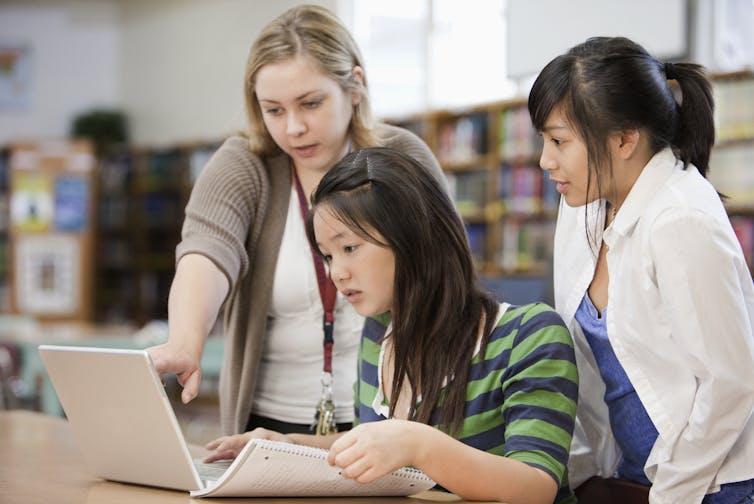
School librarians hear the question all the time: Why do we need school libraries and school librarians when students have the internet?
The perception is that a computer and Wi-Fi are all students need for their informational and recreational needs.
Meanwhile, the number of school librarians in the U.S. has dropped about 20% over the past decade, according to a July 2021 study funded by the Institute of Museum and Library Services. Many states, including Arizona, Texas and Pennsylvania, do not fund or mandate school librarian positions. And an analysis from the National Center for Education Statistics revealed that Hispanic, nonwhite and nonnative English speakers are the students most affected by the decline in librarian positions.
“Access to school librarians has become a major educational equity issue,” says Keith Curry Lance, who with Debra Kachel led the IMLS study. In a recent email he told me, “School districts losing librarians tend to be ones that can least afford the loss in a society characterized by increasing economic inequality.”
As a former school librarian who researches school library issues and trains future school librarians, I know that decades of research demonstrate that K-12 school librarians have a significant impact on student achievement.
Here are four functions that school librarians carry out that I believe make their role more important now than ever.
1. Foster digital literacy
As bestselling author Neil Gaiman put it, “Google can bring you back 100,000 answers. A librarian can bring you back the right one.”
Recently, there has been an alarming rise in misinformation and disinformation. This is bad news for democracy. A 2016 Stanford University study found that nearly 80% of high school students struggle to verify the credibility of a source.
A 2012 Pew Research study revealed that 83% of K-12 teachers think the amount of information available online today is “overwhelming for most students.” Over 70% believe that today’s digital technologies “discourage students from finding and using a wide range of sources for their research.”
School librarians are information literacy experts trained to teach students how to access and navigate the tsunami of digital information available to them, and how to determine the authenticity of that information.

2. Champion the joy of reading
School librarians collect and curate high-quality print and digital materials that help students develop a lifelong love of reading. Take, for example, Tamara Cox, librarian at Wren High School in Piedmont, South Carolina, and winner of the American Library Association’s I Love My Librarian Award in 2018. Cox partnered with the county election commission to bring in voting machines for a book award contest to creatively encourage both reading and civic education.
Findings from studies such as the 2014 South Carolina Association of School Librarians’ impact study affirm that students who attend schools with full-time certified school librarians score higher on standardized reading tests.
3. Help teachers enhance their lessons
School librarians collaborate with classroom teachers to locate resources that enhance and support authentic classroom instruction. For example, Cindy Symonds, the librarian at Round Top Elementary School in Blythewood, South Carolina, collaborated with fourth-grade teachers to have students use databases to research a historic weather event, such as Hurricane Katrina in 2005 or the Joplin Tornado in 2011. Then, with the help of a technology instructor, the students filmed themselves using a green screen to create a weather report.
[Over 115,000 readers rely on The Conversation’s newsletter to understand the world. Sign up today.]
School librarians also work to ensure that students are taught issues of intellectual freedom. They collaborate with teachers to help students understand the ethical use of ideas and information. These include lessons about acknowledging authorship, properly citing content and developing an understanding of how to correctly use and reproduce others’ work.
4. Seek out creative, diverse materials
School librarians select inclusive materials that represent diverse points of views. This ensures that students have materials that reflect their own experiences as well as the experiences of others.
Librarians often provide innovative and creative programs that promote active learning spaces where students share ideas, equipment and knowledge while they work on projects. For example, during Hispanic Heritage month, the students at James Simons Montessori School in Charleston, South Carolina, read books by Latino authors and researched the authors’ countries of origin. They also made artifacts, such as national flags and maps with landmarks and used Makey Makey invention kits to code and present their facts on interactive displays. The project combined research, literacy, coding, circuitry, self-expression and creativity.
Rosie Herold, who oversaw the project, says observers might be “taken aback by my library’s apparent disorder, the lack of desks, the constant movement of students, cardboard everywhere, the constant chatter and the energy level.”
“But,” Herold adds, “spend more than a cursory look, more than a quick investigation and you will find the future of education.”
Karen W. Gavigan, Professor of Information Science, University of South Carolina
This article is republished from The Conversation under a Creative Commons license. Read the original article.
- Details
- Written by: JULES BERNSTEIN

Bombardment of Earth’s surface by asteroids six or more miles long likely delayed the accumulation of oxygen in Earth’s atmosphere.
New evidence shows the number of ancient, large celestial bodies that crashed into Earth was up to 10 times higher than previously believed. This finding has led a team including a UC Riverside scientist to conclude that these collisions likely shaped the development of Earth’s chemistry early in its history.
The team’s work is detailed in a recent Nature Geoscience article. Impacts by asteroids or comets during the earliest years of Earth’s history likely contributed to the beginnings of life and its early evolution, yet later they delayed the development of more complex life-forms that require oxygen.
“Asteroid impacts can enhance the release of gases from the Earth that consume oxygen,” explained research team member and UCR biogeochemistry professor Tim Lyons.
“In addition, it’s common for meteorites to contain large amounts of iron that can interact with water and generate gases that affect the composition of the atmosphere,” he said. For example, iron can increase the flux of hydrogen and methane, both of which consume oxygen.
The revised understanding of our atmosphere is based on recent discoveries in Earth’s crust that point to a frequency of impacts roughly 2.4 to 3.5 billion years ago that greatly exceeds previous estimates. When large asteroids or comets struck, energy was released and it vaporized rocky materials in the planet’s crust. Small droplets of molten rock in the impact plume condensed, solidified, and fell back to Earth, creating round, sand-sized particles.
These particles, or impact spherules, are markers of ancient collisions. “In recent years, a number of new spherule layers have been identified in drill cores and outcrops, increasing the total number of known impact events during the early Earth,” said Nadja Drabon, a Harvard University professor and research team member.

The research team, led by Simone Marchi at Southwest Research Institute, found that the impacts tapered off around 2.4 billion years ago. This reduction coincided with a major shift in surface chemistry triggered by the rise in atmospheric oxygen, dubbed the Great Oxidation Event.
“For eons, there was a dance between the rise and fall of oxygen before it became a permanent feature of our atmosphere,” Lyons said. “Then, finally, the balance tipped for a number of reasons, one of which was the declining frequency of impacts.”
Readers need not be concerned about the re-emergence of an era in which we are again bombarded by giant asteroids. Impacts are far less common over the second half of Earth’s history. And while there are thousands of near-Earth objects today, some with the potential to hit Earth, the vast majority are quite small, and NASA closely monitors the larger ones.
Remarkably, though, impacts played a major role in shaping the history of life on Earth over billions of years. In addition to affecting oxygen, they caused major extinction events and changed the composition of the atmosphere in ways that warmed Earth’s surface and triggered the formation of organic molecules that likely served as the initial building blocks of life.
Impacts were particularly large and frequent in our early history. As the frequency and size of extraterrestrial object impacts declined, their ability to hold back the accumulation of oxygen in the atmosphere also declined, contributing to the initial rise of oxygen in Earth’s atmosphere roughly 2.4 billion years ago.
“This change,” Lyons said, “set the stage for the complex, oxygen-requiring life that followed, including the first animals more than a billion and a half years later.”
Jules Bernstein is senior public information officer for the University of California, Riverside.

- Details
- Written by: LAKE COUNTY NEWS REPORTS
High cyanotoxin levels in September prompted the advisory for individual household intakes, not public water systems.
With the generous help and support of Golden State and Mt. Konocti Mutual Water companies, alternative water filling stations were established to provide safe drinking water for affected residents. County officials said this likely helped prevent acute health issues for many.
The most recent Clear Lake cyanotoxin sampling, conducted Oct. 26, showed one shoreline site is at the danger level for cyanotoxins, five sites are at the warning level and two sites are at the caution level.
The highest microcystin level, at Redbud Park in Clearlake, was 25.11 µg/L and there were no detections of anatoxin-a. View the most recent data here.
Now that microcystin and anatoxin levels in the lake are significantly reduced, the drinking water health advisory is being lifted.
Alternative water-fill stations will remain in place until the end of the year, to give people time to service their systems as recommended below. Recreational water advisory signs are also being updated.
Officials cautioned that the fact Clear Lake cyanotoxin levels have improved does not ensure it is safe to drink water from individual privately managed water systems. Earlier testing showed other contaminants may also be present in these systems. People using these private water systems must make sure they are regularly maintained and tested; for cyanotoxins, and also coliform and nitrates.
As high cyanotoxin levels subside, officials urge residents not on public water systems to flush their water treatment systems before starting to use the water for drinking, cooking, and other uses. Filters may be contaminated with algal — or cyanobacterial — matter that can release toxins, so it’s recommended that treatment system filters be replaced.
Toxins can also remain in holding tanks and pipes, so holding tanks should be drained and indoor spigots run for five to 10 minutes. Consult the company that services your treatment system for instructions or assistance specific to your system.
Find helpful guidance — issued by the Thurston County Public Health and Social Services Department in Washington state — for purging household plumbing after a cyanobacteria bloom here.
Remember: If you are getting water from a public water system, your drinking water is being monitored and treated for cyanotoxins, and meets state and federal standards. These precautions are listed only for people drawing water directly from the lake for their individual household use. Boiling and bleach will not reduce cyanotoxins, and may make the problem worse.
“Now that we have seen drought and climate change are bringing about historically high cyanobacteria toxin levels, we need to prepare for the coming season,” the Lake County Health Services and Water Resources departments and Big Valley Band of Pomo Indians said in a joint statement.
People who have their own water systems should consider alternative water sources or more robust treatment with frequent testing and monitoring.
Public Health and local water districts are planning community forums in the coming months to explore potential solutions.