 How to resolve AdBlock issue?
News
- Details
- Written by: National Oceanic and Atmospheric Administration
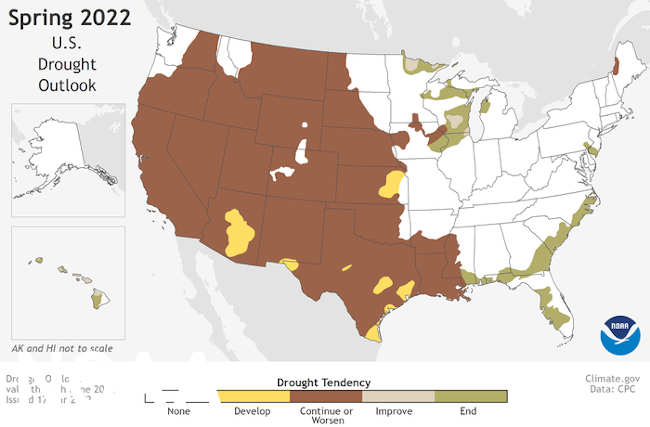
The National Oceanic and Atmospheric Administration, or NOAA, has issued its U.S. Spring Outlook and for the second year in a row, forecasters predict prolonged, persistent drought in the West where below-average precipitation is most likely.
NOAA’s Climate Prediction Center — part of the National Weather Service — is also forecasting above-average temperatures for most of the U.S. from the Desert Southwest to the East Coast and north through the Midwest to the Canadian border from April to June.
“NOAA’s Spring Outlook helps build a more weather and climate ready nation by informing local decision makers and emergency managers of this spring’s hazardous weather, such as extreme drought,” said NOAA Administrator Rick Spinrad, Ph.D. “NOAA’s seasonal outlooks provide advanced warning of the conditions to come, enabling communities to make preparations that boost their resilience to these hazards.”
Spring Outlook for drought, temperature and precipitation
“Severe to exceptional drought has persisted in some areas of the West since the summer of 2020 and drought has expanded to the southern Plains and Lower Mississippi Valley,” said Jon Gottschalck, chief, Operational Prediction Branch, NOAA’s Climate Prediction Center. “With nearly 60% of the continental U.S. experiencing minor to exceptional drought conditions, this is the largest drought coverage we’ve seen in the U.S. since 2013.”
Short-term drought recently developed in a region stretching from North Carolina southward through parts of Florida.
Dry conditions will bring an elevated risk of wildfires across the Southwest and southern Plains and north to the Central Plains, especially when high winds are present. Drought conditions in the Southwest are unlikely to improve until the late summer monsoon rainfall begins.
More than half of the U.S. is predicted to experience above-average temperatures this spring, with the greatest chances in the Southern Rockies and Southern Plains. Below-average temperatures are most likely in the Pacific Northwest and southeast Alaska.
Above-average precipitation is most likely in portions of the Great Lakes, Ohio Valley, mid-Atlantic and the west coast of Alaska, while below-average precipitation is forecast for portions of the Central Great Basin, Southwest, Central and Southern Rockies and Central and Southern Plains, eastward to the Central Gulf Coast.
Spring flood risk
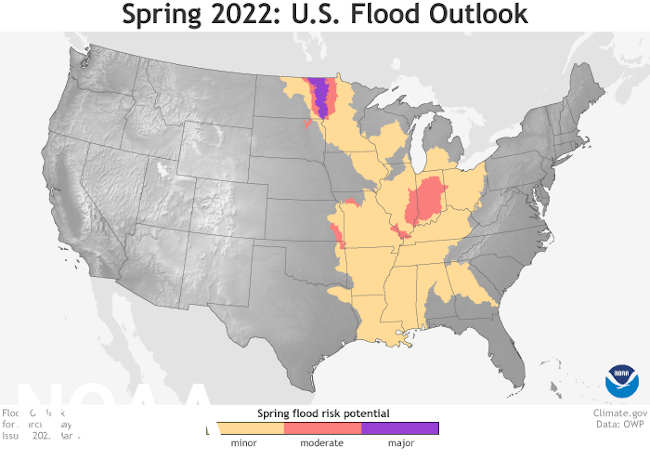
There is a minor-to-moderate flood risk throughout much of the eastern half of continental U.S., including the Southeast, Tennessee Valley, lower Mississippi Valley, Ohio Valley, and portions of the Great Lakes, upper Mississippi Valley, and middle Mississippi Valley. An above-normal ice breakup and flood potential is also present in Alaska.
“Due to late fall and winter precipitation, which saturated soils and increased streamflows, major flood risk potential is expected for the Red River of the North in North Dakota and moderate flood potential for the James River in South Dakota,” said Ed Clark, director, NOAA’s National Water Center.
Spring snowmelt in the western U.S. is unlikely to cause flooding.
NOAA’s National Hydrologic Assessment evaluates a number of factors, including current conditions of snowpack, drought, soil saturation levels, frost depth, streamflow and precipitation.
For detailed hydrologic conditions and forecasts, go to water.weather.gov.
- Details
- Written by: Mendocino College
Assembly Bill 132, the Postsecondary Education Trailer Bill, provides $100 million in one-time funding to help California community colleges provide comprehensive basic needs services to reduce equity and achievement gaps among traditionally underrepresented student populations across California.
According to the California Community Colleges Chancellor's Office, before the COVID-19 pandemic, approximately 50% of California community college students faced food insecurity, 60% faced housing insecurity and 19% faced homelessness within the past year.
A mid-pandemic survey, administered by the Student Senate for California Community Colleges indicated the pandemic exacerbated students’ basic needs insecurity: 67% of students reported higher levels of mental health distress and 40% reported dealing with a loss of income resulting in their inability to pay for housing expenses.
These needs, when unmet, easily and often lead to student crises and, without timely and significant intervention at an individual level, frequently leave students in extraordinarily difficult positions.
Often these students are forced into unfortunate and unnecessary choices, to address their crisis or to continue enrolling in classes to complete their educational journeys.
“Students shouldn’t have to worry about being able to afford their next meal,” said Janelle Meyers, Director of community relations and communication. “They cannot properly focus on their academics if they’re struggling with meeting their basic needs. The Basic Needs Department serves as a hub where students can feel safe and comfortable asking for resources that keep them moving towards their educational goals.”
To better support Mendocino College students, the Basic Needs Department will:
• Increase student access to nutritious and sufficient food.
• Connect students to resources to find safe, secure and adequate housing.
• Promote sustained mental and physical well-being and social-emotional support.
• Provide connections to affordable transportation assistance.
• Supply resources for personal hygiene care.
• Offer emergency funds.
• Deliver access to affordable and reliable internet access as well as technology devices.
Mendocino College has already begun laying the groundwork for a successful Basic Needs Department by:
• Adding staff capacity by creating a Basic Needs Liaison role to an office or team.
• Working closely with internal student support programs such as Financial Aid, Counseling, CalFresh Outreach, the college Food Pantry, and local community resources to ensure access to support in real-time.
• Establish clear pathways with instructions on navigating services to reduce barriers to accessing services.
• Creating an inviting webpage as a one-stop-shop for students experiencing challenges meeting their basic needs.
To learn more about the Mendocino College Basic Needs Department, visit www.mendocino.edu/basic-needs.
If you are part of a local organization that can offer basic needs assistance to Mendocino College students and would like to be added to the resource list, please contact Naoto Horiguchi at 707-467-1081.
- Details
- Written by: Elizabeth Larson
Dogs available for adoption this week include mixes of Anatolian shepherd, Australian cattle dog, Australian Kelpie, Chihuahua, German shepherd, Great Pyrenees, husky, Jack Russell terrier, Labrador retriever, shepherd and pit bull.
Dogs that are adopted from Lake County Animal Care and Control are either neutered or spayed, microchipped and, if old enough, given a rabies shot and county license before being released to their new owner. License fees do not apply to residents of the cities of Lakeport or Clearlake.
The following dogs at the Lake County Animal Care and Control shelter have been cleared for adoption.
Call Lake County Animal Care and Control at 707-263-0278 or visit the shelter online for information on visiting or adopting.

Male husky mix
This 3-year-old male husky mix has a short black and white coat.
He is in kennel No. 6, ID No. LCAC-A-3152.

Male pit bull terrier
This 1-year-old male pit bull terrier has a short white and tan coat.
He is in kennel No. 7, ID No. LCAC-A-2821.

Female shepherd mix
This 5-year-old female shepherd mix has a tricolor coat.
She was in kennel No. 9, ID No. LCAC-A-2793.
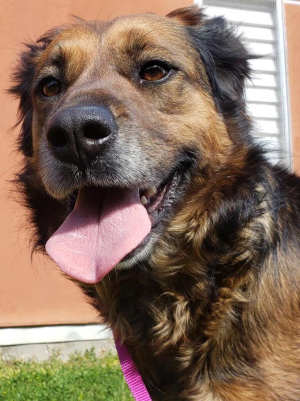
Female shepherd mix
This 7-year-old female shepherd mix has a tricolor coat.
She was in kennel No. 10, ID No. LCAC-A-2792.

‘Annie’
“Annie” is a 1-year-old female Jack Russell terrier with a short white coat with brown markings.
She is in kennel No. 11, ID No. LCAC-A-3090.

‘Jingo’
“Jingo” is a 3-year-old male Labrador retriever with a short black coat.
He is in kennel No. 12, ID No. LCAC-A-2636.

Male Chihuahua
This 3-year-old male Chihuahua has a short tan coat.
He is in kennel No. 13a, ID No. LCAC-A-2992.

Male Chihuahua
This 2-year-old male Chihuahua has a short brown coat.
He is in kennel No. 13b, ID No. LCAC-A-2993.

Female Labrador retriever
This 4-year-old female Labrador retriever has a short black coat.
She is in kennel No. 14, ID No. LCAC-A-2694.
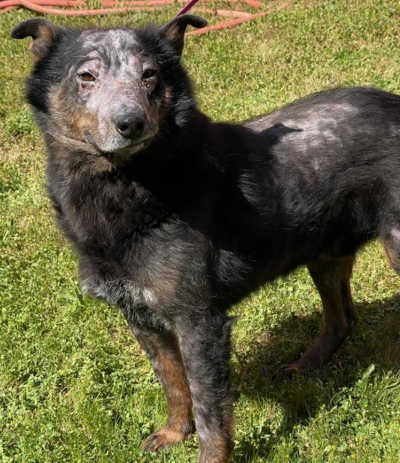
Australian cattle dog
This 3-year-old male Australian cattle dog has a black coat with tan markings.
He is in kennel No. 16, ID No. LCAC-A-3131.
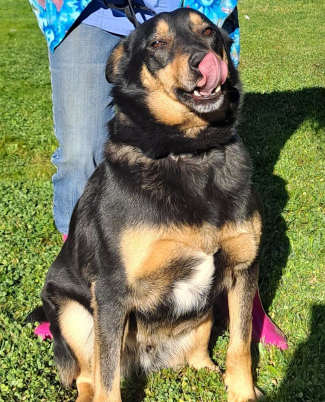
‘Max’
“Max” is a 4-year-old male Australian Kelpie mix with a black and tan coat with white markings.
She is in kennel No. 18, ID No. LCAC-A-2852.

Female German shepherd
This 2-year-old female German shepherd has a black coat.
She is in kennel No. 19, ID No. LCAC-A-2844.

Female shepherd mix
This 1-year-old female shepherd mix has a short tricolor coat.
She is in kennel No. 20, ID No. LCAC-A-2843.

Male pit bull terrier
This 3-year-old male pit bull terrier has a short tan and white coat.
He is in kennel No. 21, ID No. LCAC-A-2948.

‘Barney’
“Barney” is a 3-year-old male retriever with a brown and black coat with white markings.
He is in kennel No. 23, ID No. LCAC-A-2856.

‘Blue’
“Blue” is a 4-year-old female husky with a gray and white coat, and blue eyes.
She is in kennel No. 25, ID No. LCAC-A-2816.

Anatolian shepherd-Great Pyrenees
This 2-year-old male Anatolian shepherd-Great Pyrenees has a short white coat.
He is in kennel No. 26, ID No. LCAC-A-2536.

Female pit bull terrier
This 2-year-old female pit bull terrier has a short black and white coat.
She is in kennel No. 33, ID No. LCAC-A-3085.

Male Australian cattle dog
This 3-year-old male Australian cattle dog has a short black, tan and white coat.
He is in kennel No. 34, ID No. LCAC-A-3130.
Email Elizabeth Larson at
- Details
- Written by: Tom Langen, Clarkson University

Curious Kids is a series for children of all ages. If you have a question you’d like an expert to answer, send it to
Why do flocks of birds swoop and swirl together in the sky? – Artie W., age 9, Astoria, New York
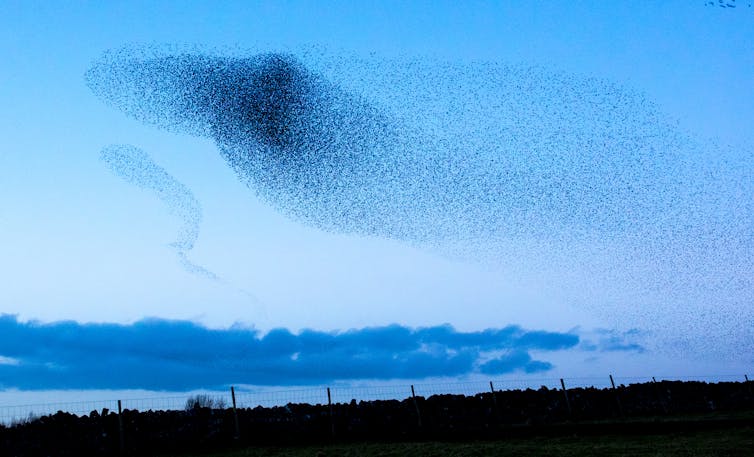
A shape-shifting flock of thousands of starlings, called a murmuration, is amazing to see. As many as 750,000 birds join together in flight. The birds spread out and come together. The flock splits apart and fuses together again. Murmurations constantly change direction, flying up a few hundred meters, then zooming down to almost crash to the ground. They look like swirling blobs, making teardrops, figure eights, columns and other shapes. A murmuration can move fast – starlings fly up to 50 miles per hour (80 kilometers per hour).
The European or common starling, like many birds, forms groups called flocks when foraging for food or migrating. But a murmuration is different. This special kind of flock is named for the sound of a low murmur it makes from thousands of wingbeats and soft flight calls.
Murmurations form about an hour before sunset in fall, winter and early spring, when the birds are near where they’ll sleep. After maybe 45 minutes of this spectacular aerial display, the birds all at once drop down into their roost for the night.
Why do starlings form murmurations?
Unlike the V formations of migrating geese, murmurations provide no aerodynamic advantage.
Scientists think a murmuration is a visual invitation to attract other starlings to join a group night roost. One theory is that spending the night together keeps the starlings warmer as they share their body heat. It might also reduce the chance an individual bird would be eaten overnight by a predator such as an owl or marten.
This dilution effect might be part of the reason murmurations happen: The more starlings in the flock, the lower the risk to any one bird of being the one that gets snagged by a predator. Predators are more likely to catch the nearest prey, so the swirling of a murmuration could happen as individual birds try to move toward the safer middle of the crowd. Scientists call this the selfish herd effect.
Of course, the more birds in a flock, the more eyes and ears to detect the predator before it’s too late.
And a gigantic mass of whirling, swirling birds can make it hard to focus on a single target. A falcon or hawk can get confused and distracted by tricky wave patterns in the murmuration’s movements. It also must be careful not to collide with the flock and get hurt.
Over 3,000 citizen scientist volunteers reported spotting murmurations in a recent study. A third of them saw a raptor attack the murmuration. That observation suggests that murmurations do form to help protect the birds from predators – but it’s also possible a huge murmuration would be what attracted a hawk, for instance, in the first place.
How do starlings coordinate their behavior?
Murmurations have no leader and follow no plan. Instead, scientists believe movements are coordinated by starlings observing what others around them are doing. Birds in the middle can see through the flock on all sides to its edge and beyond. Somehow they keep track of how the flock is moving as a whole and adjust accordingly.
To learn what’s happening inside murmurations, some researchers film them using many cameras at the same time. Then they use computer programs to track the movements of individual starlings and create 3D models of the flock.
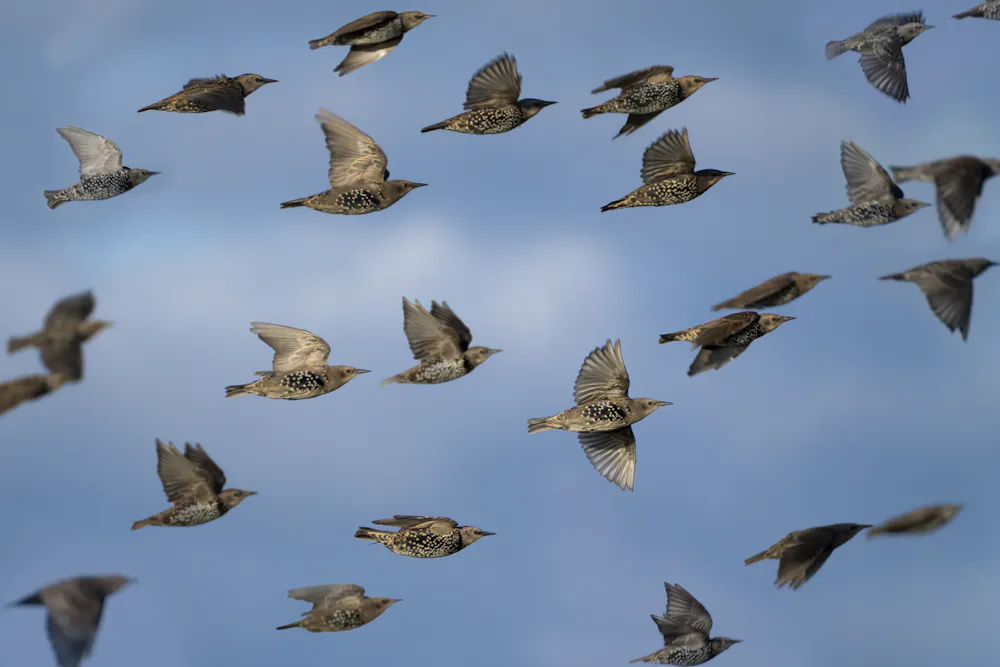
The videos reveal that the birds are not as densely packed as they might appear from the ground; there is room to maneuver. Starlings are closer to their side neighbors than those in front or behind. Starlings on the edge frequently move deeper into the flock.
Mathematicians and computer scientists try to create virtual murmurations using rules that birds might follow in a flock – like moving in the same direction as their neighbor, staying close and not colliding. From these simulations, it seems that each bird must keep track of seven neighbors and adjust based on what they’re doing to keep the murmuration from falling apart in a chaotic mess. And they do all this while flying as fast as they can.
Large schools of fish can appear to behave like murmurations, as do groups of some swarming insects, including honeybees. All these synchronized movements can happen so fast within flocks, herds, swarms and schools that some scientists once thought it required animal ESP!
Biologists, mathematicians, physicists, computer scientists and engineers are all working to figure out how animals carry out these displays. Curiosity drives this research, of course. But it may also have practical applications too, like helping develop autonomous vehicles that can travel in tight formation and work in coordinated groups without colliding.
Hello, curious kids! Do you have a question you’d like an expert to answer? Ask an adult to send your question to
And since curiosity has no age limit – adults, let us know what you’re wondering, too. We won’t be able to answer every question, but we will do our best.
Tom Langen, Professor of Biology, Clarkson University
This article is republished from The Conversation under a Creative Commons license. Read the original article.