 How to resolve AdBlock issue?
News
- Details
- Written by: Elizabeth Larson
The agency said the decision specifically involves its community cat program and vaccination clinics.
“We'd like to thank the community for their understanding during this time,” Lake County Animal Care and Control said in a Facebook announcement.
Asked about the reasons for the decision, Lake County Animal Care and Control Director Jonathan Armas responded in an email, “I currently cannot comment on the situation placing the specified services on hold. I will provide an update as soon as possible.”
Armas added, “We are currently working to resume services as soon as possible. VIP Pet Care still provides vaccinations on a rotating schedule throughout the county. Spay/Neuter services are still offered at all local vet offices and the SPCA of Lake County has limited services as well.”
SPCA of Lake County provides spay/neuter and vaccination clinics. Visit the organization’s website for more information.
Email Elizabeth Larson at
- Details
- Written by: GOVERNOR’S OFFICE
The proposed funding would support tribal initiatives that advance shared climate and biodiversity goals including research, development and implementation of traditional knowledge; workforce training, capacity building and technical support; and tribal nature-based climate conservation programs, among others.
“Too often, California Native American tribal communities are overlooked and suffer many of the worst impacts of climate change,” said Gov. Newsom. “The California way is not to hide from our past, but to embrace it with a commitment to build upon our values of inclusiveness and equity for everyone who calls this state home.”
The proposal has garnered praise from Assemblyman James C. Ramos (D-Highland), the first and only California Native American serving in the state’s Legislature.
“California has a tremendous amount of work ahead of us to meet our ambitious climate goals,” Ramos said. “Tribes have a connection to the land and have safeguarded the land for centuries. It makes sense to tap into valuable tribal knowledge for land and natural resource restoration. I applaud the governor’s announcement.”
In 2020, Gov. Newsom called for accelerated use of nature-based solutions to combat the climate crisis through Executive Order N-82-20.
The order called for a cohesive strategy to improve management of the state’s diverse landscapes to protect climate-vulnerable communities, safeguard biodiversity, achieve carbon neutrality, improve public health and safety, and expand economic opportunity.
Two major initiatives were launched as part of this strategy, a major new conservation goal and a first-ever strategy to expand climate-smart land management.
The state committed to conserve 30% of state lands and coastal waters by 2030, becoming a leader in an international effort referred to as “30X30.”
During public workshops for these initiatives, it was clear that California Native American tribes offered significant solutions and a willingness to partner with the state.
State agencies are finalizing a Natural and Working Lands Climate Smart Strategy that will identify the state’s priorities for managing our landscapes to meet California's ambitious climate goals.
“We heard loud and clear in our consultations with more than 70 different California Native American tribes a strong desire from tribal governments to play a leading role in restoration and conservation efforts that benefit Tribal communities and honor their connections to the lands and waters,” said California Natural Resources Secretary Wade Crowfoot. “Tribes also identified a need for capacity building resources to participate more centrally in California’s conservation and climate efforts. This proposed funding can make that collaboration possible.”
Under the Governor’s budget proposal, the California Natural Resources Agency, or CNRA, would manage the new tribal funding commitment.
Already this year in related programs, CNRA and its entities have awarded funds to tribes for a wide variety of projects including: The Ocean Protection Council through their Prop. 1 grant program funded $1,276,951 to the Wiyot Tribe for the purchase of 48 acres and restoration of their ancestral land that will also strengthen coastal resiliency in the Humboldt coastline.
And $772,602 in youth access grant funds to the Torres Martinez Desert Cahuilla Indians, Robinson Rancheria of Pomo Indians and the Wiyot Tribe.
Gov. Newsom acknowledged that California Native peoples have lived interdependently with, and stewarded this environment since time immemorial, and that the state has a role in the violent disruption of that relationship.
“As we have heard over the last few days, removing California Native people and practices from the places they have lived and thrived in since time immemorial has had far-reaching negative impacts, including many of the climate challenges we are currently experiencing,” said Governor's Tribal Advisor Christina Snider. “This proposal, which anticipates a tribally-led and informed process, is a step in the right direction to begin to honor what California Native peoples have been through and respectfully defer to tribal communities as the first people of this place.”
By collaborating with tribes, state officials said they will be able to incorporate solutions driven by the first peoples of this state to build a more resilient, equitable, and thriving future for all Californians.
- Details
- Written by: Robin Marks
Some people are gifted with genes that pack the benefits of slumber into an efficient time window, keeping them peppy on only four or six hours of sleep a night, according to researchers at UC San Francisco.
In addition, the scientists said, these “elite sleepers” show psychological resilience and resistance to neurodegenerative conditions that may point the way to fending off neurological disease.
“There’s a dogma in the field that everyone needs eight hours of sleep, but our work to date confirms that the amount of sleep people need differs based on genetics,” said neurologist Louis Ptacek, MD, one of the senior authors on the study, which appears in iScience on March 15. “Think of it as analogous to height; there’s no perfect amount of height, each person is different. We’ve shown that the case is similar for sleep.”
For over a decade, Ptacek and co-senior author, Ying-Hui Fu, PhD, both members of the UCSF Weill Institute for Neurosciences, have been studying people with Familial Natural Short Sleep, or FNSS, the ability to function fully on – and have a preference for – four to six hours of sleep a night.
They’ve shown that it runs in families and, thus far, have identified five genes across the genome that play a role in enabling this efficient sleep. There are still many more FNSS genes to find, the researchers said.
This study tested Fu’s hypothesis that elite sleep can be a shield against neurodegenerative disease. Her ideas contrast somewhat with current thinking that, for many people, lack of sleep can accelerate neurodegeneration.
The difference, Fu said, is that with FNSS, the brain accomplishes its sleep tasks in a shorter time. In other words, less time spent efficiently sleeping may not equate to a lack of sleep.
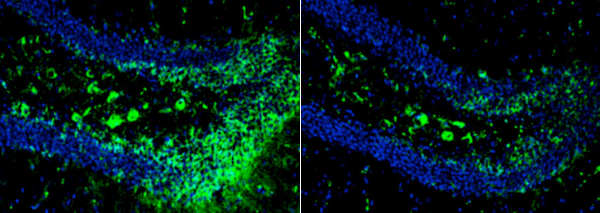
The team chose to look at mouse models of Alzheimer’s disease because that condition is so prevalent, said Fu. They bred mice that had both short-sleep genes and genes that predisposed them to Alzheimer’s and found that their brains developed much less of the hallmark aggregates associated with dementia.
To confirm their findings, they repeated the experiment using mice with a different short-sleep gene and another dementia gene and saw similar results.
Fu and Ptacek believe that similar investigations of other brain conditions would show the efficient-sleep genes conferring comparable protections. Improving peoples’ sleep could delay progression of disease across a whole spectrum of conditions, they said.

There’s a dogma in the field that everyone needs eight hours of sleep, but our work to date confirms that the amount of sleep people need differs based on genetics.
“Sleep problems are common in all diseases of the brain,” she said. “This makes sense because sleep is a complex activity. Many parts of your brain have to work together for you to fall asleep and to wake up. When these parts of the brain are damaged, it makes it harder to sleep or get quality sleep.”
Understanding the biological underpinnings of sleep regulation could identify drugs that will help ward off problems with sleep disorders. In addition, improving sleep in healthy people may sustain wellbeing and improve the quality of time we each have, the researchers said. But pursuing the many genes involved is a long game that they liken to putting together a thousand-piece jigsaw puzzle.
“Every mutation we find is another piece,” said Ptacek. “Right now we’re working on the edges and the corners, to get to that place where it’s easier to put the pieces together and where the picture really starts to emerge.“
Despite the long road ahead, there’s already promise in some of the few genes they’ve identified. At least one of them can be targeted with existing drugs that might be repurposed. Their hope is that within the next decade, they’ll have helped facilitate new treatments that allow people with brain disorders to get a better night’s rest.
“This work opens the door to a new understanding of how to delay and possibly prevent a lot of diseases,” said Fu. “Our goal really is to help everyone live healthier and longer through getting optimum sleep.”
Authors: Additional authors on the study include Qing Dong, Nicholas W Gentry, Thomas McMahon, Maya Yamazaki, Lorena Benitez-Rivera, and Tammy Wang, all of UCSF and Li Gan of Weill Cornell Medicine.
Funding: This work was supported by NIH grants NS117929, NS072360 and NS104782 and the William Bowes Neurogenetics Fund.
Robin Marks writes for the University of California San Francisco.
- Details
- Written by: Elizabeth Larson
Clearlake Police Chief Andrew White said the fatal fire occurred at Leisure Time Mobile Home Park.
He said it looked like a kitchen fire that got out of control.
A 72-year-old man died in the fire, White said.
The Lake County Sheriff’s Office said Monday that next of kin had not yet been identified, so the man’s name could not be released.
Lake County Fire Chief Willie Sapeta said the Leisure Time fire was dispatched at 10:14 a.m. Sunday in a fifth wheel trailer that was being used as a residence.
“We were on scene fairly quick,” he said.
During the fire’s dispatch, Sapeta said a possible entrapment was reported.
Firefighters arrived on scene and quickly knocked down the fire before finding the victim who had died inside, Sapeta said.
Sapeta said the fire was contained to the RV where it started.
He said the investigation is pending and not expected to be completed until later this week.
On Sunday evening, a fire was reported at a residence in the 3200 block of Old Highway 53 in Clearlake, Sapeta said.
He said the home’s residents had left hot ashes from the barbecue on the porch.
The fire did a fair amount of damage to the porch, and Sapeta said firefighters had to pull down half the ceiling to get to the rafters, where the fire had been burning for awhile.
Overall, Sapeta called it a “pretty amazing save,” with the structure not destroyed.
While earlier in the day there had been some tragedy, firefighters got a big win not just in saving the home in the second incident but helping to protect both the human inhabitants and their pets.
The home’s residents included two beautiful Rottweilers who Sapeta said were probably the friendliest dogs he’s met, and one of those dogs’ three puppies.
“All the puppies were saved with no resuscitation needed,” said Sapeta, noting the healthy Rottweiler-pit bull mix pups look like they’re going to grow up big — they already have paws the size of cupcakes.
Up until this weekend, the district hadn’t seen much fire action recently, Sapeta said. “It’s been quiet for us for almost three weeks.”
On Monday the district also responded as mutual aid to Clearlake Oaks for an RV fire that extended into a structure on Beryl Way, Sapeta said.
Email Elizabeth Larson at