 How to resolve AdBlock issue?
News
- Details
- Written by: Elizabeth Larson
The board will meet beginning at 9 a.m. Tuesday, March 22, in the board chambers on the first floor of the Lake County Courthouse, 255 N. Forbes St., Lakeport.
The meeting can be watched live on Channel 8, online at https://countyoflake.legistar.com/Calendar.aspx and on the county’s Facebook page. Accompanying board documents, the agenda and archived board meeting videos also are available at that link.
To participate in real-time, join the Zoom meeting by clicking this link.
The meeting ID is 989 1903 5810, pass code 995795. The meeting also can be accessed via one tap mobile at +16699006833,,98919035810#,,,,*995795#.
All interested members of the public that do not have internet access or a Mediacom cable subscription are encouraged to call 669-900-6833, and enter the Zoom meeting ID and pass code information above.
To submit a written comment on any agenda item visit https://countyoflake.legistar.com/Calendar.aspx and click on the eComment feature linked to the meeting date. If a comment is submitted after the meeting begins, it may not be read during the meeting but will become a part of the record.
In an untimed item, the board will consider a recruitment strategy for county administrative officers.
County Administrative Officer Carol Huchingson announced on Thursday that she will resign, effective April 29.
Huchingson said she is retiring after six years in the job.
In a new and untimed item, Animal Care and Control will introduce the pet of the week.
The board on Tuesday also will present a proclamation at 9:07 a.m. designating the month of March 2022 as March for Meals Month.
At 9:15 a.m., the board will host the presentation of the Employee Service Awards.
The full agenda follows.
CONSENT AGENDA
5.1: Approve the nomination of Supervisor Sabatier to serve on the Economic Mobility Leadership Network.
5.2: Approve revisions to Exhibit A of the Uniform and Clothing Purchase Policy.
5.3: Adopt proclamation designating March 22, 2022, as National Agriculture Day.
5.4: Approve Amendment No.1 to the FY 2021-22 agreement between county of Lake and Ever Well Health Systems for a new contract maximum of $101,700.00 and authorize the board chair to sign.
5.5: Approve the extended use of county juvenile hall facility for a temporary support shelter targeting Lake County’s chronically homeless population through June 30, 2022.
5.6: Approve Board of Supervisors meeting minutes for March 1 and 11, 2022.
5.7: Approve continuation of resolution authorizing teleconference meetings during a state of emergency that continues to exist.
5.8: Adopt resolution approving the Amendment 2 to Agreement No. 18G30117 between the secretary of state and the county of Lake for voting systems replacement funds.
5.9: Approve Continuation of a local health emergency by the Lake County health officer for the Cache fire.
5.10: Approve continuation of a local health emergency related to the 2019 Coronavirus (COVID-19) as proclaimed by the Lake County Public Health officer.
5.11: Approve continuation of a local health emergency and order prohibiting the endangerment of the community through the unsafe removal, transport, and disposal of fire debris for the LNU Complex wildfire.
5.12: Approve continuation of a local emergency in Lake County in response to the LNU Lightning Complex wildfire event.
5.13: Approve continuation of a local emergency due to COVID-19.
5.14: Approve continuation of an emergency declaration for drought conditions not available.
5.15: Approve continuation of a local emergency by the Lake County sheriff/OES director for the Cache fire.
5.16: Approve the purchase of two sport utility vehicles, and authorize the Public Works director/assistant purchasing agent to issue a purchase order through the statewide bid contract to Downtown Ford in the amount of $66,598.16.
5.17: Approve a purchase order for the purchase of a bottom dump trailer for county road maintenance in the amount of $64,954.75, and authorize the Public Works director/assistant purchasing agent to sign the purchase order.
5.18: Authorize the chairman to sign the FY21 Edward Byrne Justice Assistance Grant certifications and assurances and financial capability questionnaire.
5.19: Adopt proclamation designating the month of March 2022 as March for Meals Month.
TIMED ITEMS
6.3, 9:07 a.m.: Presentation of proclamation designating March 22, 2022, as National Agriculture Day.
6.4, 9:08 a.m.: Presentation of proclamation designating the month of March 2022 as March for Meals Month.
6.5, 9:15 a.m.: Presentation of Employee Service Awards.
6.6, 9:30 a.m.: Hearing on account and proposed assessment for 11450 E State Hwy 20, Clearlake Oaks.
UNTIMED ITEMS
Pet of the Week.
7.2: Consideration of recruitment strategy for county administrative officer.
CLOSED SESSION
8.1: Public employee evaluation: Social Services Department Director Crystal Markytan.
8.2: Public employee evaluation: Registrar of Voters Maria Valadez.
Email Elizabeth Larson at
- Details
- Written by: LAKE COUNTY NEWS REPORTS
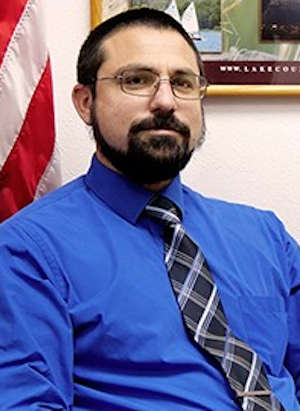
LAKE COUNTY, Calif. — Bruno Sabatier is running for a second term as District 2 supervisor for the county of Lake.
The Lake County Registrar of Voters confirmed that Sabatier will run for his second term unopposed.
The election will be held on June 7, as part of the statewide primary.
Between 2015 and 2018, Sabatier served as a Clearlake City Council member, helping Clearlake progress on many of its issues.
During his first term, beginning in 2019, he said he has continued those efforts as a member of the Board of Supervisors by utilizing the strategies and successes that he has learned along the way.
He has not only represented District 2, but he said he continues to collaborate in order to provide and support initiatives in other districts as well.
The past four years have not come without its obstacles to overcome. Cannabis, COVID, drought, and a decrease in consequences toward petty crimes have been some of the major obstacles to deal with, he said.
Sabatier said he works to tackle problems head on and provides information to better understand the problem while also providing solutions on how to resolve or break through these obstacles.
For cannabis, Sabatier said he not only provided greater support for expanding the industry’s footprint within the county, but he also drafted resolutions enhancing the environmental review and neighbor notification process before obtaining an early activation.
In 2020, after reviewing the applications being processed and noticing their infringement on traditional and historical ag areas, he drafted the Farmland Protection Zone banning outdoor cannabis from the areas and clarifying future traditional farmland protections.
Following the rules set up for the industry is important to him as well, as he said he has worked with staff to shut down a couple of legal operations in his own district that were not in compliance after receiving complaints from the community.
Due to the drought and the increased number of water trucks, especially related to cannabis farms both legal and illegal, Sabatier drafted a resolution making water haulers accountable for delivering water illegally to any cannabis grows.
He also drafted a resolution requiring that all projects going before the Planning Commission provide a hydrology report considering the cumulative impacts to neighboring properties and that all applicants provide a proposed drought management plan for their projects.
During the onset of COVID-19, many Lake County businesses were forced to close. Sabatier drafted many letters for the board’s approval to send to the Governor’s Office requesting that businesses be released from the closures set in place.
When state contracts, assisting the county with COVID mitigation, were not forthcoming or were being breached, Sabatier said he reached out to the state and advocated for the resources that Lake County needed, eventually receiving what Lake County was promised during the pandemic.
With state criminal law reducing the convictions and consequences for petty crime, Sabatier said it has become apparent to him that code enforcement could provide assistance in cleaning up our communities where law enforcement’s capabilities had been reduced.
He has advocated for increased code enforcement staffing throughout his first term and proposed the Road Map Task Force in February 2021.
The task force was approved by the board and provided a $1 million budget to clean up the Clearlake Oaks area in District 3. Ensuring a safe and clean environment in our communities is paramount to Sabatier’s agenda for a better tomorrow.
Sabatier said he works with other supervisors to enable success. The Road Map Task Force is one example of wanting to see the county succeed in other areas, not just District 2.
With two dedicated law enforcement and two dedicated code enforcement officers, the quality of life in Clearlake Oaks has the potential to increase with efforts being made to entice investors to come and invest in vacant commercial lots and develop more opportunities for jobs and economic growth.
In District 4, he proposed to meet with Supervisor Tina Scott and other department heads to discuss the former juvenile hall facility being transitioned into an emergency homeless shelter. He said the new Elijah House has been critical to the county’s pandemic response with many who were homeless now having transitioned out of the shelter and into their own homes.
While providing support in other districts, Sabatier said his true passion still lies with the city of Clearlake, and he continues to enjoy strong relationships with the current council and city staff.
He is working with county groups such as the Rural Arts Initiative to bring in new murals and art sculptures in the city, and the Bureau of Land Management and Cal Fire to help protect the city from future fires.
Sabatier said he is always looking for ways to compliment the work being done by the city with his own initiatives. Currently, after receiving approval from the board, he is working on a new upgraded concrete skatepark for Austin Park.
So what’s next in the next four years? What are the key items that Sabatier wants to focus on?
When prompted with these questions, Sabatier responds with, “We need to build economic sustainability with the new revenues that we’ve created mixed with a safer and cleaner environment to bring in new investors.”
He wants to continue focusing on the success of the Road Map Task Force in hopes that in two years it will be carbon copied into another area of Lake County.
He plans to focus on food sustainability within the county as most of the agricultural crops are not grown for food purposes.
He wants to focus on the illegal cannabis market and make them accountable for their unfair business practice, evasion of taxes, and their environmental crimes.
If you’ve been following the Board of Supervisors meetings, you will know that Sabatier reads everything that is provided to him. Oftentimes, he will pull consent agenda items just to fix a dollar amount that didn’t match or to ask follow-up questions.
“I have worked hard these past three years to learn as much as I could as quickly as I could by being present and active. When reelected, you can expect the same level of work ethic that I have shown since day one,” he said.
Sabatier has many more ideas and plans for the upcoming years. If you’d like to hear more about them, you can reach him at 707-695-0834 or via email at
- Details
- Written by: KRISTIN KERNS-D’AMORE, JOEY MARSHALL AND BRIAN MCKENZIE
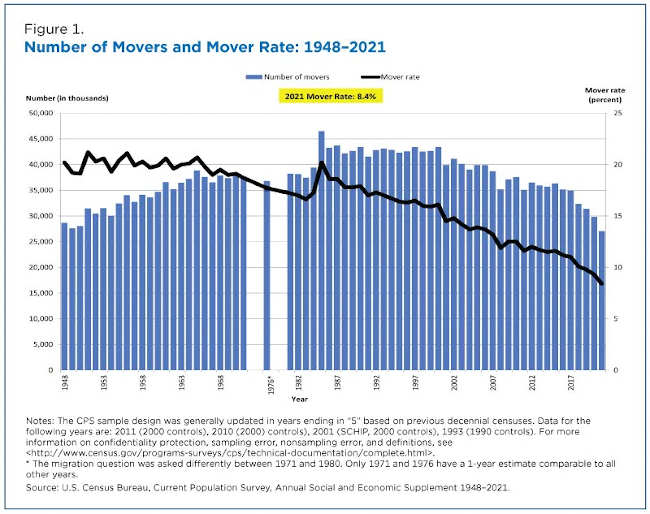
The COVID-19 pandemic did not stop a decline in the nation’s mover rate which in 2021 was at a new historical low over more than seven decades, according to the Current Population Survey Annual Social and Economic Supplement (CPS ASEC). The 2021 mover rate was less than half what it was in 1948.
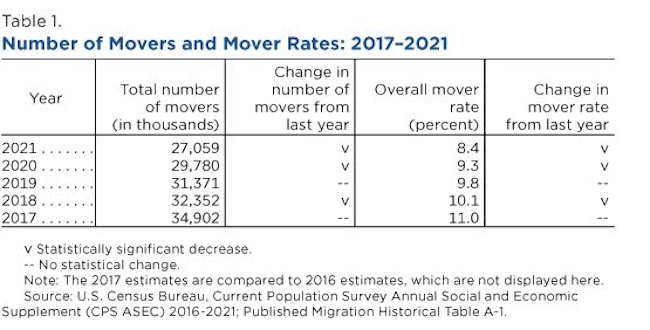
In 2021, 8.4% of people lived in a different residence one year ago, down from 9.3% in 2020.
In the CPS ASEC, migration is measured as having a different residence one year prior to being interviewed from February to April. For example, 2021 CPS ASEC migration estimates captured people who changed residences from early 2020 to early 2021.
The 2020 and 2021 CPS ASEC migration estimates reflect different time periods relative to the COVID-19 pandemic. In the 2021 data, most possible moving days occurred during the pandemic, while in the 2020 data, most possible moving days occurred before the pandemic.
Moving slowdown
A falling mover rate is nothing new, and the pandemic did not disrupt this decline.
Over the past five years, both the annual mover rate and number of movers fell (from the previous year) in 2018, 2020, and 2021. (Neither the mover rate nor the number of movers changed statistically in 2017 or 2019). The number of movers declined in 2018, 2020, and 2021 despite continued U.S. population growth.
The 2021 mover rate decline is even more dramatic when compared to what it was more than seven decades ago.
In 1948, the first year the CPS collected this information, the mover rate was 20.2%, more than twice the 2021 mover rate (8.4%). The 2021 mover rate was lower than all prior mover rates from 1948 to 2020, marking a new historical low.
Aspects of migration stable between 2017 and 2021
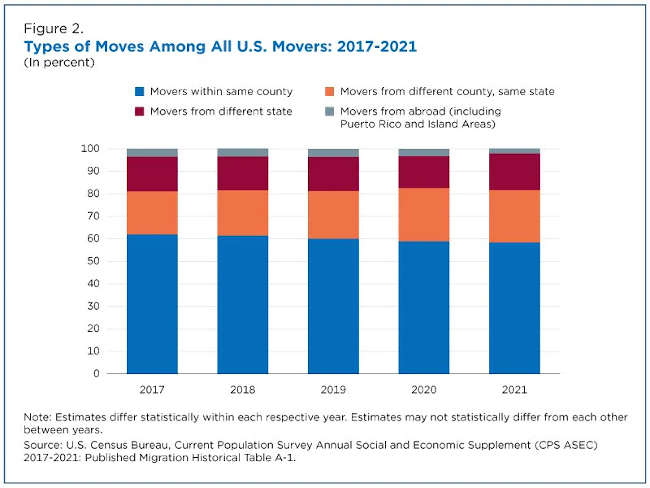
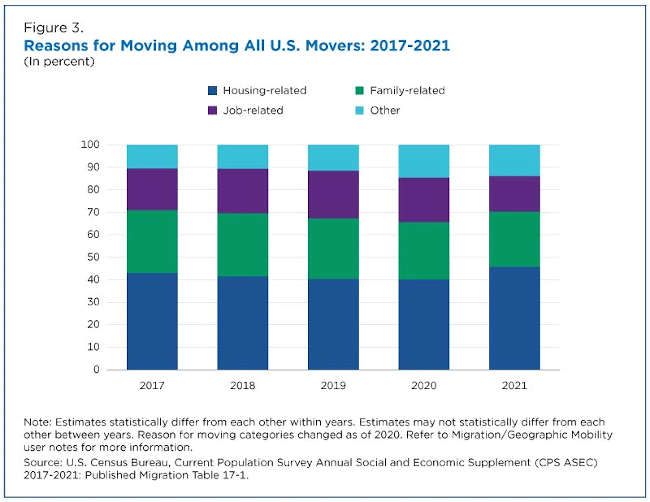
Even as the mover rate declined in recent years, other aspects of migration remained relatively stable, including types of moves, the main reason for moving and migration between regions.
In recent years, movers did not typically cross state or even county lines. In 2021, less than one-fifth moved from one state to another, while more than half moved within the same county. This was also the case in 2017 through 2020.
Nearly half of all movers in 2021 cited housing-related reasons for moving, which were also the most prevalent reasons given for moves from 2017 to 2021.
The next most prevalent reasons for moving in those years were family-related reasons, job-related reasons and, lastly, other reasons.
Moving across regions
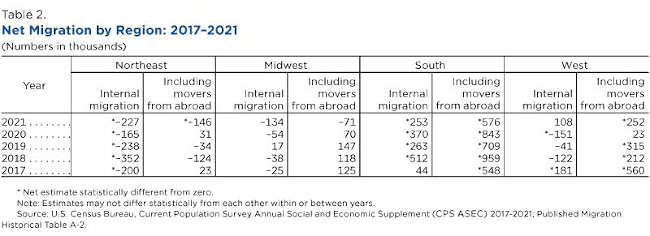
Across the four regions, net population changes associated with migration did not happen consistently or in the same direction in recent years.
In 2021, the South gained people from migration between regions, about 253,000, while the Northeast lost people, about 227,000. The Midwest and West did not experience statistically significant gains or losses.
In addition, the South experienced net internal gains in 2018 through 2020, and the Northeast also experienced net internal losses in 2017 through 2020.
Including movers from abroad, the South experienced net gains each year from 2017 through 2021 and the Northeast experienced a net loss in 2021.
Changes in migration from 2020 to 2021
The pandemic did not disrupt a decline in the national mover rate but it may have affected migration in other ways.
The relative share of movers crossing state lines increased from 2020 to 2021. At the same time, the share of movers from abroad declined, which may be related to international travel restrictions during the pandemic.
The relative share of movers indicating housing-related reasons increased from 2020 to 2021. At the same time, the share moving for job-related reasons declined, which may be linked to economic and workplace disruptions during the pandemic.
About the CPS ASEC migration estimates
The CPS ASEC migration estimates are among persons at least one year of age and living in the United States (50 states and District of Columbia). Movers from Puerto Rico and the U.S. Island Areas are counted as movers from abroad. As of 2020, there were changes to the survey’s reason for moving categories.
COVID-19-related changes to survey operations and nonresponse may have influenced 2020 and 2021 estimates.
More CPS ASEC migration estimates are available in our historical tables, historical graphs and annual detailed tables.
Definitions and more information about confidentiality protection, sampling error, and nonsampling error are available on the full CPS ASEC Technical Documentation page.
Kristin Kerns-D’Amore is a survey statistician in the Census Bureau’s Social, Economic, and Housing Statistics Division. Joey Marshall is a survey statistician in the Census Bureau’s Center for Economic Studies. Brian McKenzie is a branch chief in the Social, Economic, and Housing Statistics Division.
- Details
- Written by: Marlene B. Schwartz, University of Connecticut
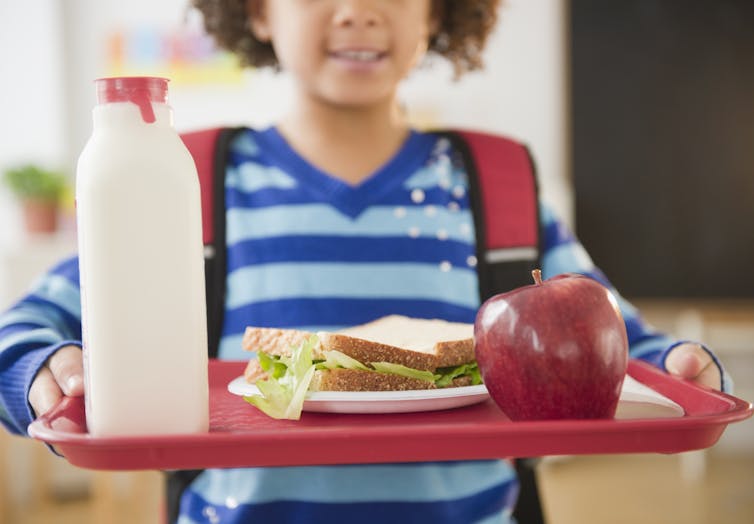
Public schools have been serving all students free meals since the COVID-19 pandemic first disrupted K-12 education. In March 2022, Congress rejected calls to keep up the federal funding required to sustain that practice and left that money out of a US$1.5 trillion spending package that President Joe Biden signed into law on March 11, 2022. We asked food policy expert Marlene Schwartz to explain why free meals make a difference and what will happen next.
How did the COVID-19 pandemic initially affect the school lunch program?
In March 2020, nearly all U.S. K-12 school buildings closed due to the COVID-19 pandemic.
The U.S. Department of Agriculture, which administers the federal government’s National School Lunch Program, quickly granted waivers to increase program flexibility and accommodate the challenges of the pandemic.
These waivers, which have been renewed several times, were critically important for school food service programs as the programs abruptly shifted away from serving meals in cafeterias and designed new distribution models to continue to feed students. Many school meal staff across the country created grab-and-go meals that families could pick up, which was particularly important in the spring of 2020 and the following school year. Another major change, which has continued during the 2021-2022 school year, is that school systems are able to serve meals to all students at no cost.
Prior to the COVID-19 pandemic, nearly 30 million lunches were served every school day to K-12 students through the National School Lunch Program. Schools provided roughly three-quarters of those meals at reduced rates or no cost at all – with the federal government reimbursing a portion of the cost of those meals.

How much money is involved?
The program cost $14 billion in 2019, before the pandemic disrupted it.
The price of a school lunch for families without free or reduced-cost meals varies. In 2017, full-price lunches tended to run between $2.50 and $2.75 apiece.
Are all public school students still getting free meals?
Yes. However, that will no doubt change once the latest waiver expires on June 30, 2022.
Advocates urged Congress to keep funding school nutrition programs at higher levels. But Congress did not include that money in the $1.5 trillion spending bill House and Senate lawmakers passed in March 2022.
This means that next fall, most schools will have to resume the old three-tiered system where some families don’t pay at all, some receive discounted lunches, and others must pay full price.
Two states will buck that trend. California and Maine will continue providing universal school meals after the federal waiver ends due to measures their state legislators passed and governors signed into law during the COVID-19 pandemic.
At the federal level, more than a dozen senators and roughly 50 members of the House of Representatives backed proposed legislation in 2021 that would permanently make school lunch free for all students, regardless of their income. There is significant support for this idea among advocates, but the future of this type of federal legislation remains to be seen.
What are the advantages of making school meals free to everyone?
In my view, the biggest advantage to universal school meals is that more students actually eat nutritious school meals. Following the regulations that emerged from the 2010 Healthy Hunger-Free Kids Act, the nutritional quality of school meals improved significantly, and a recent study found that schools typically provide the healthiest foods that children eat all day.
The research shows that making school meals free for everyone improves attendance and boosts diet quality. It also decreases the risk of food insecurity and the stigma associated with receiving a free meal. When no one has to pay, the growing problem of school meal debt is also eliminated.
There are important logistical benefits to universal school meals. Families don’t have to fill out any paperwork to establish their eligibility for free or reduced-price meals. And cafeteria staff can focus on serving the meals if they don’t need to track payments.
What’s wrong with charging some students for lunch again?
You have to look at the costs and benefits of the big picture. Universal school meals provide significant benefits to the school community as a whole – most notably, reductions in food insecurity and improvements in student diet quality. I believe these benefits are far greater than the marginal cost of providing free meals to students who would otherwise pay.
The fall of 2022 is also much too early to revert back to the three-tiered system because school food programs continue to face significant challenges. Supply chain disruptions have made it harder to buy some kinds of food, including chicken and whole grain products. In addition, many schools are having trouble hiring the staff they need to prepare and serve the meals, and inflation is increasing food costs.
What do you see happening in the future?
Ideally, the federal government will reconsider this issue and support universal school meals.
If that does not happen, advocates, policymakers and researchers will be watching what happens in California and Maine. We will be able to compare what happens in these states versus those that do not continue to provide all students with free meals. My hope is that this information will inform future decisions about implementing universal school meals for all students nationally.
[Over 150,000 readers rely on The Conversation’s newsletters to understand the world. Sign up today.]
Marlene B. Schwartz, Professor of Human Development and Family Sciences, University of Connecticut
This article is republished from The Conversation under a Creative Commons license. Read the original article.