How to resolve AdBlock issue?
Refresh this page
How to resolve AdBlock issue?
Refresh this page
Lake County News,California
  • Home
    • Registration Form
  • News
    • Education
    • Veterans
    • Community
      • Obituaries
      • Letters
      • Commentary
    • Police Logs
    • Business
    • Recreation
    • Health
    • Religion
    • Legals
    • Arts & Life
    • Regional
  • Calendar
  • Contact us
    • FAQs
    • Phones, E-Mail
    • Subscribe
  • Advertise Here
  • Login
How to resolve AdBlock issue?
Refresh this page

News

Space News: The Moon is getting slightly farther away from the Earth each year − a physicist explains why

Details
Written by: Stephen DiKerby, Michigan State University
Published: 18 October 2025

Earth rises over the Moon, as seen by the Apollo 8 astronauts. Bill Anders/NASA
Curious Kids is a series for children of all ages. If you have a question you’d like an expert to answer, send it to This email address is being protected from spambots. You need JavaScript enabled to view it..

Is the Moon getting farther away from Earth? – Judah, 9, Broken Arrow, Oklahoma


The Moon is getting 1½ inches (3.8 centimeters) farther away from the Earth every year.

Scientists measure the distance to the Moon by bouncing lasers off mirrors placed there by space probes and astronauts.

By measuring the amount of time it takes light to travel to the Moon and back, scientists can very precisely measure the distance to the Moon and how the distance changes.

The distance to the Moon actually changes over a single month as it goes around the Earth. The Moon is typically 239,000 miles (385,000 km) away from the Earth, but its orbit is not a perfect circle and changes by about 12,400 miles (20,000 km) as it orbits the Earth. This change is why some full moons are a bit bigger than others; these are called supermoons.

As an astrophysics researcher, I’m interested in the motion and interaction of objects such as planets, stars and galaxies. The motions of the Earth and Moon have many interesting consequences, and studying how they move over time can help researchers better understand how each has changed over the 4½ billion years since the Earth and Moon formed.

Tidal forces

So, why is the Moon getting farther away? It’s all because of tides.

Tides come from a difference in gravity across an object. The force of gravity exerted by the Moon is about 4% stronger on the side of Earth that faces toward the Moon, compared to the opposite side of the Earth facing away, because gravity gets weaker with distance.

This tidal force causes the oceans to slosh around in two bulges that point toward and away from the Moon. They do this because the gravitational force pulling on Earth by the Moon isn’t just an average force that’s the same strength everywhere. The Moon’s gravity is strongest on the closer side of the Earth, creating a bulge of water pointing toward the Moon. It’s weaker on the opposite side of the Earth, which leaves another bulge of water that lags behind the rest of the Earth.
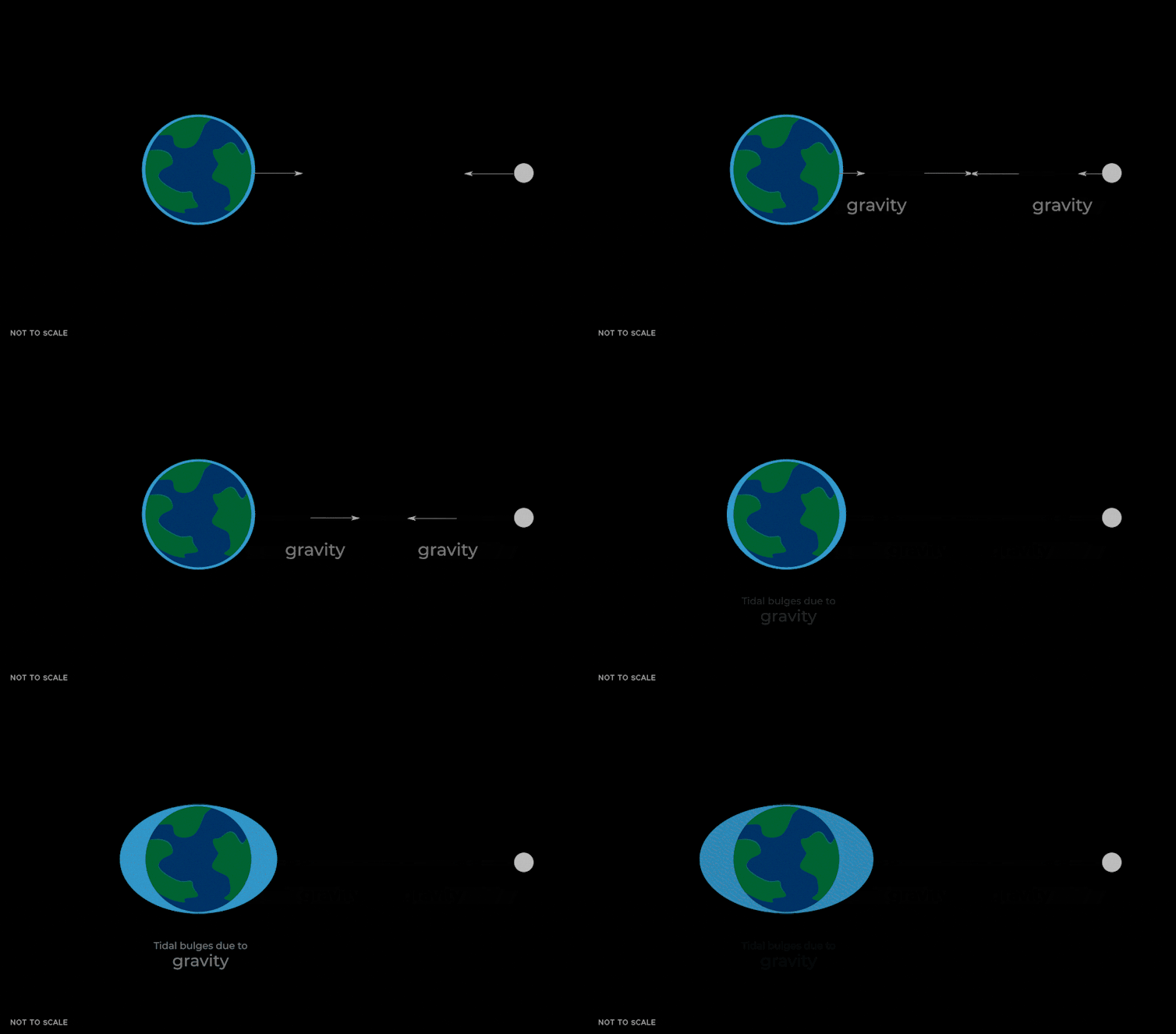
An animation showing the formation of tides
A NASA animation, not to scale, shows how the Moon creates tides on the Earth. The water in the oceans sloshes toward and away from the Moon. NASA/Vi Nguyen

As the Earth rotates, these bulges move around and keep pointing at the Moon because of its gravitational pull. In New York City or Los Angeles, the water level can change by about 5 feet due to these tidal bulges.

These liquid bulges do not quite line up with the Moon – they “lead” it a little bit because the Earth is rotating and dragging them forward. These bulges also exert a gravitational pull back on the Moon. The bulge closer to the Moon isn’t just pulling the Moon toward the center of the Earth, but also a little bit ahead in its orbit – like the boost a sports car gets as it goes around a curve.
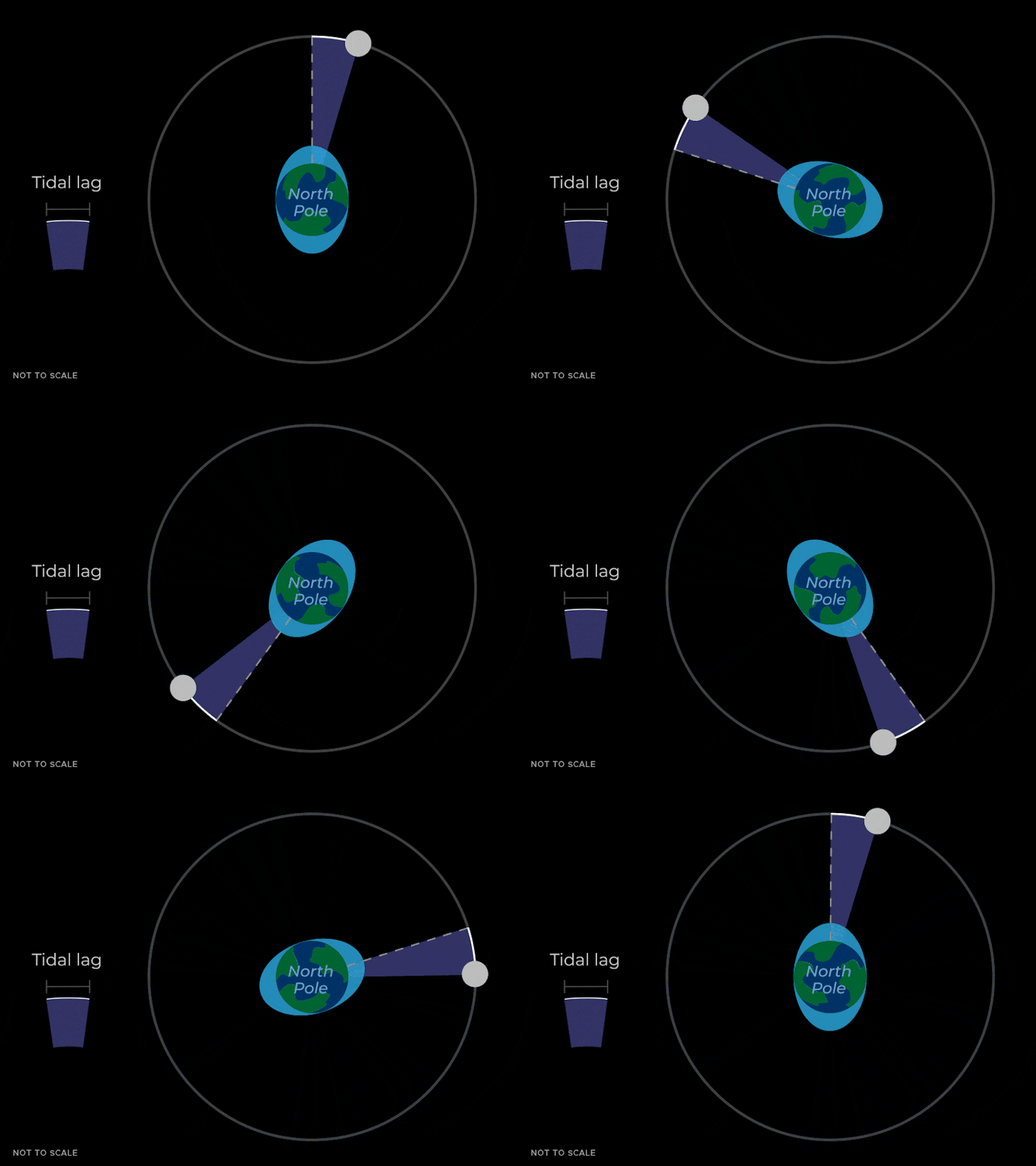
An animation of the moon orbiting the Earth, with two bulges growing and ebbing away
As the Moon orbits the Earth, the tidal bulges do not exactly point toward the Moon, but instead a little bit ahead of it because of friction between the bulges and the rotating Earth. NASA/Vi Nguyen

This forward pull from the closer tidal bulge causes the Moon to speed up, which causes the size of its orbit to increase. Think of a baseball player hitting a home run. If the player hits the ball faster at home plate, it’ll zoom higher up into the sky.

So the bottom line is that the gravity of the closer tidal bulge on the Earth is pulling the Moon forward, which increases the size of the Moon’s orbit. This means that the Moon gets slightly farther away from the Earth. This effect is very gradual and only detectable on average over years.

Does the Moon’s increasing distance affect Earth?

The Moon gains momentum as its orbit gets bigger. Think about spinning a weight attached to a string. The longer the string, the more momentum the weight has, and the harder it is to stop.

Because the Earth is doing the work of increasing the Moon’s momentum, the Earth’s rotation slows down in turn, as its momentum goes to the Moon. To put it another way, as the Moon’s orbital momentum increases, the Earth’s rotational momentum decreases in exchange. This exchange makes a day get very slightly longer.

But don’t worry, these effects are so small: 1.5 inches per year compared to a distance of 239,000 miles (384,000 km) is just 0.00000001% per year. We’ll keep having eclipses, tides and days that last 24 hours for millions of years.

Was the Moon closer to us in the past?

The Earth’s days were shorter in the past.

The Moon probably formed around 4.5 billion years ago, when a young Earth was hit by a Mars-size protoplanet, causing a lot of material to get knocked off into space.

Eventually, that material formed the Moon, and it was initially much closer to the Earth. Back then, you’d see the Moon much bigger in the sky.

A NASA simulation of the collision between early Earth and a now-destroyed protoplanet that likely created the Moon.

By examining fossilized clam shells for material showing their daily growth patterns, paleontologists found evidence that 70 million years ago – near the end of the time of dinosaurs – the day was only 23.5 hours long, just as predicted by astronomical data.

What will happen in the future?

So, will the Moon eventually escape from the Earth’s gravitational pull as it moves away?

If we fast-forward tens of billions of years into the future, eventually the Earth’s rotation could slow down until it is tidally locked with the Moon. That means that it would take just as long for the Earth to rotate as the Moon does to orbit. At this point, the Moon would stop getting more distant, and you would see the Moon only from one side of the Earth.

A NASA video shows how the Sun might appear as a red giant billions of years in the future.

But two things will stop that from happening. First, in a billion years or so, the Sun will get brighter and boil away the oceans. Then, there won’t be large tidal bulges of water to cause the Moon to get more distant. A few billion years later, the Sun will expand into a red giant, probably destroying the Earth and the Moon.

But these events are so far in the future that you don’t need to worry about them. You just get to enjoy tides on the beach, solar eclipses and our beautiful Moon.


Hello, curious kids! Do you have a question you’d like an expert to answer? Ask an adult to send your question to This email address is being protected from spambots. You need JavaScript enabled to view it.. Please tell us your name, age and the city where you live.

And since curiosity has no age limit – adults, let us know what you’re wondering, too. We won’t be able to answer every question, but we will do our best.The Conversation

Stephen DiKerby, Postdoctoral Researcher in Physics and Astronomy, Michigan State University

This article is republished from The Conversation under a Creative Commons license. Read the original article.
Lake County Office of Education to host transfer fair at Woodland Community College Lake County Campus

Details
Written by: LAKE COUNTY NEWS REPORTS
Published: 17 October 2025

LAKE COUNTY, Calif. — The Lake County Office of Education is partnering with Woodland Community College’s Lake County Campus to host the Lake County College and Transfer Fair.

The event will take place from 9 to 11 a.m. Friday, Oct. 24, at the campus, 15880 Dam Road Extension in Clearlake.

Current Lake County high school and community college students are invited to learn about opportunities to transfer to other schools.

They also can meet with representatives of colleges and universities including California State University, Chico; Dominican University of California; Cal Poly Humboldt; Jessup University; San Francisco State University; Simpson University; Sonoma State University; Southern Oregon University; University of California, Davis; University of California, Santa Cruz; Woodland Community College; and Mendocino College.

On Oct. 23, ahead of the fair, Woodland Community College will be honored with a Pathway Champion Award by the Campaign for College Opportunity. 

Each year, this organization recognizes California Community Colleges and CSU campuses that are breaking barriers to help more students transfer and graduate with a degree.

This year, WCC is among 40 Pathway Champions statewide and is recognized with an “Excellence in Placement” Award for campuswide growth in transfer-level English success. 

To earn this honor, WCC ranked among the top three California Community Colleges with the highest percentage point growth in students completing a transfer-level English course from the 2022-23 to 2023-24 academic year.

For more information, contact Matt Russell at This email address is being protected from spambots. You need JavaScript enabled to view it. or 707-262-4171 or Christian Villalobos, This email address is being protected from spambots. You need JavaScript enabled to view it. or 707-262-4124.

Officials reach agreement to provide affordable insulin to Californians

Details
Written by: LAKE COUNTY NEWS REPORTS
Published: 17 October 2025
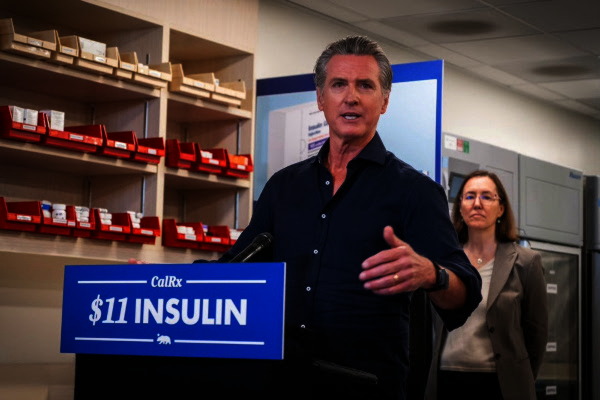
Gov. Gavin Newsom announces the availability of affordable insulin for Californians on Thursday, Oct. 16, 2025. Photo courtesy of the Governor’s Office.

California has become the first and only state to contract for its own affordable insulin.

On Thursday, Gov. Gavin Newsom announced that CalRx biosimilar insulin glargine pens will be available to consumers in California beginning Jan. 1, 2026.

“This launch marks a significant step in the state's ongoing effort to lower prescription drug prices and improve medication access statewide,” Newsom’s office said.

Through an agreement secured by Civica Rx — a nonprofit generic drug manufacturer — with Biocon Biologics, Californians will have access to an interchangeable biosimilar insulin glargine pen offered under the CalRx brand and pricing. 

“California didn’t wait for the pharmaceutical industry to do the right thing — we took matters into our own hands,” said Newsom. “By beginning the process to manufacture our own insulin and pricing it at a maximum cost of $11 a pen in a five-pack, California and Civica are showing the nation what it looks like to put people over profits. No Californian should ever have to ration insulin or go into debt to stay alive — and I won’t stop until health care costs are crushed for everyone.”

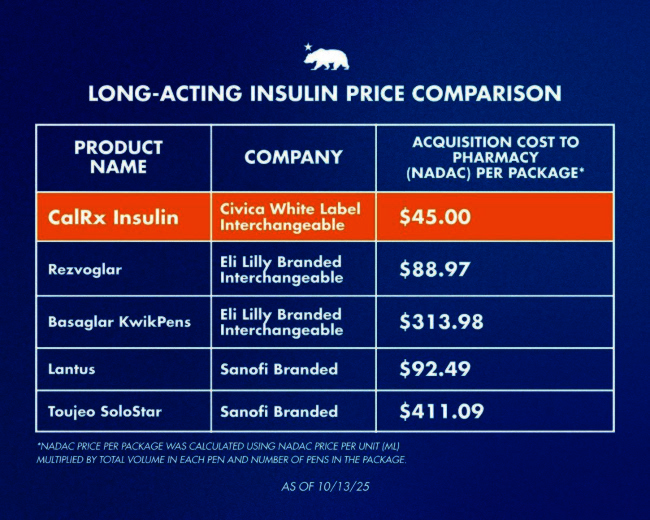
Insulin glargine is a long-acting insulin analog used in the management of diabetes. The CalRx insulin glargine pens are interchangeable with Lantus, which officials said will ensure seamless substitution for patients, and will be available to California pharmacies for $45 and to consumers at a suggested retail price of no more than $55 per five-pack of 3 mL pens — a substantial reduction from current retail market prices.

"We are grateful for the support of the state of California for our effort to bring affordable insulin to all Americans," said Ned McCoy, president and CEO of Civica. "The state shares our vision to ensure a sustainable, quality supply of affordable, essential medicines for people who need them."

“Today’s action marks a significant milestone in California’s ongoing efforts to reduce prescription drug costs," said California Health and Human Services Agency Secretary Kim Johnson on Thursday. “Lowering the cost of insulin moves us closer to a California where no one is forced to choose between their health and their financial stability.”

The insulin glargine pen agreement with Biocon Biologics complements Civica Rx’s broader insulin development strategy. 

Civica Rx continues its ongoing efforts to independently produce interchangeable biosimilar versions of insulin glargine and rapid-acting insulin under the CalRx label, further solidifying a reliable and affordable insulin supply for Californians.

“California is taking action to tackle the insulin affordability crisis," said Elizabeth Landsberg, director of the Department of Health Care Access and Information, or HCAI. "We’re committed to transparent pricing, eliminating hidden costs, and ensuring equitable medication access for uninsured, underinsured, and vulnerable residents across our state."

“In a moment where inflation is spiking everyday prices for Californians and our health care system is under attack in the form of Medicaid cuts from H.R. 1, a lower cost insulin will bring much needed relief both to California pocketbooks and our state budget,” said member Chris Noble, Health Access California’s organizing director and member of the CalRx Insulin Patient Advisory Council. “California consumers need relief now, so as a person dependent on insulin to live and a health care advocate, I’m relieved to see CalRx moving quickly to lower insulin costs for the people of California while continuing to pursue other needed prescription drug cost solutions.”

“California’s continued leadership in tackling insulin’s broken market is a promising step forward,” said Allison Hardt, T1 International’s Community Development director and member of the CalRx Advisory Council. “We celebrate progress that puts patients first and secures insulin at a stable, transparent price while encouraging bold next steps toward true public manufacturing — for people, not for profit.”

CalRx initiative

The launch of CalRx-branded insulin is part of a broader strategy of the governor’s first executive order in 2019 to lower prescription drug costs and ensure fair and transparent pricing is accessible to all Californians. 

To date, no other state has taken action to procure its own affordable medication available for purchase to the public to compete with market-priced products.

Thursday’s announcement builds on the successes of the CalRx Naloxone Access Initiative, which has successfully driven down the market price of naloxone, saving consumers money and helping the state purchase more of this life-saving medication to reverse opioid overdoses. 

The CalRx program continues to identify opportunities to make drugs more affordable and accessible in California. 

Newsom recently signed significant legislation advancing health care affordability by lowering the cost of prescription drugs, including:

SB 40, capping consumer cost-sharing for insulin at $35 for a month-long supply. 

SB 41, reducing prescription drug prices by regulating the practices of pharmacy benefit managers (PBMs), which negotiate prices between drug manufacturers, health care insurance providers, and pharmacies.

Since his first executive order in 2019, Governor Newsom has prioritized making health care more affordable to ensure that families do not have to pick between purchasing medications or having food on the table.

For more information on CalRx insulin, visit CalRx Biosimilar Insulin Initiative.

Clearlake Animal Control: ‘Mona Lisa’ and the dogs

Details
Written by: Elizabeth Larson
Published: 17 October 2025
“Mona Lisa.” Photo courtesy of Clearlake Animal Control.

CLEARLAKE, Calif. — Clearlake Animal Control has dozens of dogs needing new homes this week.

The shelter has 46 adoptable dogs listed on its website.

This week’s dogs include “Mona Lisa,” a female American pit bull terrier mix with a brown and white coat. 

The shelter is located at 6820 Old Highway 53. It’s open from 9 a.m. to 6 p.m. Tuesday through Saturday. 

For more information, call the shelter at 707-762-6227, email This email address is being protected from spambots. You need JavaScript enabled to view it. or visit Clearlake’s adoptable dogs here.

This week’s adoptable dogs are featured below.

Email Elizabeth Larson at This email address is being protected from spambots. You need JavaScript enabled to view it.. Follow her on Twitter, @ERLarson, and on Bluesky, @erlarson.bsky.social. Find Lake County News on the following platforms: Facebook, @LakeCoNews; X, @LakeCoNews; Threads, @lakeconews, and on Bluesky, @lakeconews.bsky.social. 

  1. Why countries struggle to quit fossil fuels, despite higher costs and 30 years of climate talks and treaties
  2. Annual Lake County Health & Wellness Expo takes place Oct. 18
  3. Governor signs McGuire bill to increase access to maternal care in rural communities
  • 126
  • 127
  • 128
  • 129
  • 130
  • 131
  • 132
  • 133
  • 134
  • 135
How to resolve AdBlock issue?
Refresh this page