 How to resolve AdBlock issue?
News
- Details
- Written by: CITY OF LAKEPORT
The deadline to apply is Monday, Nov. 28, at 5 p.m.
The city invites applications for the following committees and commissions:
• Lakeport Planning Commission;
• Measure Z Advisory Committee; and
• the Lakeport Economic Development Advisory Committee.
The city is also recruiting one appointee to the Lakeport Fire Protection District.
All appointments are effective Jan. 1, 2023.
Interested persons are invited to submit a commission-committee application, which can be found online at www.cityoflakeport.com on the Committees and Commissions page.
The applications will be distributed to the City Council for review and interviews will be held on Dec. 12 and 13.
For additional information, please contact Deputy City Clerk Hilary Britton at 707-263-5615, Extension 102, or by email at
- Details
- Written by: LAKE COUNTY NEWS REPORTS
The group will meet at 5 p.m. via Zoom and at Lakeport City Hall, 255 Park St. The public is invited to attend.
The meeting ID is 999 3833 2870, pass code is 336698. The meeting also can be accessed via phone at 1-669-900-6833.
On the agenda is the Scotts Creek maintenance project, the city of Lakeport’s South Main Street annexation and its drought mitigation plan meeting, the South Cow Mountain Management Area implementation plan and the Multi-Tribal Fire Prevention Grant application.
In other business, there will be discussion about new use permits, consideration of Assembly Bill 361 authorizing teleconference meetings during state of emergency, a discussion about amending bylaws regarding how and where meetings are held and posting of notice and agendas, and a request to consider the Board of Supervisors stagger two year terms for council members as provided by the council bylaws.
The group also will discuss a draft letter to the Board of Supervisors asking for a request to be made to Congressman Mike Thompson to seek funding from the Bureau of Land Management Commissioner in Washington, D.C. to maintain lower Scotts Creek, the main tributary into Clear Lake.
There also will be reports from the Scotts Valley Groundwater Protection Committee and the Scotts Valley Firewise Committee.
The group will next meet on Jan. 23.
- Details
- Written by: Janine Smith-Citron

KELSEYVILLE, Calif. — The fourth annual Festival of Trees, a benefit for Hospice Services of Lake County, will be held on Saturday, Dec. 3.
The event returns to a magical venue at Sophie’s Day Spa, 3855 Main St.
The Festival of Trees Spectacular Party and live auction features 25 exquisite Christmas trees designed and donated by community members.
Proceeds from the live and silent auctions will support the Wings of Hope grief counseling program for children and families and special needs of hospice patients throughout our Lake County community.
The public is invited to preview decorated trees at no charge on Friday, Dec. 2, from 4 to 8:30 p.m., before and after the Kelseyville Christmas in the Country & Parade of Lights.
Tickets for Saturday’s Festival of Trees are available and may be purchased at www.lakecountyhospice.org or by calling 707-263-6222.
The event begins at 5:30 p.m. with savories and sweets on small plates prepared by a variety of local chefs, bakers and restaurants. A no host bar providing local wines and beer will be available throughout the evening.
Lake County Sheriff Brian Martin will delight the audience with his talents as auctioneer and Jennifer Strong of Strong Financial Services, a passionate Hospice Services supporter, will serve as mistress of ceremonies.
Manager of the Funky Dozen Larry Thompson will queue up lively dance music immediately following the auction.
“We are excited to kick off the holiday season with the spectacular party atmosphere of the Festival of Trees 2022,” said interim Hospice Services Executive Director Hope Moroni. “This event facilitates the coming together of individuals during a traditionally giving time of year in support of the highly valuable services Hospice Services provides in our community.”
The success of Festival of Trees is made possible largely in part by several community sponsors including Platinum Sponsors Lake County Tribal Health Consortium, Michaels Insurance Services, Calpine Corp., Savings Bank of Mendocino, Roto-Rooter of Lake County, California Exterminators, Adventist Health Clearlake and Kelly Butcher.
Other sponsors include the UPS Store, Twin Pine Casino and Hotel, Lake Pharmacy, Tomkins Tax Associates, Cats Paw Vineyards, High County Security, Roland and Nell Shaul, Jonas Energy Solutions, Chapel of the Lakes and Sutter Lakeside Hospital.
Hospice Services of Lake County has been providing compassionate comfort care to Lake County residents for over 44 years, promoting quality of life when families need it the most.
The Wings of Hope program provides grief counseling for children who have experienced the death of a loved one.
Community members are encouraged to learn how our compassionate team can assist you and your loved ones. Call 707-263-6222 or visit Hospice Services of Lake County, 1862 Parallel Drive, Lakeport.
Additional information is also available on Hospice Services of Lake County’s website.
Janine Smith-Citron is director of development for Hospice Services of Lake County.
- Details
- Written by: Mneesha Gellman, Emerson College
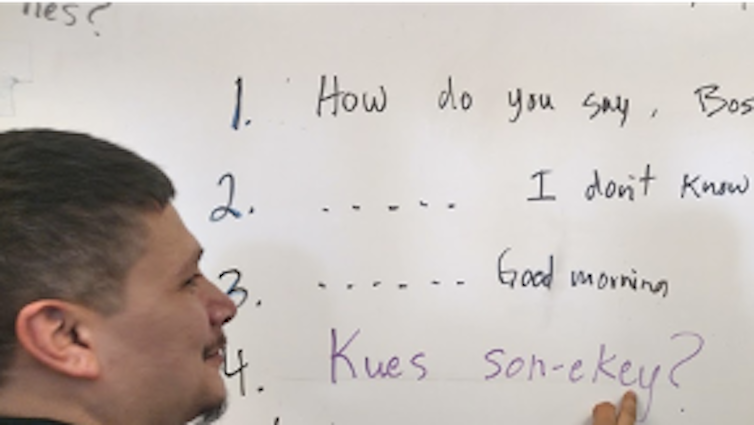
Whenever November would roll around, James Gensaw, a Yurok language high school teacher in far northern California, would get a request from a school administrator. They would always ask him to bring students from the Native American Club, which he advises, to demonstrate Yurok dancing on the high school quad at lunch time.
“On the one hand, it was nice that the school wanted to have us share our culture,” Gensaw told me during an interview. “On the other, it wasn’t always respectful. Some kids would make fun of the Native American dancers, mimicking war cries and calling out ‘chief.’”
“The media would be invited to come cover the dancing as part of their Thanksgiving coverage, and it felt like we were a spectacle,” he continued. “Other cultural groups and issues would sometimes be presented in school assemblies, in the gym, where teachers monitored student behavior. I thought, why didn’t we get to have that? We needed more respect for sharing our culture.” James Gensaw’s work in California’s public high schools as a Yurok language teacher and mentor to Native American students is part of a reckoning with equity and justice in schools.
Yurok language in schools
Tribal officials say Gensaw is one of 16 advanced-level Yurok language-keepers alive today. An enrolled Yurok tribal member, Gensaw is also part of the tribe’s Yurok Language Program, which is at the forefront of efforts to keep the Yurok language alive.
Today, the Yurok language is offered as an elective at four high schools in far northern California. The classes meet language instruction requirements for admission to University of California and California State University systems.
Yurok language classes are also offered in local Head Start preschool programs as well as in some K-8 schools when there is teacher availability, and at the College of the Redwoods, the regional community college. To date, eight high school seniors have been awarded California’s State Seal of Biliteracy in Yurok, a prestigious accomplishment that signifies commitment to and competency in the language.
When I started researching the effects of Yurok language access on young people in 2016, there were approximately 12 advanced-level speakers, according to the Yurok Language Program. The 16 advanced-level speakers in 2022 represent a growing speaker base and they are something to celebrate. Despite colonization and attempts to eradicate the Yurok language by interrupting the transfer of language from parents to their children, Yurok speakers are still here.
Throughout the 19th and 20th centuries, boarding schools in the United States operated as spaces for what I refer to as “culturecide” — the killing of culture — in my latest book, “Indigenous Language Politics in the Schoolroom: Cultural Survival in Mexico and the United States.” Students in both the United States and Mexico were often made to attend schools where they were beaten for speaking Indigenous languages. Now, new generations are being encouraged to sign up to study the same language many of their grandparents and great-grandparents were forced to forget.
Language as resistance
The Yurok Tribe made the decision years ago to prioritize growing the number of Yurok speakers and as part of that, to teach Yurok to anyone who wanted to learn. They have many online resources that are open for all. Victoria Carlson is the Yurok Language Program Manager and a language-keeper herself. She is teaching Yurok to her children as a first language, and she drives long distances to teach the language at schools throughout Humboldt and Del Norte counties.
“When we speak Yurok, we are saying that we are still here,” Carson said in an interview with me, echoing a sentiment that many Yurok students relayed to me as well. “Speaking our language is a form of resisting all things that have been done to our people.”
The students in Mr. Gensaw’s classes are majority, but not exclusively, Native American. Through my research I learned that there are white students who sign up out of interest or because nothing else fit in their schedule. There are Asian American students who wish that Hmong or Mandarin was a language option, but they take Yurok since it is the most unique language choice available. And there are Latinx students who already are bilingual in English and Spanish and who want to challenge themselves linguistically.
In my book and related publications, I document how access to Indigenous languages in school benefits different groups of students in a range of ways. Heritage-speakers — those who have family members who speak the language — get to shine in the classroom as people with authority over the content, something that many Native American students struggle with in other classes. White students have their eyes opened to Native presence that is sorely missing when they study the Gold Rush, Spanish missionaries in California, or other standard topics of K-12 education that are taught from a colonizing perspective. And students from non-heritage minority backgrounds report an increased interest in their own identities. They often go to elders to learn some of their own family languages after being inspired that such knowledge is worth being proud of.
Bringing languages like Yurok into schools that are still, as historian Donald Yacovone points out, dominated by white supremacist content, does not in and of itself undo the effects of colonization. Getting rid of curricula that teach the Doctrine of Discovery – the notion that colonizers “discovered” the Americas and had a legal right to it – is a long-term process. But placing Native American languages into public schools both affirms the validity of Indigenous cultural knowledge and also asserts the contemporary existence of Native people at the same time. It is a place to start.
One step at a time
In my experience, as a researcher on education policy and democracy, I have found that putting more culturally diverse courses in school is something that better prepares young people to learn how to interact in healthy ways with people who are different from themselves.
Gensaw, the Yurok language teacher, is at the forefront of this. One year when he was again asked if he could bring the students to dance around Thanksgiving time, he said yes, but not on the quad. He requested a school assembly space where student behavior could be monitored. The school said yes, and the students danced without being demeaned by their peers. These steps are just the beginning of what it takes to undo the effects of colonization.
Mneesha Gellman, Associate Professor of Political Science, Emerson College
This article is republished from The Conversation under a Creative Commons license. Read the original article.