 How to resolve AdBlock issue?
News
- Details
- Written by: Eric Hittinger, Rochester Institute of Technology; Eric Williams, Rochester Institute of Technology; Qing Miao, Rochester Institute of Technology, and Tiruwork B. Tibebu, Rochester Institute of Technology

The planet is heating up as greenhouse gas emissions rise, contributing to extreme heat waves and once-unimaginable flooding. Yet despite the risks, countries’ policies are not on track to keep global warming in check.
The problem isn’t a lack of technology. The International Energy Agency recently released a detailed analysis of the clean energy technology needed to lower greenhouse gas emissions to net zero globally by 2050. What’s needed, the IEA says, is significant government support to boost solar and wind power, electric vehicles, heat pumps and a variety of other technologies for a rapid energy transition.
One politically popular tool for providing that government support is the subsidy. The U.S. government’s new Inflation Reduction Act is a multibillion-dollar example, packed with financial incentives to encourage people to buy electric vehicles, solar panels and more.
But just how big do governments’ clean energy subsidies need to be to meet their goals, and how long are they needed?
Our research points to three important answers for any government considering clean energy subsidies – and for citizens keeping an eye on their progress.
Why subsidize at all?
An obvious first question is: Why should governments subsidize clean energy at all?
The most direct answer is that clean energy helps to reduce harmful emissions – both of gases that cause local pollution and of those that warm the planet.
Reducing emissions helps to lower both public health costs and damage from climate change, which justifies government spending. Reports have estimated that the U.S. spends US$820 billion a year just on health costs associated with air pollution and climate change. Globally, the World Health Organization estimated that the costs reached $5.1 trillion in 2018. Taxing and regulating polluting industries can also cut emissions, but carrots are often more politically popular than sticks.
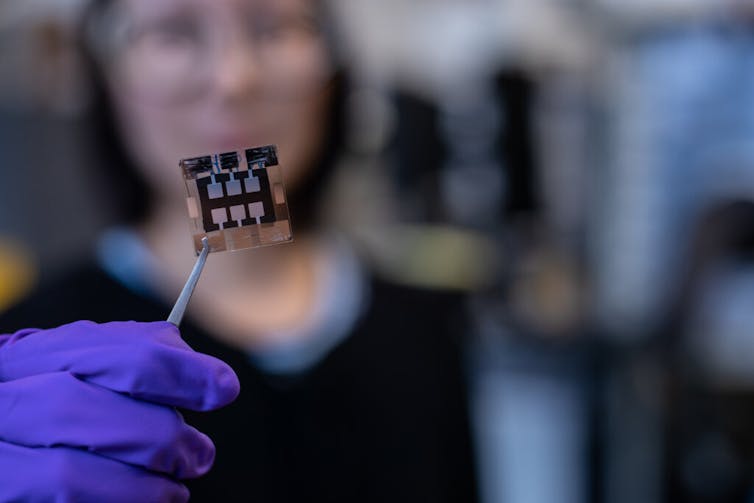
A less obvious reason for subsidies is that government support can help a new and initially expensive technology become competitive in the market.
Governments have been central to the development of many technologies that are pervasive today, including microchips, the internet, solar panels and GPS. Microchips were fantastically expensive when first developed in the 1950s. Demand from the U.S. military and NASA, which could pay the high price, fueled the growth of the industry, and costs eventually dropped enough that they’re now found in everything from cars to toasters.
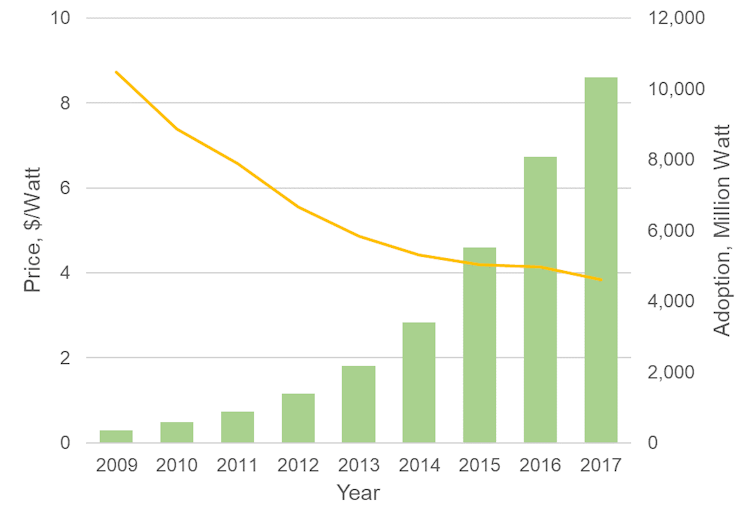
Government support has also helped to bring down the cost of solar power. Rooftop solar system costs fell 64% from 2010 to 2020 in the U.S. because cells became more efficient and higher volumes drove prices down.
How much money?
So, subsidies can work, but what’s the right amount?
Too low, and a subsidy has no effect. Giving everyone a coupon for $1 off an electric car won’t change anyone’s buying plans. But subsidies can also be set too high.
The government doesn’t need to spend money persuading consumers who already plan to buy an electric car and can afford one, yet studies show clean energy subsidies disproportionately go to richer people. When people who would have purchased the item anyway receive subsidies, they’re known as “free riders.”
The ideal subsidy attracts new buyers while avoiding free riders and overspending on people who are already convinced. The subsidy can only work when it convinces a previously uninterested consumer to buy a product.
How long should subsidies last?
Timing is also important when thinking about the size of subsidies. When a promising technology is new and expensive, free riders are less of an issue. A large subsidy may be needed to attract even a few buyers, build out the emerging market and support the industry’s growth.
Solar power is a good example: In 2005, solar was several times more expensive than traditional electricity sources. Subsidies, like the 30% Investment Tax Credit established that year, helped lower the cost, and today’s solar is about one-tenth the price and cost-competitive with other electricity sources.
Once a clean technology is competitive, subsidies can still play an important role in speeding up the energy transition, but at a lower level than in the past.
In our research on residential solar panels, we estimate that the ideal subsidy for rooftop solar should have been initially higher than the actual federal tax credit but fall more quickly, declining to zero after 14 years from its start date.
By starting the subsidy about 20% higher, our models found that it would have boosted production faster, which would cut costs faster and reduce the need for high future subsidies.
Should subsidies eventually disappear?
It makes sense for subsidies to disappear altogether once a technology is sufficiently cost-competitive. However, even if a technology is competitive, it might be worth further subsidy if the speed of adoption is important.
The argument for continuing a subsidy depends on whether the additional adoption it stimulates is cost-effective in reducing emissions. Wind power is cheaper than fossil fuel power in many parts of the country. Even so, we found that continuing subsidies for wind power would lead to valuable emission benefits.
That said, sometimes subsidies stick around when they shouldn’t.
Fossil fuels have been heavily subsidized for decades, despite their harm to human health, the environment and the climate, all of which raise public costs. Governments globally spent almost $700 billion on fossil fuel subsidies in 2021. The U.S. government, in recent years, has spent more on renewable energy tax credits than fossil fuels, which is a promising transition of government support.
Global impact
While the U.S. was the focus of our solar subsidy research, this way of thinking – balancing the costs and benefits of subsidies – can be applied in other nations to design better subsidies for clean energy technologies.
The subsidy is just one policy tool, but it is an important one for both stimulating early-stage technologies and accelerating deployment of more competitive options. As the world attempts the fastest energy transition in history, today’s energy subsidy decisions will affect its ability to succeed.
Eric Hittinger, Associate Professor of Public Policy, Rochester Institute of Technology; Eric Williams, Professor of Sustainability, Rochester Institute of Technology; Qing Miao, Associate Professor of Public Policy, Rochester Institute of Technology, and Tiruwork B. Tibebu, Ph.D. Student, Rochester Institute of Technology
This article is republished from The Conversation under a Creative Commons license. Read the original article.
- Details
- Written by: Elizabeth Larson
Call Lake County Animal Care and Control at 707-263-0278 or visit the shelter online at http://www.co.lake.ca.us/Government/Directory/Animal_Care_And_Control.htm for information on visiting or adopting.
The following cats at the shelter have been cleared for adoption.

Male domestic shorthair
This 3-year-old male domestic shorthair cat has an orange tabby coat.
“This guy can be shy at first, but once he knows that you are all about the pets, he will roll right over and start his purr machine. He has a unique curly tail which he flicks around when curious,” shelter staff said.
He is in cat room kennel No. 13, ID No. LCAC-A-4021.

Male domestic shorthair
This 8-year-old male domestic shorthair cat has an orange tabby coat.
He is in cat room kennel No. 47, ID No. LCAC-A-4319.

‘Sampson’
“Sampson” is a male domestic shorthair with a black coat.
He is in cat room kennel No. 77, ID No. LCAC-A-4317.
Email Elizabeth Larson at
- Details
- Written by: Angela De Palma-Dow

Dear Readers,
There is no question and answer for today’s Lady of the Lake, rather I will be providing some important information about an upcoming open house for the Blue Ribbon Committee for the Rehabilitation of Clear Lake.
If you live on or near Clear Lake, get your drinking water from the lake, use the lake for recreation or business, or just care about water quality and quantity issues, then you will want to know about the Blue Ribbon Committee and the projects the committee is funding, so you understand the future of water resources in Lake County. If you are just a concerned community member, or have an interest in natural resources, this committee — and the upcoming open house — will be of interest to you too.
As a lake lover, and with my day job working on water resource programs and projects, I am thankful for the Blue Ribbon Committee. The Blue Ribbon Committee has been essential in bringing much needed research, planning, and financial resources to the local lake community. Additionally, the monthly subcommittee and quarterly meetings have been a gathering place for much needed information, technology, and education, to those working on lake projects and in water resource research and management.
All BRC meetings and sub committee meetings are publicly accessible online and the meetings agendas and minutes are also always available and accessible at the Natural Resources Agency Blue Ribbon for the Rehabilitation of Clear Lake website.
Lake County News has several articles covering the Blue Ribbon Committee, see the Search results for all Blue Ribbon Committee Lake County News Articles.
As Lady of the Lake, I first covered the Blue Ribbon Committee in a previous two-part columns, you can find them here:
Bemused and Confused about the Blue Ribbon Committee, Part One (Sept. 12, 2021).
More about the Blue Ribbon Committee, Part Two (Sept. 19, 2021).
Previous Lady of the Lake columns cover the formation, purpose, and the 2018-2021 lake and watershed projects that were approved and awarded for funding (~ $5.4 Million). Funding for proposed projects comes from two places; Prop 68 Implementation fund and the Governors General Fund Allocation. Previously approved 2021 projects were funded with about $3M of Prop 68 funds and the rest from General Funds. All project funds are administered by the California Natural Resources Agency or CNRA.
The Blue Ribbon Committee is charged with allocating funding to support projects that will lead to improvements to Clear Lake ecology and economy. These projects start as proposals, brought to the Technical or Socio Economic Sub Committees (of the Blue Ribbon Committee) by any organization that is capable of executing the project.
Proposals can include activities that improve water quality, create or restore habitat, provide or enhance natural resource community education, or anything of a similar nature that can demonstrate that it will lead to an improvement for Clear Lake or the plant, animal, or human communities that depend on the lake.
There is no restriction on the type of organizations that can bring forth a proposal, however the more local and collaborative the organization, and the proposed project itself, the more likely it will receive approval for advancement to the Blue Ribbon Committee at large from the individual sub-committees. The organization of course needs to also be able to enter into and execute a contract agreement with the CNRA.

Upcoming events
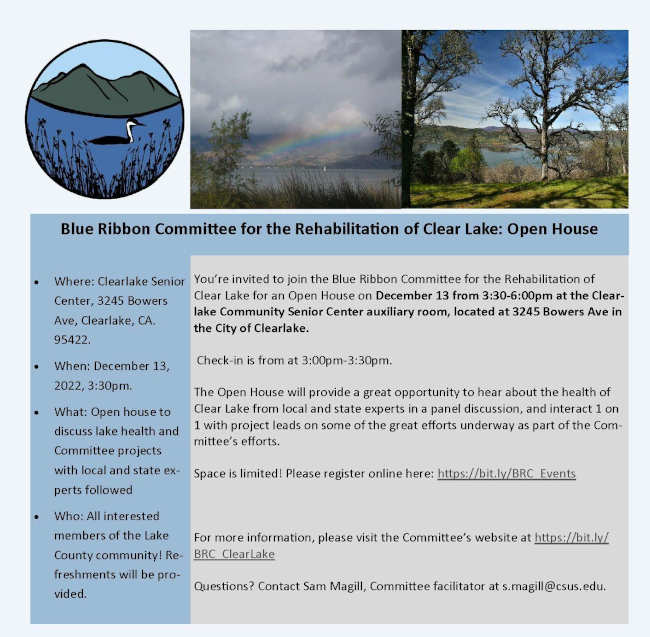
You have a chance to learn about the Blue Ribbon Committee at an open house showcasing some of the Committee’s exciting projects to increase the health of Clear Lake and its communities on Dec. 13 from 3:30 to 6 p.m. at the Clearlake Senior Center, located at 3245 Bowers Ave in the City of Clearlake. Seating is limited, so please reserve your space by registering online here: https://bit.ly/BRC_Events. Additional information is provided in the flier below. Questions? Contact Sam Magill at
If you are unable to attend in person, but would like to join us for the opening presentation, please click on this link to register for the webinar.
The Open House on Dec. 13 will feature some of the in-progress 2020 / 2021 funded projects and organizations:
County of Lake Water Resources Department and Watershed Protection District
• Clear Lake Dilapidated Structure Abatement Project
• Stormwater, Trash Remediation, and Illicit Discharge Project
• Clear Lake Ambient Monthly Monitoring Program
• Clear Lake Community Outreach Survey: Perspectives and Attitudes
Big Valley Band of Pomo Indians, Environmental Department
• Kelsey Creek Fish Ladder Restoration
• Tule Restoration & Primrose removal Project
U.S. Geological Survey
• Mercury Modeling and Clear Lake Tributary modeling & monitoring
UC Davis
• Piloting Environmental Education Resources (UCD Center for Regional Change)
• Citizen and Community Science (UCD Center for Regional Change)
• In-Lake Modeling and Monitoring (UCD Tahoe Environmental Research Center)
Seigler Springs Community Redevelopment Association
• Cobb Mountain Watershed Education Project

Upcoming projects and how to be involved
Below is a list of the 2022 approved projects, and their organization sponsor, approved for funding in 2023. These projects collectively equal about $6.3M, but source of funding for each project (Prop 68 or General Fund) is still being finalized. These projects were proposed, refined, and approved by the Blue Ribbon Committee in 2022.
In-Lake Mercury Modeling — USGS
Airborne Electromagnetic Survey of Lake County Groundwater Basins — County of Lake Water Resources Department
Scotts Valley Aquifer Evaluation — Scotts Valley Band of Pomo Indians of California
Environmental Education Pathways Program — Mendocino Community College
EcoCultural Prescribed Fire & Tule Restoration — Tribal EcoRestortion Alliance
Hypolimnetic Oxygenation Pilot Project- Oaks Arm -UC Davis Tahoe Environmental Research Center
Adobe Creek Hydrology and Groundwater Monitoring — Big Valley Rancheria EPA
Groundwater Dependent Ecosystems and Wetland Restoration Analysis and Implementation — Big Valley EPA
Big Valley HAB and Bank Erosion Pilot Project — Big Valley Rancheria EPA
Web-Based Clearinghouse for Data / Citizen Science App — Big Valley Rancheria EPA
If you want to know more about these projects, and past projects, or meet some of the individuals from the organizations conducting this breadth of work to improve the lake,you can attend the monthly sub-committee meetings, as well as the Dec. 13 Open House. Regular meetings for the Blue Ribbon Committee are still being held remotely via zoom, and facilitated by the Sacramento State Consensus and Collaboration Program.
You can sign up for notices and updates from the Blue Ribbon Committee from their Listserv here.
At any time you wish to know more about the committee, or inquire about submitting a proposal, contact the committee facilitator, Sam Magill at
In addition, should you have specific questions about a project or proposal that is a product of the Blue Ribbon Committee, you can write to me, at
Sincerely,
Lady of the Lake
You can now hear from the Lady on the Lake on local radio, KPFZ 88.1, the last Sunday of every month, during the “Lake County Fire Recovery” and “What’s Next” weekly shows between 2 to 4 p.m.
Angela De Palma-Dow is a limnologist (limnology = study of fresh inland waters) who lives and works in Lake County. Born in Northern California, she has a Master of Science from Michigan State University. She is a Certified Lake Manager from the North American Lake Management Society, or NALMS, and she is the current president/chair of the California chapter of the Society for Freshwater Science. She can be reached at
- Details
- Written by: Elizabeth Larson
“We have quite a few dogs that have been here for 20+ days. These dogs have had little interest for adoption,” the agency reported on its Facebook page.
“In order to help find these dogs new homes for the holidays, we are reducing the adoptions fees down to $30 total to take them home,” Animal Care and Control said in its post.
To view the dogs, visit the shelter website or the Shelter Luv site.
Dogs that are adopted from Lake County Animal Care and Control are either neutered or spayed, microchipped and, if old enough, given a rabies shot and county license before being released to their new owner. License fees do not apply to residents of the cities of Lakeport or Clearlake.
Call Lake County Animal Care and Control at 707-263-0278, visit the shelter online for information on visiting or adopting, or go to the shelter at 4949 Helbush Drive in Lakeport to fill out an application.
The following dogs are available for the $30 fee.

Female pit bull terrier
This 9-month-old female pit bull terrier has a short gray coat.
She is in kennel No. 7, ID No. LCAC-A-4213.

‘Arlo’
“Arlo” is a 3-year-old male basset hound-Labrador retriever mix with a short brown coat.
He is in kennel No. 9, ID No. LCAC-A-4164.

Female Labrador retriever
This 3-month-old female Labrador retriever has a short black coat.
She is in kennel No. 13, ID No. LCAC-A-4162.

Male Labrador retriever
This 2-year-old male Labrador retriever has a short black coat.
He is in kennel No. 14, ID No. LCAC-A-4112.

Male pit bull terrier puppy
This 3-month-old pit bull terrier puppy has a short white coat with gray markings.
He is in kennel No. 23c, ID No. LCAC-A-4120.

Female pit bull
This 1 and a half year old female pit bull has a short brown coat with white markings.
She is in kennel No. 25, ID No. LCAC-A-4217.
Email Elizabeth Larson at