 How to resolve AdBlock issue?
News
- Details
- Written by: LAKE COUNTY NEWS REPORTS
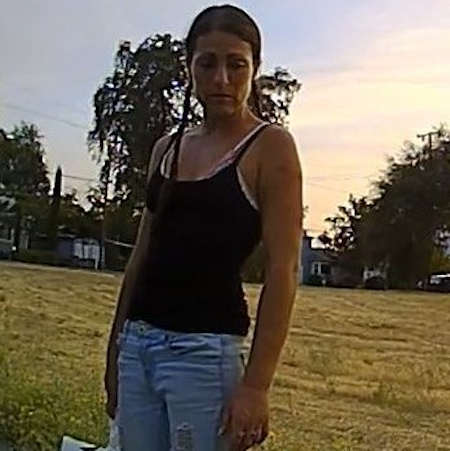
LAKE COUNTY, Calif. — The Lakeport Police Department is asking for the community’s help in its effort to locate a woman reported missing in the fall.
The Lakeport Police Department said it is investigating the disappearance of Lien Merry Lloyd, 33. Her first name is pronounced “Lee-Ann.”
Lloyd’s mother contacted Lakeport Police on Oct. 6 to file a missing person report on her, telling police that she was last aware of her daughter being in Lakeport in July.
In August and September, the Lakeport Police Department had enforcement contacts with Lloyd.
At the time of the original report Lloyd was entered into the National Missing and Unidentified Persons System, which will trigger a notification to Lakeport Police should any other law enforcement agency run her in the National Crime Information System, which is a standard practice.
Lloyd is a white female, 5 feet 2 inches tall and 130 pounds, with brown hair and brown eyes.
She is reported to have a tattoo of a bird on either her right arm or right ankle.
“We are currently following some leads but have not located Lloyd,” the police department said.
Anyone who may have information on Lloyd’s whereabouts or who she may have been associated with dating back to July of 2022 is asked to contact Officer Katie Morfin by email at
You can also submit information anonymously by texting the words TIP LAKEPORT followed by your message to 888777.
- Details
- Written by: LAKE COUNTY NEWS REPORTS

LAKE COUNTY, Calif. — An important new project in the city of Clearlake has received support courtesy of the annual Wine Auction.
On Thursday, the city of Clearlake received a $10,000 donation from the Lake County Wine Alliance to support the Clearlake Youth Center remodel project.
Since taking over the Clearlake Youth Center in October, city staff have been working on an extensive remodel, including replacing kitchen equipment, and replacing flooring, painting, and all-new activity equipment.
Once the Clearlake Youth Center remodel is completed, the creation of such programs like summer and day camps, youth classes, will be held at this facility.
The Clearlake Youth Center will also be available for youth event rentals.
All proceeds from events such as Breakfast with Santa, Bunny Brunch, comedy show fundraiser, and Movies in the Park goes directly to creating and maintaining the youth programs.
A portion of the building also will be used for a daycare for the children of Konocti Unified School District staff and city employees.
“The city is honored to receive these funds from the Lake County Wine Alliance, and we are extremely grateful for the assistance in getting this building and our youth programs up and running again. Our kids need it. A special thanks to Marie Beery for thinking of us and all her support for community programs,” said City Manager Alan Flora.
The check was delivered to city’s Recreation and Events Coordinator Tina Viramontes at the Saw Shop on Thursday.
Weston Seifert, owner of the Saw Shop, is the Lake County restaurant chairperson, and the Saw Shop catered the dinner for the 2022 Wine Auction.
- Details
- Written by: Elizabeth Larson
The board will meet beginning at 1 p.m. Friday, Jan. 13, in the board chambers on the first floor of the Lake County Courthouse, 255 N. Forbes St., Lakeport.
The meeting can be watched live on Channel 8, online at https://countyoflake.legistar.com/Calendar.aspx and on the county’s Facebook page. Accompanying board documents, the agenda and archived board meeting videos also are available at that link.
To participate in real-time, join the Zoom meeting by clicking this link.
The meeting ID is 924 1464 6983, pass code 216475. The meeting also can be accessed via one tap mobile at +16699006833,,92414646983#,,,,*216475#.
All interested members of the public that do not have internet access or a Mediacom cable subscription are encouraged to call 669-900-6833, and enter the Zoom meeting ID and pass code information above.
To submit a written comment on any agenda item visit https://countyoflake.legistar.com/Calendar.aspx and click on the eComment feature linked to
the meeting date. If a comment is submitted after the meeting begins, it may not be read during the meeting but will become a part of the record.
On Friday afternoon the board, sitting as the Lake County Housing Commission, will hear a presentation describing the financing and funding sources and relative positions of the lienholders for the Collier Avenue Affording Housing Project, also referred to in county documents as the No Place Like Home Permanent Supportive Housing Project.
The project will be located on 3.3 acres at 6853 Collier Ave. in Nice.
The Rural Communities Housing Development Corp., or RCHDC, based in Ukiah, will develop the affordable housing project, which will serve low income or very low income households meeting the definition of mental disorder, substance substance use disorder or at risk of homelessness.
It will consist of 40 units, most one- and two-bedroom apartments with one unit set aside for a manager.
RCHDC previously reported that 49% of the units are set aside for clients suffering with serious mental illness and those who are at risk of homelessness, who are clients of Behavioral Health Services.
County documents explain that the project will house adults 18 years and older with a “serious mental disorder” as defined by the California Code, Welfare and Institutions Code. Under that code, serious mental disorders include bipolar, post-traumatic stress disorder, schizophrenia, major affective disorders or other severely disabling mental disorders.
As part of the discussion, the board will consider a host of final agreements for the project. In his report to the board Behavioral Health Services Director Todd Metcalf, whose department would refer clients to the project for housing, said the documents “represent the final step in executing the Collier Avenue Housing project, prior to breaking ground.”
In other business on Friday, Sheriff Rob Howe is asking the board to ratify the proclamation of the existence of a local emergency due to the atmospheric river event that Howe signed on Thursday.
The proclamation notes that the atmospheric river event began on Jan. 4 and that, as a result, a local emergency now exists throughout Lake County.
Email Elizabeth Larson at
- Details
- Written by: Stacy Morford, The Conversation
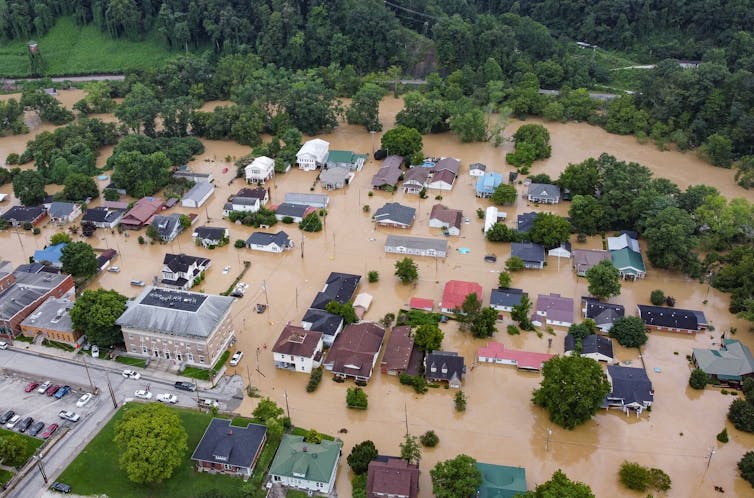
U.S. weather disasters are getting costlier as more people move into vulnerable areas and climate change raises the risks of extreme heat and rainfall, the National Oceanic and Atmospheric Administration warned as it released its annual billion-dollar disasters report on Jan. 10, 2023.
Even with an average hurricane season, 2022 had the third-highest number of billion-dollar disasters in the U.S. since 1980.
In all, 18 disasters each caused more than US$1 billion in damage. The list included three hurricanes, two tornado outbreaks, a destructive fire season, several extreme storms and a drought that disrupted sectors across the economy.
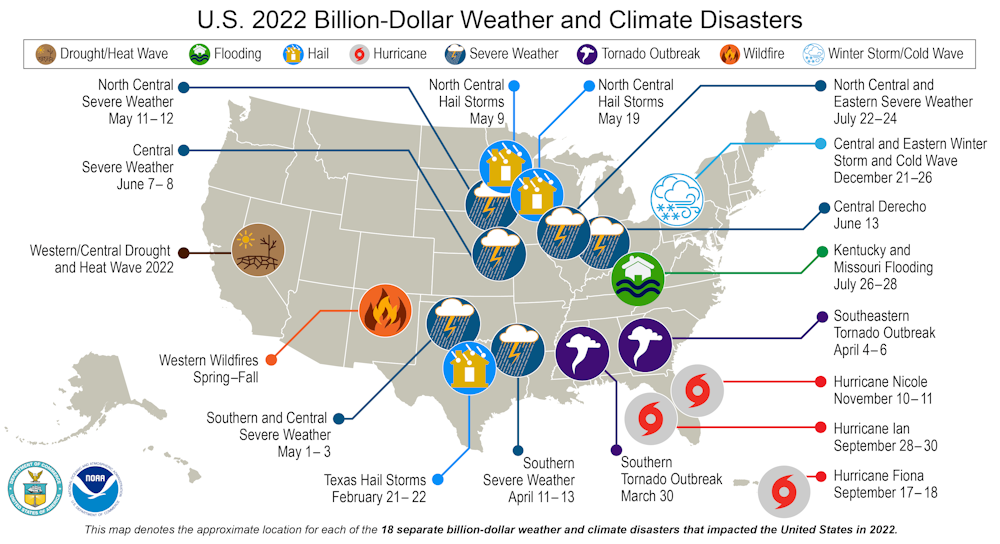
It was also the third-costliest year, compared to past years adjusted for inflation, due primarily to Hurricane Ian’s widespread damage in Florida. Together, the 2022 disasters topped $165 billion, not counting the damage still being tallied from December’s winter storms.
Several scientists wrote about the year’s weather disasters and connections to climate change. Here are three essential reads from The Conversation’s archive:
1. Hurricane Ian
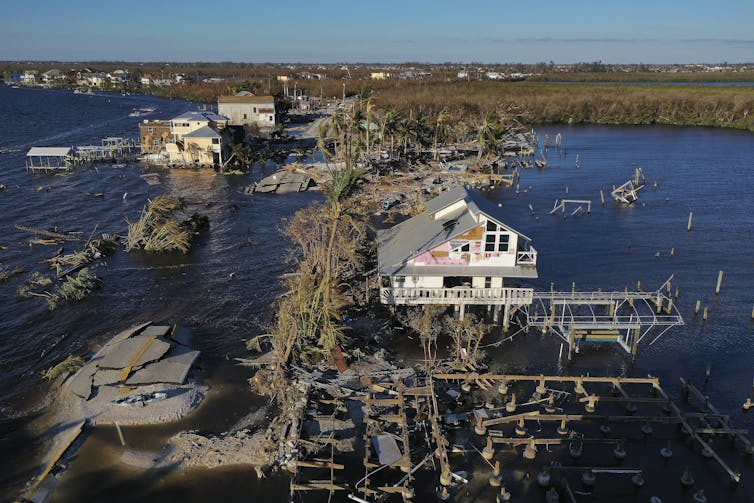
The most expensive U.S. weather disaster of 2022 was Hurricane Ian, which grew into a monster of a storm over the warm waters of the Gulf of Mexico in late September.
Ian hit the barriers islands off Fort Myers, Florida, with 150-mph sustained winds, tying for the fifth-strongest wind speed at U.S. landfall on record. Its storm surge swept through coastal neighborhoods, where the population has boomed in recent years, and its rainfall deluged a large swath of the state. Twenty inches of rain fell in Daytona Beach, triggering erosion with devastating consequences.
At least 144 deaths were attributed to the storm in Florida alone, and the total damage neared $113 billion.
Did global warming play a role?
In some ways, yes, but there are still a lot of unknowns when it comes to hurricanes, explained climate scientists Matthew Barlow of UMass-Lowell and Suzana Camargo of Columbia University.
For example, “it is clear that climate change increases the upper limit on hurricane strength and rain rate, and that it also raises the average sea level and therefore storm surge,” Barlow and Camargo wrote.
Less clear is global warming’s influence on hurricane frequency, though research points to an uptick in the strength of storms that do form. “We expect more of them to be major storms,” Barlow and Camargo wrote. “Hurricane Ian and other recent storms, including the 2020 Atlantic season, provide a picture of what that can look like.”
2. The drought
The second-costliest disaster, at over $22 billion, was the widespread drought across much of the U.S. West and parts of the Midwest. It left reservoirs near record lows, disrupted farming in several states and temporarily shut down barge traffic on the Mississippi River.
At one point, 2,000 barges were backed up along the river, where 92% of U.S. agriculture exports travel.
Rivers the size of the Mississippi can be slow to respond to droughts, but during the flash drought of 2022, the river fell 20 feet in less than three months – even though its major tributaries were flowing at normal levels, wrote earth scientists Ray Lombardi, Angela Antipova and Dorian Burnette of the University of Memphis.
They described the dramatic drop in the river’s water levels as a “preview of a climate-altered future.”
“Warmer atmospheric temperatures have the potential to evaporate more water, causing drought, and to hold more water, causing extreme rainfall,” the scientists wrote. “Over the past 100 years, year-to-year changes from very dry to very wet in the Mississippi River Valley have become more frequent. We expect this trend to continue as global temperatures continue to rise because of climate change.”
3. Extreme storms and flooding
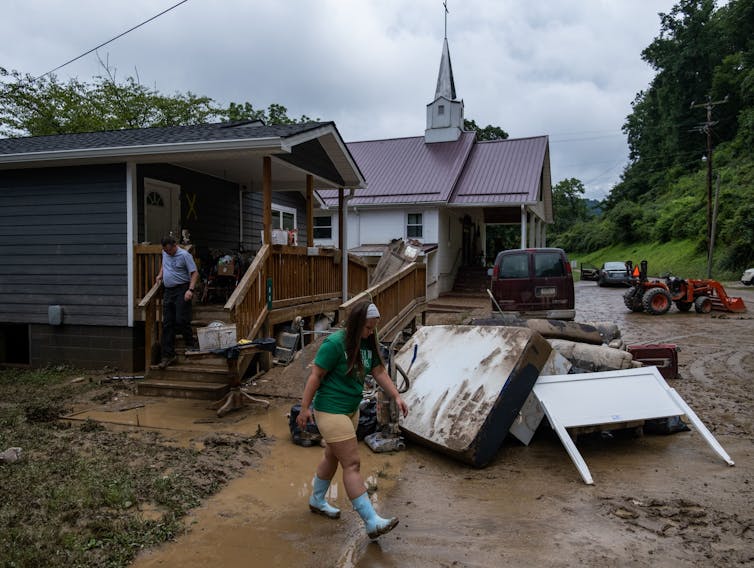
Many of 2022’s billion-dollar disasters involved extreme storms, including hail, tornadoes, and a derecho that damaged power lines from Wisconsin to West Virginia.
It was also a summer of flooding, beginning with rain falling on snow that turned the Yellowstone River into a record-shattering torrent. St. Louis, Dallas, eastern Kentucky, southern Illinois and Death Valley were all hit with 1,000-year floods. Storms in the South knocked out Jackson, Mississippi’s fragile water supply for weeks.
Climate models have consistently shown that extreme rainfall events will become more common as the climate warms, wrote University of Dayton climate scientist Shuang-Ye Wu.
Some of that is basic physics – warmer air increases the amount of moisture that the atmosphere can hold by about 7% per degree Celsius. Increased humidity can enhance latent heat in storms, increasing their intensity and leading to heavier rainfall, Wu explained.
Even though humans are becoming more adept at managing climate risks, research published in 2022 found that extreme flooding and droughts are still getting deadlier and more expensive, and the costs are likely to continue to rise.
“This past summer might just provide a glimpse of our near future as these extreme climate events become more frequent,” Wu wrote. “To say this is the new ‘normal,’ though, is misleading. It suggests that we have reached a new stable state, and that is far from the truth.”
This is a roundup of articles from The Conversation’s archives.
Stacy Morford, Environment + Climate Editor, The Conversation
This article is republished from The Conversation under a Creative Commons license. Read the original article.