 How to resolve AdBlock issue?
News
- Details
- Written by: Erin Schneider and Tim J. Marshall
Nearly 51% of the U.S. population age 16 and over, or 124.7 million people, informally helped their neighbors between September 2020 and 2021 at the height of the pandemic, according to the latest Volunteering and Civic Life in America research.
In response to a separate question, more than 23% of people in that age group, or 60.7 million, said they formally volunteered through an organization during the same period.
Conducted by the U.S. Census Bureau and AmeriCorps, the 2021 data show trends in formal volunteering, informal helping, and other civic behaviors nationally, at the state level, and within the 12 largest metro areas.
The research, released every two years, shows that those who formally volunteered gave more than 4.1 billion hours of service with an estimated economic value of $122.9 billion.
The 2021 Civic Engagement and Volunteering Supplement is the most comprehensive data on U.S. volunteering and civic engagement assembled.
The research reveals that despite the devastating impact of the COVID-19 pandemic, the U.S. population continued to serve each other and their communities — giving their time and talent to help others at a time of unprecedented need.
They helped neighbors by doing favors like watching each other’s children, running errands, and other activities to lend a hand.
People also found new ways to help their communities during the pandemic by supporting COVID-19 testing, immunization and other public health efforts; conducting wellness checks on isolated seniors; supporting food banks; and providing virtual tutoring and mentoring to help students stay on track in school.
2021 Civic Engagement and Volunteering Supplement
The goal of the research sponsored by AmeriCorps is to collect information on the extent to which our nation’s communities are places where individuals are civically active.
A comprehensive view on national and state formal volunteering and informal helping rates research includes:
• A national look at both formal and informal volunteering and civic engagement.
• Snapshots of formal volunteering and informal helping rates by demographic groups.
• Highlights of all 50 states and the District of Columbia’s formal volunteering and informal helping rates.
• Formal volunteering and informal helping rates for the 12 largest metropolitan areas.
National demographics
While formal volunteering rates dropped from 2019 to 2021 in every demographic group, informal helping rates largely remained steady.
Trends in formal volunteering 2019-2021:
• The rate drop was substantially larger for women (8 percentage points) than men (5 percentage points) but women continued to volunteer at a higher rate.
• Generation X (ages 41 to 56 in 2021) had the highest rate of all generations.
• People ages 16-17 had the highest rate of all age groups at 28%, followed by people ages 45 to 54 at 27%.
• Parents with children under 18 formally volunteered at a higher rate (30%) than those without children in their household (21%).
How many helped informally:
• Baby boomers had the highest rate (59%) of all generations.
• Veterans helped their neighbors at a rate of 59%, 8 percentage points higher than nonveterans.
• People with children under age 18 helped at a higher rate (58%) than those without children in their household (49%).
Top states and metro areas for volunteering and civic engagement
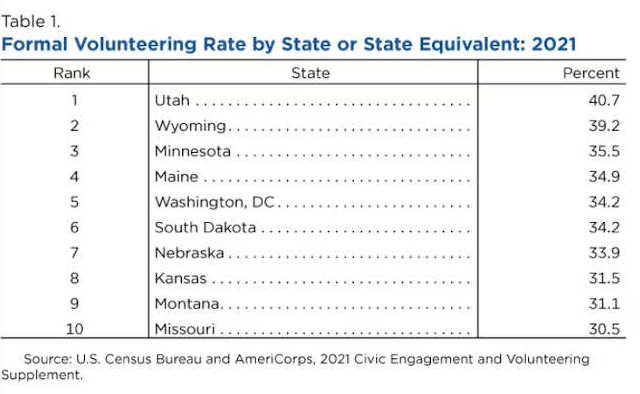
Utah (40.7%) and Wyoming (39.2%) topped the list of states with the highest formal volunteering rates in 2021 (Table 1).
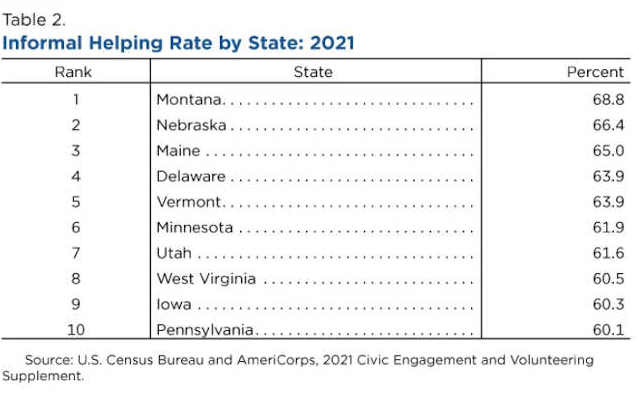
Montana (68.8%) and Nebraska (66.4%) had the highest rates of informal helping, which includes helping others outside of an organizational context like doing favors for neighbors (Table 2).
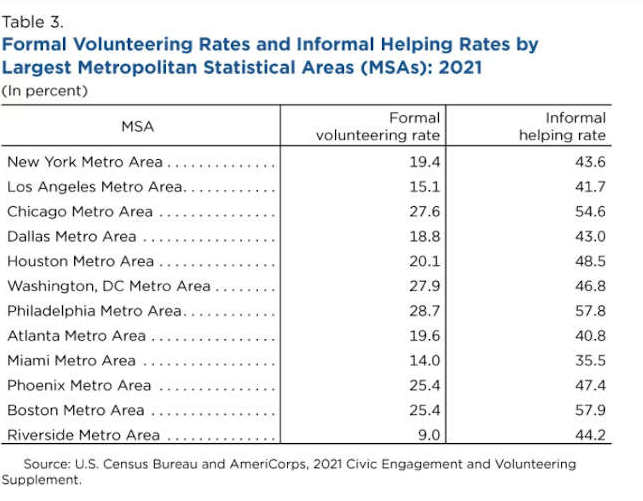
Among the 12 largest metropolitan areas, Philadelphia had the highest rate of formal volunteering (28.7%) and Boston had the highest informal helping rates (57.9%) (Table 3).
Volunteering and Civic Engagement in America complements a large body of other AmeriCorps’ research demonstrating a substantial return on investment in national service for both the government and the communities served, such as improved employment outcomes and mental and physical health benefits for those who volunteer.
AmeriCorps will release additional analyses of Civic Engagement and Volunteering Supplement data in the coming months.
Erin Schneider is content manager in AmeriCorps’ Office of External Affairs. Tim J. Marshall is assistant survey director for the U.S. Census Bureau’s Current Population Survey.
- Details
- Written by: Chris Impey, University of Arizona and Connie Walker, National Optical-Infrared Astronomy Research Laboratory

For most of human history, the stars blazed in an otherwise dark night sky. But starting around the Industrial Revolution, as artificial light increasingly lit cities and towns at night, the stars began to disappear.
We are two astronomers who depend on dark night skies to do our research. For decades, astronomers have been building telescopes in the darkest places on Earth to avoid light pollution.
Today, most people live in cities or suburbs that needlessly shine light into the sky at night, dramatically reducing the visibility of stars. Satellite data suggests that light pollution over North America and Europe has remained constant or has slightly decreased over the last decade, while increasing in other parts of the world, such as Africa, Asia and South America. However, satellites miss the blue light of LEDs, which are commonly used for outdoor lighting – resulting in an underestimate of light pollution.
An international citizen science project called Globe at Night aims to measure how everyday people’s view of the sky is changing.
Measuring light pollution over time
Relying on citizen scientists makes it much easier to take multiple measurements of the night sky over time from many different places.
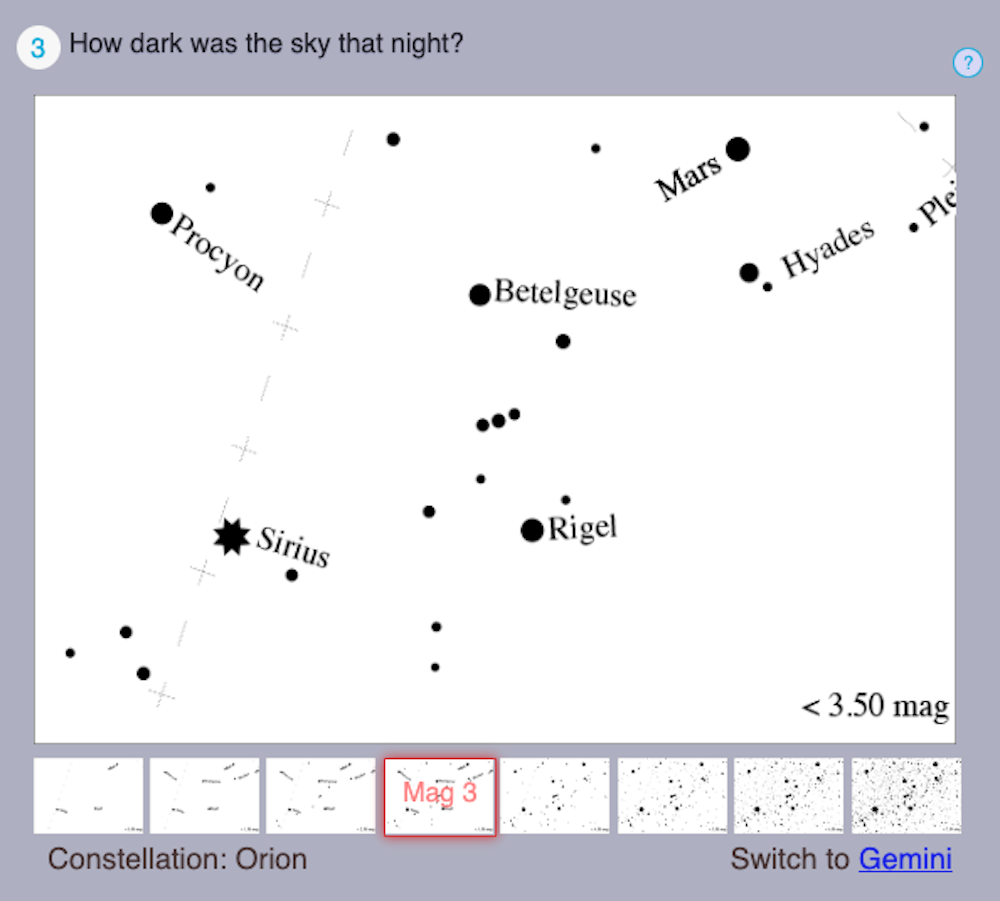
To provide data to the project, volunteers enter the date and time, their location and local weather conditions into an online reporting page anytime an hour or more after sunset on certain nights each month. The page then shows eight panels, each displaying a constellation visible at that time of year – like Orion in January and February, for example. The first panel, representing a light-polluted night sky, only shows the few brightest stars. Each panel shows progressively more and fainter stars, representing darker and darker skies. The participant then matches what they see in the sky with one of the panels.
The Globe at Night team launched the report page as an online app in 2011, just at the beginning of widespread adoption of LEDs. In the recent paper, the team filtered out data points taken during twilight, when the Moon was out, when it was cloudy or when the data was unreliable for any other reason. This left around 51,000 data points, mostly taken in North America and Europe.
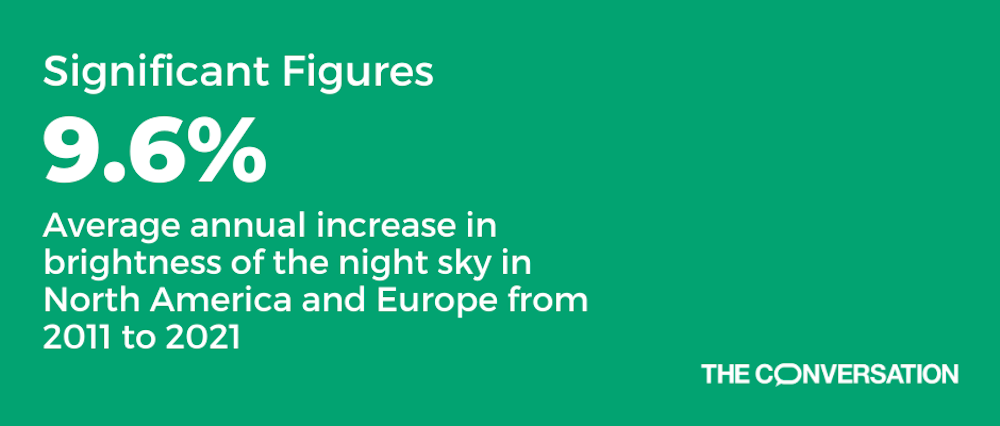
The data shows that the night sky got, on average, 9.6% brighter every year. For many people, the night sky today is twice as bright as it was eight years ago. The brighter the sky, the fewer stars you can see.
If this trend continues, a child born today in a place where 250 stars are visible now would only be able to see 100 stars on their 18th birthday.
Causes, impacts and solutions
The main culprits driving increasing brightness of the night sky are urbanization and the growing use of LEDs for outdoor lighting.
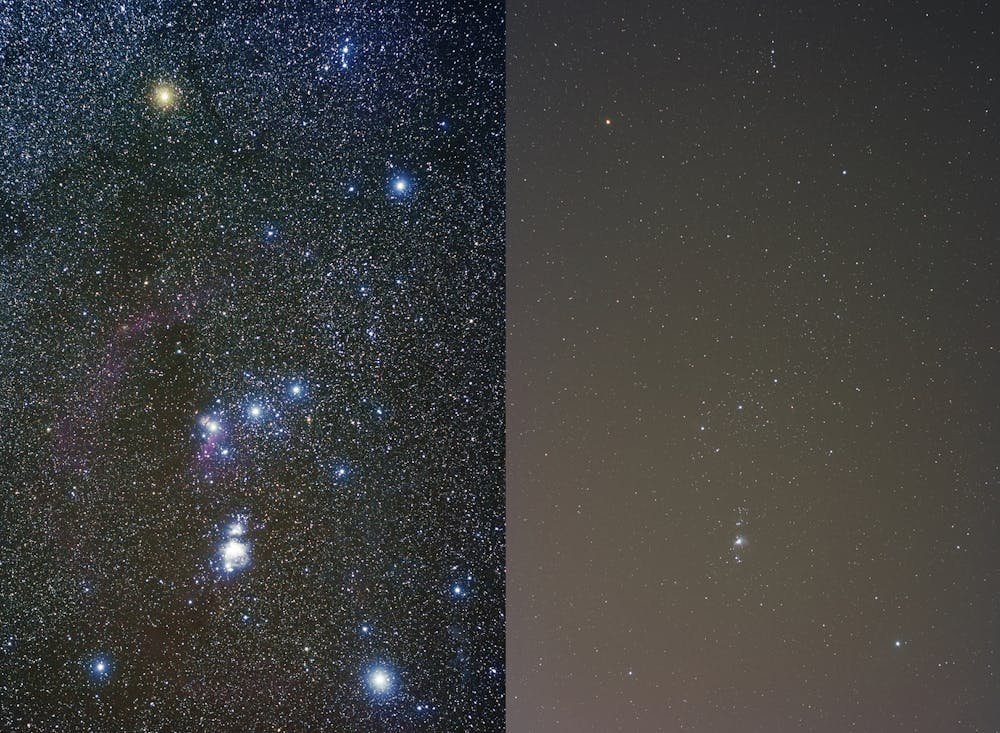
The loss of dark skies, both from light pollution and also from increasing numbers of satellites orbiting Earth, threatens our ability as astronomers to do good science. But everyday people feel this loss too, as the degradation of dark skies is also a loss of human cultural heritage. Starry night skies have inspired artists, writers, musicians and philosophers for thousands of years. For many, a star-filled sky provides an irreplaceable sense of awe.
Light pollution also interferes with the daily cycle of light and dark that plants and animals use to regulate sleep, nourishment and reproduction. Two-thirds of the world’s key biodiversity areas are affected by light pollution.
Individuals and their communities can make simple changes to reduce light pollution. The secret is using the right amount of light, in the right place and at the right time. Shielding outdoor light fixtures so they shine downward, using bulbs that emit more yellow-colored light instead of white light and putting lights on timers or motion sensors can all help reduce light pollution.
The next time you are far away from a major city or another source of light pollution, look up at the night sky. A view of the roughly 2,500 stars you can see with the naked eye in a truly dark sky might convince you that dark skies are a resource worth saving.
Chris Impey, University Distinguished Professor of Astronomy, University of Arizona and Connie Walker, Scientist, National Optical-Infrared Astronomy Research Laboratory
This article is republished from The Conversation under a Creative Commons license. Read the original article.
- Details
- Written by: Elizabeth Larson
On Friday, Sheriff Rob Howe declared the local emergency due to low elevation snow and the extreme cold that has occurred over the past week.
The snow — the likes of which even longtime residents said they hadn’t seen before — knocked out power across nearly all of Lake County.
At one point, Pacific Gas and Electric Co. said 33,600 Lake County customers lost power due to the weather.
On Tuesday, hundreds still remained out of power in scattered outages across Lake County, PG&E reported.
“This was a pretty unprecedented event here in Lake County,” Howe told the board during the brief discussion of the declaration.
Howe said the amount of damage from the storms likely won’t be clear until the snow starts to melt off.
And that may not take place immediately, given that portions of Cobb remain snowed in, with more snow falling on Tuesday afternoon.
Supervisor Bruno Sabatier said he hoped there will be a debriefing on the emergency to review how it has been handled, and what went well and what didn’t.
“Of course, I’d welcome that,” said Howe.
Howe added, “This event probably isn’t completely over. We don’t anticipate anything like we saw a few days ago but we’re still in the middle of this winter storm.”
Board members joined Howe in offering thanks to the many first responders and front line workers, including county staff.
Howe said he’s been trying to thank everyone but there are so many people that he knew he was missing some.
“There’s just too many to thank. There's a lot of people working a lot of hours, trying to keep our community safe, and I appreciate all of them. I’m glad you do, too,” Howe said.
Board Chair Jessica Pyska said she appreciated Howe’s leadership and the work of everyone involved in the storm response.
“It was pretty incredible to see everybody mobilize,” she said.
Howe, in turn, thanked the board for its support.
There was no public comment before Sabatier moved to ratify Howe’s emergency proclamation, with Vice Chair Moke Simon seconding and the board voting unanimously to approve it.
Snow continues to impact schools; additional county services to be suspended Wednesday
Due to the continuing challenge from weather conditions, on Tuesday Middletown Unified schools, the Lake County International Charter School and the Middletown Preschool were closed.
The rest of Lake County’s public schools reopened on Tuesday after having Friday and Monday snow days.
Despite there being reports on Tuesday afternoon of more snow falling steadily in Cobb, shortly after 6 p.m. Tuesday, Middletown Unified Superintendent Thad Owens posted on the district’s Facebook page that all of the district’s schools will be open on Wednesday at normal times.
Owens said the district will be running the modified snow and ice routes for Cobb buses, with all other routes to be normal.
The county of Lake also reported a return to more normal operations after having opened warming centers in the county and a hotline for homebound residents.
On Tuesday afternoon, the county said that, based on the National Weather Service’s report that storm activity is slowing, some of its enhanced services will be suspended as of 7 a.m. Wednesday.
That includes the closure of warming centers at the Lower Lake Town Hall and the Middletown Senior Center on Wednesday. Both facilities will remain open overnight on Tuesday. For more information on these warming centers, call 707-533-3599.
Sunrise Services Foundation’s warming center at 1111 Whalen Way in Lakeport will remain open around the clock for the short term. Call 707-349-5022 for more information.
The county’s 24/7 community Hotline for Homebound Individuals — available at 707-262-4421 — also will no longer be available as of 7 a.m. Wednesday.
After that hotline ends, all non-emergency concerns that require Lake County Sheriff/Office of Emergency Services support, including those resulting from winter weather, should be routed to Central Dispatch at 707-263-2690. Please use 911 for emergency calls.
Meantime, Lake County Public Works staff continue to plow and clear roads countywide both of snow and downed trees.
Public Works said Tuesday morning that primary roads have been plowed and crews were working to clear secondary roads.
Lake County residents are urged to remain vigilant as continued winter weather is expected.
The National Weather Service has issued a freeze warning for Lake County, with temperatures expected to drop into the 20s during the early morning hours on Wednesday and Thursday.
Drivers should use extreme caution when traveling in the morning hours as icy conditions are likely to exist on the roadways and sidewalks, officials said.
Forecasters also said additional rain and sleet is expected Saturday through Sunday, with further snowfall possible, especially at higher elevations in Lake County and across the region.
Email Elizabeth Larson at
- Details
- Written by: LAKE COUNTY NEWS REPORTS
Arrested as a result of the search warrant were James Biocca Jr., 54, of Healdsburg, and Melody Yadon, 51, of Willits, according to Lakeport Police Chief Brad Rasmussen.
Rasmussen said that at 3 p.m. Monday several Lakeport Police Officers served a Lake County Superior Court search warrant on a storage unit locker in Kelseyville that was under the control of Biocca and Yadon.
The probable cause for this search warrant was based on Biocca’s arrest on Feb. 7, when he was in possession of approximately 98.8 grams of fentanyl and approximately 21.3 grams of methamphetamine that were packaged for sale, Rasmussen said.
At approximately 4:30 p.m. Monday, while officers were searching the storage locker, Rasmussen said Biocca and Yadon showed up at the storage facility in the same vehicle Biocca was driving when he was previously arrested.
Before their arrival, Rasmussen said the officers had already located suspected methamphetamine and drug paraphernalia in the locker.
Officers contacted Biocca in the storage facility office and arrested him. Rasmussen said the officers subsequently located methamphetamine in Biocca’s front sweatshirt pocket.
Rasmussen said officers also contacted Yadon who was still in the vehicle and arrested her. The vehicle was searched incident to the arrests and additional methamphetamine and fentanyl were found.
During Monday’s investigation, other items of evidence including $1,042 were located which indicated the drugs were possessed for sale, Rasmussen said.
Biocca and Yadon were transported to the Lake County Correctional Facility for booking. During the booking process, Rasmussen said Yadon was found to have additional fentanyl hidden on her person.
Biocca was booked for possession for sale and transportation of a controlled substance, possession for sale and transportation of a narcotic, possession of pepper spray by a convicted felon, conspiracy to commit a felony, and committing a felony while out on bail for a felony. Officers sought a bail enhancement on him and a superior court judge ordered bail of: $250,000, Rasmussen said.
Rasmussen said Biocca has an extensive criminal history that includes drug arrests, burglary, vehicle theft, receiving stolen property, evading a peace officer and six prior felony convictions.
Yadon was booked for possession for sale and transportation of a controlled substance, possession for sale and transportation of a narcotic, and conspiracy to commit a felony. Yadon’s bail was set by the bail schedule at $10,000.
Between the items located at the search warrant and those found in possession of Biocca and Yadon, Rasmussen said officers seized approximately 50.7g of methamphetamine and approximately 36.2g of suspected fentanyl.
In total, between the two recent arrests of Biocca, Rasmussen said officers have seized approximately 72 grams (2.54 ounces) of suspected methamphetamine and approximately 135 grams (4.76 ounces) of suspected fentanyl.
Similar to the Feb. 7 seizure, some of the fentanyl seized on Monday was a type commonly known as “rainbow fentanyl,” which means the drugs were multicolored to make them look more attractive.
According to the DEA, just 2 milligrams of fentanyl is considered to be enough to cause an overdose and kill someone.
Based on this data, the amount of fentanyl seized Monday could have killed up to 18,100 people. The amount seized between these two separate arrests could have killed up to 67,500 people, Rasmussen said.