 How to resolve AdBlock issue?
News
- Details
- Written by: LAKE COUNTY NEWS REPORTS

UPPER LAKE, Calif. — Upper Lake Unified Superintendent Dr. Giovanni H. Annous has received the prestigious California Superintendent of the Year Award for 2023 from the Small School District Association, or SSDA.
California has 939 school districts of which 730 are classified as small school districts.
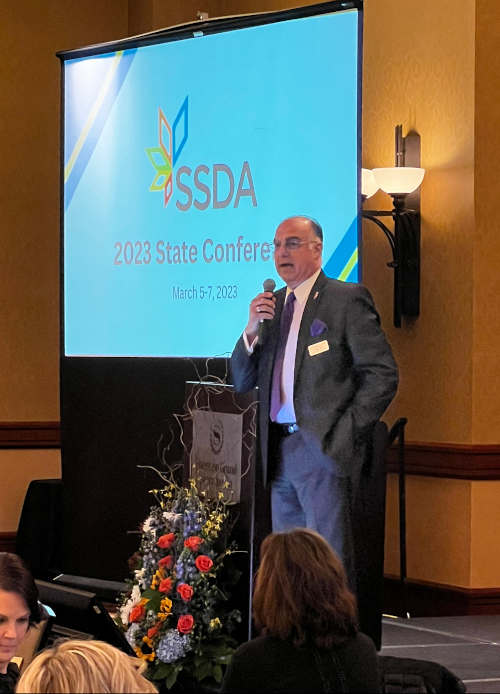
Dr. Annous was recognized for his achievements and leadership of the Upper Lake Unified School District, or ULUSD, at the annual SSDA conference held in Sacramento.
“To be honored by SSDA and your peers with such a prestigious award is extremely gratifying,” said Annous. “To be recognized with an award that bears Charles Binderup’s name is of high honor. I am forever grateful to the Upper Lake USD community for believing in me and for their collaborative and continued support. I am also eternally thankful to our selfless and dedicated ULUSD school board and leadership team members for their hard work and commitment through our successful journey. Leading ULUSD has been my privilege, pleasure, and the best professional gift I have ever received.”
Dr. Annous hails from a family of educators; his father and mother are retired physical education and language teachers, his sister, Dr. Jinane Annous, is a retired superintendent, and his wife, Majda, is a school psychologist.
He and his wife are the proud parents of their 15-year-old son, Sebastien.
Dr. Annous graduated from Cal State Long Beach with a degree in electrical, biomedical, and clinical engineering. He holds two Master of Science degrees in education with a focus on curriculum and instruction and educational administration.
He earned a Doctorate in Educational Leadership from the University of Laverne.
Dr. Annous’ career in education has spanned over 30 years; 26 of those years were spent in school and district leadership.
He started in the classroom teaching seventh and eighth grade science.
Annous served as a dean of students, assistant principal, middle school principal, high school principal and superintendent.
For 19 years, he served as a core adjunct professor for the University of Redlands, teaching in graduate and postgraduate programs.
In the past six years at the Upper Lake Unified School District, Dr. Annous has established and maintains positive relations with the Board of Education.
He has collaboratively passed two bond measures, solidified the unification of two districts and increased district average daily attendance.
With a strong balanced budget, he has increased employee compensation while establishing and maintaining successful relationships with labor partners. Moreover, Dr. Annous designed and developed a state-of-the-art Career Technical Education Complex, a cutting-edge health and fitness center, and phase one of the new elementary school.
In addition, Dr. Annous conceptualized and built a wellness center that serves the at-promise population of the district. Most of these accomplishments occurred against the backdrop of the COVID-19 pandemic, during which he kept the schools of the district open for in-person learning, with up to 78% of the students on campuses.
In 2018, Dr. Annous founded the Northshore Youth Club, a successful nonprofit organization providing academic, athletics, arts, and adventure programs serving upward of 600 children annually in and around Lake County.
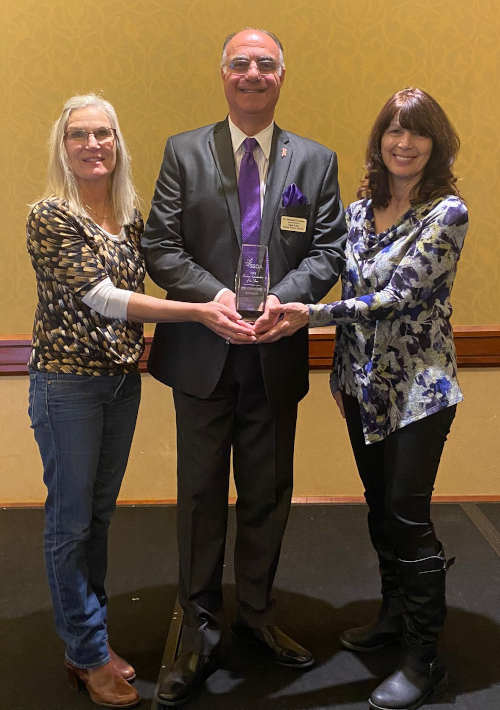
Dr. Annous was named 2021 Superintendent of the Year for Association of California School Administrators Region 4 which encompasses all school districts in Marin, Napa, Sonoma, Lake, Mendocino and Colusa counties.
ULUSD board members and staff community lauded Annous as a visionary leader.
“Upper Lake Unified School District is very proud to have Dr. Annous as our superintendent and we are happy his hard work has been acknowledged by the education community and his peers. Our students and staff have received the best leadership and vision. Congratulations, Dr. Giovanni Annous!,” said Diane Plante, Upper Lake Unified School District Board president.
“Dr. Annous is a brilliant visionary without boundaries, he works tirelessly to provide the best for the staff, students, as well as the community. He is a phenomenal example of servant leadership,” said Upper Lake Unified Vice President Joanne Breton.
“Dr. Annous has been a transformational leader for our district, supportive and encouraging of the individual, fostering team development, and putting our community first. We have benefited from his experience and insight as we continue to develop and be inspired by the example he sets for us all at ULUSD,” said Anna Sabalone, president of the Upper Lake Employees Association, secondary assessment coordinator, and art, AVID and humanities teacher.
“Dr. Annous' passion, dedication, and tireless energy are evidenced by his remarkable accomplishments for our district. He treats us like family and is always willing to throw on his chef's hat and cook the entire staff a delicious meal. Under his leadership, he brought a vision to life, and our district thrived. I’m so proud to work for the Upper Lake Unified School District family. Congratulations, Dr. Annous!” said Angel Hayenga, English chair and teacher.
“Dr. Annous has made Upper Lake a destination district for our community. We appreciate his inspiration and energy, which is highly contagious. Our students are his top priority,” said ULUSD Board Member Claudine Pedroncelli.
“Dr. Annous’ dedication to education extends beyond teaching students. He is passionate about developing his staff and maximizing their potential,” said district Chief Business Official Michael Kauble.
“Dr. Annous is the epitome of a supportive, loving, giving, intelligent, visionary leader. He doesn’t just send his teams out to do the work. He is part of the change from the ground up. Everyone that works with Dr. Annous knows he has a heart of gold. Through his visionary leadership, the Upper Lake Unified School district is moving forward in an upward trajectory and there are only better things on the horizon with Dr. Annous at the helm,” said Tenderly Logan, assistant superintendent of pupil personnel services.
“It has been an honor and a privilege to be part of the ULUSD team under the leadership of Dr. Annous. His direction has turned our community into a destination district and established so many opportunities for the students of the Northshore to be successful,” said Upper Lake Middle School Principal Mike Smith.
- Details
- Written by: Elizabeth Larson
On Tuesday, Fish and Wildlife announced that it wouldn’t give the listing, which the California Fish and Game Commission, Lake County’s tribes and the Center for Biological Diversity asked for the agency to do last year.
The hitch, a fish native to Clear Lake, is known as the “chi” to Lake County’s tribes, for whom it has had an important cultural role due to being a primary food source historically.
In recent years, observers have noted a marked decline in hitch population, and that information — along with advocacy from Big Valley and other local tribes — led to the Board of Supervisors declaring a Clear Lake hitch emergency in February.
Fish and Wildlife’s Tuesday statement noted, “While the species’ population numbers in Clear Lake are troubling, many of the issues affecting Clear Lake and its associated tributaries are chronic and have no immediate solution or need further investigation to determine an appropriate solution.”
“We are disappointed that not only did USFWS not reach out to inform the tribal leaders who signed the emergency listing request of the service's decision, but they also continue to insist that the causes of our chi's demise are uncertain and complex,” said Big Valley Band of Pomo Indian Chairman Philip Gomez.
“An emergency listing could require that water users time their extractions and use during the spawning season. This would result in increased water flow in the creeks during the critical spawning period, allowing newly hatched chi to make it back to the lake,” Gomez said. “Without state or federal requirements such as these, a year with normal to little rain will result again in severely reduced levels of our chi as we have seen for years. This is a step that USFWS could have required in an emergency listing.”
The hitch has been listed as threatened under the California Endangered Species Act since 2014.
In 2020, Fish and Wildlife declined to list the fish, which led to a lawsuit by the Center for Biological Diversity.
Fish and Wildlife said Tuesday that it is still in the midst of an evaluation of the hitch, which is expected to be completed in 2025. That has the potential to lead to a federal listing under its regular process.
However, Meg Townsend of the Center for Biological Diversity told Lake County News this week that a listing doesn’t guarantee that a species can be saved, and that protections for the species and habitat are needed.
Over the past month and a half, the high water levels in Clear Lake and its tributaries — the result of this winter’s string of atmospheric river storms — has made for better spawning conditions for the hitch, which have been spotted in large numbers.
In some cases, creeks spilling over into fields in the Kelseyville area led to farmers and tribal representatives working side by side to move the fish safely back into the streams in April. That work has to be done under a special state permit.
“The multi tribal hitch observation and rescue efforts, along with the Big Valley Tribe’s ongoing review and monitoring of the ground and surface water flows in the watershed are important efforts that are providing some protection, but more is needed. We can't have our chi go extinct on our watch,” Gomez said.
Email Elizabeth Larson at
- Details
- Written by: LAKE COUNTY NEWS REPORTS

LAKE COUNTY, Calif. — On Saturday, May 6, Konocti Unified School District students and their families will host an outdoor event to celebrate the first year of its new music and arts program: ONline Rural Arts and Music Program or “On-Ramp.”
Families and community members are encouraged to drop by Pomo Elementary School located at 3350 Acacia St. in Clearlake from 11 a.m. to 2 p.m. for food, live music, and interactive arts activities led by On-Ramp teachers.
The event will feature approximately 500 student self-portraits featuring a variety of artistic styles and media, all integrated with students’ personal narrative writing, as well as student musical performances led by new music specialist teacher, Brenda Gravesen.
The Lower Lake High School drumline and a local brass quintet will also perform.
Konocti Unified is able to provide this district-wide elementary music program using face-to-face instruction supported by online resources because it was chosen as one of only 27 districts nationwide to receive a four-year grant from the U.S. Department of Education called the Assistance for Arts Education grant.
“Konocti Unified is thrilled for this opportunity to bring music and the arts to our elementary students,” said Konocti Unified Superintendent Becky Salato. “From solid research, we know that participation in the arts improves academic achievement, engages students and families, and builds the Social/Emotional Learning skills our students need for success in school and in life.”
- Details
- Written by: D. Brian Blank, Mississippi State University and Brandy Hadley, Appalachian State University

Small businesses – the heartbeat of the U.S. economy – are beginning to feel the pinch of tighter credit conditions as the Federal Reserve continues to increase borrowing costs.
A flurry of headlines in recent weeks has suggested a credit crunch – meaning the availability of lending gets scarcer – is already happening.
That’s in large part brought on by the actions of the Federal Reserve, which has been raising borrowing costs for companies and consumers for over a year in an effort to tame inflation and lifted rates by another quarter point on May 3, 2023. Concerns about the availability of credit have also risen as a result of a spate of bank failures, including that of First Republic on May 1.
A decline in the availability of loans and other financing poses problems for all types of companies. But this can be particularly detrimental to small businesses, which have limited resources to sustain their growth and rely heavily on regional bank financing, currently the most stressed pocket of lending.
Small but mighty
Despite their size, small businesses – typically defined as companies with under 500 employees – are a very important part of the U.S. economy.
Almost all of them, however, employ fewer than 20. And yet collectively they account for half of all private-sector workers and 44% of private-sector output.
And virtually all for-profit companies are considered small businesses.
Small businesses don’t borrow a lot of money, with the average size of their debt just US$195,000. Altogether, though, it really adds up. At the end of 2022, small businesses owed nearly $18 trillion in debt.
About 70% of small businesses have at least some outstanding debt, which they use to help cover basic operating expenses like wages, rent and inventory, as well as to invest in new equipment and the like. After individual savings, the second-most common source of capital to start a business is loans from a bank, so the ability to access capital is crucial for businesses – a lack of financing is often cited as the primary reason for failure.
While large companies have a range of financing options at their disposal, such as raising capital by selling stock or issuing convertible bonds, small businesses generally rely on bank loans for over 90% of their financing.
Consequently, if bank lending becomes harder to come by, they may need to cut spending or seek alternative sources of more expensive capital to continue investing and expanding. This could have implications for employment and commercial real estate, leading to further slowdowns in growth.
The last time small businesses faced similar financing challenges was during the 2008 financial crisis, when 1.8 million small businesses failed.
Signs of credit tightening
Whether or not the current banking turmoil is creating a serious credit crunch for small businesses remains an open question.
The stories warning of a crunch point to a variety of statistics. For example, the money supply is shrinking at the fastest pace since 1960. Bank lending fell in March by the most since the Fed began compiling the data in 1975. And the share of U.S. banks that say they’re tightening credit standards versus loosening them is at a level that has preceded the past few recessions.
But the money supply was already very elevated, commercial bank lending has recovered somewhat since March, and this is the first time in decades that credit has tightened as a result of rate increases, which is different from other recent recessions. In those cases, credit tightening may very well have been the consequence of the downturn, as opposed to the cause.
In addition, a monthly survey on small business economic trends conducted by the National Federation of Independent Business, a lobbying group, found that overall optimism remained high in March, the latest data available.
Yet the survey did find that more business owners reported that it was harder to get a loan than in the past. Banks continue to tighten their lending standards to levels approaching those seen during the pandemic as policymakers consider stricter regulations to prevent the bank crisis from spreading.
This tightening of credit could lead to decreased capital expenditures and slower payroll growth in the future. These challenges for small businesses may ultimately end up causing the economy to decelerate further after a sluggish first quarter.
When companies have limited cash during a potential downturn, bankruptcy and company failures can occur, which is almost what happened in March, when Silicon Valley Bank was on the brink of causing many companies to lose the deposits they needed to make payroll.
Room for optimism
On the bright side, companies have been bracing for reduced access to credit since at least March 2022, when the Fed began raising rates.
What’s more, they’ve been anticipating that higher rates could drive the U.S. into recession. That means they should have had plenty of time to prepare to weather most potential storms.
In addition, strong consumer spending, overall healthy bank balance sheets, steady growth in new business creation and a regulatory response that aims to ensure credit doesn’t dry up too much could help avert a credit crisis for small businesses.
But with a fourth bank failing and lingering uncertainty as to whether the quarter-point hike on May 3 will be the Fed’s last, we believe small businesses – and the U.S. economy – aren’t out of the woods quite yet.
Still, with the number of new business applications growing, we anticipate more businesses next year than the U.S. has today, and that may be welcome news for an economy trudging through a challenging environment.
This article was updated to include details of Fed rate hike.
D. Brian Blank, Assistant Professor of Finance, Mississippi State University and Brandy Hadley, Associate Professor of Finance and the David A. Thompson Distinguished Scholar in Applied Investments, Appalachian State University
This article is republished from The Conversation under a Creative Commons license. Read the original article.
- U.S. Fish and Wildlife denies emergency listing for Clear Lake hitch; full species evaluation to be completed in 2025
- Lakeport City Council expands contract for Lakeport Boulevard corridor study
- Tribes, lawmakers, advocates outline obstacles, solutions to confronting violence against state’s Native Americans