 How to resolve AdBlock issue?
News
- Details
- Written by: Courtney Carignan, Michigan State University
The Research Brief is a short take about interesting academic work.
The big idea
Concerns about unnecessary use of a common class of antimicrobial chemicals used in disinfectants reinforces recommendations to opt for soap and water or safer products, my colleagues and I determined in our recent critical review of the scientific literature.
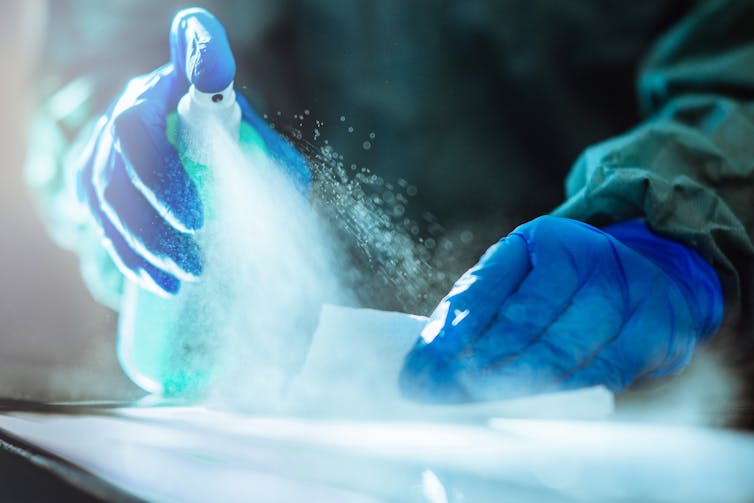
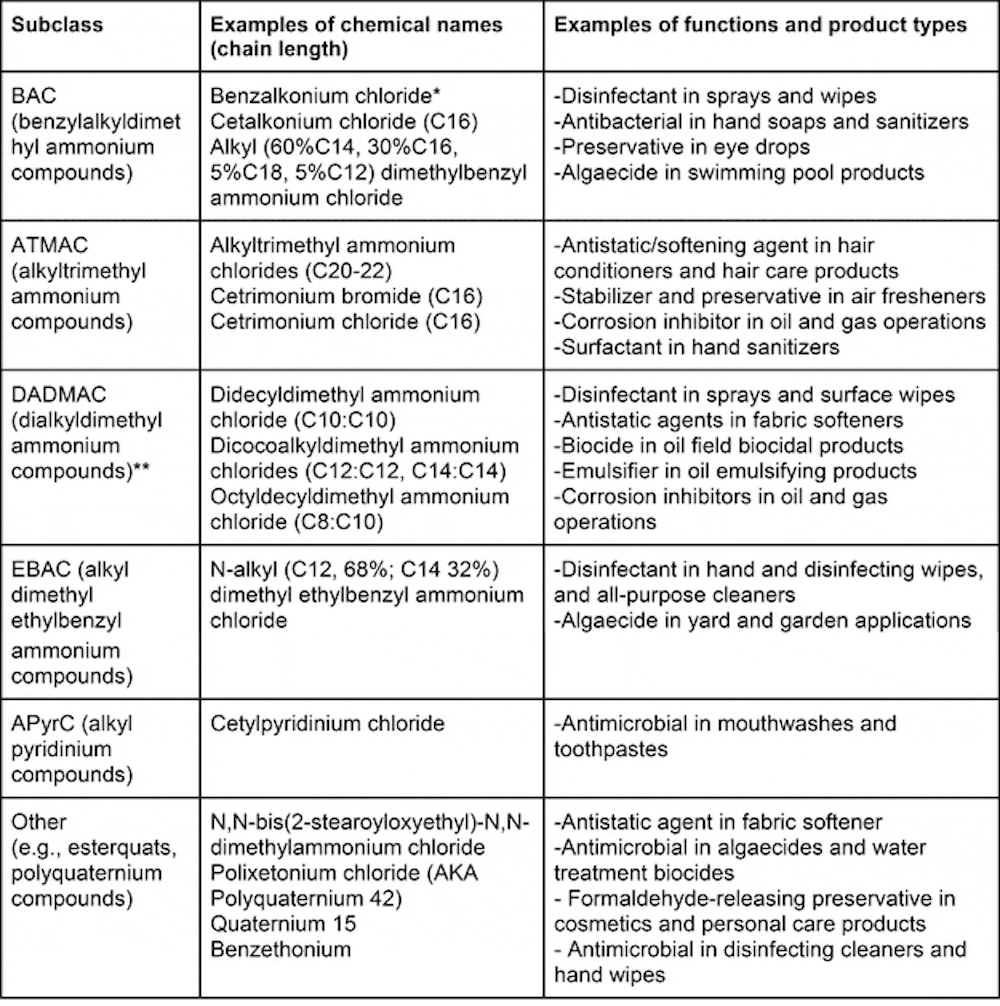
Quaternary ammonium compounds, or QACs, are increasingly marketed and used in homes, schools and workplaces with limited evidence for their appropriateness or safety. These chemicals can be found in common disinfectant solutions, wipes, hand sanitizers, sprays and even foggers.
Laboratory animal studies have found that some QACs can have developmental and reproductive toxicity with sustained exposure, may contribute to weight gain, and can impair energy production in cells.
Surprisingly, despite these concerns, studies on people have been limited to patients with allergic contact dermatitis and workplace-induced asthma among workers in hospitals and other facilities that require a sterile environment. We were even more surprised to find a lack of comprehensive screening for health hazards in the majority of this large class of common and widely used chemicals.
One of the top reasons to use antimicrobials only when needed is that overuse leads to the rise of antimicrobial resistance, which contributes to millions of deaths per year worldwide. QACs and other antimicrobials create “superbugs” that not only can’t be killed by disinfectants but can also become resistant to lifesaving antibiotics.
Why it matters
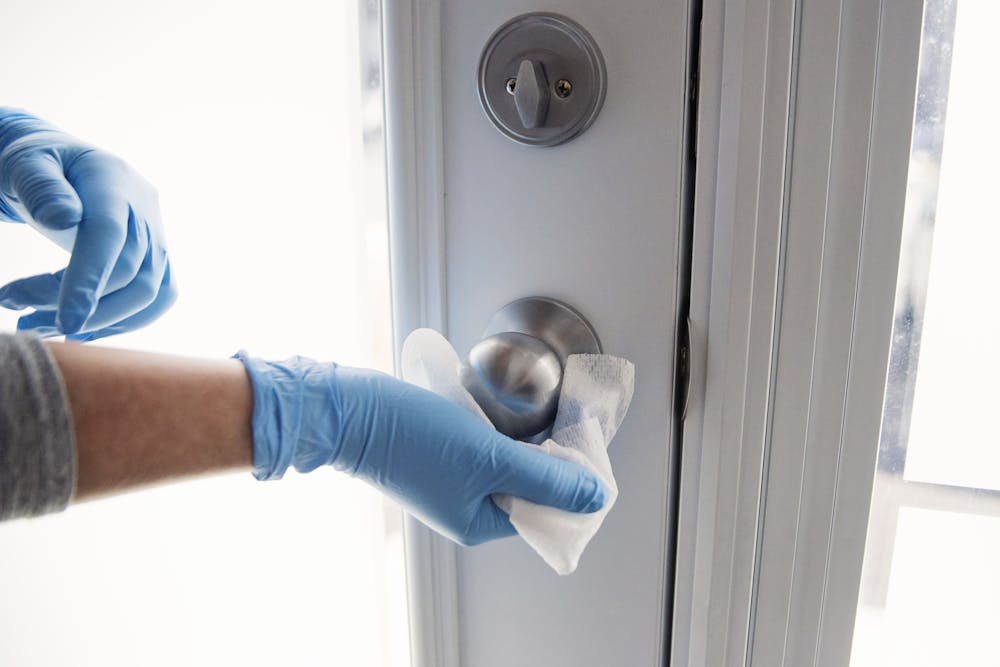
When the COVID-19 pandemic began, recommendations circulated in the news and social media to disinfect almost everything, from doorknobs to desks to groceries. Because COVID-19 is not primarily transmitted from surfaces, many of these disinfection practices don’t substantially reduce transmission risk.
Our team became concerned that frequent disinfectant use could lead to adverse health effects from QACs. Most people probably don’t know about existing health concerns regarding QACs, or aren’t aware that QACs can remain on surfaces and in indoor air and dust long after the product has dried, exposing more people to these chemicals than just the initial user. Researchers have found that the average levels of these chemicals in people’s bodies have risen since the pandemic began.
What still isn’t known
One of the most commonly used QACs is benzalkonium chloride. Others may be identified on ingredient labels with names that end in “ammonium chloride” or similar terms.
While reading labels can help consumers identify QACs, some products may not require disclosure of these chemicals in the ingredient list. For example, pesticide labels are required to list QACs whereas paint labels are not. QACs can be used in a wide variety of consumer products where they may or may not be listed when used, including personal care products, textiles, paints, medical instruments and more.
What’s next
Reducing the harm of QACs requires their disclosure in all products, comprehensively screening them for health hazards and closely monitoring their broader effects in people and on the environment.
In the meantime, my colleagues and I recommend that individuals, schools and workplaces take a close look at their cleaning practices to see where disinfectants can be replaced with safe cleaners or safer disinfectants.
Cleaning with soap or detergent removes most types of harmful germs like COVID-19 from surfaces. While disinfection can help kill any remaining microbes, it should be limited to situations where people have been actively ill, such as vomit on a surface, and during certain disease outbreaks.
For disinfectants to work properly, they must be left on the surface long enough to kill the germs, and this required contact time may be noted on the product. When you use or handle disinfectants you should wear protective gloves and eyeglasses or safety glasses, and you should open windows and doors to ventilate indoor spaces.
Courtney Carignan, Assistant Professor of Food Science and Human Nutrition, Pharmacology and Toxicology, Michigan State University
This article is republished from The Conversation under a Creative Commons license. Read the original article.
- Details
- Written by: Pat Brennan

A science team gains new insight into the atmosphere of a “mini-Neptune,” a class of planet common in the galaxy but about which little is known.
NASA’s James Webb Space Telescope has observed a distant planet outside our solar system — and unlike anything in it — to reveal what is likely a highly reflective world with a steamy atmosphere. It’s the closest look yet at the mysterious world, a “mini-Neptune” that was largely impenetrable to previous observations.
And while the planet, called GJ 1214 b, is too hot to harbor liquid-water oceans, water in vaporized form still could be a major part of its atmosphere.
“The planet is totally blanketed by some sort of haze or cloud layer,” said Eliza Kempton, a researcher at the University of Maryland and lead author of a new paper, published in Nature, on the planet. “The atmosphere just remained totally hidden from us until this observation.” She noted that, if indeed water-rich, the planet could have been a “water world,” with large amounts of watery and icy material at the time of its formation.
To penetrate such a thick barrier, the research team took a chance on a novel approach: In addition to making the standard observation — capturing the host star’s light that has filtered through the planet’s atmosphere — they tracked GJ 1214 b through nearly its entire orbit around the star.
The observation demonstrates the power of Webb’s Mid-Infrared Instrument (MIRI), which views wavelengths of light outside the part of the electromagnetic spectrum that human eyes can see. Using MIRI, the research team was able to create a kind of “heat map” of the planet as it orbited the star.
The heat map revealed — just before the planet’s orbit carried it behind the star, and as it emerged on the other side — both its day and night sides, unveiling details of the atmosphere’s composition.
“The ability to get a full orbit was really critical to understand how the planet distributes heat from the day side to the night side,” Kempton said. “There’s a lot of contrast between day and night. The night side is colder than the day side.” In fact, the temperatures shifted from 535 to 326 degrees Fahrenheit (from 279 to 165 degrees Celsius).
Such a big shift is only possible in an atmosphere made up of heavier molecules, such as water or methane, which appear similar when observed by MIRI. That means the atmosphere of GJ 1214 b is not composed mainly of lighter hydrogen molecules, Kempton said, which is a potentially important clue to the planet’s history and formation — and perhaps its watery start.
“This is not a primordial atmosphere,” she said. “It does not reflect the composition of the host star it formed around. Instead, it either lost a lot of hydrogen, if it started with a hydrogen-rich atmosphere, or it was formed from heavier elements to begin with — more icy, water-rich material.”
Cooler than expected
And while the planet is hot by human standards, it is much cooler than expected, Kempton noted. That’s because its unusually shiny atmosphere, which came as a surprise to the researchers, reflects a large fraction of the light from its parent star rather than absorbing it and growing hotter.
The new observations could open the door to deeper knowledge of a planet type shrouded in uncertainty. Mini-Neptunes — or sub-Neptunes as they’re called in the paper — are the most common type of planet in the galaxy, but mysterious to us because they don’t occur in our solar system.
Measurements so far show they are broadly similar to, say, a downsized version of our own Neptune. Beyond that, little is known.
“For the last almost decade, the only thing we really knew about this planet was that the atmosphere was cloudy or hazy,” said Rob Zellem, an exoplanet researcher who works with co-author and fellow exoplanet researcher Tiffany Kataria at NASA’s Jet Propulsion Laboratory in Southern California. “This paper has really cool implications for additional detailed climate interpretations — to look at the detailed physics happening inside this planet’s atmosphere.”
The new work suggests the planet might have formed farther from its star, a type known as a red dwarf, then spiraled gradually inward to its present, close orbit. The planet’s year — one orbit around the star — takes only 1.6 Earth days.
“The simplest explanation, if you find a very water-rich planet, is that it formed farther away from the host star,” Kempton said.
Further observations will be needed to pin down more details about GJ 1214 b as well as the formation histories of other planets in the mini-Neptune class. While a watery atmosphere seems likely for this planet, a significant methane component also is possible. And drawing broader conclusions about how mini-Neptunes form will require more of them to be observed in depth.
“By observing a whole population of objects like this, hopefully we can build up a consistent story,” Kempton said.
More about the mission
The James Webb Space Telescope is the world’s premier space science observatory. Webb will solve mysteries in our solar system, look beyond to distant worlds around other stars, and probe the mysterious structures and origins of our universe and our place in it. Webb is an international program led by NASA with its partners, ESA (European Space Agency), and CSA (Canadian Space Agency).
MIRI was developed through a 50-50 partnership between NASA and ESA. NASA’s Jet Propulsion Laboratory led the U.S. efforts for MIRI, and a multinational consortium of European astronomical institutes contributes for ESA.
George Rieke with the University of Arizona is the MIRI science team lead. Gillian Wright is the MIRI European principal investigator. Alistair Glasse with UK ATC is the MIRI instrument scientist, and Michael Ressler is the U.S. project scientist at JPL. Laszlo Tamas with UK ATC manages the European Consortium.
The MIRI cryocooler development was led and managed by JPL, in collaboration with Northrop Grumman in Redondo Beach, California, and NASA’s Goddard Space Flight Center in Greenbelt, Maryland. Caltech manages JPL for NASA.
For more information about the Webb mission, visit https://www.nasa.gov/webb.
Pat Brennan works for the Jet Propulsion Laboratory in Pasadena, California.
- Details
- Written by: LAKE COUNTY NEWS REPORTS
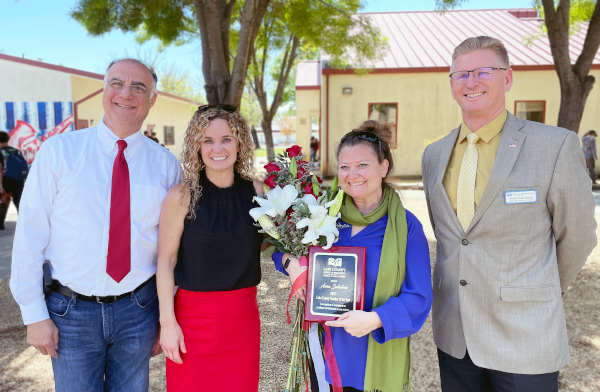
LAKE COUNTY, Calif. — Anna Sabalone, Art, AVID, Academic Decathlon, and Humanities Teacher at Upper Lake High School, has been named Lake County Teacher of the Year for 2023.
“Anna Sabalone is a transformational leader at Upper Lake High School. She is small but mighty,” said Annie Pivniska Petrie, principal of Upper Lake High School. “Her school and team can always count on her for steady leadership, insight and guidance.”
Sabalone received notification of the honor on Thursday, May 11, during Teacher Appreciation Week.
Her students and colleagues gathered at the Upper Lake High School, where she was presented with the Teacher of the Year plaque and flowers.
Sabalone was chosen as the Upper Lake Unified Teacher of the Year in March.
In late April, Sabalone participated in an interview at the Lake County Office of Education. She was chosen from a group of four other Lake County District Teachers of the Year to represent Lake County at the California Teacher of the Year competition this fall.
Three out of the five 2023 District Teachers of the Year are Lake County high school alumni.
The other district teachers of the year include:
• Joni Falkenberg — Kelseyville Unified School District.
• Rachel Weidner — Konocti Unified School District.
• Sandi Morton — Lakeport Unified School District.
• Jon Prather — Middletown Lake Unified School District.
Sabalone became a full-time teacher after realizing she had a passion for sharing knowledge during her time as a substitute teacher.
“I wanted to help the youth of my home learn that there are no limits but that which we place upon ourselves,” she said.
Sabalone started her teaching career at Upper Lake High School 15 years ago. There she has taught Art, AVID and Academic Decathlon/Humanities. She also teaches Art History at Mendocino Community College.
Outside of the classroom, Sabalone coaches the Upper Lake High School Mock Trial team, where she led the team to be state finalist in 2021.
Sabalone feels fortunate to have the opportunity to inspire current and past students by fostering an atmosphere of exploration and refusing to allow students to give up or place limits on their abilities.
“My students, and all they do with their lives in school, and after they graduate is my greatest contribution and accomplishment. Their success is my joy,” Sabalone said. “My contribution is in inspiring a life-long love of learning.”
Engaged, collaborative, creative chaos is how Sabalone fosters student success in the classroom she said. This allows students to push themselves and each other, utilize their resources, provide feedback and ask questions to dig deeper into the content.
“Ms. Sabalone’s students are excelling in college and beyond. It is not uncommon for graduates to stop by and “See Ms. Sab,” Petrie said. “She helps all students succeed, no matter their circumstance.”
Members of the interview panel included Rebecca Walker, deputy superintendent of schools; Rena Roush, Lake County Teacher of the Year 2022; Jennifer Kelley, former Lake County and California Teacher of the Year; Alan Siegel, former Lake County and California Teacher of the Year; Erica Boomer, former Lake County and California Teacher of the Year; and Jo Fay, representing the California Retired Teachers Association.
Lake County has had three California Teachers of the Year in the last 18 years. Erica Boomer from Upper Lake Unified School District was named a California Teacher of the Year 2019. Jennifer Kelly from the Middletown Unified School District received the honor in 2011, and Alan Siegel from Konocti Unified School District received the honor in 2005.
Lake County Superintendent of Schools Brock Falkenberg acknowledged Lake County teachers’ high success rate in the California Teacher of the Year program.
“Our Lake County students are being served well by some of the best teachers in our state. Each and every one works diligently to put students first,” Falkenberg said.
The Lake County Teacher of the Year program is administered through the Lake County Office of Education and the California Department of Education.
For more information about Anna Sabalone and the Lake County District Teachers of the Year, please visit https://www.lakecoe.org/TOY.
- Details
- Written by: LAKE COUNTY NEWS REPORTS
The one-time funding will support at-risk communities, including those in the Tulare Basin, respond to the impacts of this year’s winter storms and better withstand future flooding.
“California is facing unprecedented weather whiplash — we just experienced the driest three years on record, and now we’re dealing with historic flooding,” Newsom said. “Our investments must match this reality of climate-driven extremes. We’re committing even more resources to support communities up and down the state as they continue responding to the impacts of this year’s storms.”
The Governor’s May revision of the budget, which will be announced Friday, invests $290 million in new flood proposals:
• $125 million to support preparedness, response and recovery related to the 2023 storms — funding shifted from drought contingency to flood contingency to address the weather whiplash California is facing;
• $75 million to support local flood control projects;
• $25 million to expand the current California Small Agricultural Business Drought Relief Grant Program to provide direct assistance to eligible agriculture-related businesses that have been affected by the recent storms;
• $25 million for potential additional disaster relief and response costs in this fiscal year to address immediate impacts;
• $40 million for the San Joaquin Floodplain restoration.
The $290 million is on top of the governor’s January proposal of $202 million in flood investments to protect urban areas, improve levees in the Delta region and support projects in the Central Valley — bringing total flood investments to nearly $500 million.
The governor’s budget also includes proposed legislation that codifies provisions from recent executive orders that allow for the safe diversion of flood flows for groundwater recharge purposes. These provisions would make it easier to capture floodwater to recharge groundwater by setting clear conditions for diverting floodwaters without permits or affecting water rights.
Also on Thursday, the governor announced that the state will fundraising the Corcoran Levee in the Tulare Basin, which is key to protecting critical infrastructure, including large correctional and medical facilities, and public safety for the immediate surrounding communities. This marks the third time the state or federal government has intervened to raise the levee.
Due to over-pumping groundwater, the ground beneath the levee has subsided. The U.S. Army Corps of Engineers made repairs to the levee in 1969 and again in 1983. The state’s funding will allow the local flood control district to raise the levee to 192 feet.
The state’s funding will be contingent upon locals' ability to meet a set of criteria to ensure the work is done efficiently and at the lowest possible cost to taxpayers.