 How to resolve AdBlock issue?
News
- Details
- Written by: LAKE COUNTY NEWS REPORTS
LAKE COUNTY, Calif. — For decades Clear Lake has been a popular spot for “flying boats” and seaplanes, and this fall the Museums of Lake County will feature an exhibit on that slice of aviation history.
In the video above, discover the fascinating history of flying boats on Clear Lake with museum curator Clark McAbee, a former brown shoe Airedale in Naval Aviation.
McAbee also offers a sneak peek into the upcoming fall exhibit, “Wings over Water — An Aviation History of Lake County.”
For more information, visit the Museums of Lake County website.
- Details
- Written by: Elizabeth Larson
Dogs available for adoption this week include mixes of American bulldog, Anatolian shepherd, border collie, German shepherd, husky, pit bull, plott hound and terrier.
Dogs that are adopted from Lake County Animal Care and Control are either neutered or spayed, microchipped and, if old enough, given a rabies shot and county license before being released to their new owner. License fees do not apply to residents of the cities of Lakeport or Clearlake.
The following dogs at the Lake County Animal Care and Control shelter have been cleared for adoption.
Call Lake County Animal Care and Control at 707-263-0278 or visit the shelter online for information on visiting or adopting.

‘Sparkles’
“Sparkles” is a 6-year-old female terrier with a short black and tan coat.
She is in kennel No. 2, ID No. LCAC-A-5116.

‘Max’
“Max” is a 7-month-old male terrier mix with a short black coat.
He is in kennel No. 5, ID No. LCAC-A-4248.

Male pit bull
This 1-year-old male pit bull has a short tan coat.
He is in kennel No. 8, ID No. LCAC-A-5120.

‘Tux’
“Tux” is a 2-year-old male border collie-shepherd mix has a long black coat.
He is in kennel No. 9, ID No. LCAC-A-5012.

Male Anatolian shepherd
This one and a half year old male Anatolian shepherd has a tan and black coat.
He is in kennel No. 12, ID No. LCAC-A-5036.

Female pit bull-shepherd puppy
This 5-month-old female pit bull-shepherd puppy has a short black and tan coat.
She is in kennel No. 13, ID No. LCAC-A-5071.

‘Kyle Barkson’
“Kyle Barkson” is a 5 and a half year old male pit bull with a black and white coat.
He is in kennel No. 15, ID No. LCAC-A-5039.

Male German shepherd
This 9-month-old male German shepherd has a short black and tan coat.
He is in kennel No. 17, ID No. LCAC-A-5054.

Male plott hound
This 2-year-old male plott hound has a short brown coat.
He is in kennel No. 18, ID No. LCAC-A-5143.

Male American bulldog
This 4-year-old male American bulldog has a gray and white coat.
He is in kennel No. 19, ID No. LCAC-A-5204.

‘Pluto’
“Pluto” is a 2-year-old male pit bull terrier-hound mix with a short brown coat.
He is in kennel No. 20, ID No. LCAC-A-5052.

Male pit bull terrier
This 3-year-old male pit bull terrier has a short black and white coat.
He is in kennel No. 21, ID No. LCAC-A-5076.

Male shepherd
This 2-year-old male shepherd has a tan and white coat.
He is in kennel No. 22, ID No. LCAC-A-5223.

Male terrier
This 1-year-old male terrier mix has a short brown coat.
He is in kennel No. 23, ID No. LCAC-A-5110.

Male terrier
This 1-year-old male terrier has a short tan coat.
He is in kennel No. 24, ID No. LCAC-A-5111.

Male pit bull terrier
This 1-year-old male pit bull terrier has a black coat with white markings.
He is in kennel No. 27, ID No. LCAC-A-5203.

‘Max’
“Max” is a 13-year-old male terrier with a long white coat.
He is in kennel No. 28, ID No. LCAC-A-5115.

Male husky-shepherd
This 2-year-old male husky-shepherd has a tricolor coat.
He is in kennel No. 30, ID No. LCAC-A-5210.

Female pit bull-shepherd puppy
This 5-month-old female pit bull-shepherd puppy has a short tricolor coat.
She is in kennel No. 32, ID No. LCAC-A-5072.
Email Elizabeth Larson at
- Details
- Written by: NATIONAL OCEANIC AND ATMOSPHERIC ADMINISTRATION
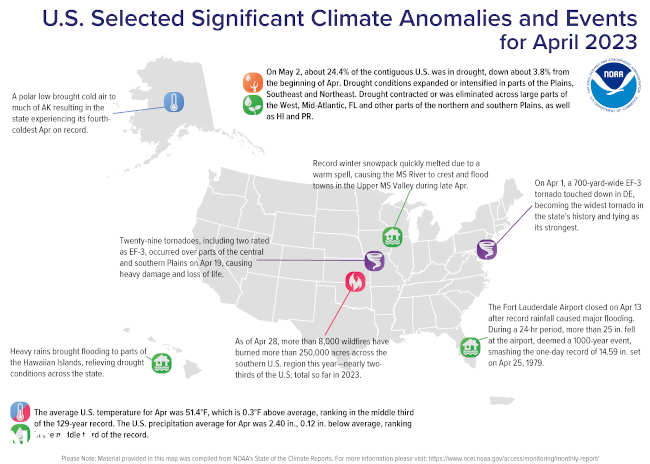
So far, 2023 stands out for the remarkable warmth that covered many parts of the U.S., with some states seeing their warmest January–April period on record.
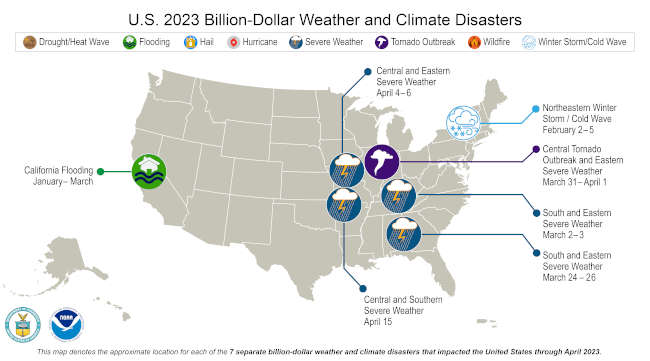
The first four months of the year have also been marked by seven separate billion-dollar disasters that have struck the nation, according to scientists from NOAA’s National Centers for Environmental Information.
Below are more takeaways from NOAA’s latest monthly U.S. climate report:
Climate by the numbers
April 2023
The average April temperature across the contiguous U.S. was 51.4 degrees F (0.3 of a degree above the 20th-century average), ranking the month in the middle third of the 129-year climate record.
Maryland and Delaware ranked second warmest on record for April while New Jersey ranked third warmest on record. Connecticut, Florida, Massachusetts, New Hampshire, New York, Pennsylvania, Rhode Island, Vermont and Virginia each saw their top-10 warmest Aprils on record.
Conversely, below-average temperatures covered the Northwest to the central Rockies and northern Plains, and parts of the southern Plains. North Dakota ranked 10th coldest on record for the month.
The average precipitation for the month was 2.40 inches — 0.12 of an inch below average, which places the month in the middle third of the historical record.
Arizona, Missouri, Nebraska and New Mexico saw their third-to-sixth driest Aprils on record, respectively. Meanwhile, Delaware ranked seventh wettest, North Carolina eighth wettest and New Jersey saw its 10th-wettest April on record.
Year to date | January through April 2023
The average U.S. temperature for the year to date (YTD) was 40.9 degrees F (1.8 degrees above average), ranking in the warmest third of the climate record.
Delaware, Florida, Maryland, New Jersey, North Carolina, Pennsylvania and Virginia each had their warmest January–April YTD on record. Connecticut, Massachusetts, New Hampshire, New York, Rhode Island, South Carolina and West Virginia each had their second-warmest such YTD, while 14 additional states ranked among their warmest 10 January-to-April periods on record.
The average precipitation for the first four months of 2023 was 10.22 inches (0.74 of an inch above normal), ranking in the wettest third of the January–April record.
Wisconsin saw its wettest such YTD on record, while Michigan ranked fourth wettest and Utah ranked seventh wettest. On the dry side, Maryland ranked 13th driest on record for this four-month period.
Other notable climate events in this report
Seven separate billion-dollar disasters struck this year: Through the end of April 2023, the U.S. was struck with seven separate weather and climate disasters, each with losses exceeding $1 billion, including:
• Five severe weather events.
• A Northeastern winter storm/cold wave.
• A California flooding event.
The total cost of these events exceeds $19 billion and resulted in 97 direct and indirect fatalities. The number of billion dollar disasters so far in 2023 is significant. Only 2017 and 2020 had more during this timeframe, with eight separate disasters recorded in the January-April period.
An active severe weather month: Several notable weather systems produced severe thunderstorms and a number of tornadoes that impacted portions of the U.S. in April 2023:
• April 1: A 700-yard-wide EF-3 tornado that touched down in Delaware was the widest tornado in the state's history. The same tornado was equal in strength to one that struck Delaware on April 28, 1961 — the strongest tornadoes recorded in the state.
• April 19: A tornado outbreak occurred across areas of the southern and central Plains. A total of 29 tornadoes, including two EF-3 tornadoes, was confirmed by the National Weather Service, causing heavy damage and loss of life.
• April 30: A state of emergency was declared after a rare EF-3 tornado touched down in Virginia Beach, destroying more than 100 structures.
Parts of Florida inundated with flooding: In less than a 24-hour period, more than 25 inches of rain fell at the Fort Lauderdale Airport on April 13. The event, deemed a 1,000-year event by the National Weather Service, smashed the previous one-day record of 14.59 inches of rain set on April 25, 1979.
- Details
- Written by: Jay L. Zagorsky, Boston University

The World Health Organization declared on May 5, 2023, that the COVID-19 pandemic is no longer a public health emergency. Although the virus is still causing hospitalizations and deaths, many travelers who were reluctant to go abroad because of the pandemic now feel freer to travel internationally again.
That’s going to be a whole lot easier to do this summer if you already have a valid passport. The wait times for getting one are soaring. The State Department says it can take up to 13 weeks for it to process passport applications, and up to nine weeks for expedited service that requires the payment of extra fees. It’s getting about 500,000 passport applications a week, which is at least 30% more than last year, Secretary of State Antony Blinken said in March. And delays in processing were already aggravating in 2021 and 2022.
I’m among the many Americans who have had to cancel or delay trips because of the long wait times. I was hoping to fly to London for a weeklong break between teaching economics courses. Unfortunately, renewing my passport took so long I couldn’t go.
The government says staffing issues are contributing to the delays. As an economist who researches the everyday experiences of consumers, I wondered if there was more to the story, since international travel is a big business. U.S. residents spent around US$17 billion in just the month of March 2023 going abroad.
Origin of passports
Passports have been around a long time. They became more widespread about four centuries ago during the reign of the French King Louis the XIV. The king gave people with royal connections letters asking foreign officials to let the traveler “passe port” – French for pass through – the port or border of another country safely.
You can find a similar statement in the front of every U.S. passport, which “requests all whom it may concern to permit the citizen/national of the United States named herein to pass without delay or hindrance.”
One reason for the passport bottleneck in the United States is a long-term increase in demand for those official blue booklets. Back in 1989, there were three valid passports for every 100 people in this country. Today there are more than 45 passports for every 100 Americans. More recently, many Americans who let their passports expire because they were avoiding international travel when the pandemic began are eager to travel again.
Changes after 2000
The U.S. population has increased about 1% each year over the past three decades. During that same period the number of people holding a valid passport has jumped an average of 10% each year, 10 times faster than population growth.
Part of the rising demand for passports followed a policy change in the early 2000s. Before then no passport was required for U.S. citizens to travel to Canada, Mexico or the Caribbean. A driver’s license or an official document like a birth certificate was suitable documentation to visit countries that shared a common border with the U.S. By 2009, however, a passport was needed to visit those nearby countries by air, land or sea.
But the new rules don’t fully account for the surge in passport issuance. In 2010, about 100 million people had valid U.S. passports. Today, over 150 million do.
Lost, stolen and damaged passports
Another reason for the passport boom is that the State Department is fielding more requests than before for reissued passports to replace lost or stolen documents.
One problem while traveling is keeping your passport safe. While so far no one has ever stolen my passport, I have spilled food on it while climbing mountains, gotten it soaked in a monsoon and crushed it in my luggage on the world’s longest flight.
If your passport is ever lost, destroyed or stolen, you need to file a DS-64 form with the State Department. Filing this form prevents a thief from using that passport. The data is not just kept in the U.S. but is also sent to Interpol’s Stolen/Lost Travel Document database, which prevents worldwide travel by someone posing as you when traveling with your stolen passport.
The government periodically releases the number of DS-64 forms filed. In 2005 a bit more than 100,000 were submitted. This jumped fivefold to over 500,000 people who reported losing their passports in 2021.
Who gets passports?
Where do passport applications come from?
Not surprisingly, states with more people tend to get more passports. For example, Californians got the highest number of passports, about 2.7 million, in 2022.
But some states have more wanderlust than others. After adjusting for population, over the past few years the top two sources for international travel are the high-income states of New Jersey and Massachusetts. Around 1 out every 17 residents in those places applied annually for a passport.
The states where residents are the least likely to apply for a passport are the low-income states of Mississippi and West Virginia. In those places only about 1 out every 65 residents applied on average each year.
What can be done?
One of the reasons passport processing times have gotten so long is that many people are taking trips they put off in the spring of 2020. What can be done?
I suggest two things.
First, the Caribbean is one of the most popular U.S. tourist destinations. U.S. travelers today can visit the U.S. Virgin Islands and Puerto Rico without a passport because they are U.S. territories. I believe that expanding this access to a small number of Caribbean countries, as was possible before the 2009 policy change, would boost tourism and reduce passport demand.
Second, citizens with a current passport should be able to use it while waiting for a renewal. Right now old passports must be submitted with renewal forms, which blocks international travel. The State Department doesn’t really need the old documents. It recently ran a trial allowing people to renew passports online without asking for their current passport books.
Once a new passport is issued, the old one becomes invalid. This could present a problem for people traveling abroad while their passport renews. There is a simple solution for this. At the beginning of the COVID-19 pandemic the State Department allowed U.S. citizens who were abroad when their passports expired to reenter the country.
Extending this policy would mean people could continue traveling no matter how long it takes to renew their passport.
Jay L. Zagorsky, Clinical Associate Professor of Markets, Public Policy and Law, Boston University
This article is republished from The Conversation under a Creative Commons license. Read the original article.