 How to resolve AdBlock issue?
News
- Details
- Written by: LAKE COUNTY NEWS REPORTS
The meeting will begin at 4 p.m. at the Moose Lodge, located at 15900 Moose Lodge Lane in Clearlake Oaks.
The meeting will be available via Zoom. The meeting ID is 986 3245 2684, pass code is 666827.
On June 7, ERTH will host a meeting with the new sheriff, Rob Howe.
Sheriff Howe will discuss the status of his department, share his goals and answer questions.
The meeting also will feature a discussion of Lake County’s 10-year road rehabilitation plan and the roads that are not included.
There also will be an update on the annual Catfish Derby front he Clearlake Oaks/Glenhaven Business Association.
Other ongoing agenda items include commercial cannabis cultivation projects and a cannabis ordinance task force update, updates on Spring Valley, the Northshore Fire Protection District, a report from Supervisor EJ Crandell, new business and announcements.
The group’s next meeting will take place on July 5.
ERTH’s members are Denise Loustalot, Jim Burton, Tony Morris and Pamela Kicenski.
For more information visit the group’s Facebook page.
- Details
- Written by: LAKE COUNTY NEWS REPORTS
Last week, the U.S. District Court for the District of Montana issued a ruling in a case brought by Forest Service Employees for Environmental Ethics against the U.S. Forest Service seeking to enjoin the USFS’ use of aerial fire retardants during firefighting activities.
Forest Service Employees for Environmental Ethics, or FSEEE, filed the suit over what it said were repeated violations by the USFS of the Clean Water Act.
The court ruled that USFS may continue using aerial fire retardants while pursuing a Clean Water Act permit.
Ahead of the ruling, a broad coalition of communities and landholders affected by wildfires filed an amicus brief and participated in oral arguments supporting USFS’ ability to use aerial fire retardants.
Ken Pimlott, former director of Cal Fire, said the decision, handed down on Friday, will save lives.
“The aerial application of fire retardant is a critical part of the U.S. Forest Service’s firefighting strategy, and it unquestionably reduces a fire’s rate of spread, intensity, and danger to firefighters and the public,” said Pimlott. “Taking this tool away would undermine the health and safety of our communities and cause significant economic harm to businesses navigating the constant threat of wildfire. Because the court rightfully chose to prioritize public safety, Americans across the West can breathe a sigh of relief.”
On March 9, the California Forestry Association joined the Town of Paradise, California, which was devastated in the 2018 Camp Fire; Butte and Plumas counties, California; Rural County Representatives of California; American Forest Resource Council; National Alliance of Forest Owners; Federal Forest Resource Coalition; Montana Wood Products Association; Oregon Forest Industry Council; Washington Forest Protection Association; California Farm Bureau Federation; National Wildfire Suppression Association; and California Women for Agriculture in petitioning the U.S. District Court for the District of Montana to join the case brought in October 2022 by Forest Service Employees for Environmental Ethics.
On March 31, the U.S. District Court for the District of Montana granted the coalition the right to file an amicus brief and participate in the upcoming oral arguments on the summary judgment motion.
On April 14, the coalition filed an amicus brief in opposition to the motion by the Forest Service Employees for Environmental Ethics, or FSEEE, for summary judgment, which included a declaration in support of the putative intervenors’ opposition to the plaintiff’s motion for summary judgment from Ken Pimlott, former director of the California Department of Forestry and Fire Protection.
On April 24, the Court heard oral arguments from FSEEE, USFS and the coalition of amici curiae.
Matt Dias, president and CEO of the California Forestry Association, said the decision is a victory for communities and industry stakeholders whose livelihoods depend on the Forest Service’s ability to successfully fight catastrophic wildfires.
“Fire retardant is one of the most important tools we have in our toolbox, and the court’s decision to safeguard this tool was ultimately a decision to prioritize lives, land, businesses, and forested environments. I am grateful to the court for considering how truly important this decision was to California forests and the American West as a whole,” Dias said.
“No one knows the damage that these fires can cause more so than communities like mine. We lost our town to one of the biggest fires in California history, so this case was very personal for us. Our brave firefighters need every tool in the toolbox to protect human lives and property against wildfires, and today’s ruling ensures we have a fighting chance this fire season,” said Paradise Mayor Greg Bolin.
“Our farmers and ranchers face severe threats from wildfires that can occur in national forests and spread to agricultural lands, and they rely on state and federal agencies to use every tool possible to fight these fires,” said Jamie Johansson, president of California Farm Bureau. “Continuing the use of aerial fire retardants will save the lives of livestock, preserve grazing operations, and protect our rural agricultural communities from peril.”
“Catastrophic wildfires can endanger fish and wildlife species, compromise air quality, and threaten the safety of Washington’s communities,” said Jason Spadaro, executive director of the Washington Forest Protection Association. “The greatest threat of catastrophic wildfire today is in U.S. National Forests, and because fire ignores ownership boundaries, private forest landowners rely on U.S. Forest Service to deploy aerial fire retardants to suppress these wildfires. This decision will protect healthy, sustainable forests across Washington State, benefiting our air and water quality as well as the flourishing wildlife habitats in and around our forests.”
- Details
- Written by: Albert C. Lin, University of California, Davis
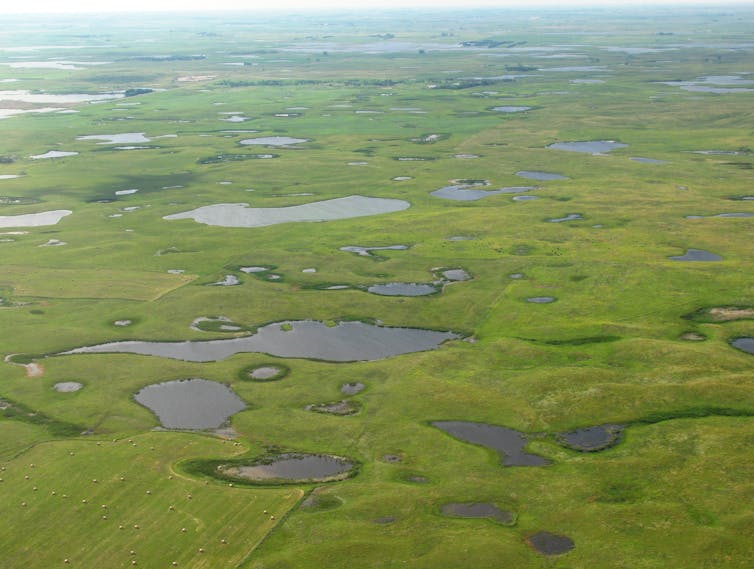
The U.S. Supreme Court has ruled in Sackett v. EPA that federal protection of wetlands encompasses only those wetlands that directly adjoin rivers, lakes and other bodies of water. This is an extremely narrow interpretation of the Clean Water Act that could expose many wetlands across the U.S. to filling and development.
Under this keystone environmental law, federal agencies take the lead in regulating water pollution, while state and local governments regulate land use. Wetlands are areas where land is wet for all or part of the year, so they straddle this division of authority.
Swamps, bogs, marshes and other wetlands provide valuable ecological services, such as filtering pollutants and soaking up floodwaters. Landowners must obtain permits to discharge dredged or fill material, such as dirt, sand or rock, in a protected wetland.
This can be time-consuming and expensive, which is why the Supreme Court’s ruling on May 25, 2023, will be of keen interest to developers, farmers and ranchers, along with conservationists and the agencies that administer the Clean Water Act – namely, the Environmental Protection Agency and the U.S. Army Corps of Engineers.
For the last 45 years – and under eight different presidential administrations – the EPA and the Corps have required discharge permits in wetlands “adjacent” to water bodies, even if a dune, levee or other barrier separated the two. The Sackett decision upends that approach, leaving tens of millions of acres of wetlands at risk.
The Sackett case
Idaho residents Chantell and Mike Sackett own a parcel of land located 300 feet from Priest Lake, one of the state’s largest lakes. The parcel once was part of a large wetland complex. Today, even after the Sacketts cleared the lot, it still has some wetland characteristics, such as saturation and ponding in areas where soil was removed. Indeed, it is still hydrologically connected to the lake and neighboring wetlands by water that flows at a shallow depth underground.
In preparation to build a house, the Sacketts had fill material placed on the site without obtaining a Clean Water Act permit. The EPA issued an order in 2007 stating that the land contained wetlands subject to the law and requiring the Sacketts to restore the site. The Sacketts sued, arguing that their property was not a wetland.
In 2012, the Supreme Court held that the Sacketts had the right to challenge EPA’s order and sent the case back to the lower courts. After losing below on the merits, they returned to the Supreme Court with a suit asserting that their property was not federally protected. This claim in turn raised a broader question: What is the scope of federal regulatory authority under the Clean Water Act?
What are ‘waters of the United States’?
The Clean Water Act regulates discharges of pollutants into “waters of the United States.” Lawful discharges may occur if a pollution source obtains a permit under either Section 404 of the act for dredged or fill material, or Section 402 for other pollutants.
The Supreme Court has previously recognized that the “waters of the United States” include not only navigable rivers and lakes, but also wetlands and waterways that are connected to navigable bodies of water. But many wetlands are not wet year-round, or are not connected at the surface to larger water systems. Still, they can have important ecological connections to larger water bodies.
In 2006, when the court last took up this issue, no majority was able to agree on how to define “waters of the United States.” Writing for a plurality of four justices in U.S. v. Rapanos, Justice Antonin Scalia defined the term narrowly to include only relatively permanent, standing or continuously flowing bodies of water such as streams, oceans, rivers and lakes. Waters of the U.S., he contended, should not include “ordinarily dry channels through which water occasionally or intermittently flows.”
Acknowledging that wetlands present a tricky line-drawing problem, Scalia proposed that the Clean Water Act should reach “only those wetlands with a continuous surface connection to bodies that are waters of the United States in their own right.”
In a concurring opinion, Justice Anthony Kennedy took a very different approach. “Waters of the U.S.,” he wrote, should be interpreted in light of the Clean Water Act’s objective of “restoring and maintaining the chemical, physical, and biological integrity of the Nation’s waters.”
Accordingly, Kennedy argued, the Clean Water Act should cover wetlands that have a “significant nexus” with navigable waters – “if the wetlands, either alone or in combination with similarly situated lands in the region, significantly affect the chemical, physical, and biological integrity of other covered waters more readily understood as ‘navigable.’”
Neither Scalia’s nor Kennedy’s opinion attracted a majority, so lower courts were left to sort out which approach to follow. Most applied Kennedy’s significant nexus standard, while a few held that the Clean Water Act applies if either Kennedy’s standard or Scalia’s is satisfied.
Regulators have also struggled with this question. The Obama administration incorporated Kennedy’s “significant nexus” approach into a 2015 rule that followed an extensive rulemaking process and a comprehensive peer-reviewed scientific assessment. The Trump administration then replaced the 2015 rule with a rule of its own that largely adopted the Scalia approach.
The Biden administration responded with its own rule defining waters of the United States in terms of the presence of either a significant nexus or continuous surface connection. However, this rule was promptly embroiled in litigation and will require reconsideration in light of Sackett v. EPA.
The Sackett decision and its ramifications
The Sackett decision adopts Scalia’s approach from the 2006 Rapanos case. Writing for a five-justice majority, Justice Samuel Alito declared that “waters of the United States” includes only relatively permanent, standing or continuously flowing bodies of water, such as streams, oceans, rivers, lakes – and wetlands that have a continuous surface connection with and are indistinguishably part of such water bodies.
None of the nine justices adopted Kennedy’s 2006 “significant nexus” standard. However, Justice Brett Kavanaugh and the three liberal justices disagreed with the majority’s “continuous surface connection” test. That test, Kavanaugh wrote in a concurrence, is inconsistent with the text of the Clean Water Act, which extends coverage to “adjacent” wetlands – including those that are near or close to larger water bodies.
“Natural barriers such as berms and dunes do not block all water flow and are in fact evidence of a regular connection between a water and a wetland,” Kavanaugh explained. “By narrowing the Act’s coverage of wetlands to only adjoining wetlands, the Court’s new test will leave some long-regulated adjacent wetlands no longer covered by the Clean Water Act, with significant repercussions for water quality and flood control throughout the United States.”
The majority’s ruling leaves little room for the EPA or the Army Corps of Engineers to issue new regulations that could protect wetlands more broadly.
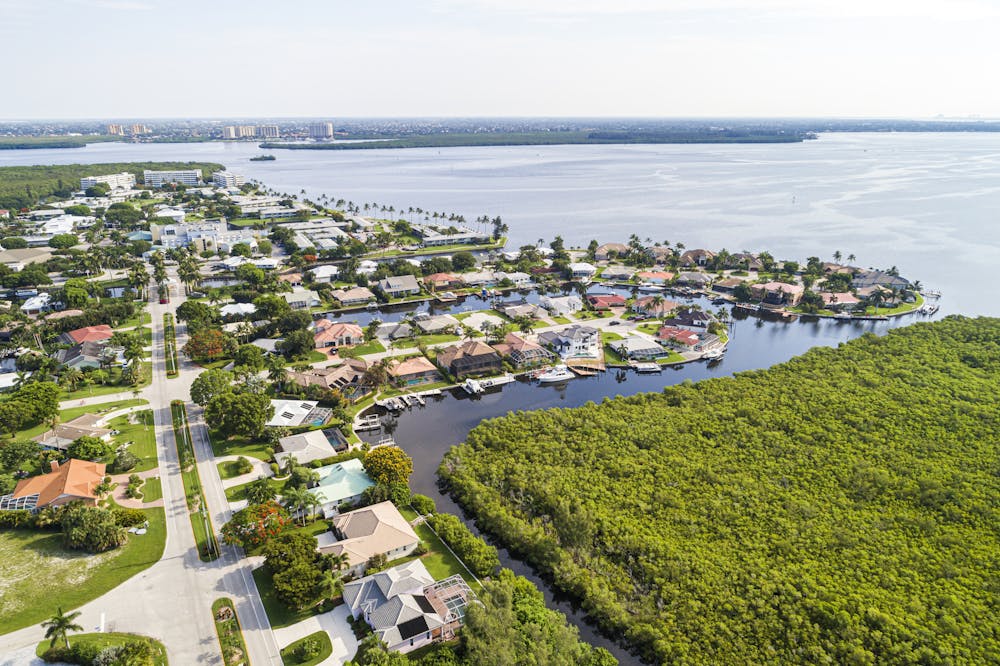
The court’s requirement of a continuous surface connection means that federal protection may no longer apply to many areas that critically affect the water quality of U.S. rivers, lakes and oceans – including seasonal streams and wetlands that are near or intermittently connected to larger water bodies. It might also mean that construction of a road, levee or other barrier separating a wetland from other nearby waters could remove an area from federal protection.
Congress could amend the Clean Water Act to expressly provide that “waters of the United States” includes wetlands that the court has now stripped of federal protection. However, past efforts to legislate a definition have fizzled, and today’s closely divided Congress is unlikely to fare any better.
Whether states will fill the breach is questionable. Many states have not adopted regulatory protections for waters that are outside the scope of “waters of the United States.” In many instances, new legislation – and perhaps entirely new regulatory programs – will be needed.
Finally, a concurring opinion by Justice Clarence Thomas hints at potential future targets for the court’s conservative supermajority. Joined by Justice Neil Gorsuch, Thomas suggested that the Clean Water Act, as well as other federal environmental statutes, lies beyond Congress’ authority to regulate activities that affect interstate commerce, and could be vulnerable to constitutional challenges. In my view, Sackett v. EPA might be just one step toward the teardown of federal environmental law.
This is an update of an article originally published on Sept. 26, 2022.
Albert C. Lin, Professor of Law, University of California, Davis
This article is republished from The Conversation under a Creative Commons license. Read the original article.
- Details
- Written by: Elizabeth Larson
Widespread rain was reported across Lake County on Sunday afternoon.
On the Northshore, the storm began around 3:30 p.m. with heavy rain.
A short time later, loud thunder claps could be heard as strikes began occurring.
Online lightning strike maps showed dozens of strikes around Lake County.
One was reported to have sparked a fire in a tree along Elk Mountain Road in Upper Lake.
Lake County News’ weather observation station showed that about half an inch of rain fell on the Northshore over the course of a few hours, before the rain stopped early Sunday evening.
The National Weather Services said conditions are expected to be clear for the rest of this week.
However, an incoming weather system expected to arrive later this week will increase the potential for more showers and thunderstorms across northwest California, the forecast said.
Email Elizabeth Larson at