 How to resolve AdBlock issue?
News
- Details
- Written by: Robert Sanders
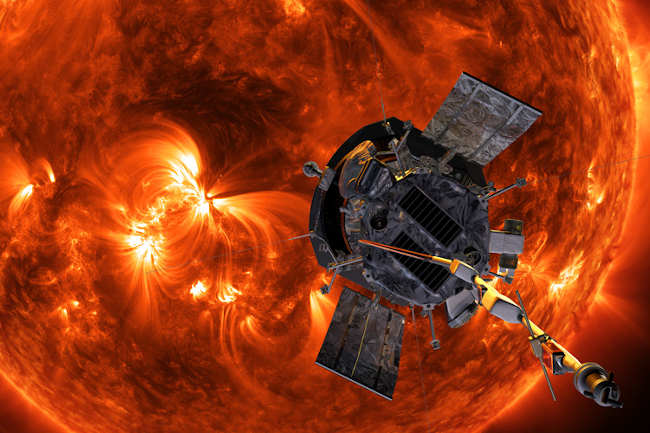
BERKELEY, Calif. — NASA's Parker Solar Probe has flown close enough to the sun to detect the fine structure of the solar wind close to where it is generated at the sun's surface, revealing details that are lost as the wind exits the corona as a uniform blast of charged particles.
It's like seeing jets of water emanating from a showerhead through the blast of water hitting you in the face.
In a paper appearing online today (June 7) in the journal Nature, a team of scientists led by Stuart D. Bale, a professor of physics at the University of California, Berkeley, and James Drake of the University of Maryland-College Park, report that the Parker Solar Probe has detected streams of high-energy particles that match the supergranulation flows within coronal holes, which suggests that these are the regions where the so-called "fast" solar wind originates.
Coronal holes are areas where magnetic field lines emerge from the surface without looping back inward, thus forming open field lines that expand outward and fill most of space around the sun.
These holes are usually at the poles during the sun's quiet periods, so the fast solar wind they generate doesn't hit Earth. But when the sun becomes active every 11 years as its magnetic field flips, these holes appear all over the surface, generating bursts of solar wind aimed directly at Earth.
Understanding how and where the solar wind originates will help predict solar storms that, while producing beautiful auroras on Earth, can also wreak havoc with satellites and the electrical grid.
“Winds carry lots of information from the sun to Earth, so understanding the mechanism behind the sun’s wind is important for practical reasons on Earth,” Drake said. “That’s going to affect our ability to understand how the sun releases energy and drives geomagnetic storms, which are a threat to our communication networks.”
Based on the team's analysis, the coronal holes are like showerheads, with roughly evenly spaced jets emerging from bright spots where magnetic field lines funnel into and out of the surface of the sun. The scientists argue that when oppositely directed magnetic fields pass one another in these funnels, which can be 18,000 miles across, the fields often break and reconnect, slinging charged particles out of the sun.
"The photosphere is covered by convection cells, like in a boiling pot of water, and the larger scale convection flow is called supergranulation," Bale said. "Where these supergranulation cells meet and go downward, they drag the magnetic field in their path into this downward kind of funnel. The magnetic field becomes very intensified there because it's just jammed. It's kind of a scoop of magnetic field going down into a drain. And the spatial separation of those little drains, those funnels, is what we're seeing now with solar probe data."
Based on the Parker's detection of some much higher energy particles — particles traveling 10 to 100 times faster than the solar wind average — the researchers conclude that the wind could only be made by this process, which is called magnetic reconnection. Parker was launched in 2018 primarily to resolve two conflicting explanations for the origin of the high-energy particles that comprise the solar wind: magnetic reconnection or acceleration by plasma or Alfvén waves.
"The big conclusion is that it's magnetic reconnection within these funnel structures that's providing the energy source of the fast solar wind," Bale said. "It doesn't just come from everywhere in a coronal hole, it's substructured within coronal holes to these supergranulation cells. It comes from these little bundles of magnetic energy that are associated with the convection flows. Our results, we think, are strong evidence that it's reconnection that's doing that."
The funnel structures likely correspond to the bright jetlets that can be seen from Earth within coronal holes, as reported recently by Nour Raouafi, a co-author of the study and the Parker Solar Probe project scientist at the Applied Physics Laboratory at Johns Hopkins University. APL, located in Laurel, Maryland, designed, built, manages and operates the spacecraft.
“Solving the mystery of the solar wind has been a six-decade dream of many generations of scientists,” said Raouafi. “Now, we are grasping at the physical phenomenon that drives the solar wind at its source — the corona.”
Plunging into the sun
By the time the solar wind reaches Earth, 93 million miles from the sun, it has evolved into a homogeneous, turbulent flow of roiling magnetic fields intertwined with charged particles that interact with Earth's own magnetic field and dump electrical energy into the upper atmosphere.
This excites atoms, producing colorful auroras at the poles, but has effects that trickle down into Earth's atmosphere. Predicting the most intense winds, called solar storms, and their near-Earth consequences is one mission of NASA's Living With a Star program, which funded Parker.
The probe was designed to determine what this turbulent wind looks like where it's generated near the sun's surface, or photosphere, and how the wind's charged particles — protons, electrons and heavier ions, primarily helium nuclei — are accelerated to escape the sun's gravity.
To do this, Parker had to get closer than 25 to 30 solar radii, that is, closer than about 13 million miles.
"Once you get below that altitude, 25 or 30 solar radii or so, there's a lot less evolution of the solar wind, and it's more structured — you see more of the imprints of what was on the sun," Bale said.
In 2021, Parker's instruments recorded magnetic field switchbacks in the Alfvén waves that seemed to be associated with the regions where the solar wind is generated. By the time the probe reached about 12 solar radii from the surface of the sun — 5.2 million miles — the data were clear that the probe was passing through jets of material, rather than mere turbulence.
Bale, Drake and their colleagues traced these jets back to the supergranulation cells in the photosphere, where magnetic fields bunch up and funnel into the sun.
But were the charged particles being accelerated in these funnels by magnetic reconnection, which would slingshot particles outward, or by waves of hot plasma — ionized particles and magnetic field — streaming out of the sun, as if they're surfing a wave?
The fact that Parker detected extremely high-energy particles in these jets — tens to hundreds of kiloelectron volts (keV), versus a few keV for most solar wind particles — told Bale that it has to be magnetic reconnection that accelerates the particles and generates the Alfvén waves, which likely give the particles an extra boost.
"Our interpretation is that these jets of reconnection outflow excite Alfvén waves as they propagate out," Bale said. "That's an observation that's well known from Earth's magnetotail, as well, where you have similar kind of processes. I don't understand how wave damping can produce these hot particles up to hundreds of keV, whereas it comes naturally out of the reconnection process. And we see it in our simulations, too. "
Parker won't be able to get any closer to the sun than about 8.8 solar radii above the surface — about 4 million miles — without frying its instruments. Bale expects to solidify the team's conclusions with data from that altitude, though the sun is now entering solar maximum, when activity becomes much more chaotic and may obscure the processes the scientists are trying to view.
"There was some consternation at the beginning of the solar probe mission that we're going to launch this thing right into the quietest, most dull part of the solar cycle," Bale said. "But I think without that, we would never have understood this. It would have been just too messy. I think we're lucky that we launched it in the solar minimum."
The work was funded by NASA (Contract NNN06AA01C).
Robert Sanders writes for the UC Berkeley News Center.
- Details
- Written by: LAKE COUNTY NEWS REPORTS

KELSEYVILLE, Calif. — Caltrans and local officials on Wednesday gathered at State Route 29 at Konocti Rock Company Road to celebrate the completion of the $85 million Konocti Corridor project, the first phase of a safety project that will eventually widen an 8-mile section of Route 29.
The cost was covered by Caltrans, the Lake Area Planning Council, or Lake APC, and the Federal Highway Administration.
“Completing the first phase of the Konocti Corridor Project advances the long term vision for a brighter future for Lake County and all Californians,” said Caltrans District 1 Director Matt Brady. “Our continuing partnership with the Lake Area Planning Council and the Federal Highway Administration has helped make this safety project possible.”
Lake APC Executive Director Lisa Davey-Bates, who has worked on this project for 23 years, highlighted the importance of the partnerships that enabled the project to proceed.

“From the start, it’s been a long, but rewarding process. I’d like to take this opportunity to give my sincerest thanks to Caltrans staff who have contributed their time, energy, and financial support to the Konocti Corridor project,” said Davey-Bates. “Since 1988 there has been a team of experts working together on this project to provide a safer and more efficient roadway network for motorists, cyclists and pedestrians in Lake County.”
The corridor serves the communities of Lakeport, Kelseyville, Lower Lake and Middletown, as well as auto and commercial truck traffic traveling between U.S. 101 and Interstate 5.
With anticipated traffic growth, by expanding the section of highway to four lanes with controlled access, capacity will be increased, and highway safety will be significantly improved.
In addition, the new expressway will assist in achieving the long-range plan to divert traffic from communities on the northern end of Clearlake, where pedestrian and nonmotorized traffic safety have been an ongoing concern.

In all, the project will widen an 8-mile section of Route 29 and is separated into three different segments.
The recently completed 3-mile segment, 2C, extends from east of Route 175 near Kelseyville to Konocti Rock Company Road.
The other two portions, segment 2A and 2B, are to the east of 2C, and the partners are working to secure funding to complete the project.
“While we are grateful for the completion of the first phase of the Konocti Corridor safety project, we are still not done,” said Caltrans Corridor Manager Jaime Matteoli. “Our team is currently working on the financial support needed to finish the five-mile stretch of roadway on Route 29.”
O.C. Jones & Sons was the contractor for the first segment of the project.
For more information, visit https://dot.ca.gov/caltrans-near-me/district-1/d1-projects/d1-konocti-corridor-lake-29.

- Details
- Written by: LAKE COUNTY NEWS REPORTS

CLEARLAKE, Calif. — The Clearlake Police Department is attempting to locate a missing 14-year-old girl.
Naedean Rachel Parker, 14, was last seen in Clearlake, police said.
She is described as a black female juvenile, with a short black afro with brown highlights and brown eyes.
Naedean is 5 feet, 3 inches tall and weighs 130 pounds. A description of the clothing she was wearing when last seen was not available.
If you have any information regarding her whereabouts, please contact the Clearlake Police Department at 707-994-8251, Extension 1.
- Details
- Written by: Emily Hemendinger, University of Colorado Anschutz Medical Campus

Media influences and conventional beauty standards have long plagued society.
This issue took on new urgency in May 2023 when the U.S. surgeon general issued a major public advisory over the links between social media and youth mental health.
Research shows that images of beauty as depicted in movies, television and magazines can lead to mental illness, issues with disordered eating and body image dissatisfaction.
These trends have been documented in women and men, in the LGBTQ+ community and in people of different racial and ethnic backgrounds.
Experts have long suspected that social media may be playing a role in the growing mental health crisis in young people. However, the surgeon general’s warning is one of the first public warnings supported by robust research.
Social media can be toxic
Body dissatisfaction among children and adolescents is commonplace and has been linked to decreased quality of life, worsened mood and unhealthy eating habits.
As an eating disorder and anxiety specialist, I regularly work with clients who experience eating disorder symptoms, self-esteem issues and anxiety related to social media.
I also have firsthand experience with this topic: I am 15 years post-recovery from an eating disorder, and I grew up when people were beginning to widely use social media. In my view, the impact of social media on diet and exercise patterns needs to be further researched to inform future policy directions, school programming and therapeutic treatment.
The mental health of adolescents and teens has been declining for the past decade, and the COVID-19 pandemic contributed to worsening youth mental health and brought it into the spotlight. As the mental health crisis surges, researchers have been taking a close look at the role of social media in these increasing mental health concerns.
The pros and cons of social media
About 95% of children and adolescents in the U.S. between the ages of 10 and 17 are using social media almost constantly.
Research has shown that social media can be beneficial for finding community support. However, studies have also shown that the use of social media contributes to social comparisons, unrealistic expectations and negative mental health effects.
In addition, those who have preexisting mental health conditions tend to spend more time on social media. People in that category are more likely to self-objectify and internalize the thin body ideal. Women and people with preexisting body image concerns are more likely to feel worse about their bodies and themselves after they spend time on social media.
A breeding ground for eating disorders
A recent review found that, as with mass media, the use of social media is a risk factor for the development of an eating disorder, body image dissatisfaction and disordered eating. In this review, social media use was shown to contribute to negative self-esteem, social comparisons, decreased emotional regulation and idealized self-presentation that negatively influenced body image.
Another study, called the Dove Self-Esteem Project, published in April 2023, found that 9 in 10 children and adolescents ages 10 to 17 are exposed to toxic beauty content on social media and 1 in 2 say that this has an impact on their mental health.
Eating disorders are complex mental illnesses that develop because of biological, social and psychological factors. Eating disorder hospitalizations and the need for treatment have dramatically increased during the pandemic.
Some reasons for this include isolation, food scarcity, boredom and social media content related to weight gain, such as the “quarantine15.” That was a reference to the weight gain some people were experiencing at the beginning of the pandemic, similar to the “freshman 15” belief that one will gain 15 pounds in the first year of college. Many teens whose routines were disrupted by the pandemic turned to eating disorder behaviors for an often-false sense of control or were influenced by family members who held unhealthy beliefs around food and exercise.
Researchers have also found that increased time at home during the pandemic led to more social media use by young people and therefore more exposure to toxic body image and dieting social media content.
While social media alone will not cause eating disorders, societal beliefs about beauty, which are amplified by social media, can contribute to the development of eating disorders.
‘Thinspo’ and ‘fitspo’
Toxic beauty standards online include the normalization of cosmetic and surgical procedures and pro-eating-disorder content, which promotes and romanticizes eating disorders. For instance, social media sites have promoted trends such as “thinspo,” which is focused on the thin ideal, and “fitspo,” which perpetuates the belief of there being a perfect body that can be achieved with dieting, supplements and excessive exercise.
Research has shown that social media content encouraging “clean eating” or dieting through pseudoscientific claims can lead to obsessive behavior around dietary patterns. These unfounded “wellness” posts can lead to weight cycling, yo-yo dieting, chronic stress, body dissatisfaction and higher likelihood of muscular and thin-ideal internalization.
Some social media posts feature pro-eating-disorder content, which directly or indirectly encourages disordered eating. Other posts promote deliberate manipulation of one’s body, using harmful quotes such as “nothing tastes as good as thin feels.” These posts provide a false sense of connection, allowing users to bond over a shared goal of losing weight, altering one’s appearance and continuing patterns of disordered eating.
While young people can often recognize and understand toxic beauty advice’s effects on their self-esteem, they may still continue to engage with this content. This is in part because friends, influencers and social media algorithms encourage people to follow certain accounts.
How policy changes could help
Legislators across the U.S. are proposing different regulations for social media sites.
Policy recommendations include increased transparency from social media companies, creation of higher standards of privacy for children’s data and possible tax incentives and social responsibility initiatives that would discourage companies and marketers from using altered photos.
Phone-free zones
Small steps at home to cut down on social media consumption can also make a difference. Parents and caregivers can create phone-free periods for the family. Examples of this include putting phones away while the family watches a movie together or during mealtimes.
Adults can also help by modeling healthy social media behaviors and encouraging children and adolescents to focus on building connections and engaging in valued activities.
Mindful social media consumption is another helpful approach. This requires recognizing what one is feeling during social media scrolling. If spending time on social media makes you feel worse about yourself or seems to be causing mood changes in your child, it may be time to change how you or your child interact with social media.
Emily Hemendinger, Assistant Professor of Psychiatry, University of Colorado Anschutz Medical Campus
This article is republished from The Conversation under a Creative Commons license. Read the original article.