 How to resolve AdBlock issue?
News
- Details
- Written by: LAKE COUNTY NEWS REPORTS

LOWER LAKE, Calif. — A new glamping retreat is set to open later this month in Lower Lake.
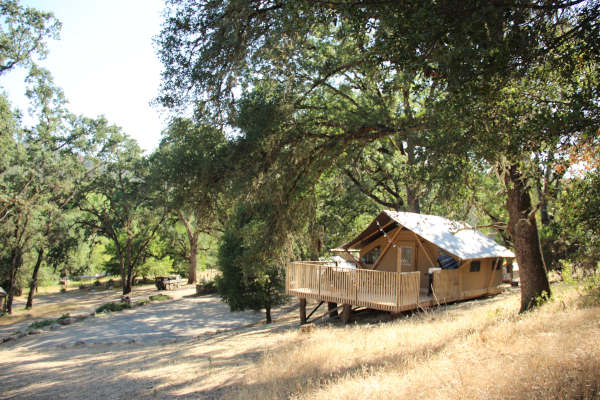
Huttopia, a popular family-owned European elevated camping brand recognized for its collection of sustainable ready-to-camp, or “prêt-à-camper,” lodging concepts across the world, announced Tuesday the debut of its sixth location in North America, Huttopia Wine Country, opening this June 30 in partnership with Six Sigma Ranch and Winery.
Set on the 4,300-acre Six Sigma Ranch and Winery, Huttopia Wine Country will feature fully solar-powered facilities, including the main lodge, swimming pool and all accommodations, making it the world’s first Huttopia camp to be truly off-grid.
Opening with a collection of 63 fully solar-powered wood and canvas tents in three different configurations accommodating from two to five guests, the ready-to-camp property offers guests uninterrupted access to Six Sigma’s miles of hiking and mountain biking trails, wine tastings and vineyard tours, and panoramic views of the region’s rolling vineyard hills.
On-site amenities include a central lodge, kids’ playground, camp store and custom-fitted Airstream food truck, offering fresh-made meals, small dining delights and a selection of wines from the Six Sigma Winery and across France.
Families can explore with the property’s electric mountain bike rentals, wind down with the solar-heated swimming pool, or games of Ping-Pong, pétanque and corn hole.
“When we started our partnership Six Sigma Ranch and Winery, it felt like a natural fit for us given our shared ethos as family-run businesses with a focus on sustainability,” said Margaux Bossanne, Huttopia’s North American brand manager. “To establish Huttopia’s presence in a location as pristine as this will afford our guests a familiar experience in a new and desirable location, and we’re also thrilled to be able to offer visitors to Six Sigma low-impact lodging to rest their heads at the end of the day.”
Open this June 30 through late November, and seasonally from March through November beginning in 2024, Huttopia Wine Country rates start at $109 per night.
Huttopia also features North American ready-to-camp sites in Southern Maine, New Hampshire’s White Mountains, New York’s Adirondacks, Sutton, Quebec and the most recent addition, Huttopia Paradise Springs in Southern California.
For more information, visit the Huttopia website.
- Details
- Written by: LAKE COUNTY NEWS REPORTS
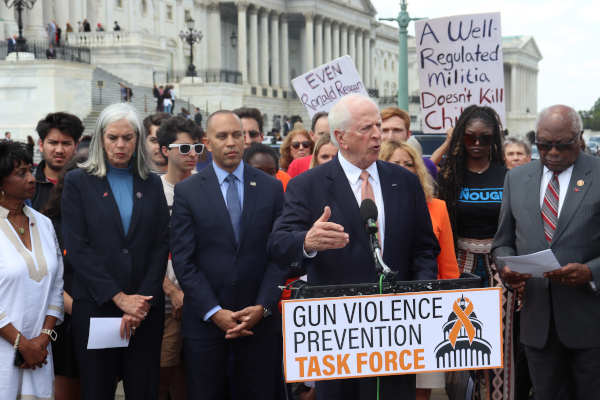
On Tuesday, Gun Violence Prevention Task Force Chairman Rep. Mike Thompson (CA-04), Task Force Vice Chair Rep. Lucy McBath (GA-07), Assistant Democratic Leader Jim Clyburn (SC-06), and House Democratic Leader Hakeem Jeffries (NY-08) announced a legislative strategy on gun violence prevention.
Reps. Thompson, Clyburn and McBath filed discharge petitions for their bills: the Bipartisan Background Checks Act, the Enhanced Background Checks Act and the Assault Weapons Ban
“Over the last several months, members of the Gun Violence Prevention Task Force have been personally appealing to House Republicans to find any common ground for bipartisan action on gun violence prevention,” said Thompson. “While the American people are calling for progress, it remains clear that House Republican Leadership refuses to take this issue seriously. The American people deserve more from their elected representatives, and House Democrats are launching three discharge petitions on gun violence prevention legislation that would help save lives and keep our children safe, including my Bipartisan Background Checks Act. Action on gun violence prevention is long overdue — the only question is will Republicans join us in bringing these bills up for a vote.”
“As a nation, we should not be in a situation where our children are afraid to go to school or where people have to live in fear when they go to a mall, a concert or a place of worship. House Democrats are determined to address this crisis and I'm grateful to the Gun Violence Prevention Task Force for leading the charge and launching these three discharge petitions. While extreme MAGA Republicans are willing to flood our streets with weapons of war, House Democrats are willing to do whatever is necessary to protect our communities and end the scourge of gun violence once and for all,” said Jeffries.
“This Saturday, June 17, marks eight years since nine parishioners lost their lives and three others were victimized at the Emanuel AME Church in Charleston, South Carolina. In the years since, my bill to close the deadly loophole that allowed the shooter to obtain his gun has passed the House twice under Democratic majorities, but Republican opposition has prevented it from being enacted into law,” said Assistant Democratic Leader James E. Clyburn. “We need action to end this gun violence epidemic. That starts with signing these discharge petitions to enact common-sense gun violence prevention legislation and protect our communities.”
“Today marks a new step in our journey to ending gun violence in America. My colleagues and I have just filed discharge petitions to force Republican leadership to bring common-sense gun safety legislation to the floor," said McBath. "After the conviction of my son’s killer, I made a promise to Jordan on the steps of the Courthouse to take all the love I have as a mother and spend the rest of my life devoted to making sure parents across the country never had to go through the same pain that I did. It is these policies that will fulfill our promise."
Under House parliamentary rules, once a petition has garnered 218 signatures, a motion to discharge can then be offered on the Floor and the measure can be put to a vote.
- Details
- Written by: NATIONAL OCEANIC AND ATMOSPHERIC ADMINISTRATION
May 2023 was quite warm across the contiguous U.S., ranking as the 11th-warmest May in the climate record.
The month also wrapped up a rather warm year so far, according to scientists from NOAA’s National Centers for Environmental Information.
Below are highlights from NOAA's U.S. monthly climate report for May 2023:
Climate by the numbers
May 2023
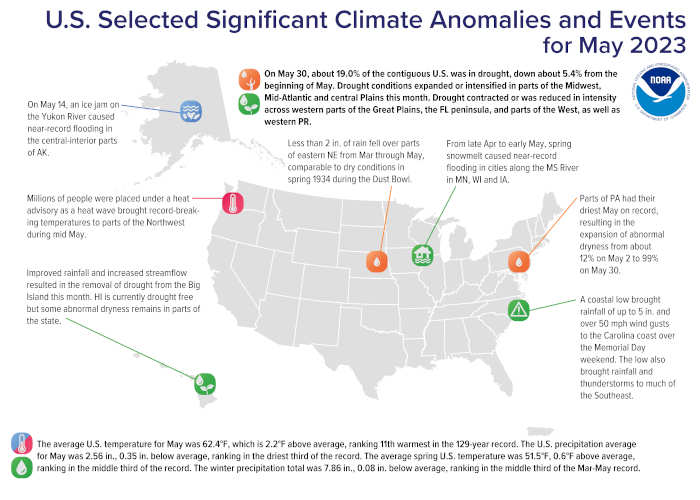
The average May temperature across the contiguous U.S. was 62.4 degrees F (2.2 degrees above the 20th-century average), ranking as the 11th-warmest May in NOAA’s 129-year climate record.
Temperatures were generally below average along the East Coast and above average across much of the West. Washington state had its warmest May on record while Minnesota, North Dakota, South Dakota and Wyoming each had a May that ranked as their top-5 warmest. Idaho, Montana and Oregon saw their fifth-warmest May, while South Carolina’s May was the state’s 10th-coolest.
The average precipitation for May was 2.56 inches (0.35 of an inch below average), which ranked in the driest third of the record.
Precipitation was above average across much of the western Plains and West and in parts of the Southeast and New England. Precipitation was below average from the Mississippi River Valley to the Mid-Atlantic and southern New England, and in parts of the Northwest and central Rockies. Wisconsin saw its fourth-driest May on record while Pennsylvania saw its fifth driest. Maryland and Michigan ranked eighth and ninth driest on record, respectively. No state experienced a top-10 wettest May on record.
Meteorological spring (March through May 2023) | Year to date
The average temperature for the contiguous U.S. during meteorological spring was 51.5 degrees F (0.6 of a degree above average), which ranked in the middle third of the climate record. Florida ranked fourth warmest while Massachusetts ranked 10th warmest on record for this spring season.
The spring precipitation total of 7.86 inches (0.08 of an inch below average) placed it in the middle third of the record. Maryland and Pennsylvania each ranked ninth driest on record while Kansas ranked 13th driest.
The average U.S. temperature for the year to date (YTD, January through May 2023) was 45.2 degrees F, 1.9 degrees above average, ranking as the 18th-warmest such YTD on record.
Precipitation for the first five months of 2023 totaled 12.82 inches — 0.43 of an inch above average — ranking in the middle third of the record. January-through-May 2023 ranked as Utah's 11th wettest and Nevada’s 13th wettest such period on record, while Maryland ranked fifth driest and Pennsylvania ranked 12th driest.
Other notable highlights from the report
Drought improved dramatically: According to the May 30 U.S. Drought Monitor reportoffsite link, 19.0% of the contiguous U.S. was in drought, down about 5.4% from the beginning of May 2023. Drought coverage in the contiguous U.S. has dropped nearly 44% over the last seven months, from 62.78% on November 11, 2022 to 18.95% on May 30, 2023 — the fastest reduction in drought coverage since the start of the U.S. Drought Monitor report and the smallest drought footprint since May 26, 2020.
A stormy May in some parts of the U.S.: Several notable weather systems produced severe thunderstorms and a number of tornadoes that impacted portions of the U.S. last month.
• May 7: A line of thunderstorms moved into southern Indiana and northern Kentucky. A total of six tornadoes was confirmed by NOAA’s National Weather Service (NWS), five of which occurred within a 15-minute span.
• May 11: A tornado outbreak occurred across areas of central Oklahoma. A total of nine tornadoes was confirmed by NWS, snapping utility poles and damaging homes.
• May 12: Severe thunderstorms produced several tornadoes, up to grapefruit-sized hail and flooding in parts of Nebraska. A total of 19 tornadoes, including three rated as EF-2, was confirmed by NWS.
- Details
- Written by: Patrick Heuveline, University of California, Los Angeles
The Research Brief is a short take about interesting academic work.
The big idea
People in the U.S. are dying at higher rates than in other similar high-income countries, and that difference is only growing. That’s the key finding of a new study that I published in the journal PLOS One.
In 2021, more than 892,000 of the 3,456,000 deaths the U.S. experienced, or about 1 in 4, were “excess deaths.” In 2019, that number was 483,000 deaths, or nearly 1 in 6. That represents an 84.9% increase in excess deaths in the U.S. between 2019 and 2021.
Excess deaths refer to the actual number of deaths that occur in a given year compared with expected deaths over that same time period based on prior years or, as in this study, in other countries.
In my study, I compared the number of U.S. deaths with those in the five largest countries in Western Europe: England and Wales, France, Germany, Italy and Spain. Those five countries make for a good comparison because they are nearly, if not quite, as wealthy as the U.S. and their combined population is similar in size and diversity to the U.S. population.
I also chose those countries because they were used in an earlier study from another research team that documented a 34.5% increase in excess deaths in the U.S. between 2000 and 2017.
The acceleration of this already alarming long-term trend in excess deaths in the U.S. was exacerbated by the fact that the U.S. experienced higher death rates from COVID-19 compared with similar countries. However, COVID-19 alone does not account for the recent increase in the number of excess deaths in the U.S. relative to comparison countries.
Why it matters
Rising living standards and medical advances through the 20th century have made it possible for people in wealthy countries to live longer and with a better quality of life. Given that the U.S. is the largest economic power in the world, with cutting-edge medical technology, Americans should have an advantage over other countries in terms of life span and death rates.
But in the last 50 years, many countries around the world have outpaced the U.S. in how fast death rates are declining, as revealed by trends in life expectancy.
Life expectancy is an average age at death, and it represents how long an average person is expected to live if current death rates remain unchanged throughout that person’s lifetime. Life expectancy is based on a complex combination of death rates at different ages, but in short, when death rates decline, life expectancy increases.
Compared to about 20 other high-income countries, since around the mid-1970s the U.S. life expectancy has been slipping from about the middle, or median, to the lowest rungs of life expectancy. So the relative stagnation in life expectancy in the U.S. compared with other countries is directly related to the fact that death rates have also declined more slowly in the U.S.
The U.S. has higher death rates than its peer countries due to a variety of causes. Cardiovascular disease prevalence has been an important driver of life expectancy changes across the globe in recent decades. But while death rates from cardiovascular disease have continued to decline in other parts of the world, those rates have stagnated in the U.S..
A key reason for this trend is the rise in obesity, as research shows that obesity increases the risk of death from cardiovascular disease. High prevalence of obesity in the U.S. also likely contributed to the relatively high death rates from COVID-19.
Another cause is that the U.S. has disproportionately high death rates from intentional injuries in the form of homicides, in particular those caused by firearms. Moreover, it also has high death rates from unintentional injuries, in particular drug overdoses.
What other research is being done
While these specific causes of deaths should clearly be health policy priorities today, there might be more fundamental causes to the elevated U.S. death rates.
In the early 1990s, young people in the U.S. between the ages of 15 and 34 were already dying at higher rates than their peers in other countries from a combination of homicides, unintentional injuries – in large part from motor vehicle accidents – and deaths from HIV/AIDS.
Research is underway to understand the more fundamental societal causes that may explain the vulnerability of the U.S. population to successive epidemics, from HIV/AIDS and COVID-19 to gun violence and opioid overdoses.
These include racial and economic inequalities, which combined with a weaker social security net and lack of health care access for all may help explain larger health and death disparities compared to European countries.
Patrick Heuveline, Professor of Sociology, University of California, Los Angeles
This article is republished from The Conversation under a Creative Commons license. Read the original article.