 How to resolve AdBlock issue?
News
Space News: Webb telescope celebrates first year of science with close-up on birth of sun-like stars
- Details
- Written by: NATIONAL AERONAUTICS AND SPACE ADMINISTRATION
From our cosmic backyard in the solar system to distant galaxies near the dawn of time, NASA’s James Webb Space Telescope has delivered on its promise of revealing the universe like never before in its first year of science operations.
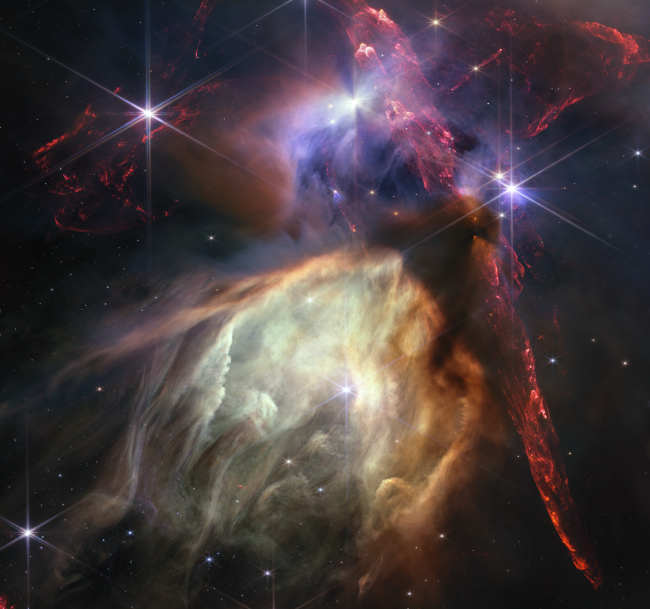
To celebrate the completion of a successful first year, NASA has released Webb’s image of a small star-forming region in the Rho Ophiuchi cloud complex.
“In just one year, the James Webb Space Telescope has transformed humanity’s view of the cosmos, peering into dust clouds and seeing light from faraway corners of the universe for the very first time. Every new image is a new discovery, empowering scientists around the globe to ask and answer questions they once could never dream of,” said NASA Administrator Bill Nelson. “Webb is an investment in American innovation but also a scientific feat made possible with NASA’s international partners that share a can-do spirit to push the boundaries of what is known to be possible. Thousands of engineers, scientists, and leaders poured their life’s passion into this mission, and their efforts will continue to improve our understanding of the origins of the universe — and our place in it.”
The new Webb image released today features the nearest star-forming region to us. Its proximity at 390 light-years allows for a highly detailed close-up, with no foreground stars in the intervening space.
“On its first anniversary, the James Webb Space Telescope has already delivered upon its promise to unfold the universe, gifting humanity with a breathtaking treasure trove of images and science that will last for decades,” said Nicola Fox, associate administrator of NASA’s Science Mission Directorate in Washington. “An engineering marvel built by the world’s leading scientists and engineers, Webb has given us a more intricate understanding of galaxies, stars, and the atmospheres of planets outside of our solar system than ever before, laying the groundwork for NASA to lead the world in a new era of scientific discovery and the search for habitable worlds.”
Webb’s image shows a region containing approximately 50 young stars, all of them similar in mass to the Sun, or smaller.
The darkest areas are the densest, where thick dust cocoons still-forming protostars. Huge bipolar jets of molecular hydrogen, represented in red, dominate the image, appearing horizontally across the upper third and vertically on the right. These occur when a star first bursts through its natal envelope of cosmic dust, shooting out a pair of opposing jets into space like a newborn first stretching her arms out into the world.
In contrast, the star S1 has carved out a glowing cave of dust in the lower half of the image. It is the only star in the image that is significantly more massive than the Sun.
“Webb’s image of Rho Ophiuchi allows us to witness a very brief period in the stellar life cycle with new clarity. Our own Sun experienced a phase like this, long ago, and now we have the technology to see the beginning of another’s star’s story,” said Klaus Pontoppidan, who served as Webb project scientist at the Space Telescope Science Institute in Baltimore, Maryland, since before the telescope’s launch and through the first year of operations.
Some stars in the image display telltale shadows indicating protoplanetary disks — potential future planetary systems in the making.
A full year, across the full sky
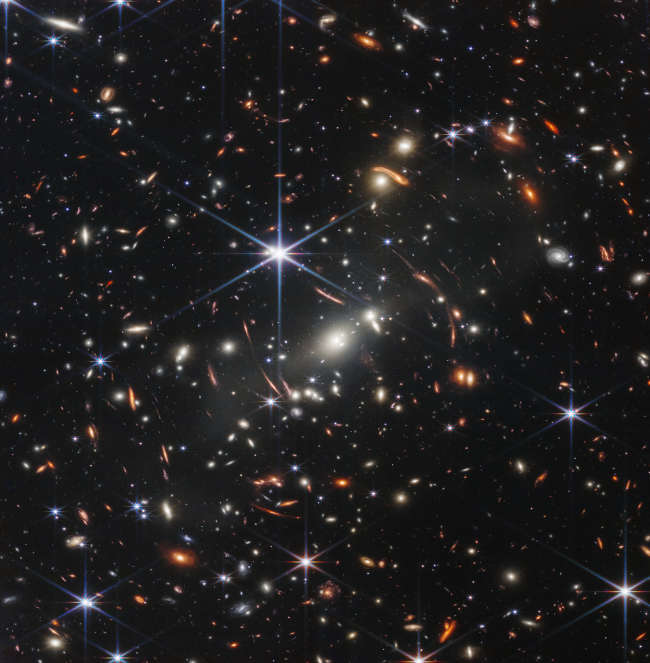
From its very first deep field image, unveiled by President Joe Biden, Vice President Kamala Harris and Nelson live at the White House, Webb has delivered on its promise to show us more of the universe than ever before. However, Webb revealed much more than distant galaxies in the early universe.
“The breadth of science Webb is capable of exploring really becomes clear now, when we have a full year’s worth of data from targets across the sky,” said Eric Smith, associate director for research in the Astrophysics Division at NASA Headquarters and Webb program scientist. “Webb’s first year of science has not only taught us new things about our universe, but it has revealed the capabilities of the telescope to be greater than our expectations, meaning future discoveries will be even more amazing.” The global astronomy community has spent the past year excitedly poring over Webb’s initial public data and getting a feel for how to work with it.
Beyond the stunning infrared images, what really has scientists excited are Webb’s crisp spectra — the detailed information that can be gleaned from light by the telescope’s spectroscopic instruments. Webb’s spectra have confirmed the distances of some of the farthest galaxies ever observed, and have discovered the earliest, most distant supermassive black holes.
They have identified the compositions of planet atmospheres (or lack thereof) with more detail than ever before, and have narrowed down what kinds of atmospheres may exist on rocky exoplanets for the first time.
They also have revealed the chemical makeup of stellar nurseries and protoplanetary disks, detecting water, organic carbon-containing molecules, and more. Already, Webb observations have resulted in hundreds of scientific papers answering long-standing questions and raising new ones to address with Webb.
The breadth of Webb science is also apparent in its observations of the region of space we are most familiar with — our own solar system.
Faint rings of gas giants appear out of the darkness, dotted by moons, while in the background Webb shows distant galaxies.
By comparing detections of water and other molecules in our solar system with those found in the disks of other, much younger planetary systems, Webb is helping to build up clues about our own origins — how Earth became the ideal place for life as we know it.
“With a year of science under our belts, we know exactly how powerful this telescope is, and have delivered a year of spectacular data and discoveries,” said Webb Senior Project Scientist Jane Rigby of NASA's Goddard Space Flight Center. “We've selected an ambitious set of observations for year two — that builds on everything we've learned so far. Webb's science mission is just getting started — there's so much more to come.”
The James Webb Space Telescope is the world's premier space science observatory. Webb is solving mysteries in our solar system, looking beyond to distant worlds around other stars, and probing the mysterious structures and origins of our universe and our place in it. Webb is an international program led by NASA with its partners, European Space Agency and the Canadian Space Agency.
- Details
- Written by: LAKE COUNTY NEWS REPORTS
LAKE COUNTY, Calif. — After losing one of its members in the spring, the Lake County Board of Education has appointed a well-known businesswoman to fill the vacancy.
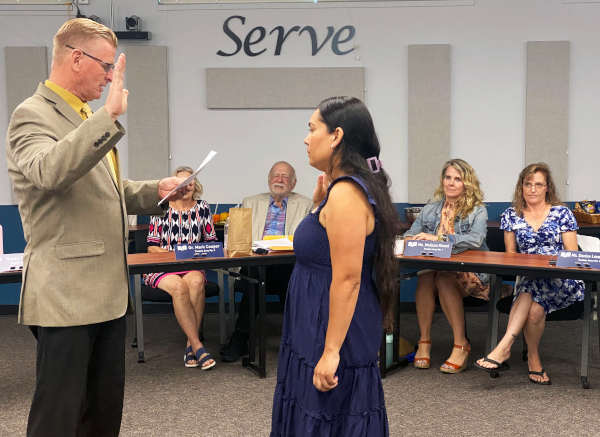
At its meeting on Wednesday, June 14, the board voted to appoint Itzia Rico to be the trustee representing Area 5, which includes Kelseyville.
The vacancy occurred on April 27, due to the death of Board Member Anna Rose Ravenwoode.
The Lake County Office of Education held a public recruitment for board candidates and received three applications. Applicants were Rico, Shauna Petker and Gary Olson.
During a regular board meeting, board members Denise Loustalot, Melissa Kinsel, Mark Cooper and Nancy Hudson interviewed the three applicants in open session.
Following the board’s deliberation, the trustees voted to appoint Rico, who was then sworn in. The term of her appointment will be until December 2024.
Rico is a longtime Lake County resident and the owner of Studebakers coffee shop located in downtown Kelseyville. She is part of the Kelseyville Business Association and has served as their secretary.
“I realize how important it is for our youth to succeed. They are the future of our communities,” Rico said. “Through my own children, I see how much teachers influence our kids. I hope to learn how I can help too, as a board member.”
Rico is a mother of five children, four of whom are enrolled in schools in the Kelseyville Unified School District.
She has volunteered in classrooms, coached youth basketball and held a free volleyball camp for middle school players that did not make the school team.
She is always looking for ways to support schools and Lake County students.
“Her ties to the community, perspective as a parent and her focus on putting students first is a welcome addition to the dynamic of the Board of Education,” said Lake County Superintendent of Schools Brock Falkenberg.
The Board of Education thanks all applicants for putting themselves up for consideration.
Pursuant to California Ed Code section 5091, the Lake County Board of Education trustees provisionally appointed Itzia Rico to fill the vacancy on June 14, 2023.
Unless a petition calling for a special election containing a sufficient number of signatures is filed with the Lake County Superintendent of Schools within 30 days of the provisional appointment, the appointment shall become an effective appointment.
- Details
- Written by: LAKE COUNTY NEWS REPORTS
To complete the project, the county of Lake, and cities of Lakeport and Clearlake have contributed a total of $20,000 in matching funds.
The CEDS update is a locally driven effort to guide the economic prosperity and resiliency and serves to engage community leaders, private sector firms and industries in the development of the five-year plan.
The completed CEDS will act as a road map for future economic development efforts and provide supporting documents when seeking federal grant funding to complete projects that fit within priorities named within the CEDS.
Lake EDC will be seeking community input and collaboration during the 12-month process.
Steps in the process will include data analysis, community listening sessions and engagement with agencies involved in infrastructure, private sector industry, healthcare, resiliency, education, natural environment, and government.
Additionally, Lake EDC will be publishing a request for proposals, or RFPs, to assist in the development of the CEDS.
To find out more about the CEDS process, how you can participate, or how to bid on the RFPs, visit https://lakecountycaedc.org/CEDS/.
- Details
- Written by: Derek Lemoine, University of Arizona; Jeffrey Shrader, Columbia University, and Laura Bakkensen, University of Arizona

Weather forecasts have gotten quite good over the years, but their temperatures aren’t always spot on – and the result when they underplay extremes can be lethal. Even a 1-degree difference in a forecast’s accuracy can be the difference between life and death, our research shows.
As economists, we have studied how people use forecasts to manage weather risks. In a new working paper for the National Bureau of Economic Research, we looked at how human survival depends on the accuracy of temperature forecasts, particularly during heat waves like large parts of the U.S. have been experiencing in recent days.
We found that when the forecasts underplayed the risk, even small forecast errors led to more deaths.
Our results also show that improving forecasts pays off. They suggest that making forecasts 50% more accurate would save 2,200 lives per year across the country and would have a net value that’s nearly twice the annual budget of the National Weather Service.
Forecasts that are too mild lead to more deaths
In the U.S. alone, the National Oceanic and Atmospheric Administration issues 1.5 million forecasts per year and collects around 76 billion weather observations that help it and private companies make better forecasts.
We examined data on every day’s deaths, weather and National Weather Service forecast in every U.S county from 2005 to 2017 to analyze the impact of those forecasts on human survival.
We then compared deaths in each county over the week following a day with accurate forecasts to deaths in the same county over the week following a day with inaccurate forecasts but the same weather. Because weather conditions were the same, any differences in mortality could be attributed to how people’s reactions to forecasts affected their chance of dying in that weather.
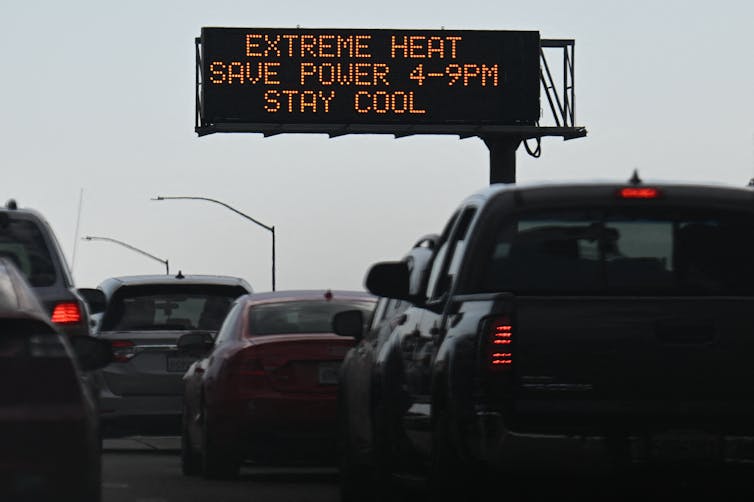
We found similar results when the forecast was wrong on hot days with temperatures above 86 degrees Fahrenheit (30 Celsius) and on cold days with temperatures below freezing. Both summer days that were hotter than forecast and winter days that were colder had more deaths. Forecasts that went the other way and overestimated the summer heat or winter cold had little impact.
That doesn’t mean forecasters should exaggerate their forecasts, however. If people find that their forecasts are consistently off by a degree or two, they might change how they use forecasts or come to trust them less, leaving people at even higher risk.
People are paying attention
People do pay attention to forecasts and adjust their activities.
The American Time Use Survey, conducted continuously for the U.S. Bureau of Labor Statistics, shows what Americans across the country are doing on any given day. We found that on days when the forecast called for temperatures to be milder than they turned out to be – either cooler on a hot day or warmer on a cold day – people in the survey spent more time on leisure and less in home or work settings.
Electricity use also varies in sync with forecasts, suggesting that people’s use of air conditioning does not just respond to the weather outside but also depends on how they planned for the weather outside.

However, forecasts are not used equally across society. Deaths among racial minorities are less sensitive to forecast errors, we found. That could be due in part to having less flexibility to act on forecasts, or not having access to forecasts. We will dig into this difference in future work, as the answer determines how the National Weather Service can best reach everyone.
The value of better forecasts
It’s clear that people use forecasts to make decisions that can matter for life and death – when to go hiking, for example, or whether to encourage an elderly neighbor to go to a cooling center.
So, what is the value of accurate forecasts?
We combined our theoretical model with federal cost-benefit estimates of how people value improvements in their chances of survival. From those, we estimated people’s willingness to pay for better forecasts. That calculation accounts for the risk of dying from extreme weather and for the costs of using forecasts to reduce their risk of dying, such as the costs of altering work and play schedules or using electricity.
The result shows that 50% more accurate forecasts are worth at least US$2.1 billion per year based on the mortality benefits alone. In comparison, the 2022 budget of the National Weather Service was less than $1.3 billion.
Weather forecasts have gotten steadily better over the past decades. About 68% of the next-day temperature forecasts now have an error of less than 1.8 degrees. Our results suggest investing in improved forecast accuracy would probably be worth the cost.
Past improvements have come from better models, better observations and better computers. Future improvements could come from similar channels or from applying recent innovations in machine learning and artificial intelligence to weather prediction and communication.
Climate change will increase the frequency of extremely hot days, which are especially important for human health and survival to forecast accurately. Climate change will make the weather weirder, but weird weather can do less harm when we can see it coming.
Derek Lemoine, Associate Professor of Economics, University of Arizona; Jeffrey Shrader, Assistant Professor of International and Public Affairs, Columbia University, and Laura Bakkensen, Associate Professor of Economics and Policy, University of Arizona
This article is republished from The Conversation under a Creative Commons license. Read the original article.