How to resolve AdBlock issue?
News
- Details
- Written by: Elizabeth Larson
The fire district board will meet at 5 p.m. Tuesday, Aug. 8, in the boardroom at headquarters Station 50, 445 N. Main St.
On the agenda is a public hearing on the district’s proposed 2023-24 budget.
The board also will receive a presentation from staff regarding the district’s new Water Rescue Program training and launch.
In other business, the board will consider entering into a contract with Cal Fire for dispatch services and Kelseyville Fire Protection District for dispatch billing services.
They also will discuss adjusting the 2023-24 Measure M parcel tax to account for inflation/cost of living allowance.
Also on the agenda is the finalization of the purchase of 420 N. Forbes, a parking lot next to the main station, which is included in the 2023-24 proposed budget.
Board members also will consider hiring a firm to perform the 2022-23 audit.
The board also will hold a closed session review of Fire Chief Patrick Reitz.
Email Elizabeth Larson at
- Details
- Written by: Elizabeth Larson
The board will meet beginning at 9 a.m. Tuesday, Aug. 8, in the board chambers on the first floor of the Lake County Courthouse, 255 N. Forbes St., Lakeport.
The meeting can be watched live on Channel 8, online at https://countyoflake.legistar.com/Calendar.aspx and on the county’s Facebook page. Accompanying board documents, the agenda and archived board meeting videos also are available at that link.
To participate in real-time, join the Zoom meeting by clicking this link.
The meeting ID is 969 7504 1585, pass code 923894. The meeting also can be accessed via one tap mobile at +16699006833,,96975041585#,,,,*923894#.
All interested members of the public that do not have internet access or a Mediacom cable subscription are encouraged to call 669-900-6833, and enter the Zoom meeting ID and pass code information above.
In a closed session discussion planned for 1 p.m., the board will continue holding interviews for the chief public defender.
In another closed session that is untimed, the supervisors will hold interviews for the Public Health officer.
During public session, at 10 a.m., the board will consider adopting the three-year Lake County Mental Health Services Act Program and Expenditure Plan for Fiscal Years 2023-26.
At 11 a.m., the board will receive a presentation from North Coast Opportunities on its New Digs program.
The full agenda follows.
CONSENT AGENDA
5.1: Approve travel exceeding 1,500 miles for County Administrative Officer Susan Parker to attend the International City/County Management Association Annual Conference in Austin, Texas, from Sept. 30 to Oct. 4, 2023, in an amount not to exceed $4,000.
5.2: Approve agreement between the county of Lake and Visit Lake County California for provision of administrative services to Lake County Tourism Improvement District in the amount of $112,500 from July 1, 2023, to June 30, 2024, and authorize chair to sign.
5.3: Sitting as the Lake County Air Quality Management District Board of Directors, authorize the air pollution control officer to extend the memorandum of understanding by and between county of Mendocino and the Lake County Air Quality Management District for air pollution control officer duties through Oct. 1, 2023.
5.4: Approve agreement between county of Lake and Women's Recovery Services for substance use disorder residential treatment services in the amount of $105,850 for fiscal year 2023-24 and authorize the board chair to sign.
5.5: Approve the continuation of the proclamation declaring a shelter crisis due to the current need for sheltering for those experiencing homelessness during the weather and temperature patterns that the county of Lake has been experiencing.
5.6: Approve continuation of proclamation declaring a Clear Lake hitch emergency.
5.7: Approve continuation of proclamation of the existence of a local emergency due to pervasive tree mortality.
5.8: Approve continuation of an emergency declaration for drought conditions.
5.9: Approve continuation of a local emergency by the Lake County Sheriff/OES director for the January 2023 Atmospheric River Event.
5.10: Approve continuation of proclamation of the existence of a local emergency due to low elevation snow and extreme cold.
5.11: Approve Board of Supervisors minutes for Aug. 1, 2023.
5.12: (a) Waive the formal bidding process, pursuant to Lake County Code Section 38.1, as an extension of an annual agreement; and (b) approve agreement between the county of Lake and Planet Labs PBC for fiscal year 2023-24 provision of satellite imagery services, amount not to exceed $55,022.41, and authorize the chair to sign.
5.13: Approve abandoned vehicle towing and disposal agreements between county of Lake and (a) Jones Towing for an annual amount not to exceed $30,000 for a term from July 31, 2023, through June 30, 2024; and (b) Kelseyville Auto Salvage and Towing for an annual amount not to exceed $10,000, for a term from June 30, 2023, through June 30, 2024, and authorize the chair to sign.
5.14: Approve contract between the county of Lake and Lake County Office of Education for differential response services in the amount of $70,000 per fiscal year from July 1, 2023, to June 30, 2026, and authorize the chair to sign.
5.15: Approve contract between the Lake County Department of Social Services and Lake Family Resource Center for differential response services in the amount of $75,000 per fiscal year from July 1, 2023, to June 30, 2026, and authorize the chair to sign.
5.16: Approve contract between county of Lake and California Department of Social Services for adoption services for $266,867 per year and authorize the chair to sign.
TIMED ITEMS
6.2, 9:07 a.m.: Pet of the Week.
6.3, 9:10 a.m.: Consideration of Lake County Tourism Improvement District 2022 Annual Marketing Report.
6.4, 9:45 a.m.: Sitting as Lake County Sanitation District, Board of Directors, consideration of resolution approving an exception to Lake County Sewer Code Sec. 205, allowing APN 012-026-140, located at 9586 S State Highway 29 in Lower Lake, to remain on a private septic system.
6.5, 10 a.m.: Consideration of resolution adopting the three-year Lake County Mental Health Services Act Program and Expenditure Plan for Fiscal Years 2023-26.
6.6, 10:30 a.m.: Consideration of purchase order for an agreement with Freightliner Northwest/ Enoven for weight truck bid, for an amount not to exceed $300,000, and authorize agricultural commissioner to sign.
6.7, 11 a.m.: North Coast Opportunities presentation for their New Digs program.
CLOSED SESSION
8.1, 1 p.m.: Public employee appointment pursuant to Gov. Code Section 54957(b) (1): Interviews for chief public defender; appointment of chief public defender.
8.2: Public employee appointment pursuant to Gov. Code Section 54957(b) (1): Interviews for Public Health officer; appointment of Public Health officer.
8.3: Conference with legal counsel: Existing litigation pursuant to Gov. Code sec. 54956.9 (d)(1) — FERC Project No. 77, Potter Valley Hydroelectric Project.
8.4: Addendum, conference with legal counsel: Significant exposure to litigation pursuant to Gov. Code section 54956.9(d)(2), (e)(1) — One potential case.
Email Elizabeth Larson at
- Details
- Written by: Sonia Hassan, Wayne State University and Hala Ouweini, Wayne State University

Every two minutes, in about the time it takes to read a page of your favorite book or brew a cup of coffee, a woman dies during pregnancy or childbirth, according to a February 2023 report from the World Health Organization. The report reflects a shameful reality in which maternal deaths have either increased or plateaued worldwide between 2016 and 2020.
On top of that, of every 10 babies born, one is preterm – and every 40 seconds, one of those babies dies. Globally, preterm birth is the leading cause of death in children under the age of 5, with complications from preterm birth resulting in the death of 1 million children under age 5 each year.
The WHO has designated preterm birth an “urgent public health issue” in recognition of the threat it poses to global health.
Those numbers reflect a worldwide problem, but the U.S. in particular has an abysmal record on both preterm births and maternal mortality: Despite significant medical advancements in recent years, the U.S. suffers from the highest maternal mortality rate among high-income countries globally. And the 2022 March of Dimes Report Card, an evaluation of maternal and infant health, gave the United States an extremely poor “D+” grade. That data also revealed that the national preterm birth rate spiked to 10.5% in 2021, representing a record 15-year high.
We are maternal fetal medicine experts and scholars of women’s health who focus on treatments and programs to help women have better maternal health, especially those that reduce preterm birth.
Our Office of Women’s Health leads the SOS Maternity Network, which stands for the Synergy of Scholars in Maternal and Infant Health Equity, a research alliance of maternal fetal medicine physicians across the state of Michigan.
Maternal and infant death are the worst possible outcomes of pregnancy. These numbers make clear just how crucial it is to change this trajectory and to ensure all Americans have practical access to quality reproductive health care.
Dire state of maternal health care
Tori Bowie, an elite Olympic athlete, tragically lost her life at just age 32 because of complications of pregnancy and childbirth.
Bowie’s story drives home the devastating state of maternal health in the U.S. Maternal mortality is a sad and unexpected ending to the often beautiful journey of pregnancy and childbirth. It means that a baby has to go without its mother’s love, care and comforting touch and at the same time the family has to mourn the sudden loss of their loved one. Unless substantial progress is made for lowering maternal deaths, the lives of over 1 million more women like Bowie could be at risk by the year 2030, if current trends continue.
Unfortunately, the maternal and infant health crises are worsening in the U.S., and this association is far from being an unfortunate coincidence. There is an important link between infant health and maternal health, as they both rely on the accessibility and quality of health care. These U.S. rates have been increasing since 2018, when improved reporting of maternal deaths was adopted.
In 2020, the U.S. maternal mortality rate was 23.8 deaths per 100,000 live births – nearly three times as high as the country with the next-highest rate of 8.7 deaths per 100,000 live births, France.
The number of women who died within a year after pregnancy more than doubled in the U.S. over the 20-year period of 1999 to 2019. And there are significant racial disparities in this statistic: The highest number of pregnancy-related deaths were recorded among Black women, increasing from 26.7 per 100,000 births to 55.4 per 100,000 during that same time period.
Worse yet, the Centers for Disease Control and Prevention has determined that about 84% of such maternal deaths are preventable.
Tragic rates of infant mortality and preterm birth
Notably, in 2020 the U.S. also experienced the highest infant mortality rate of all high-income countries. The U.S infant mortality rate was 5.4 deaths per 1,000 live births, in contrast to the 1.6 deaths per 1,000 live births in Norway, the country with the lowest infant mortality rate.
You may have heard the term “preemie” before, perhaps when a loved one delivered a baby more than three weeks before the expected due date. A premature birth is one that occurs before the 37th week of pregnancy. Preterm-related causes are responsible for 35.8% of infant deaths in the U.S.
Preterm babies are often not fully physiologically prepared for delivery, which can result in a range of medical complications. While preterm births lead to rising infant mortality rates, even those who survive can face health problems such as breathing difficulties, problems with feeding, significant developmental delay and more throughout their lives. Preterm birth also presents additional risks for the mother, as women who deliver preterm are at higher risk for cardiovascular complications later in life.
Thus, preterm birth takes a significant toll on families and their communities, with serious ramifications in medical, social, psychological and financial contexts.
Maternal care during pregnancy is key
Maternal care appointments and screenings are essential to prevent prenatal complications and a women’s increased risk for developing long-term complications such as cardiovascular disease. For that reason, patients should secure prenatal care as early as possible in the pregnancy and continue to regularly have prenatal care appointments.
Preterm birth can occur unexpectedly in an otherwise normal-seeming pregnancy. It looks no different from the early signs of a typical labor, except that it occurs before 37 weeks of pregnancy. The symptoms of premature labor can include contractions, unusual vaginal discharge, the feeling of pressure in the pelvic area, low dull backache or cramps in the uterus or abdomen. A person who experiences these symptoms during pregnancy should seek medical attention.
Some people are more predisposed to preterm birth based on individual risk factors like substance use, multiple pregnancy – such as twins – infections, race, a medical history of prior preterm delivery and heightened stress levels. Our research team and others have shown that COVID-19 is a known risk factor for preterm birth.
It’s important to speak with your primary care provider to assess how your current health may affect future pregnancy and whether lifestyle changes – such as adopting a healthy diet and active lifestyle and avoiding smoking and drinking alcohol – can improve your likelihood of a full-term delivery.
Preterm birth prevention
The more that pregnant women take ownership of their health and ask their doctors to perform a simple cervical length screening during their pregnancy, the earlier preterm birth can be detected and prevented and the more lives will be saved.
Evidence has shown that patients with a short cervix face a greater risk of the cervix’s opening too early in pregnancy, resulting in preterm birth and other adverse outcomes. The cervix is the lower section of the uterus, which connects to the vaginal canal. As pregnancy progresses, it stretches, softens and ultimately opens in the process of normal childbirth.
All patients – even those who are seemingly low risk – should ask their doctors to have their cervical length checked by transvaginal ultrasound during pregnancy between 19 and 24 weeks. A short cervical length indicates a high risk of a premature delivery. Luckily, there are treatments available, such as vaginal progesterone, which can prevent preterm birth in women found by ultrasound to have a short cervix. This treatment can reduce the risk of preterm birth by more than 40%.
We are optimistic that with greater awareness of these issues and a shift in the focus to evidence-based practices coupled with increased access to vulnerable populations, the U.S. can begin to give women like Bowie and so many others the health care they and their infants deserve.
This article has been updated to highlight the most recent trends in maternal mortality that were reported on July 3, 2023, and to highlight the stark racial disparities.
Sonia Hassan, Professor of Obstetrics and Gynecology and Maternal Fetal Medicine, Wayne State University and Hala Ouweini, Research Associate in Women's Health, Wayne State University
This article is republished from The Conversation under a Creative Commons license. Read the original article.
- Details
- Written by: Robert R. Callis
The U.S. homeownership rate in 2022 was even higher than before the COVID-19 pandemic — 65.8% compared to 64.6% in 2019 — a rebound driven largely by those age 44 and younger, according to the Census Bureau’s Current Population Survey/Housing Vacancy Survey (CPS/HVS).
Homeownership continued to climb from the downturn following the foreclosure crisis (2004) and Great Recession (2008), when rates dipped as low as 63.4% in 2016. Homeownership rates recovered approximately half of the 5.6% decrease from 2004 to 2016.
The recovery began before the pandemic hit the United States in March 2020: rates rose 1.2 points from 2016 to 2019, and by another 1.2 points from 2019 to 2022.
The pandemic disrupted CPS/HVS data collection operations in 2020 and part of 2021. As a result, it is difficult to know whether the homeownership rate grew during each year of the pandemic.
To account for the disruption, this article focuses on homeownership rate changes from the low in 2016; the 2019 pre-pandemic rate; and the rate in 2022 (when data collection returned to normal).
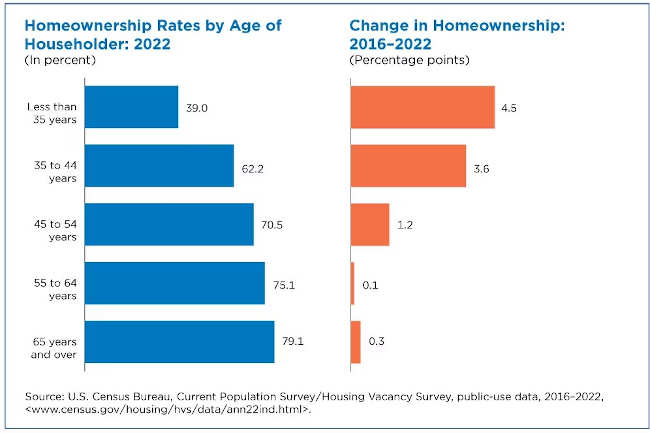
Younger households typically are more likely to rent than own homes. Yet from 2016 to 2022, homeownership among adults under age 55 went up but remained stable among older populations.
From 2016 to 2019, homeownership increased among householders under age 35 (up 2.2 percentage points), ages 35 to 44 (up 1.5 points), and 45 to 54 (up 0.8 points). The increases for the 35 to 44 age group were not statistically different from the youngest and the oldest age groups.
Rates among older householders were not statistically different during the same period.
The pattern was similar from 2019 to 2022 when homeownership rates also rose about 2% among householders under age 35 and between ages 35 and 44, with one exception: the rate also inched up (0.5 percentage points) among those age 65 and over. There was no statistically significant change among householders in other age groups.
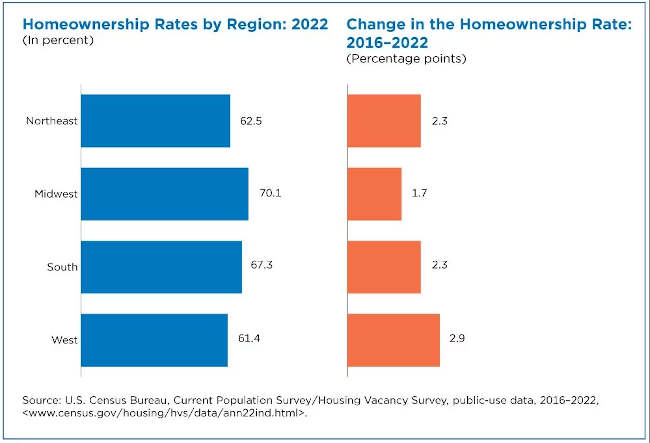
Homeownership rates rose in the Northeast, South and West from 2016 to 2019, and in all regions from 2019 to 2022.
Low mortgage rates likely helped drive the rise, even after rates began to go up in 2022.
By 2022, the homeownership rate in the Midwest hit 70%, the highest of all regions. The South had the second-highest homeownership rate (67.3%), followed by two regions that were not statistically different: the Northeast (62.5%) and West (61.4%).
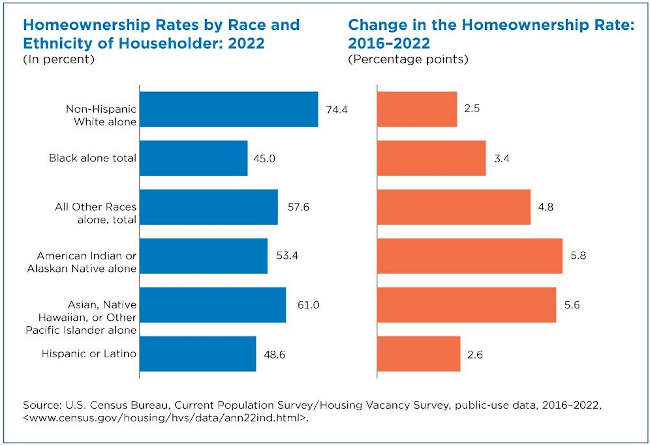
Homeownership rates rose from 2016 to 2019 among non-Hispanic White householders, Asian, and Native Hawaiian, or Other Pacific Islander householders. There was no increase among Black or American Indian/Alaskan Native householders.
But from 2019 to 2022, homeownership rates increased among householders of all races and ethnicities except for American Indian or Alaskan Native householders.
The share of non-Hispanic White householders who owned a home grew from 71.9% in 2016 to 74.4% in 2022. There was about a 3-point increase for Black alone householders (45%) and about a 6-point increase for American Indian or Alaska Native householders (53.4%) and Asian, Native Hawaiian, or Other Pacific Islander householders (61.0%).
There was no significant difference in the increases for non-Hispanic white householders compared to Black alone, American Indian or Alaska Native, or Hispanic householders.
The difference was also not significant for Black householders compared to American Indian or Alaska Native or Hispanic householders, or for American Indian or Alaska Native versus Asian, Native Hawaiian, or Other Pacific Islander or Hispanic householders.
About the CPS/HVS
Each annual CPS/HVS release includes more detailed information about homeownership rates by region, age of householder, and race/ethnicity of householder. It also includes overall homeownership estimates for the 50 states and the District of Columbia and the 75 largest metropolitan statistical areas.
In addition, it provides characteristics of vacant housing units for rent and for sale at the national and regional levels, as well as rental and homeowner vacancy rates.
More information on confidentiality protection, methodology, sampling and nonsampling error, and definitions is available in this document.
Robert R. Callis is a survey statistician in the Census Bureau’s Social, Economic, and Housing Statistics Division.