 How to resolve AdBlock issue?
News
- Details
- Written by: LAKE COUNTY NEWS REPORTS
A copy of the executive order can be found here.
This year’s historic winter storms damaged levees and left debris in river channels that exacerbate the risk of flooding next winter — damaged levees provide less protection from high water flows, and debris and vegetation within river channels reduce capacity to move high water flows.
By acting now, the executive order allows affected communities to accelerate work to restore levee function and river channel capacity degraded by last winter’s storms and floods.
More specifically, the executive order:
• Streamlines public agencies’ emergency levee repair and debris removal work to address this past winter’s storms and prepare for next winter;
• Applies to emergency levee repair and debris clearing impacted by this past winter’s storms, including: the San Joaquin River and tributaries, the Tulare Lake Basin and tributaries, the Salinas River and tributaries, the Pajaro River and tributaries, and other coastal streams between the Pajaro River and the Ventura River;
• Suspends certain laws, regulations, and criteria in existing orders – conditioned on agencies complying with specified environmental and resource protection requirements – for emergency levee repair and debris removal projects. Suspensions include:
• Lake and streambed alteration agreement laws and regulations implemented by the California Department of Fish and Wildlife;
• Limiting provisions in State Water Board water quality certifications that would otherwise limit circumstances under which a public agency could rely on emergency regional general permits issued by the U.S. Army Corps of Engineers;
• Waste discharge requirements laws and regulations implemented by the Water Boards for projects that do not require an Army Corps of Engineers emergency permit;
• The California Environmental Quality Act.
• Includes a number of common-sense conditions to protect the environment and natural resources, drawn from the existing regulatory expertise at the Department of Fish and Wildlife, Department of Water Resources, and the Water Boards.
This action builds on the series of measures Gov. Newsom has taken to protect communities from flooding while replenishing California’s groundwater and storage.
• Proclaimed a state of emergency in January mobilizing state government ahead of the winter storms, proclaimed a state of emergency in 53 counties to support response and recovery efforts, and activated the National Guard to support disaster response and relief;
• At the governor’s request, President Biden issued a Presidential Emergency Declaration and a Presidential Major Disaster Declaration to bolster state and local recovery efforts;
• Executive orders to expedite emergency flood preparation and response activities in the Tulare Lake Basin and San Joaquin River Basin, such as floodwater diversion, debris removal, and levee repairs;
• Visited the Tulare Lake Basin to see flooding impacts firsthand, meet with community leaders, and emphasize the state’s commitment to supporting the counties impacted by flooding.
• Announced $17.2 million to fortify the Corcoran Levee, protecting critical infrastructure, correctional and medical facilities, and more;
• Committed over $500 million in the 2023-24 state budget to support flood response and projects to protect communities from future floods;
• Executive orders in February and March to capture rain and floodwater for groundwater recharge, reservoir storage, and more.
• Leveraging the more than $8.6 billion committed by Gov. Newsom and the Legislature in the last two budget cycles to build water resilience, the state is continuing to take aggressive action to prepare for the impacts of climate-driven extremes in weather on the state’s water supplies.
- Details
- Written by: PRESTON DYCHES
What's up for August? See Saturn at dusk and dawn, the Perseid meteors return and a “super blue moon.”
In August, we've lost Venus and Mars from the evening sky, but we'll have great views of Saturn all night. Saturn reaches opposition this month, meaning it's directly opposite the Sun as seen from Earth.
Planets at opposition rise just after sunset and are visible until dawn, and it's when they appear at their biggest and brightest for the year. Look for the giant planet low in the eastern sky around 9 p.m. by mid-month, appearing a bit higher each evening as August continues.
On the morning of Aug. 3, Saturn appears just a couple of finger widths apart from the nearly full Moon. Find them in the west before sunrise.
The Moon then makes a nice pairing with the Pleiades star cluster on the morning of the 9th, with Jupiter hanging nearby. And then the Moon has a super-close meetup with the reddish star Antares — brightest star in the constellation Scorpius — on the evening of Aug. 24.
August brings one of the best known annual meteor showers, the Perseids. And this year the stage is set for a good show, as the peak night — Aug. 12 and into Aug. 13 — is near the new moon.
The meteors are bits of dust — most no larger than sand grains — that originate from comet Swift-Tuttle. Earth sweeps through the comet's debris trail every year about this same time, resulting in the annual shower.
The radiant — the point in the sky where the meteors appear to originate — is toward the northeast, appearing in-between the upside down “W” of constellation Cassiopeia and bright star Capella.
Observing the Perseids is easy — just find yourself a safe, dark spot to lie down with your feet pointing roughly toward the northeast, and look straight up. The best time to view them is between midnight and dawn, as the radiant rises higher in the sky. Meteor activity likely will be at its greatest in the hour preceding dawn.
Now, the crescent moon also rises in the couple of hours before dawn, but it's only about 7% illuminated, and so it shouldn't pose a significant problem for viewing the meteors. You might also see a few meteors in the early morning hours during the week before and after the peak.
August begins and ends with a full moon, making for a special occurrence that only happens every couple of years. You see, a second full moon in a single calendar month is commonly called a “blue moon.” They happen every 2 to 3 years because the Moon's monthly cycle is just a bit shorter than the average length of a month. So eventually a full moon will happen at the beginning of a month, with enough days left for a complete lunar cycle. When that happens, we get a blue moon.
But there's more! The Aug. 30 blue moon is also a supermoon. The moon's orbit isn't a perfect circle, so sometimes it's a little farther away from Earth and sometimes closer. At its closest point, called perigee, it's 14% closer than at its farthest.
About three to four times a year, the full moon phase happens to coincide with the Moon reaching perigee, and we call that event a supermoon. While it technically appears a little bit bigger (and a tad brighter) than the average full moon, the difference is not super noticeable to the eye.
The combination of these two special full moons, making for a “super blue moon,” occurs about every 10 years, on average — though the time between any two occurrences can vary from two months to two decades or more.
So enjoy this month's two full moons. And while the second one won't appear supersized, or any bluer than usual, now you know what makes it special.
Stay up to date with all of NASA's missions to explore the solar system and beyond at nasa.gov.
Preston Dyches works for NASA's Jet Propulsion Laboratory.
- Details
- Written by: Elizabeth Larson
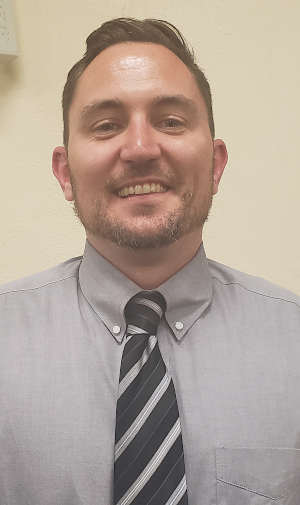
LAKEPORT, Calif. — The city of Lakeport has welcomed its new Community Development director, a Lake County native who has worked in a variety of jobs in bigger cities around the state but is returning to move up to a new step in his career.
Joey Hejnowicz was introduced to the Lakeport City Council and the community at the council’s Tuesday evening meeting.
Hejnowicz grew up in Kelseyville, and after graduating from high school at age 18, he decided to head off to San Diego because he was looking to live in a bigger city.
He received his undergraduate degree in business with an emphasis in hospitality and tourism and was a hospitality manager for 10 years.
Hejnowicz then made his way closer to home, to Santa Rosa, where he worked in wine sales and business development for a winery for about a year.
Then he landed a job with the city of Santa Rosa, working for the finance department and later in the city manager’s office for several years.
During his time at the city of Santa Rosa, Hejnowicz gained diverse experience, from working on utility billing and rent stability ordinances, to acting as the city’s zero waste coordinator.
Hejnowicz said he is excited to meet more of the community in his new role with the city of Lakeport.
He and his wife and dog are living in Kelseyville, in the home he grew up in, which has remained in his family.
Hejnowicz succeeds Jennifer Byers, who left in November to take the assistant economic development director job with the city of Bakersfield after just over two years with the city of Lakeport.
Email Elizabeth Larson at
- Details
- Written by: LAKE COUNTY NEWS REPORTS
Although gun violence is the leading cause of death for American kids, the House of Representatives has yet to vote on even one gun violence prevention bill in this Congress.
“American children should not be scared to go to school. Parents should not be scared that when they send their kids off in the morning that it may be the last time they see them alive,” said Thompson, who represents Lake County in the House of Representatives.
“Gun violence demands our attention, yet the Republican House Leadership has not brought a single gun violence prevention bill up for a vote. The Gun Violence Prevention Task Force is calling on Speaker McCarthy to help us save lives and pass legislation that would keep our kids safe,” Thompson said.
Republicans canceled the last day of scheduled votes in July over disagreements within the Republican conference about how to proceed on a government funding bill.
Should the vote schedule fall apart again, the letter calls on House Republican Leadership to use that time to vote on life-saving gun violence prevention legislation, instead of canceling votes altogether.
The full text of the letter is below.
Dear Speaker McCarthy,
We are disappointed that Republican leadership cancelled votes in July with so many pressing issues facing our country. Foremost amongst those is the gun violence crisis that is the leading cause of death for children in America.
As Members of the Gun Violence Prevention Task Force, we call on you to schedule votes on gun violence prevention legislation as soon as possible this year. We also have a new standing request that should the vote schedule fall apart again, you would fill that time to vote on life-saving gun violence prevention legislation, instead of canceling votes altogether.
Gun violence is the leading cause of death of children in America since 2020. Last year, 1,686 children were killed and another 4,485 were injured by gun violence. Despite this preventable carnage, the House has yet to vote on even one gun violence prevention bill.
To save the lives of our kids, we only need the opportunity to vote on gun violence prevention legislation and the support from a tiny minority of the Republican Conference. For example, if only 20 Republicans, 10 in the House and 10 in the Senate voted for the Bipartisan Background Checks bill, we would have the votes to help prevent felons, domestic abusers, terrorists and people with serious mental health conditions from accessing guns.
The American people strongly support action on the gun violence crisis and the gun violence prevention laws that will keep their kids alive. A recent Fox News poll shows that 87 percent support universal background checks; 80 percent support red flag laws and 61 percent support banning assault weapons.
We reiterate our insistence that the House schedule votes on gun violence prevention legislation without further delay and also offer to quickly advance gun violence prevention legislation should other planned legislation be canceled again.
Thompson represents California’s Fourth Congressional District, which includes all or part of Lake, Napa, Solano, Sonoma and Yolo counties.