 How to resolve AdBlock issue?
News
- Details
- Written by: Chris Impey, University of Arizona
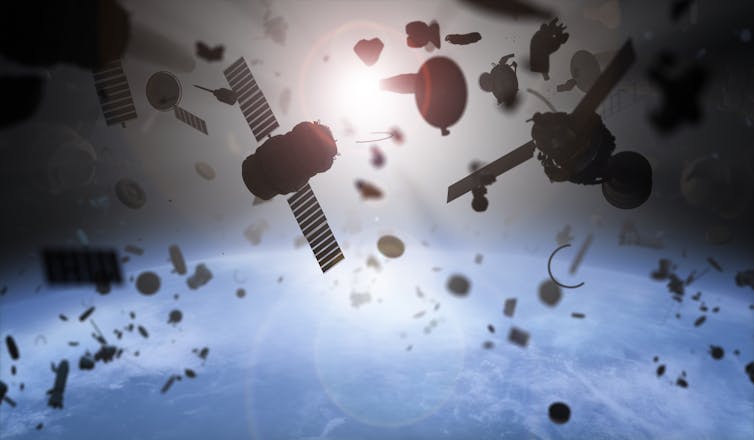
There’s a lot of trash on the Moon right now – including nearly 100 bags of human waste – and with countries around the globe traveling to the Moon, there’s going to be a lot more, both on the lunar surface and in Earth’s orbit.
In August 2023, Russia’s Luna-25 probe crashed into the Moon’s surface, while India’s Chandrayann-3 mission successfully landed in the southern polar region, making India the fourth country to land on the Moon.
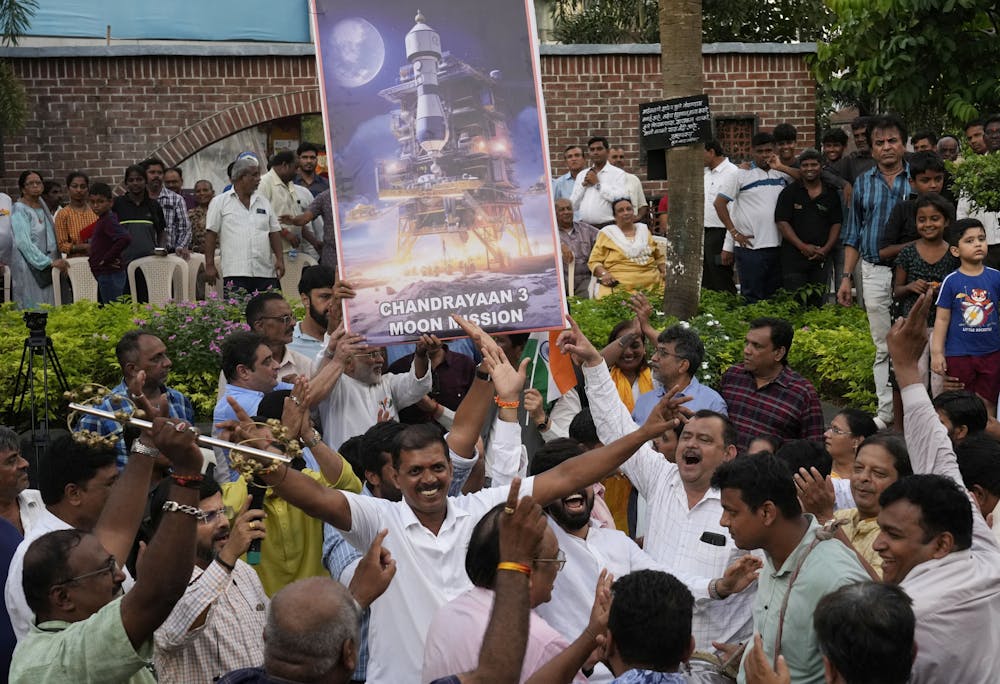
With more countries landing on the Moon, people back on Earth will have to think about what happens to all the landers, waste and miscellaneous debris left on the lunar surface and in orbit.
I’m a professor of astronomy who has written a book about the future of space travel, articles about our future off-Earth, conflict in space, space congestion and the ethics of space exploration. Like many other space experts, I’m concerned about the lack of governance around space debris.
Space is getting crowded
People think of space as vast and empty, but the near-Earth environment is starting to get crowded. As many as 100 lunar missions are planned over the next decade by governments and private companies like SpaceX and Blue Origin.
Near-Earth orbit is even more congested than the space between Earth and the Moon. It’s from 100 to 500 miles straight up, compared with 240,000 miles to the Moon. Currently there are nearly 7,700 satellites within a few hundred miles of the Earth. That number could grow to several hundred thousand by 2027. Many of these satellites will be used to deliver internet to developing countries or to monitor agriculture and climate on Earth. Companies like SpaceX have dramatically lowered launch costs, driving this wave of activity.
“It’s going to be like an interstate highway, at rush hour in a snowstorm, with everyone driving much too fast,” space launch expert Johnathan McDowell told Space.com.
The problem of space junk
All this activity creates hazards and debris. Humans have left a lot of junk on the Moon, including spacecraft remains like rocket boosters from over 50 crashed landings, nearly 100 bags of human waste and miscellaneous objects like a feather, golf balls and boots. It adds up to around 200 tons of our trash.
Since no one owns the Moon, no one is responsible for keeping it clean and tidy.
The clutter in Earth’s orbit includes defunct spacecraft, spent rocket boosters and items discarded by astronauts such as a glove, a wrench and a toothbrush. It also includes tiny pieces of debris like paint flecks.
There are around 23,000 objects larger than 10 cm (4 inches) and about 100 million pieces of debris larger than 1 mm (0.04 inches). Tiny pieces of junk might not seem like a big issue, but that debris is moving at 15,000 mph (24,140 kph), 10 times faster than a bullet. At that speed, even a fleck of paint can puncture a spacesuit or destroy a sensitive piece of electronics.
In 1978, NASA scientist Donald Kessler described a scenario where collisions between orbiting pieces of debris create more debris, and the amount of debris grows exponentially, potentially rendering near-Earth orbit unusable. Experts call this the “Kessler syndrome.”
Nobody is in charge up there
The United Nations Outer Space Treaty of 1967 says that no country can “own” the Moon or any part of it, and that celestial bodies should only be used for peaceful purposes. But the treaty is mute about companies and individuals, and it says nothing about how space resources can and can’t be used.
The United Nations Moon Agreement of 1979 held that the Moon and its natural resources are the common heritage of humanity. However, the United States, Russia and China never signed it, and in 2016 the U.S. Congress created a law that unleashed the American commercial space industry with very few restrictions.
Because of its lack of regulation, space junk is an example of a “tragedy of the commons,” where many interests have access to a common resource, and it may become depleted and unusable to everyone, because no interest can stop another from overexploiting the resource.
Scientists argue that to avoid a tragedy of the commons, the orbital space environment should be seen as a global commons worthy of protection by the United Nations. The lead author of a Nature article arguing for a global commons filed an amicus brief – a type of outside comment offering support or expertise – on a case that went to the U.S. Court of Appeals for the District of Columbia Circuit in late 2021.
The author and his research collaborators argued that U.S. environmental regulations should apply to the licensing of space launches. However, the court declined to rule on the environmental issue because it said the group lacked standing.
National geopolitical and commercial interests will likely take precedence over interplanetary conservation efforts unless the United Nations acts. A new treaty may emerge from the work of the U.N. Office for Outer Space Affairs, which in May 2023 generated a policy document to address the sustainable development of activities in space.
The U.N. can regulate the activities of only its member states, but it has a project to help member states craft national-level policies that advance the goals of sustainable development.
NASA has created and signed the Artemis Accords, broad but nonbinding principles for cooperating peacefully in space. They have been signed by 28 countries, but the list does not include China or Russia. Private companies are not party to the accords either, and some space entrepreneurs have deep pockets and big ambitions.
The lack of regulation and the current gold rush approach to space exploration mean that space junk and waste will continue to accumulate, as will the related problems and dangers.
Chris Impey, University Distinguished Professor of Astronomy, University of Arizona
This article is republished from The Conversation under a Creative Commons license. Read the original article.
- Details
- Written by: LAKE COUNTY NEWS REPORTS
Registrar of Voters Maria Valadez’s office on Friday released an update on the filing periods for three judicial seats, three supervisorial seats and the office of sheriff-coroner.
Those offices will be on the ballot for the presidential primary election, which takes place on March 5.
County offices up for election in March are Superior Court judge seats for departments 1, 3 and 4; supervisorial seats for districts 1, 4 and 5; and sheriff-coroner.
Current office holders for the Superior Court are Michael Lunas, Andrew Blum and Shanda Harry, representing departments 1, 3 and 4, respectively.
For the supervisorial seats, the district 1, 4 and 5 seats are held by Moke Simon, Michael Green and Jessica Pyska.
Green has announced that he will not seek election. Gov. Gavin Newsom appointed Green in October to fill the remainder of Tina Scott’s term.
The Board of Supervisors appointed Rob Howe in December to succeed Sheriff Brian Martin on his retirement.
Candidates for these offices may submit “in-lieu-of-filing fee petitions” containing signatures of registered voters in the jurisdiction in which he or she is seeking nomination to offset all or part of the cost of their filing fee.
The in-lieu-of-filing petitions are available between Sept. 14 until Nov. 8, during regular office hours from 8 a.m. to 5 p.m., Monday through Friday, and closed county holidays and weekends.
The deadline to file the in-lieu-of-filing fee petitions with the Lake County Registrar of Voters’ office is the close of business on Wednesday, Nov. 8.
All candidates for elective office must also file within the nomination period of Nov. 13 through Dec. 8 a declaration of candidacy form, nomination papers and pay filing fee in order for their name to be printed on the March 5, 2024 Presidential Primary Election ballot.
In addition to local offices to be filled, the following federal and state offices will be on the March primary ballot.
Partisan federal office
• United States President, American Independent Party
• United States President, Democratic Party
• United States President, Green Party
• United States President, Libertarian Party
• United States President, Peace and Freedom Party
• United States President, Republican Party
Voter-nominated offices:
• United States Senator
• United States Representative in Congress, District 4
• State Assembly Member, District 4
For more information contact the Registrar of Voters Office at 325 N. Forbes St. in Lakeport or by phone at 707-263-2372.
- Details
- Written by: LAKE COUNTY NEWS REPORTS

CLEARLAKE, Calif. — The Clearlake Police Department is asking for the community’s help in locating a missing man.
Police are seeking Arnold Ray Griffin, 35.
Griffin is described as a black male adult, 5 feet 8 inches tall and 180 pounds, with black hair that looks like a fade and brown eyes.
He has a quarter-size mole on the back left side of his head and is missing a front tooth.
Police said Griffin was last seen in the area of the Walmart bus stop.
At that time he was seen wearing a dark blue sweatshirt, dark blue sweatpants and black shoes, and he usually has a diamond stud earring, possibly on the left ear.
If you have any information regarding his whereabouts, please contact the Clearlake Police Department at 707-994-8251, Extension 1.
- Details
- Written by: CALIFORNIA HIGHWAY PATROL

In a collaborative effort to help ensure the safety of all road users as they travel this Labor Day weekend, the California Highway Patrol, Nevada Highway Patrol and Arizona Department of Public Safety are joining forces for a maximum enforcement period.
The tri-state enforcement initiative, which began at 6;01 p.m. Friday, Sept. 1, continues through 11:59 p.m. on Monday, Sept. 4.
The Labor Day weekend marks the traditional end of summer celebrations, with many people are gearing up for holiday gatherings and road trips.
The CHP, NHP, and Arizona DPS are dedicated to ensuring everyone reaches their destinations safely, especially given the surge in traffic that typically accompanies holiday weekends.
Throughout the holiday weekend, while law enforcement will be looking for traffic violations and assisting motorists, a special emphasis will be placed on identifying and apprehending those suspected of driving under the influence of drugs and/or alcohol.
“Alcohol-and drug-impaired driving continues to be a leading cause of traffic fatalities and injuries. An impaired driver behind the wheel puts themselves and everyone on the road in great danger,” said CHP Commissioner Sean Duryee. “The CHP, along with our partners in Nevada and Arizona are committed to proactive enforcement throughout the holiday weekend. We will deploy all available personnel to ensure the highest level of safety for everyone traveling.”
Last year during the Labor Day MEP, CHP officers made more than 900 arrests for DUI, in addition to issuing nearly 5,700 speeding citations.
Sadly, 52 people were killed in crashes on California’s roads.
Avoid becoming a statistic and always designate a sober driver, utilize ride-share service, and always wear your seat belt.