 How to resolve AdBlock issue?
News
- Details
- Written by: Elizabeth Larson
The council will meet at 6 p.m. Thursday, Sept. 7, in the council chambers at Clearlake City Hall, 14050 Olympic Drive.
The meeting will be broadcast live on the city's YouTube channel or the Lake County PEGTV YouTube Channel. Community members also can participate via Zoom or can attend in person.
The webinar ID is 826 2197 1410.
One tap mobile is available at +16694449171,,82621971410# or join by phone at 669 444 9171 or 720 707 2699.
The agenda can be found here.
Comments and questions can be submitted in writing for City Council consideration by sending them to City Clerk Melissa Swanson at
To give the council adequate time to review your questions and comments, please submit your written comments before 4 p.m. Thursday, Sept. 7.
On the agenda are two presentations, one declaring Sept. 22 as Native American Day and another declaring September 2023 as Senior Center Month.
On the agenda is a public hearing to adopt Resolution 2023-39 renewing Ordinance 261-2022 and the approval of the Clearlake Police Department Military Equipment Report.
Under council business, council members will consider awarding a $626,425 contract to Pavement Coatings for the 2023 Double Chip Seal Project and authorizing the city manager to sign the contract.
The council also will discuss and consider Police Chief Tim Hobbs’ response to the 2022-23 Grand Jury Report on human trafficking and school shootings.
On the meeting's consent agenda — items that are considered routine in nature and usually adopted on a single vote — are warrants and City Council minutes, and approval of the subrecipient agreement with Citizens Caring 4 Clearlake for the Clean California Grant.
The council will hold a closed session after the meeting to discuss an existing case of litigation, Mosqueda, Miguel v. City of Clearlake, p.s.i., administered by LWP Claims Solutions Inc., and a case of anticipated litigation.
Email Elizabeth Larson at
- Details
- Written by: LAKE COUNTY NEWS REPORTS

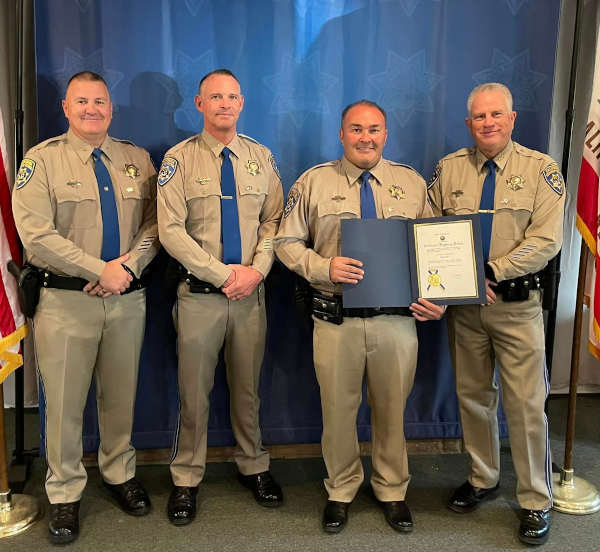
LAKE COUNTY, Calif. — Two California Highway Patrol officers with Lake County connections have been promoted to sergeant.
The CHP’s Clear Lake Area office said Officer Joel Skeen was promoted to the rank of sergeant on Friday.
Officer Adam Garcia, a Lake County native who previously worked in the Clear Lake Area office and now works in the Ukiah Area office, was promoted to sergeant on the same day, the CHP reported.
“We are proud and excited for the both of them in achieving the distinguished rank of CHP Sergeant,” the Clear Lake Area office reported on its Facebook page.
The Clear Lake Area office also recently welcomed a new academy graduate, Officer Cameron Ramsey, who arrived in July.
Like Skeen and Garcia, Ramsey comes from the North Coast — he’s from Redwood Valley and the son of a CHP officer who works in the Ukiah Area office.
- Details
- Written by: National Council on Aging
"Although falls and fall-related injuries happen more frequently with age, the good news is there are many proactive steps older adults and their families can take to prevent them," said Kathleen Cameron, senior director at NCOA’s Center for Healthy Aging.
A great place to start is using NCOA’s free online Falls Free CheckUp to learn your risk and discover how to reduce it.
Falls are the leading cause of injury-related death among adults age 65 and older. NCOA has championed this annual event since 2007 to highlight the impact of falls and empower individuals with actionable measures to mitigate their risk.
During Falls Prevention Awareness Week, community organizations and health care providers nationwide will offer workshops, screenings, and evidence-based falls prevention programs. Local organizations will use promotional resources to amplify their outreach.
NCOA’s online Falls Free CheckUp, developed in partnership with the Centers for Disease Control and Prevention, asks 13 yes/no questions and produces a score showing whether a person is at normal or high risk for a fall.
The assessment delivers tailored recommendations and offers a wealth of falls prevention resources.
Participants can also opt for reminders to schedule follow-up doctor appointments and retake the checkup in six months to monitor any changes in their risk.
According to CDC, more than one-fourth of Americans age 65+ fall each year. Falls result in more than 3 million injuries, such as hip fractures, broken bones, and brain injuries, treated in emergency departments annually, including over 800,000 hospitalizations.
For more information, please visit www.ncoa.org/Falls.
- Details
- Written by: John A. Fliter, Kansas State University and Betsy Wood, Bard College

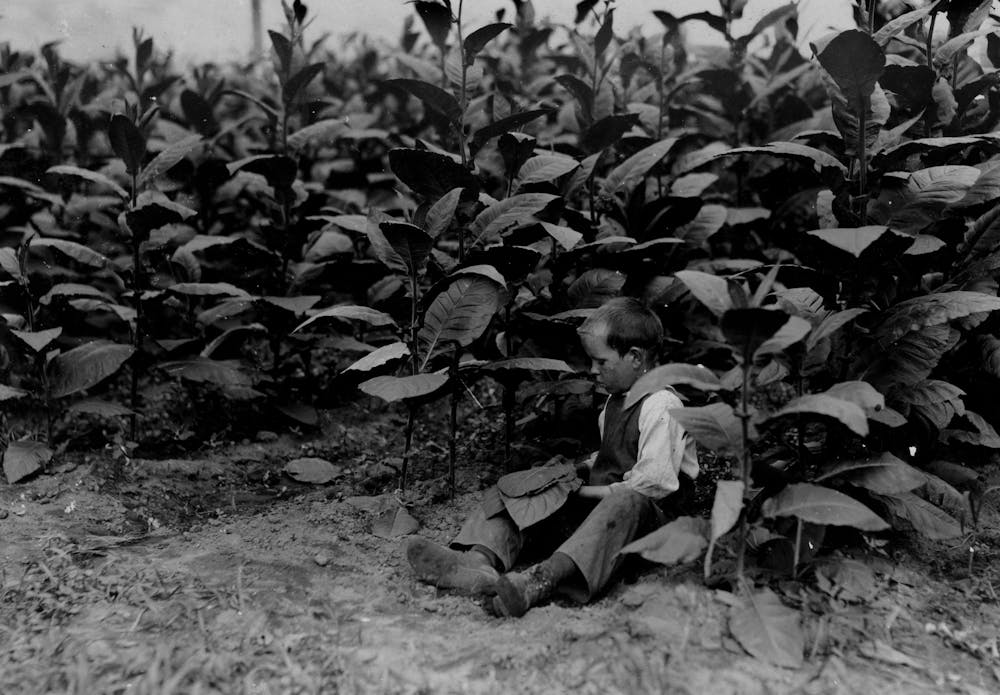
A movement to weaken American child labor protections at the state level began in 2022. By June 2023, Arkansas, Iowa, New Jersey and New Hampshire had enacted this kind of legislation, and lawmakers in at least another eight states had introduced similar measures.
The laws generally make it easier for kids from 14 to 17 years old to work longer and later – and in occupations that were previously off-limits for minors.
When Iowa Gov. Kim Reynolds signed her state’s new, more permissive child labor law on May 26, 2023, the Republican leader said the measure would “allow young adults to develop their skills in the workforce.”
As scholars of child labor, we find the arguments Reynolds and other like-minded politicians are using today to justify undoing child labor protections echo older justifications made decades ago.
Many conservatives and business leaders have long argued, based on a combination of ideological and economic grounds, that federal child labor rules aren’t necessary. Some object to the government determining who can’t work. Cultural conservatives say working has moral value for young people and that parents should make decisions for their children. Many conservatives also say that teens, fewer of whom are in the workforce today than in past decades, could help fill empty jobs in tight labor markets.
Opponents of child labor observe that when kids under 18 work long hours or do strenuous jobs, it can disrupt childhood development, interfere with their schooling and deprive them of the sleep they need. Expanding child labor can encourage kids to drop out of school and jeopardize young people’s health through injuries and work-related illnesses.
Long-brewing battle
Child labor protections, such as making many kinds of employment for children under 14 illegal and restricting the hours that teens under 18 can spend working, are guaranteed by the Fair Labor Standards Act of 1938. U.S. law also does not treat 16- and 17-year-olds as adults. The federal government deems many occupations to be too hazardous for anyone under 18.
Until that law took effect, the lack of a federal standard always obstructed progress in the states toward keeping kids in school and out of mines, factories and other sometimes hazardous workplaces.
Three years after President Franklin D. Roosevelt signed the Fair Labor Standards Act, the Supreme Court unanimously upheld it in the U.S. v. Darby Lumber ruling, which toppled a related precedent.
Challenges began during the Reagan administration
There were no significant efforts to challenge child labor laws for the next four decades. In 1982, President Ronald Reagan sought to ease federal protections to allow 14- and 15-year-olds to work longer hours in fast-food and retail establishments and to pay young workers less than the minimum wage. A coalition of Democrats, labor unions, teachers, parents and child development groups blocked the proposed changes.
By the late 1980s, child labor violations were on the rise. Some industry groups tried to loosen restrictions in the 1990s, but legal changes were minimal.
A more ambitious attempt to roll back child labor laws in the early 2000s, led by a homeschooling group, ultimately failed, but conservatives continued to call for similar changes.
When former House Speaker Newt Gingrich was vying to become a 2012 Republican presidential nominee, he made headlines by calling child labor laws “truly stupid.” He suggested kids could work as janitors in schools.
Today, the Foundation for Government Accountability, a Florida-based think tank, is drafting state legislation to strip child labor protections, The Washington Post has reported. Its lobbying arm, the Opportunity Solutions Project, has been helping push these bills through state legislatures, including in Arkansas and Missouri.
Iowa and Arkansas
In our view, Iowa has the most radical new law designed to roll back child labor protections. It allows children as young as 14 to work in meat coolers and industrial laundries, and teens 15 and older can work on assembly lines around dangerous machinery.
Teens as young as 16 can now serve alcohol in Iowa restaurants, as long as two adults are present.
U.S. Labor Department officials argue that several provisions of Iowa’s new law violate national child labor standards. However, the department has not disclosed a clear strategy for combating such violations.
Arkansas Gov. Sarah Huckabee Sanders signed her state’s Youth Hiring Act of 2023 in March. It eliminated work permits for 14- and 15-year-olds.
Previously, employers had to keep a work certificate on file that required proof of age, a description of the work and schedule – and the written consent of a parent or guardian.
Arkansas has scrapped those safeguards against child labor exploitation. We find it puzzling that supporters touted the bill as enhancing parental rights because the law removes any formal role for parents in balancing their kids’ education and employment.
Federal vs. state laws
You may wonder how states can undermine federal child labor laws. Doesn’t federal law preempt state laws?
Both federal and state laws govern the employment of minors, and all states have compulsory school attendance laws. Federal laws set a floor of regulations in youth employment that cover maximum hours, minimum ages, wages and protections from hazardous jobs.
If states pass tougher laws, as many have, the stricter standards govern workplace practices. School attendance requirements vary by state, but once someone turns 18, they’re no longer covered by the Fair Labor Standards Act’s restrictions.
Federal law, for example, does not require minors to obtain work permits or employment certificates, but most states mandate such documentation.
With the exception of New Jersey, these efforts to weaken child labor laws are being led by Republicans.
To be sure, some states are still attempting to strengthen child labor protections.
Democrats in Colorado introduced a bill that would allow injured children to sue employers for child labor violations. Gov. Jared Polis signed it into law on June 7, 2023.
Having child labor laws on the books at both the federal and state levels is only half the battle. Enforcement is another matter. Many violations in recent years have involved children who immigrated to the United States without their parents, only to wind up working long hours, sometimes in dangerous jobs, at young ages.
Construction sites?
Other states are trying to weaken protections. Ohio state lawmakers want to allow 14- and 15-year-olds to work until 9 p.m. during the school year with their parents’ permission, even though federal regulations don’t allow teens that age to work past 7 p.m.
Some states are considering legislation that directly conflicts with federal child labor standards on hazardous occupations. For example, a bill Republican Minnesota state Sen. Rich Draheim introduced would allow 16- and 17-year-olds to work in or around construction sites.
Strong opposition from politicians, child advocacy groups, education associations, labor unions and the public has defeated some of these efforts.
Georgia Republicans introduced a bill that would have eliminated work permits for minors, but they withdrew it without a vote. And Republican lawmakers in South Dakota sponsored a bill to extend working hours for children 14 and under from 7 p.m. to 9 pm. It was withdrawn as well.
In Wisconsin, Gov. Tony Evers vetoed a bill in 2022 that would have let teens work longer and later. In 2023, some Wisconsin lawmakers are trying again. They want to let 14-year-olds serve alcohol.
Taking aim at federal rules
There are some national efforts to weaken – or strengthen – child labor rules as well.
Rep. Dusty Johnson, a South Dakota Republican, seeks to revise federal regulations to permit 14- and 15-year-olds to work until 9 p.m. on school nights and up to 24 hours per week during the school year. We don’t expect his bill to pass in today’s divided Congress.
There’s also a push in the House and the Senate to let 16- and 17-year-olds work in logging operations with parental supervision.
And yet there’s also support in Congress to increase penalties for child labor violations. Currently, the maximum such fine is $15,138 per child. Pending bills in the House and Senate would increase the penalty to nearly 10 times that amount if enacted.
And several Democrats have introduced measures to strengthen federal child labor restrictions, especially in agriculture.
With so many states seeking weaker child labor protections, we believe a federal-state showdown over the question of whether young people in the United States belong in the workforce is inevitable.
John A. Fliter, Associate Professor of Political Science, Kansas State University and Betsy Wood, Assistant Professor of American History, Bard College
This article is republished from The Conversation under a Creative Commons license. Read the original article.