 How to resolve AdBlock issue?
News
- Details
- Written by: Iain White, University of Waikato
He was, said George Bernard Shaw, “one of those heroic simpletons who do big things whilst our prominent worldlings are explaining why they are Utopian and impossible”.
The celebrated playwright was referring to the ideas of Ebenezer Howard, the creative force behind the idea of “garden cities” in the late 19th and early 20th centuries; new urban centres that Howard argued would have the best of town and country, but without the problems.
There’s a reminder of that somewhat backhanded compliment in the recent news of a Silicon Valley consortium named Flannery Associates buying land with a view to creating a new city in northern California’s Solano County. The controversial project is named after the investment vehicle’s parent company, California Forever.
The parallels between contemporary utopian thinking and Howard’s ideas from more than a century ago are readily apparent. The notion of something like California Forever may appear cutting edge, but it is part of the historical foundations of current planning systems.
Indeed, the science-fiction writer H.G. Wells – a futurist whose own ideas would resonate with many in Silicon Valley – was so attracted to Howard’s ideas that he joined the Garden City Association to support their creation.
Garden city visions
Any kind of new city model tends to reflect the politics of its founders. The vision and plans stretch beyond the built form to picture a preferred lifestyle, and interactions with nature and each other.
The artist’s renderings accompanying the California Forever project depict an attractive, harmonious landscape familiar to utopian thinking: plentiful parks, open spaces and sustainable energy.
It encapsulates a politics of urban living that also emphasises the need to recast our relationships with nature. As such, these ideas also involve a large dose of social engineering. They are not just about creating a new built environment, they envision a new kind of society that’s better than the current one.
But the garden cities that were eventually developed were a far cry from Howard’s initial vision. In fact, his ideas from over a hundred years ago make those from Silicon Valley look distinctly dated.
For Howard, it was as much about social reform and organisation as city planning. He advocated for local production and relatively self-contained settlements to reduce the need to travel, as well as innovative ways of treating waste that echo current circular economy thinking.
Planning and profit
Even less like the investment logic behind California Forever, Howard also imagined a city that could challenge some of the precepts of capitalism.
Given the significant deprivation and social divide between haves and have-nots, he advocated that land in garden cities could be organised cooperatively to share wealth and reduce poverty.
The need to attract investors was one of the reasons Howard’s ambitious politics eroded. To purchase land on that scale requires significant capital, and the providers of that capital would no doubt be looking for a return.


Should California Forever materialise, history would caution us that there may be a similar gap between rhetoric and reality. While Howard’s ideas were partially implemented in places like Letchworth, the focus was more on the built environment than social justice or sustainability.
Howard moved into the new city, but his influence was marginalised by the need to accommodate shareholder interests.
While we don’t know how California Forever has been pitched to investors, it’s a fair assumption it is also shaped by the profit motive: buying cheaper agricultural land, rezoning for housing and development, drawing in state funding for infrastructure, and seeing the land rise in value.
While the images appear sustainable, long-distance commuting may be a problem given the nature of the labour market in California, as might expectations of genuine community involvement in the project. Utopian schemes have long been critiqued for their tendency towards authoritarianism – a charge not unfamiliar to the tech sector in recent times.
Howard’s ideas were also criticised as anti-urban. Shouldn’t we seek to improve existing cities rather than abandon and start anew, possibly to create a gentrified enclave?
For the tech sector, too, there is a recurring utopian trend that seeks to escape – whether to moon colonies or new cities – rather than use its vast wealth and influence to address current urban problems.
Progress and planning
But, ultimately, it’s encouraging to see groups like the Silicon Valley investors advocate for the benefits of good urban planning and what it can provide future generations. The bigger problem is that current planning systems aren’t anything like as progressive.
In many countries, similarly powerful investors routinely criticise urban planning as creating “red tape”, increasing the costs of development, or stopping markets from acting “efficiently”.
Yet the kind of city building represented by California Forever requires greater regulatory power and the kind of political ambition that was more common a century ago. And it raises the question of whether projects like this should be left to the private sector.
At the very least, perhaps, such initiatives provide an opportunity to reassess the potential of urban planning and cast a light on current societal problems. Howard’s utopian vision was designed to solve the problems of his time: exploitative landlords, slums, polluted cities and extreme disparities of wealth.
Whether or not California Forever is built, the reasons behind the idea demonstrate that while history may not repeat, it does sometimes rhyme.
Iain White, Professor of Environmental Planning, University of Waikato
This article is republished from The Conversation under a Creative Commons license. Read the original article.
- Details
- Written by: LAKE COUNTY NEWS REPORTS
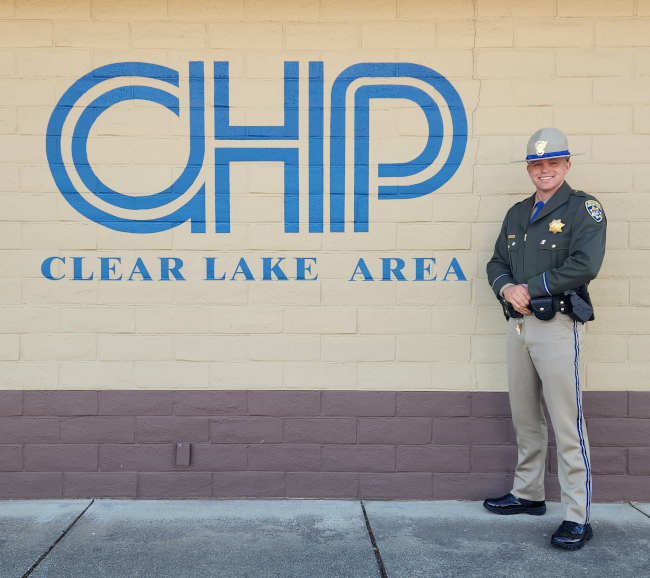
LAKE COUNTY, Calif. — The California Highway Patrol’s Northern Division Clear Lake Area office is welcoming another new officer.
Officer David Robinson graduated from the CHP Academy in West Sacramento on Sept. 1 as part of a class of 112 cadets.
After 26 weeks of intense training, the group was officially sworn in.
Officer Robinson described the CHP Academy as, “A hard challenge that prepared me for the job and life.”
Robinson is from the small town of Stonyford in Colusa County.
He attended Elk Creek High School, graduating in 2017, and went on to graduate from Butte College in Butte County with an associate degree in communications. While attending college he was an Explorer with the Chico CHP office’s post for two years.
He is the first in his family to work in law enforcement and has chosen the CHP because he wanted to serve the people of California with the highest level of professionalism and respect.
Officer Robinson will be receiving in-field training with experienced officers for approximately four months and with the ultimate goal of being on his own as one of the newest members of the California Highway Patrol.
In announcing Robinson’s arrival, the Clear Lake Area office issued a statement that said, “Lake County is a unique area and different than large metropolitan areas. It will challenge this new officers’ skills. Our goal is to get this new CHP officer ready to face the challenges he will encounter on a day-to-day basis so he can provide the highest level of safety, service, and security to the people of California.”
The Clear Lake Area office was joined in July by another recent academy graduate, Officer Cameron Ramsey, who was raised in Redwood Valley.
Earlier this month, longtime CHP Officer Joel Skeen was promoted to sergeant.
Officer Robinson encourages anyone thinking about joining the CHP’s ranks to go online and check out www.chpmadeformore.com or contact your local CHP office for more information.
The Clear Lake Area office can be reached at telephone 707-279-0103.
- Details
- Written by: Elizabeth Larson
MATH will meet at 7 p.m. Thursday, Sept.14, in the Middletown Community Meeting Room/Library at 21256 Washington St., Middletown. The meeting is open to the public.
To join the meeting via Zoom click on this link; the meeting ID is 832 1989 2440. Call in at 669-900-6833.
On this week’s agenda are guest speakers from South Lake County and Cal Fire on the 2023 fire season update, and a presentation on the Middletown Garden Project.
There also will be a continued discussion about forming a MATH committee regarding projects, and an update from District 1 Supervisor Moke Simon regarding advance notice of projects.
MATH’s next meeting will take place on Oct. 12. At that meeting, they will start accepting annual nominations for the MATH Board.
The MATH Board includes Chair Monica Rosenthal, Vice Chair Todd Fiora, Secretary Ken Gonzalez, Rosemary Córdova and Bill Waite, and alternates Julia Bono and Tom Darms.
MATH — established by resolution of the Lake County Board of Supervisors on Dec. 12, 2006 — is a municipal advisory council serving the residents of Anderson Springs, Cobb, Coyote Valley (including Hidden Valley Lake), Long Valley and Middletown.
For more information email
Email Elizabeth Larson at
- Details
- Written by: LAKE COUNTY NEWS REPORTS
The bill also requires the CSU system to follow recommendations from the State Auditor — and to obey state and federal laws — by repatriating remains and sacred artifacts to appropriate tribes.
AB 389, by Assemblymember James C. Ramos (D-San Bernardino), was amended in the Senate following a scathing report released on June 29 by the state auditor revealing the CSU system had almost 700,000 human remains and cultural objects in its possession despite a 1995 federal and state deadline to return the remains and artifacts to the proper tribes.
Some campuses have not completed their inventories so even more collections are expected to be found. Ramos requested the audit last year and initiated a joint oversight and informational hearing to review the findings in late August.
Only about 6% of collections have been returned as required by the 1990 federal Native American Graves Protection and Repatriation Act, or NAGPRA, and its 2001 California counterpart, CalNAGPRA.
“AB 389 will ensure that decades after a federal and state requirement to repatriate the remains of our ancestors, CSU takes this responsibility seriously,” Ramos said. “These bones are the remains of our families and deserve respectful reburial. It is a fundamental human right to be buried according to the customs of one’s people. I know of no other group denied this right.”
San Manuel Band of Mission Indians Vice Chairman Johnny Hernández, who testified in support of the proposal, said, “The fact that little to no progress has been made in repatriating items that are of historical and cultural significance to tribes is appalling and unacceptable.”
Hernández added, “It is imperative that tribes be consulted in order to provide an understanding of how items should be repatriated and to keep the CSUs accountable throughout the process.”
Chairperson Janet K. Bill of the Picayune Rancheria of the Chukchansi Indians commented on the process at CSU Fresno.
She noted that while that campus has completed its review, “We must highlight that they did not consult with tribes before reviewing its collection which is mandated under the 2020 Amendment to CalNAGPRA. This failure to consult denied us the opportunity to opine on the respectful treatment of our artifacts, hindered our ability to share our tribal knowledge and traditions, and undermined our tribal sovereignty.”
Key recommendations from the audit report covered in AB 389 are:
• Monitoring campus efforts to review their collections and require completion by Dec. 31, 2025.
• Ensuring that campuses have protocols regarding handling and identifying remains and cultural items.
• Issuing a systemwide NAGPRA policy establishing consistent repatriation processes and training requirements.
• Requiring campuses with more than 100 sets of remains or cultural items to have full time experienced repatriation coordinators.
AB 389 is sponsored by the San Manuel Band of Mission Indians, Picayune Rancheria of the Chukchansi Indians, Redding Rancheria, Shingle Springs Band of Miwok Indians and the Tachi Yokut Tribe.
Also supporting the bill are the Cahuilla Band of Indians, Enterprise Rancheria, Morongo Band of Mission Indians, Pala Band of Mission Indians, Santa Ynez Band of Chumash Indians, Soboba Band of Luiseno Indians, Tule River Tribe, Wilton Rancheria, the Yurok Tribe, California Indian Legal Services, California Indian Nations College, California Faculty Association, California Native Vote Project, California State University’s Office of the Chancellor, Generation Up, Indigenous Justice and the International Indian Treaty Council.