 How to resolve AdBlock issue?
News
- Details
- Written by: LAKE COUNTY NEWS REPORTS
The Garden Harvest Gala will take place on Sunday, Oct. 22.
It will be held from 5 to 8 p.m. at Boatique Winery, 8255 Red Hills Road in Kelseyville.
The event will feature a beautiful farm to fork family style dinner by Rosey Cooks, groovy jazz music by blue.hour, a local art auction and Cobb’s famous dessert auction.
Tickets are available at www.bpt.me/event/6137931.
- Details
- Written by: LAKE COUNTY NEWS REPORTS
The meeting will begin at 4 p.m. at the Moose Lodge, located at 15900 Moose Lodge Lane in Clearlake Oaks.
The meeting will be available via Zoom. The meeting ID is 986 3245 2684, pass code is 666827.
The guest speaker for the Wednesday meeting will be Community Development Department Director Mireya Turner.
Turner will speak about the Clearlake Oaks Roadmap Taskforce update, the Cannabis Ordinance Task Force update and commercial cannabis projects.
In other business, the group will get an update on Spring Valley, including illegal cannabis cultivation, FireWise Community safety and Spring Valley Lake recovery.
ERTH also will discuss the latest on Klaus Park, the new park to be built with donated land and proceeds in Clearlake Oaks.
There also will be an update from Northshore Fire Protection District, a report from Supervisor EJ Crandell, new business and announcements.
The group’s next meeting will take place on Nov. 1.
ERTH’s members are Denise Loustalot, Jim Burton, Tony Morris and Pamela Kicenski.
For more information visit the group’s Facebook page.
- Details
- Written by: Alice Godden, University of East Anglia
Billions of people around the world have received the Pfizer or Moderna COVID-19 vaccines. The rapid development of these vaccines changed the course of the pandemic, providing protection against the SARS-CoV-2 virus.
But these vaccines would not have been possible it if weren’t for the pioneering work of this year’s winners of the Nobel prize in physiology or medicine decades earlier.
Dr Katalin Karikó and Dr Drew Weissman, researchers from the University of Pennsylvania, have been given the prestigious award for their discoveries into mRNA biology. The pair were the first to discover a way of modifying mRNA that allowed it to successfully be delivered to cells and replicated by them.
Their discovery was not only integral to COVID-19 vaccine development, but may also lead to the development of many other therapies – such as vaccines for cancer.
Life’s work
Karikó is a Hungarian biochemist and Weissman an American physician scientist. The two began working together in 1985 when Karikó was a postdoctoral researcher at the University of Pennsylvania, where Weissman was already working as an immunologist. They had a shared interest in how mRNA could be used to make new therapies.
Messenger RNA (better known as mRNA) is an essential molecule to life. It’s made in the body from our very own DNA in a process called translation. DNA is our special encoded handbook of instructions for manufacturing proteins, which are the building blocks for material in the body.
Our mRNA copies and carries these genetic instructions from our DNA to our cells. The cells then make whatever protein they’ve been instructed to, such as haemoglobin which helps red blood cells carry oxygen around the body.
Karikó and Weissman thought that if it was possible to commandeer this process, mRNA could be used to instruct cells to essentially make their own cures. But at the time they started working together, attempts by other researchers to do this had been unsuccessful.
The researchers faced two major challenges as they began their work. The first was being able to prevent the host from mounting an immune response against the modified mRNA. The second was being able to deliver the mRNA into the host safely without it degrading.
To understand how they overcame the first barrier, it’s important to understand mRNA’s structure. Normally, mRNA molecules contain four types of smaller molecules known as bases (nucleosides): A (adenine), U (uridine), G (guanine), and C (cytosine). Different sequences of these bases can be strung together to produce the basis of an mRNA molecule.
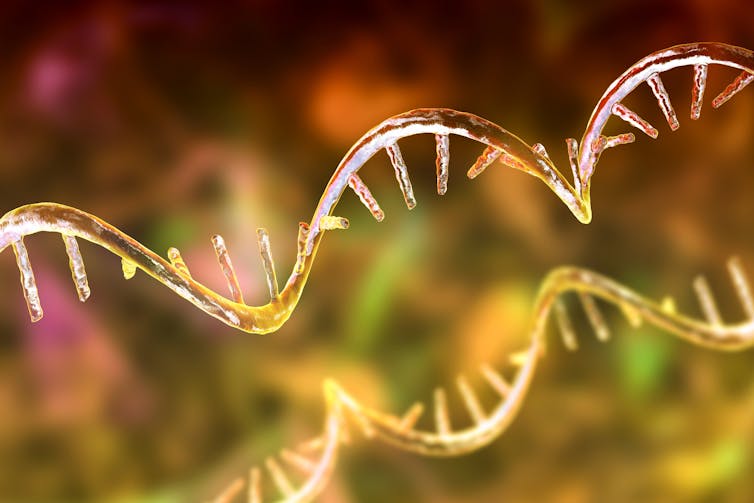
In early experiments, Karikó and Weismann found that injecting normal mRNA molecules into mice led to an immune response. This meant the mouse’s immune system saw the new mRNA as an invading pathogen and the immune cells would destroy it, instead of replicating it.
So the researchers modified the U nucleoside to create a pseudouridine, a chemical compound which stabilises RNA’s structure. When they repeated their experiment with the modified mRNA, the mice exhibited no immune response.
But Karikó and Weismann still faced the second challenge of being able to deliver the bespoke mRNA without it degrading.
They decided to use lipids (a nanoparticle) to deliver it. These fatty chemical compounds are an essential part of the cell membrane, controlling what enters and leaves the cell. Specially created lipids allowed the mRNA molecules to be delivered without being degraded or broken down by the immune system.
Karikó and Weissman’s research had successfully eliminated the obstacles that had previously stood in the way of using mRNA clinically. Being able to instruct the body to replicate virtually any harmless protein could have potential for treating a range of diseases and even protect against viral infections.
COVID vaccines
When their research was first published, it didn’t garner much attention. But in 2011, two biotech companies – Moderna and BioNTech – took notice and began research into mRNA medicines.
It’s no wonder why. Traditional vaccine production methods are time consuming, expensive and don’t work for every vaccine. But Karikó and Weissman’s work showed that synthetic mRNA could be made at a large scale.
Researchers had already been working on developing mRNA vaccines before the pandemic, such as a vaccine for Ebola that didn’t receive much commercial interest. But in 2020, when COVID-19 began spreading around the globe, vaccines were needed quickly to offer protection.
Using the foundational work of Karikó and Weissman, scientists developed a bespoke mRNA sequence which mimicked the spike protein (which allows the virus to enter our cells). This produced a harmless COVID particle which our cells then replicated, allowing our bodies to protect us from severe COVID infections when it encountered the real virus.
Karikó and Weissman’s discoveries years earlier were critical in making the COVID-19 mRNA vaccines possible. But these aren’t the only ways their work could be applied.
Researchers are now hoping to develop mRNA vaccines for diseases such as HIV and Zika virus. Studies have also shown mRNA vaccines might be useful in treating certain types of cancer.
Alice Godden, Senior research associate, School of Biological Sciences, University of East Anglia
This article is republished from The Conversation under a Creative Commons license. Read the original article.
- Details
- Written by: LAKE COUNTY NEWS REPORTS
The event will take place from 4 to 7 p.m.
This community-building partnership brings police and other government agencies together under positive circumstances.
Lakeport first hosted the event in 2013.
“Together we can reduce crime and build a stronger community,” according to Brad Rasmussen, Chief of Police in Lakeport.
The department invites the community to join together for a fun evening. “Get to know your neighbors and build relationships with your local public service agencies,” said Rasmussen.
One of the special activities to kick off that fun will be bicycle decorating on Park Street sponsored by the Lakeport Main Street Association. Children are invited to bring their bikes to the park.
Other activities for children will be available, along with raffle prizes for children and adults.
Local citizens and businesses are sponsors and donors; over 29 partner agencies will be present with booths providing important public information and resources.
Participating agencies include health services, animal care services, Sheriff’s Office of Emergency Services, Behavioral Health, Probation, Social Services, service dogs, California Highway Patrol, school district and educational services, victim witness services, disaster preparedness, Pacific Gas and Electric and city services.
Also participating are Redwood Community Services, Safe RX Lake County, Lake County Chamber of Commerce, Coast Guard Auxiliary, Lake Family Resource Center, American Red Cross, Lakeport Fire Protection District, Lakeport Elks, Sutter Lakeside Hospital and Lake County Tribal Health Consortium.
The Kiwanis Club of Lakeport will be barbecuing hot dogs. Face painting by Chayo will be offered.
Everything at this event is free of charge due to generous sponsors, including Clearlake Club, Elite Barber Shop, Hong Kong Restaurant, J. Byrd & Associates, Kingdom Games & Comics, Lakeport Auto Movies Drive-In and Lakeport Cinema 5, Lakeport Grocery Outlet and Lakeport Tire and Auto Service.
Additional sponsors are Larios Photography, NAPA Auto Parts, Pak N Mail, Stonefire Pizza, Strings and Things, Throckmorton Jones, UCC Rentals, Ukiah Oxygen Co., Joy Madeiros Veteran’s Museum and Wine in the Willows.
Updated information will be posted on the Police Department’s Facebook page, https://www.facebook.com/LakeportPolice/.
For more information, contact Chief of Police Brad Rasmussen at 707-263-5491.