 How to resolve AdBlock issue?
News
- Details
- Written by: Katherine Harry, Colorado State University and Emma Rettner, Colorado State University
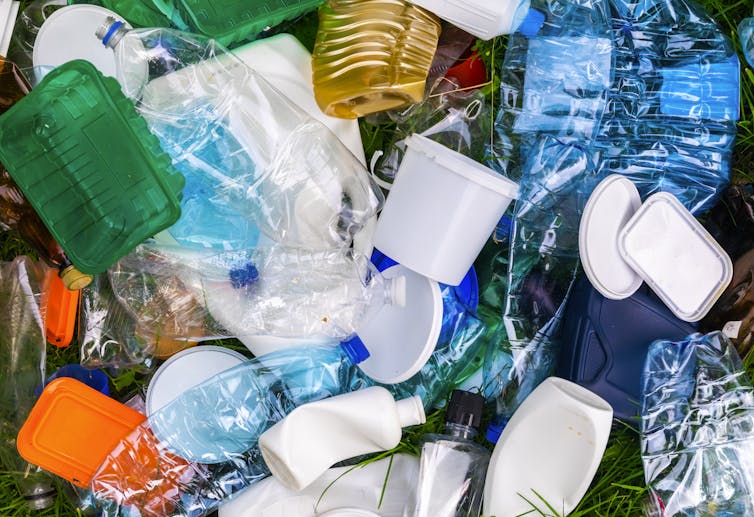
Hundreds of millions of tons of single-use plastic ends up in landfills every year, and even the small percentage of plastic that gets recycled can’t last forever. But our group of materials scientists has developed a new method for creating and deconstructing polymers that could lead to more easily recycled plastics – ones that don’t require you to carefully sort out all your recycling on trash day.
In the century since their conception, people have come to understand the enormous impacts – beneficial as well as detrimental – plastics have on human lives and the environment. As a group of polymer scientists dedicated to inventing sustainable solutions for real-world problems, we set out to tackle this issue by rethinking the way polymers are designed and making plastics with recyclability built right in.
Why use plastics, anyway?
Everyday items including milk jugs, grocery bags, takeout containers and even ropes are made from a class of polymers called polyolefins. Polyolefins make up around half of the plastics produced and disposed of every year.
These polymers are used in plastics commonly labeled as HDPE, LLDPE or PP, or by their recycling codes #2, #4 and #5, respectively. These plastics are incredibly durable because the chemical bonds that make them up are extremely stable. But in a world set up for single-use consumption, this is no longer a design feature but rather a design flaw.
Imagine if half of the plastics used today were recyclable by twice as many processes as they are now. While that wouldn’t get the recycling rate to 100%, a jump from single digits – currently around 9% – to double digits would make a big dent in the plastics produced, the plastics accumulated in the environment and their capacity for recycling and reuse.
Recycling methods we already have
Even the plastics that make it to a recycling facility can’t be reused in exactly the same way they were used before – the recycling process degrades the material, so it loses utility and value. Instead of making a plastic cup that is downgraded each time it gets recycled, manufacturers could potentially make plastics once, collect them and reuse them on and on.
Conventional recycling requires careful sorting of all the collected materials, which can be hard with so many different plastics. Here in the U.S., collection happens mainly through single stream recycling – everything from metal cans, glass bottles, cardboard boxes and plastic cups end up in the same bin. Separating paper from metal doesn’t require complex technology, but sorting a polypropylene container from a polyethylene milk jug is hard to do without the occasional mistake.

When two different plastics are mixed together during recycling, their useful properties are hugely reduced – to the point of making them useless.
But say you can recycle one of these plastics by a different method, so it doesn’t end up contaminating the recycling stream. When we mixed samples of polypropylene with a polymer we made, we were still able to depolymerize – or break down the material – and regain our building blocks without chemically affecting the polypropylene. This indicated that a contaminated waste stream could still recover its value, and the material in it could go on to be recycled, either mechanically or chemically.
Plastics we need − but more recyclable
In a study published in October 2023, our team developed a series of polymers with only two simple building blocks – one soft polymer and one hard polymer – that mimicked polyolefins but could also be chemically recycled.
Connecting two different polymers together multiple times until they form a single, long molecule creates what’s called a multiblock polymer. Just by adjusting how much of each polymer type goes into the multiblock polymer, our team created a wide range of materials with properties that spanned across polyolefin types. But creating these multiblock polymers is easier said than done.
To link these hard and soft polymers, we adapted a technique that had previously been used only on very small molecules. This method is improved relative to traditional methods of making polymers in a step-by-step fashion, developed in the 1920s, where the reactive groups on the end of the molecules need to be exactly matched.
In our method, the reactive groups are now the same as each other, meaning we didn’t have to worry about pairing the ends of each building block to make polymers that can compete with the polyolefins we already use. Using the same strategy, applied in reverse by adding hydrogen, we could disconnect the polymers back into their building blocks and easily separate them to use again.
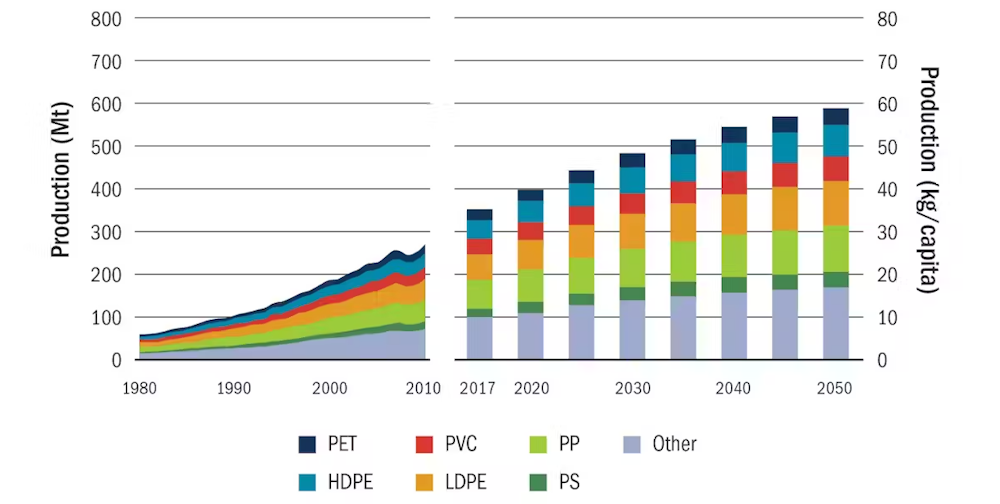
With an almost twofold increase in annual plastic use projected through 2050, the complexity and quantity of plastic recycling will only increase. It’s an important consideration when designing new materials and products.
Using just two building blocks to make plastics that have a huge variety of properties can go a long way toward reducing and streamlining the number of different plastics used to make the products we need. Instead of needing one plastic to make something pliable, another for something stiff, and a third, fourth and fifth for properties in between, we could control the behavior of plastics by just changing how much of each building block is there.
Although we’re still in the process of answering some big questions about these polymers, we believe this work is a step in the right direction toward more sustainable plastics.
We were able to create materials that mimic the properties of plastics the world relies on, and our sights are now set on creating plastic compositions that you couldn’t with existing methods.
Katherine Harry, PhD Student in Chemistry, Colorado State University and Emma Rettner, PhD Candidate in Materials Science and Engineering, Colorado State University
This article is republished from The Conversation under a Creative Commons license. Read the original article.
- Details
- Written by: NOIRLab

The unprecedented digital atlas includes data from NOIRLab telescopes and will be an invaluable resource for research into galaxy formation and the structure of the Universe
Astronomers have created a detailed atlas of almost 400,000 galaxies in our cosmic neighborhood.
The Siena Galaxy Atlas was compiled using data from NSF's NOIRLab telescopes, and is designed to be the pre-eminent digital galaxy atlas for large galaxies.
It’s a treasure trove of information for researchers investigating everything from galaxy formation and evolution to dark matter and gravitational waves. It’s also freely available online for the public to explore.
Astronomers have long sought to map the night skies, not only to fill in our picture of the cosmos we inhabit, but also to support further research.
Comprehensive compilations of astronomical objects serve many purposes: they can help scientists spot broad patterns across a population of objects, put new discoveries such as transient events in the context of their surroundings, and identify the best candidates for focused observations.
However, these resources must be routinely updated to reflect the continuous technological improvements of telescopes.
Now, a new atlas has been released with detailed information on over 380,000 galaxies at a greater level of accuracy than ever before, promising to be a boon to future astronomical inquiry.
The Siena Galaxy Atlas, or SGA, is a compilation of data from three surveys completed between 2014 and 2017 known as the DESI Legacy Surveys, which were carried out to identify galaxy targets for the Dark Energy Spectroscopic Instrument, or DESI, survey.
Data were collected at Cerro Tololo Inter-American Observatory (CTIO) and Kitt Peak National Observatory (KPNO), both Programs of NSF’s NOIRLab, and at the University of Arizona’s Steward Observatory.
The DESI Legacy Surveys used state-of-the-art instruments on telescopes operated by NOIRLab: the Dark Energy Camera Legacy Survey (DECaLS), carried out using the DOE-built Dark Energy Camera (DECam) on the Víctor M. Blanco 4-meter Telescope at CTIO in Chile; the Mayall z-band Legacy Survey (MzLS) with the Mosaic3 camera on the Nicholas U. Mayall 4-meter Telescope at KPNO; and the Beijing-Arizona Sky Survey (BASS) with the 90Prime camera on the Bok 2.3-meter Telescope, which is operated by Steward Observatory and hosted at KPNO.
The DESI Legacy Imaging Surveys data, as well as a queryable copy of the full Siena Galaxy Atlas, are served to the astronomical community via the Astro Data Lab science platform and Astro Data Archive at NOIRLab’s Community Science and Data Center (CSDC).
The SGA contains additional data from a survey by NASA’s Wide-field Infrared Survey Explorer (WISE) satellite that has been reprocessed by Aaron Meisner, an astronomer at NOIRLab.
These surveys captured images in optical and infrared wavelengths to chart a total area of 20,000 square degrees — nearly half of the night sky, making it among the largest galaxy surveys. Bringing this wealth of information together in one place, the SGA offers precise data on the locations, shapes and sizes of hundreds of thousands relatively nearby large galaxies. Besides the sheer number of objects recorded, the data in the SGA also achieve a new level of accuracy and it is the first such resource to provide data on the galaxies’ light profiles.
“Nearby large galaxies are important because we can study them in more detail than any other galaxies in the Universe; they are our cosmic neighbors,” notes John Moustakas, professor of physics at Siena College and SGA project leader. “Not only are they strikingly beautiful, but they also hold the key to understanding how galaxies form and evolve, including our very own Milky Way galaxy.”
The SGA builds on several centuries of efforts to chart the night skies. The iconic Catalogue des Nébuleuses et des Amas d'Étoiles (Catalogue of Nebulae and Star Clusters), published in 1774 by French astronomer Charles Messier, was a major milestone, as was the New General Catalogue of Nebulae and Clusters of Stars (NGC), published in 1888 by John Louis Emil Dreyer.
More recently, in 1991, astronomers assembled the Third Reference Catalog of Bright Galaxies (RC3). Several other valuable galaxy atlases have been published over the past two decades, but most of them draw on the photographic-plate measurements in the RC3, or are missing significant numbers of galaxies. Since the SGA uses digital images captured with highly sensitive instruments, it represents a substantial improvement in both data quality and completeness.
Arjun Dey, a NOIRLab astronomer who was involved in the project, explains: “Previous galaxy compilations have been plagued by incorrect positions, sizes and shapes of galaxies, and also contained entries which were not galaxies but stars or artifacts. The SGA cleans all this up for a large part of the sky. It also provides the best brightness measurements for galaxies, something we have not reliably had before for a sample of this size.”
This versatile resource will drive progress in numerous branches of astronomy and astrophysics by helping scientists find the best galaxy samples for targeted observation.
For example, the SGA will enhance research into how patterns of star formation vary across different galaxies, the physical processes underlying the diverse array of morphologies that galaxies display, and how the distribution of galaxies is related to how dark matter is spread across the Universe.
By acting as a map, the SGA will also help astronomers pinpoint the sources of transient signals like gravitational waves and understand the events that give rise to them.
“The SGA is going to be the pre-eminent digital galaxy atlas for large galaxies,” says Dey. However, he points out that the SGA is not just for academic researchers, it is freely available to view online for anyone wishing to get to know our corner of the Universe better. Dey adds, “In addition to its scientific utility, it has a lot of pictures of beautiful galaxies!”
"The public release of these spectacular data contained in the atlas will have a real impact not only on astronomical research, but also on the public’s ability to view and identify relatively nearby galaxies," says Chris Davis, NSF program director for NOIRLab. "Dedicated amateur astronomers will particularly love this as a go-to resource for learning more about some of the celestial targets they observe."
- Details
- Written by: Lake County News reports
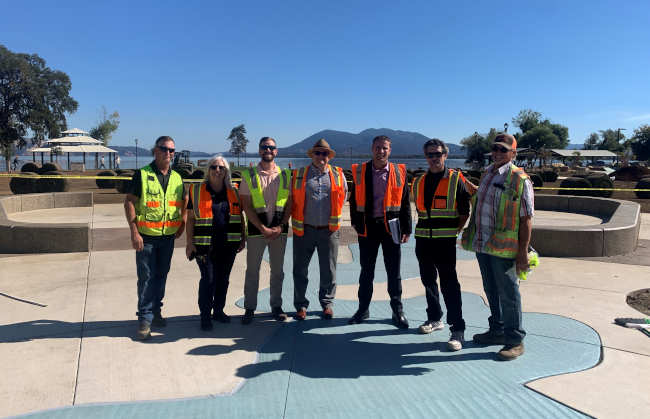
LAKEPORT, Calif. — State Senate Majority Leader Mike McGuire represents Lake County in the California Legislature and visited Lakeport on Wednesday during his travels in the district.
During a stop in Lakeport, Sen. McGuire visited Lakeport’s new Xabatin Community Park, located on the site of the former Natural High School.
McGuire visited the site with Public Works Director Ron Ladd, City Clerk Kelly Buendia, Councilmember Brandon Disney, City Manager Kevin Ingram, Councilmember Kenny Parlet and Project Coordinator Vincent Salcedo.
The park received its official name from the Lakeport City Council at its meeting on Tuesday.
“Xabatin” — pronounced Ka-bah-ten — is the original Pomo name for Clear Lake, signifying "big water."
Grand opening ceremonies for the park, funded through a $5.9 million grant through Proposition 68, will be held on Thursday, Oct. 26, at 4 p.m..
The public is invited to the celebration which will include a ribbon cutting, land acknowledgment, native dancers from the Big Valley Band of Pomo Indians and the Scotts Valley Band of Pomo Indians, along with light refreshments and food trucks.
The park is located at 800 N. Main St.
- Details
- Written by: Elizabeth Larson

LAKE COUNTY, Calif. — With the help of a SWAT team, the Clearlake Police Department took a Clearlake Oaks man into custody on Friday morning in connection to an attempted homicide case.
Treyvon Lashawn Jones, 27, was arrested following a search warrant service, Clearlake Police reported.
Clearlake Police Lt. Ryan Peterson said in a Friday news release that on Sept. 12 the department began investigating a shooting in the 14000 block of Uhl Avenue near Austin Park.
During the investigation, Peterson said it was determined that several subjects were involved in an altercation, which led to a shooting.
There were no injuries during the incident, and all three suspects fled the scene, Peterson said.
Peterson said that, as a result of the investigation, probable cause was developed to arrest the three involved subjects.
One was a juvenile who was arrested on Sept. 19 for numerous charges related to this incident, Peterson said. The other juvenile has not been arrested at this time. The names of the juveniles are not being released due to their age.
The third subject police identified in connection to the case is Jones, Peterson said.
He said the Clearlake Police Department requested assistance from the Mendo/Lake Regional SWAT team in securing the residence and arresting Jones.
Lauren Berlinn of the Lake County Sheriff’s Office said that at 7 a.m. Friday, the Mendo/Lake Regional SWAT team assisted the Clearlake Police Department in successfully serving the search warrant in the 12000 block of East Highway 20 in Clearlake Oaks.
The Lake County Sheriff’s Office issued a Nixle alert at 7:10 a.m. Friday notifying the community of the operation and asking community members to avoid the area.
Peterson said Jones was located and arrested at the residence.
Jail records showed Jones was taken into custody at 7:30 a.m. Friday. He was booked into the Lake County Jail for attempted homicide.
At the completion of the initial service of the search warrant, the scene was turned over to the Clearlake Police Department, Berlinn reported.
Peterson said the Clearlake Police Department was grateful to the Mendo/Lake Regional SWAT team for their assistance in bringing the warrant service to a safe conclusion.
Anyone with information regarding this investigation is encouraged to contact Clearlake Police Det. Christopher Kelleher at 707-994-8251.
Email Elizabeth Larson at