 How to resolve AdBlock issue?
News
- Details
- Written by: LAKE COUNTY NEWS REPORTS
The grant-funded “Reducing Impairment Statewide” campaign runs through Sept. 30, 2024.
Driving under the influence remains a critical concern, and this $5.9 million grant represents a critical injection of funding to support the CHP’s ongoing commitment to making California’s roads safer and protecting the lives of all who travel on them.
According to data from the CHP’s Statewide Integrated Traffic Records System, in 2021, 748 people were killed and 12,591 were injured in crashes involving an impaired driver within the CHP’s jurisdiction.
Each one of these injuries and deaths represents a preventable tragedy and underscores the continued need to focus efforts on reducing impaired driving.
“The California Highway Patrol is grateful for the federal funding that has made this initiative possible. Through education, enforcement, and community engagement, the CHP is determined to make our roads safer and reduce the devastating impact of impaired driving,” said CHP Commissioner Sean Duryee. “I remind all Californians to never get behind the wheel when under the influence of drugs or alcohol and to always make a safe choice when traveling. The life you save could be your own.”
With this funding, the CHP will conduct additional DUI saturation patrols, sobriety checkpoints, and traffic safety education efforts throughout California.
The increased presence of the CHP will be focused on detecting and apprehending drivers under the influence of alcohol or drugs while educating the public about the dangers of impaired driving.
DUI can encompass a range of substances, including alcohol, cannabis, impairing medications, illegal drugs, or any combination that affects a driver’s ability to drive, and will result in an arrest for those who are found to be under the influence.
To prevent DUI, the CHP encourages responsible behavior. Always designate a sober driver, take public transportation, or use a taxi or ride-share.
Additionally, the CHP would like to remind the public to call 9-1-1 if they observe a suspected DUI driver. Be prepared to provide the dispatcher a location, direction of travel, and vehicle description.
More information about the CHP’s impaired driver enforcement programs can be found on the CHP’s website.
Funding for this program was provided by a grant from the OTS, through the National Highway Traffic Safety Administration.
- Details
- Written by: LAKE COUNTY NEWS REPORTS
On Wednesday, Nov. 1, from 5:30 to 7 p.m., PG&E experts, including Regional Vice President for PG&E’s North Coast Dave Canny, will provide a brief presentation during which participants will have the opportunity to ask questions.
The event can be accessed through the below link, by phone or through PG&E’s website, www.pge.com/webinars.
Counties covered in the town hall are Lake, Humboldt, Marin, Mendocino, Napa, Siskiyou, Sonoma and Trinity.
To participate, use this link. To dial in, call 888-469-1174. The conference ID is 5429064.
In this meeting, PG&E will also provide an update regarding a pair of proposed decisions in the general rate case by the California Public Utilities Commission.
The proposed decisions would drastically reduce PG&E’s undergrounding plans of more than 2,000 miles between now and 2026.
American Sign Language interpretation will be available, along with dial-in numbers for those who aren’t able to join online.
For the full webinar events schedule, additional information on how to join and recordings and presentation materials from past events, visit www.pge.com/webinars.
- Details
- Written by: Elizabeth Larson

The Clearlake Animal Control website lists 48 adoptable dogs.
This week’s include “Dandelion,” a female Doberman Pinscher/Mix with a black and brown coat.
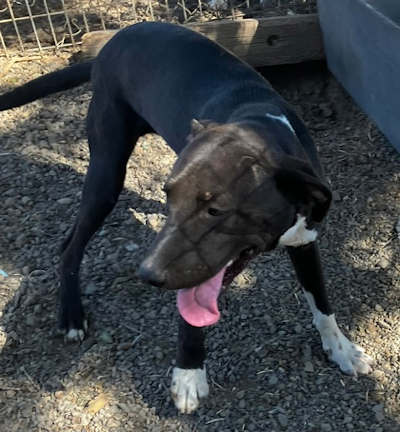
There is also “Ninja,” a 1-year-old male pit bull terrier with a black and white coat.
The shelter is located at 6820 Old Highway 53. It’s open from 9 a.m. to 6 p.m. Tuesday through Saturday.
For more information, call the shelter at 707-762-6227, email
This week’s adoptable dogs are featured below.
Email Elizabeth Larson at
- Details
- Written by: LAKE COUNTY NEWS REPORTS
At the heart of this chaotic interaction, entwined and caught in the midst of the chaos, is a pair of supermassive black holes — the nearest pair to Earth ever recorded.
The swirling arms of a spiral galaxy are among the most recognized features in the cosmos: long sweeping bands spun off from a central core, each brimming with dust, gas, and dazzling pockets of newly formed stars.
Yet this opulent figure can warp into a much more bizarre and amorphous shape during a merger with another galaxy. The same sweeping arms are suddenly perturbed into disarray, and two supermassive black holes at their respective centers become entangled in a tidal dance.
This is the case of NGC 7727, a peculiar galaxy located in the constellation of Aquarius about 90 million light-years from the Milky Way.
Astronomers have captured an evocative image of this merger’s aftermath using the Gemini Multi-Object Spectrograph, or GMOS, mounted on the Gemini South telescope in Chile, part of the International Gemini Observatory operated by NSF’s NOIRLab.
The image reveals vast swirling bands of interstellar dust and gas resembling freshly-spun cotton candy as they wrap around the merging cores of the progenitor galaxies.
From the aftermath has emerged a scattered mix of active starburst regions and sedentary dust lanes encircling the system.
What is most noteworthy about NGC 7727 is undoubtedly its twin galactic nuclei, each of which houses a supermassive black hole, as confirmed by astronomers using the European Southern Observatory’s Very Large Telescope, or VLT.
Astronomers now surmise the galaxy originated as a pair of spiral galaxies that became embroiled in a celestial dance about one billion years ago. Stars and nebulae spilled out and were pulled back together at the mercy of the black holes’ gravitational tug-of-war until the irregular tangled knots we see here were created.
The two supermassive black holes, one measuring 154 million solar masses and the other 6.3 million solar masses, are approximately 1600 light-years apart. It is estimated that the two will eventually merge into one in about 250 million years to form an even more massive black hole while dispersing violent ripples of gravitational waves across spacetime.
Because the galaxy is still reeling from the impact, most of the tendrils we see are ablaze with bright young stars and active stellar nurseries. In fact, about 23 objects found in this system are considered candidates for young globular clusters.
These collections of stars often form in areas where star formation is higher than usual and are especially common in interacting galaxies as we see here.
Once the dust has settled, NGC 7727 is predicted to eventually become an elliptical galaxy composed of older stars and very little star formation. Similar to Messier 87, an elliptical galaxy with a supermassive black hole at its heart, this may be the fate of the Milky Way and the Andromeda Galaxy when they fuse together in billions of years’ time.