 How to resolve AdBlock issue?
News
- Details
- Written by: Lake County News reports
Capt. Gregory Van Patten said the two people who died in the crash were Vaughan Wesley Porter, 54, of North Highland, Utah, and Jaime Danielle Rust, 51, of Payson, Utah.
Van Patten said the Mendocino County Sheriff's Office Coroner's Division was able to identify Porter and Rust through dental record comparisons.
The plane crash was reported on the evening of Oct. 20 in the 21000 block of Airport Road in Covelo.
Deputies arriving at the scene, along with firefighters, found the plane on fire, with the fire spreading into the vegetation.
After containing the fire, the deputies found the bodies while searching the debris field.
While the sheriff’s office is conducting the coroner’s investigation, the Federal Aviation Administration and the National Transportation Safety Board are investigating the circumstances that led to the crash.
NTSB and FAA preliminary investigation information showed that the plane was a Beech A36 Bonanza, a fixed wing single-engine plane built in 1991.
The plane was registered to Plane Haven LLC of Kalispell, Montana.
- Details
- Written by: Elizabeth Larson
Dogs available for adoption this week include mixes of Australian shepherd, border collie, boxer, Chihuahua, German shepherd, hound, Labrador retriever, pit bull, shepherd and treeing walker coonhound.
Dogs that are adopted from Lake County Animal Care and Control are either neutered or spayed, microchipped and, if old enough, given a rabies shot and county license before being released to their new owner. License fees do not apply to residents of the cities of Lakeport or Clearlake.
Those dogs and the others shown on this page at the Lake County Animal Care and Control shelter have been cleared for adoption.
Call Lake County Animal Care and Control at 707-263-0278 or visit the shelter online for information on visiting or adopting.
The shelter is located at 4949 Helbush in Lakeport.
Email Elizabeth Larson at




























- Details
- Written by: Johann Rafelski, University of Arizona

For centuries, the quest for new elements was a driving force in many scientific disciplines. Understanding an atom’s structure and the development of nuclear science allowed scientists to accomplish the old goal of alchemists – turning one element into another.
Over the past few decades, scientists in the United States, Germany and Russia have figured out how to use special tools to combine two atomic nuclei and create new, superheavy elements.


These heavy elements usually aren’t stable. Heavier elements have more protons, or positively charged particles in the nucleus; some that scientists have created have up to 118. With that many protons, the electromagnetic repulsive forces between protons in the atomic nuclei overwhelm the attractive nuclear force that keeps the nucleus together.
Scientists have predicted for a long time that elements with around 164 protons could have a relatively long half-life, or even be stable. They call this the “island of stability” – here, the attractive nuclear force is strong enough to balance out any electromagnetic repulsion.
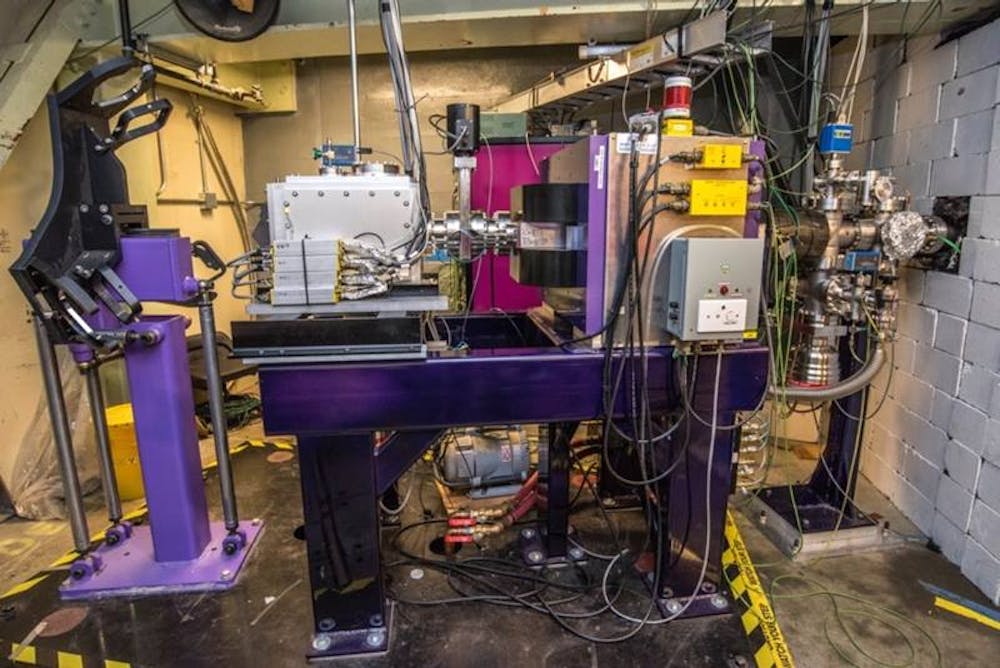
Since heavy elements are difficult to make in the lab, physicists like me have been looking for them elements everywhere, even beyond the Earth. To narrow down the search, we need to know what sort of natural processes could produce these elements. We also need to know what properties they have, like their mass densities.
Calculating density
From the outset, my team wanted to figure out the mass density of these superheavy elements. This property could tell us more about how the atomic nuclei of these elements behave. And once we had an idea about their density, we could get a better sense of where these elements might be hiding.
To figure out the mass density and other chemical properties of these elements, my research team used a model that represents an atom of each of these heavy elements as a single, charged cloud. This model works well for large atoms, particularly metals that are laid out in a lattice structure.
We first applied this model to atoms with known densities and calculated their chemical properties. Once we knew it worked, we used the model to calculate the density of elements with 164 protons, and other elements in this island of stability.
Based on our calculations, we expect stable metals with atomic numbers around 164 to have densities between 36 to 68 g/cm3 (21 to 39 oz/in3). However, in our calculations, we used a conservative assumption about the mass of atomic nuclei. It’s possible that the actual range is up to 40% higher.
Asteroids and heavy elements
Many scientists believe that gold and other heavy metals were deposited on Earth’s surface after asteroids collided with the planet.
The same thing could have happened with these superheavy elements, but super mass dense heavy elements sink into ground and are eliminated from near the Earth’s surface by the subduction of tectonic plates. However, while researchers might not find superheavy elements on Earth’s surface, they could still be in asteroids like the ones that might have brought them to this planet.
Scientists have estimated that some asteroids have mass densities greater than that of osmium (22.59 g/cm3, 13.06 oz/in3), the densest element found on Earth.
The largest of these objects is asteroid 33, which is nicknamed Polyhymnia and has a calculated density of 75.3 g/cm3 (43.5 oz/in3). But this density might not be quite right, since it’s quite difficult to measure the mass and volume of far-away asteroids.
Polyhymnia isn’t the only dense asteroid out there. In fact, there’s a whole class of superheavy objects, including asteroids, which could contain these superheavy elements. Some time ago, I introduced the name Compact Ultradense Objects, or CUDOs, for this class.
In a study published in October 2023 in the European Physical Journal Plus, my team suggested some of the CUDOs orbiting in the solar system might still contain some of these dense, heavy elements in their cores. Their surfaces would have accumulated normal matter over time and would appear normal to a distant observer.
So how are these heavy elements produced? Some extreme astronomical events, like double star mergers could be hot and dense enough to produce stable superheavy elements.
Some of the superheavy material could then remain on board asteroids created in these events. They could stay packed in these asteroids, which orbit the solar system for billions of years.
Looking to the future
The Eurpoean Space Agency’s Gaia mission aims to create the largest, most precise three-dimensional map of everything in the sky. Researchers could use these extremely precise results to study the motion of asteroids and figure out which ones might have an unusually large density.
Space missions are being conducted to collect material from the surfaces of asteroids and analyze them back on Earth. Both NASA and the Japanese state space agency JAXA have targeted low density near-Earth asteroids with success. Just this month, NASA’s OSIRIS-REx mission brought back a sample. Though the sample analysis is just getting started, there is a very small chance it could harbor dust containing superheavy elements accumulated over billions of years.
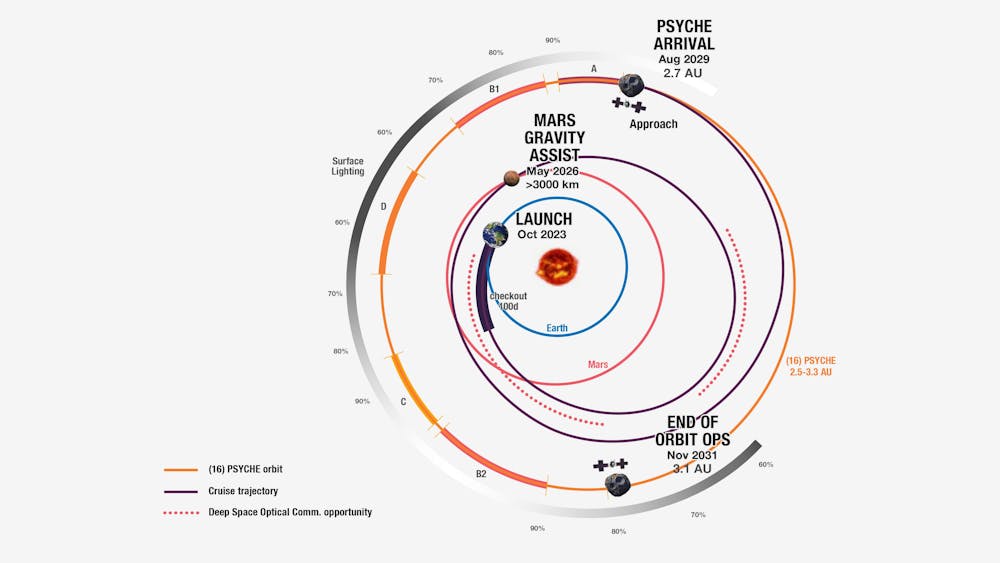
One mass-dense dust and rock sample brought back to Earth would be enough. NASA’s Psyche mission, which launched in October 2023, will fly to and sample a metal-rich asteroid with a greater chance of harboring superheavy elements. More asteroid missions like this will help scientists better understand the properties of asteroids orbiting in the solar system.
Learning more about asteroids and exploring potential sources of superheavy elements will help scientists continue the century-spanning quest to characterize the matter that makes up the universe and better understand how objects in the solar system formed.
Evan LaForge, an undergraduate student studying physics and mathematics, is the lead author on this research and helped with the writing of this article, along with Will Price, a physics graduate student.
Johann Rafelski, Professor of Physics, University of Arizona
This article is republished from The Conversation under a Creative Commons license. Read the original article.
- Details
- Written by: Elizabeth Larson
The National Weather Service said the red flag warning for all of Lake County will be in effect from 5 a.m. Saturday to 5 p.m. Sunday.
During that time, wind gusts could reach over 30 miles per hour.
The wind advisory will be in effect from 5 p.m. Saturday to 11 a.m. Sunday, and the frost advisory is for the mountains in the northern third of Lake County from 1 a.m. Saturday to 10 a.m. Sunday.
The forecast predicts warm daytime weather this week, with temperatures dropping into the 40s at night.
Conditions are forecast to transition back to wet weather later next week, when the first storm system is expected to make landfall.
In Lake County, there will be a slight chance of rain on Wednesday night and on Thursday.
There also are chances of rain on Friday, and more storms also are expected at the end of next week.
Email Elizabeth Larson at