 How to resolve AdBlock issue?
News
- Details
- Written by: Elizabeth Larson

CLEARLAKE, Calif. — Clearlake Animal Control has new dogs and other dogs waiting to be adopted this fall.
The Clearlake Animal Control website lists 46 adoptable dogs.
They include “Sissy,” a 2-year-old female German shepherd mix with a tan coat. She has been spayed and is up to date on vaccinations.
Another adoptable dog is “Smak,” a male German shepherd mix with a tricolor coat.

The shelter is located at 6820 Old Highway 53. It’s open from 9 a.m. to 6 p.m. Tuesday through Saturday.
For more information, call the shelter at 707-762-6227, email
This week’s adoptable dogs are featured below.
Email Elizabeth Larson at
- Details
- Written by: Jessica L. Adler, Florida International University
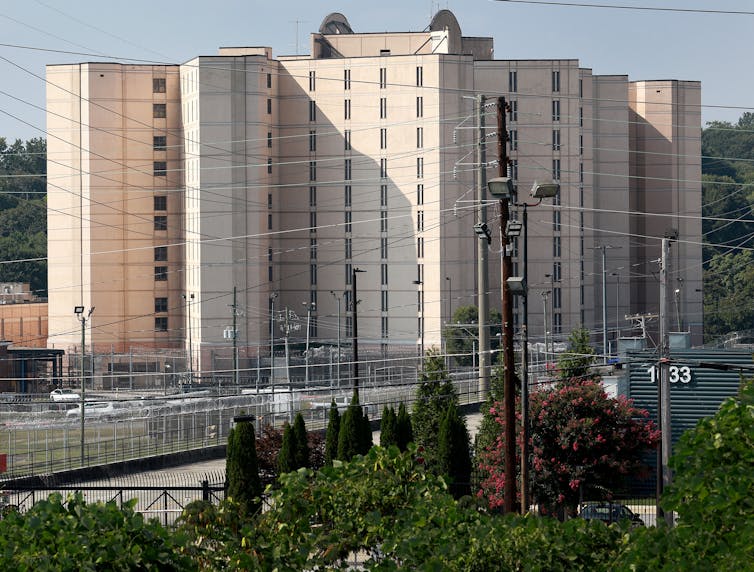
The family of Samuel Lawrence, one of 10 people to die in Georgia’s Fulton County Jail in 2023, is fighting for answers and accountability.
“I got to think about him every day of my life and I don’t know when the pain stops,” Lawrence’s father, Frank Richardson, told a local TV station in October 2023. “I pray to God that he touches that jail and puts people in place to help the other ones that are left behind.”
Shortly before his death, Lawrence, 34, had filed a complaint about jail conditions, alleging that he was brutally beaten and isolated, with insufficient food and water.
But Fulton County Sheriff Patrick Labat largely blamed the jail’s “outbreak of violence” on “the long-standing, dangerous overcrowding and the crumbling walls of the facility.”
In order to “save lives,” Labat said, his county would be requesting a “replacement jail.”
The Georgia sheriff is among many law enforcement officials to claim that people like Samuel Lawrence would be safer if communities reduced overcrowding by building new jails or enhancing existing ones.
But recent research my colleague Weiwei Chen and I published on escalating jail mortality rates nationwide calls into question that rationale.
In an article published in the June 2023 issue of Health Affairs, we examined relationships between jail conditions and jail deaths, analyzing factors such as percent of jail capacity occupied, admission and discharge rates and population demographics.
Among the variables that appeared to be most significantly related to jail mortality were turnover rate – the number of people admitted to and discharged from a facility relative to its average population – as well as the percentage of Black people in the jail population.
Jail mortality
Jails are sometimes referred to as the “front door” of the criminal justice system. Unlike prisons, which are run by federal and state governments and hold convicted people serving relatively long sentences, jails are locally managed, and the majority of their populations are being detained pretrial while unconvicted.
Data on how many people die while incarcerated is notoriously inaccessible and often unreliable. Still, available reports on jail deaths from the Bureau of Justice Statistics offer some perspective.
In 2019, overall jail death rates were below the adjusted national average of 339 per 100,000, but leading up to that year, they had steeply increased. Between 2000 and 2019, jail mortality rose by 11%, from 151 per 100,000 to 167 per 100,000.
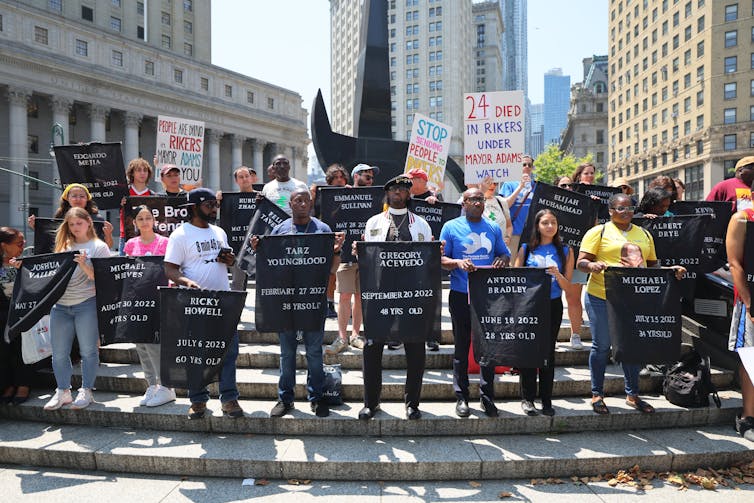
To conduct what epidemiologist Homer Venters referred to as an “apples-to-apples comparison” of circumstances and deaths in multiple jails during a period of escalating mortality, we relied on a combination of datasets.
For information about facility deaths, we turned to statistics compiled by Reuters news agency reporters, who submitted Freedom of Information Act requests to obtain mortality data from the largest jails across the U.S.
Our data on jail conditions – such as annual admissions and releases, facility capacities and demographics – came from the Bureau of Justice Statistics’ census and annual survey of jails.
Ultimately, we assessed mortality rates and conditions in approximately 450 U.S. jails between 2008 and 2019.
Some of our most robust findings about jail deaths had to do with two factors: turnover rate – the sum of weekly admissions and releases divided by average daily population – and demographics.
In the jails we examined, average turnover was 67% (slightly above the national average of 53%). Relatively high turnover rates, we found, were associated with higher death rates overall, as well as due to suicide, drugs and alcohol, and homicide.
In addition to revealing a relationship between turnover rate and mortality, our research showed that the presence of greater proportions of non-Hispanic Black people in populations of relatively large jails was associated with more deaths due to illness.
Race-based differences in illness-related deaths could be due to a variety of factors, including populationwide health disparities in the U.S.
Reliance on jails
Our findings about both turnover and racial disparities should be considered alongside the broader context of jail incarceration in the United States.
Roughly 4.9 million people are arrested and jailed each year, some of them multiple times. Overall, there were approximately 10.3 million admissions to more than 3,000 U.S. jails in 2019.
As of 2019, Black people were jailed at a rate more than three times that of white people.
People in jails have been found to be “significantly poorer” than people outside of jails, and more than 30 percent of those who are detained remain incarcerated because they cannot afford to pay bail.
Jailed people are also disproportionately likely to face health challenges. They are more likely to report having had chronic health issues, infectious diseases, mental illnesses and substance use problems.
The United States’ remarkably high population of incarcerated people – and the composition of that population – are related to decades’ worth of cuts in social welfare programs, structural racism, local and national political trends, and policing practices.
Research has shown that the cash bail system – a key driver of high jail turnover – “punishes the poor” by ensuring that they are more likely to be detained than their wealthier counterparts for the same crime. A reliance on cash bail also reportedly increases recidivism and undermines public safety.
Beyond incarceration
Our study suggests that ongoing initiatives geared at reducing incarceration – and by extension, jail turnover – could help achieve Sheriff Labat’s goal of saving lives.

Some communities, for example, have successfully limited the use of cash bail. Others have enhanced community-based services that address mental illness, drug use and homelessness without involving police, so jails are less likely to be sites of first resort for people with complex needs.
A year before Samuel Lawrence died, a report from the ACLU suggested that by adopting at least some of the above measures, Fulton County could “reduce its jail population significantly.”
It could also, our research suggests, save lives.
Jessica L. Adler, Associate Professor of History, Florida International University
This article is republished from The Conversation under a Creative Commons license. Read the original article.
- Details
- Written by: LAKE COUNTY NEWS REPORTS
The grant will support the Tribal Traffic Education Program, or TTEP — the CHP’s first grant-funded safety program specifically focused on reaching Native American communities — with funding for traffic safety education to drivers, pedestrians, and bicyclists on and near California’s tribal lands.
With a population of nearly 720,000, California is home to more Native Americans/Alaskan Natives than any other state.
There are 109 federally recognized tribes, each with its own unique culture, history and practices.
The program strives to improve service and public trust in tribal communities by implementing many of the lifesaving traffic safety programs the CHP has to offer.
“We are excited to extend our traffic safety initiatives to tribes and Native American residents within our communities,” said CHP Commissioner Sean Duryee. “The program’s primary goal is to save lives through education, while proactively building and maintaining relationships with California’s diverse tribal communities.”
CHP personnel involved in TTEP serve as resources to Native American/Alaska Native communities and tribes by sharing traffic safety information, conducting traffic safety presentations, and participating in community outreach and tribal cultural events.
The CHP has set a goal of conducting 125 tribal traffic safety presentations and other community outreach activities within the CHP’s Northern, Golden Gate, and Valley Divisions each grant cycle, with the intent of expanding the program statewide.
Program topics will include seat belt safety, proper use of child safety seats, dangers of driving under the influence, pedestrian and bicycle education, defensive driving techniques, distracted driving, teen/parent driving safety, driver license requirements, and other educational subjects.
Traffic safety presentations will be conducted at schools, public health fairs, tribal events, and other activities.
Funding for this program was provided by a grant from the California Office of Traffic Safety, through the National Highway Traffic Safety Administration.
- Details
- Written by: NATIONAL AERONAUTICS AND SPACE ADMINISTRATION
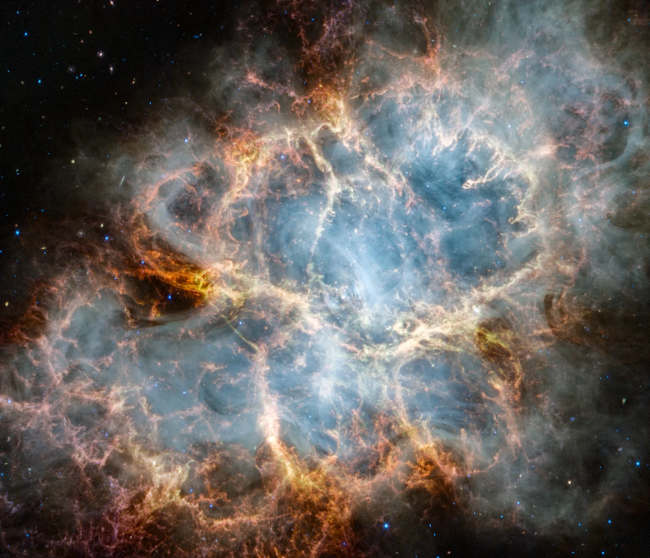
Although the Crab Nebula is one of the best-studied supernova remnants, questions about its progenitor, the nature of the explosion that created it still remain unanswered.
The NASA/ESA/CSA James Webb Space Telescope is on the case as it sleuths for any clues that remain within the supernova remnant.
Webb’s infrared sensitivity and spatial resolution are offering astronomers a more comprehensive understanding of the still-expanding scene
The NASA/ESA/CSA James Webb Space Telescope has gazed at the Crab Nebula, a supernova remnant located 6500 light-years away in the constellation Taurus.
Since this energetic event was recorded in 1054 CE by 11th-century astronomers, the Crab Nebula has continued to draw attention and additional study as scientists seek to understand the conditions, behavior and after-effects of supernovae by carefully studying this relatively close example.
With Webb’s NIRCam (Near-Infrared Camera) and MIRI (Mid-Infrared Instrument), the game is afoot as new details are uncovered — including the first complete map of dust distribution — in the search for answers about the Crab Nebula’s origins.
At first glance the general shape of the nebula is reminiscent of the 2005 optical wavelength image from the NASA/ESA Hubble Space Telescope.
In Webb’s infrared observation, a crisp, cage-like structure of fluffy gaseous filaments are shown in red and orange. However, in the central regions, emission from dust grains (yellow-white and green) is mapped out by Webb for the first time. The Hubble and Webb images of this object can be contrasted here.
Additional aspects of the inner workings of the Crab Nebula become more prominent and are seen in greater detail in the infrared light captured by Webb.
In particular, Webb highlights what is known as synchrotron radiation: emission produced from charged particles, like electrons, moving around magnetic field lines at relativistic speeds.
The radiation appears here as milky smoke-like material throughout the majority of the Crab Nebula’s interior.
This feature is a product of the nebula’s pulsar, a rapidly rotating neutron star. The pulsar’s strong magnetic fields accelerate particles to extremely high speeds and cause them to emit radiation as they wind around magnetic field lines. Though emitted across the electromagnetic spectrum, the synchrotron radiation becomes particularly vibrant in the infrared with Webb's NIRCam instrument.
To locate the Crab Nebula’s pulsar heart, trace the wisps that follow a circular ripple-like pattern in the middle to the bright white dot in the center. Further out from the core, follow the thin white ribbons of the radiation. The curvy wisps are closely grouped together, outlining the structure of the pulsar’s magnetic fields, which sculpt and shape the nebula.
At center left and right, the white material curves sharply inward from the filamentary dust cage’s edges and goes toward the neutron star’s location, as if the waist of the nebula is pinched. This abrupt slimming may be caused by the confinement of the supernova wind’s expansion by a belt of dense gas.
The wind produced by the pulsar heart continues to push the shell of gas and dust outward at a rapid pace. Notice how the filaments tend to be longer toward the upper right side of the nebula, in the same direction the pulsar is moving – not restricted by the belt of gas. Among the remnant’s interior, yellow-white and green mottled filaments form large-scale loop-like structures, which represent areas where dust grains reside.
The search for answers about the Crab Nebula’s past continues as astronomers further analyse the Webb data and consult previous observations of the nebula taken by other telescopes. Scientists will have newer Hubble data to review within the next year or so from the telescope’s reimaging of the supernova remnant. This will mark Hubble’s first look at the Crab Nebula in over 20 years, and will enable astronomers to more accurately compare Webb and Hubble’s findings.
Webb is the largest, most powerful telescope ever launched into space. Under an international collaboration agreement, ESA provided the telescope’s launch service, using the Ariane 5 launch vehicle.
Working with partners, ESA was responsible for the development and qualification of Ariane 5 adaptations for the Webb mission and for the procurement of the launch service by Arianespace. ESA also provided the workhorse spectrograph NIRSpec and 50% of the mid-infrared instrument MIRI, which was designed and built by a consortium of nationally funded European Institutes (The MIRI European Consortium) in partnership with JPL and the University of Arizona.
Webb is an international partnership between NASA, ESA and the Canadian Space Agency.