 How to resolve AdBlock issue?
News
- Details
- Written by: Lake County News reports
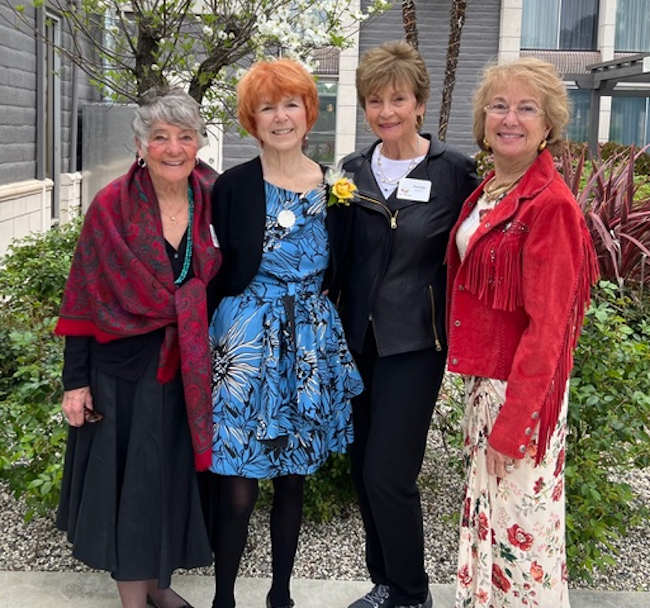
LAKE COUNTY, Calif. — A Lake County resident who is a wine industry veteran has received a prestigious award that recognizes the contributions of women in agriculture.
Terry Dereniuk, a member of Lake County California Women for Agriculture, was awarded the Common Threads North Award at a ceremony in Chico on April 3.
Common Threads has annually honored the lives of outstanding Northern California women since 1997 through the combined efforts of a nonprofit committee made up of several strong agricultural organizations.
The women recognized, whose roots are deep in agriculture, have made a difference in their communities with bountiful giving of their time, talent and treasure. Agriculture is the common thread of all honorees.
Terry Dereniuk and her husband, Buz, farm an organic vineyard in Kelseyville.
In addition Terry Dereniuk has served as president of Kelseyville Rotary, is past executive director of the Lake County Winery Association and has written successful petitions to establish four new American Viticultural Areas, or AVAs, since 2011.
She sat on the Lake County Farm Bureau Board for 10 years and is the project manager for two grants in the Lake County wine industry.
She also serves on the Community Advisory Committee for Sutter Lakeside Hospital.
Past Lake County California Women for Agriculture chapter member recipients of the Common Threads North award are Toni Scully, Marilyn Holdenried and Sharron Zoller.
- Details
- Written by: Elizabeth Larson
The board will meet beginning at 9 a.m. Tuesday, April 9, in the board chambers on the first floor of the Lake County Courthouse, 255 N. Forbes St., Lakeport.
The meeting can be watched live on Channel 8, online at https://countyoflake.legistar.com/Calendar.aspx and on the county’s Facebook page. Accompanying board documents, the agenda and archived board meeting videos also are available at that link.
To participate in real-time, join the Zoom meeting by clicking this link.
The meeting ID is 833 5785 4599, pass code 286739. The meeting also can be accessed via one tap mobile at +16699006833,,83357854599#,,,,*286739#. The meeting can also be accessed via phone at 669 900 6833.
At the start of Tuesday’s meeting, the board will meet the pet of the week and hear about what’s “New and Noteworthy” at the Lake County Library.
In untimed items, the board will consider the second amendment to an agreement between the county of Lake and Community Behavioral Health for specialty mental health services in the amount of $3,200,000 for fiscal years 2023-24, 2024-25 and 2025-26.
Appointments to the Child Care Planning and Development Council will be discussed as part of another untimed item.
During closed session, the board will hold interviews for two key department head positions — the directors of Social Services and Water Resources.
The full agenda follows.
CONSENT AGENDA
5.1: Approve second reading of ordinance amending Article XXVII of Chapter 2 of the Lake County Code to address membership of county of Lake Health Services in the existing Partnership HealthPlan of California Commission.
5.2: Approve closure of all Lake County Behavioral Health Services locations from noon to 5 p.m. on July 19 for a mandatory all staff training.
5.3: Approve Amendment No. 1 to the agreement between county of Lake and I.D.E.A. for consulting for professional consulting services in the amount of $31,000 for fiscal year 2023-2024 and authorize the chair to sign.
5.4: Approve waiver of the 900-hour extra help limitation for extra help office assistant, Kimberly Young for the fiscal year 2023-24.
5.5, Sitting as the Lake County Watershed Protection District, approve the cooperative agreement with Caltrans to provide Blue Lakes Safety Project Mitigation funds to support the Clover Creek Hitch Habitat Restoration Project in an amount not to exceed $246,492 and authorize the Water Resources director to sign the agreement, and (2) receive a presentation of the proposed project.
5.6: Approve agreement for the provision, installation, and maintenance of advanced network (data) services for an amount not to exceed $50,000 annually; and authorize the chair to sign.
5.7: Approve amendment to contract with Mendocino County for juvenile hall services in the amount of $100,000 annually and extend contract through June 2025; and authorize the chair to sign.
5.8: Adopt resolution accepting official canvass of the Presidential Primary Election held on March 5, 2024.
5.9: Approve contract between county of Lake and Prentice Long for public authority labor negotiation services, in the amount of $30,000 per year from Feb. 1, 2024, to Jan. 31, 2027, and authorize the chair to sign.
TIMED ITEMS
6.2, 9:03 a.m.: Pet of the Week.
6.3, 9:04 a.m.: New and Noteworthy at the Library.
UNTIMED ITEMS
7.2: Consideration of Amendment No. 2 to the agreement between the county of Lake and Community Behavioral Health for specialty mental health services in the amount of $3,200,000 for fiscal years 2023-24, 2024-25 and 2025-26.
7.3: Consideration of the following appointments to the Child Care Planning and Development Council and changes to membership assignments.
CLOSED SESSION
8.1: Public employee appointment pursuant to Gov. Code Section 54957(b) (1): Interviews for Social Services director; appointment of Social Services director.
8.2: Public employee appointment pursuant to Gov. Code Section 54957(b) (1): Interviews for Water Resources director; appointment of Water Resources director.
Email Elizabeth Larson at
- Details
- Written by: Clayton Buck, George M. Hayward and Lydia R. Anderson
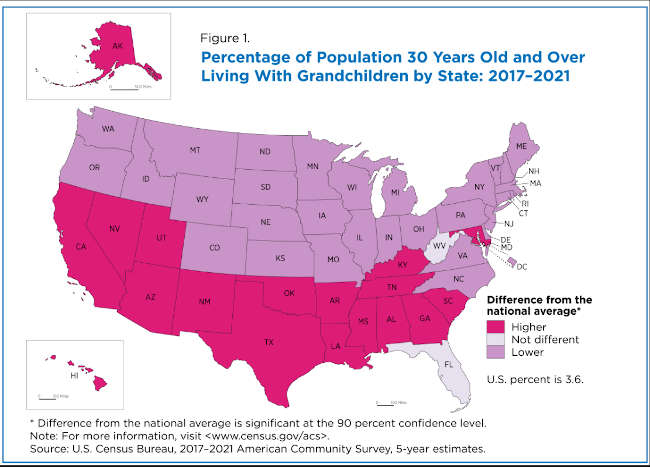
About 6.7 million people or 3.3% of adults age 30 and over lived with their grandchildren in 2021, according to a recently released U.S. Census Bureau report on the characteristics and geography of grandparents living with grandchildren under the age of 18 in the United States.
Alaska, Hawaii and states in the Southeast and Southwest had a higher share of grandparent-grandchildren households than the national average while states in the Northeast, Midwest and Pacific Northwest had lower shares.
Grandparents have long served critical roles in U.S. families that are shaped by changing demographic trends, such as increasing life expectancy, which allows grandparents more years to develop relationships with grandchildren.
Cultural expectations of the role of grandparents also contribute to differences in living arrangements.
States with highest share of grandparents living with grandchildren
Using 2017-2021 American Community Survey, 5-year estimates, Figure 1 shows the percentage of the population age 30 and over who lived with grandchildren under the age of 18 and whether the estimate for each state differed significantly from the national average.
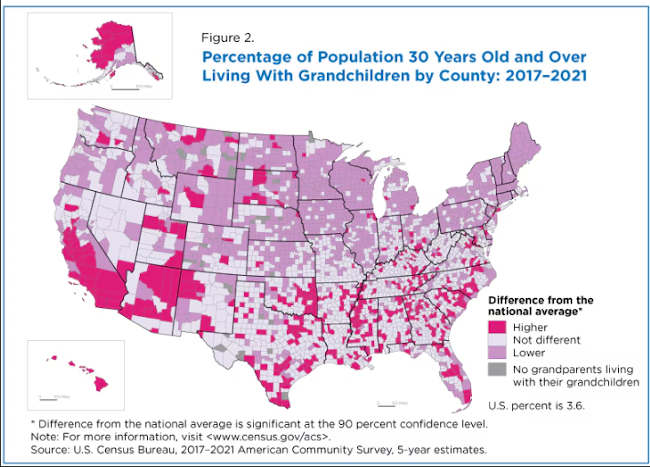
The county-level map (Figure 2) offers an even more granular look at how these estimates vary. Some states, such as Connecticut, Iowa, Maine, Massachusetts, New Hampshire, Oregon, Rhode Island and Vermont had zero counties with percentages higher than the national average.
The geographic patterns reflect the demographics and cultural characteristics of people who live in those areas.
The South, for example, has a higher percentage of Black or African American populations in the region who have a relatively high rate of living with grandchildren.
Lower percentages in the Northeast and Midwest could reflect higher percentages of non-Hispanic White populations, who have among the lowest percentage of grandparents living with grandchildren.
The high percentages of grandparents living with grandchildren throughout Alaska and Hawaii reflect the higher percentages of American Indian and Alaska Native (AIAN) and Native Hawaiian and Other Pacific Islander (NHPI) populations, respectively. Both groups (AIAN and NHPI) have among the highest percentages living with grandchildren.
Grandparents caring for grandchildren
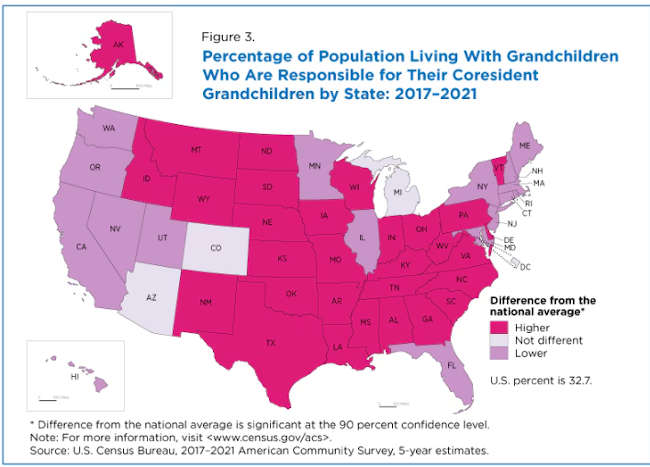
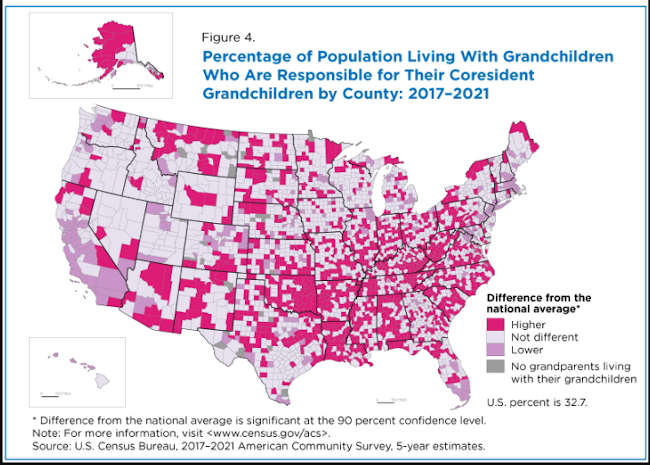
Nationally, roughly 32.7% of grandparents living with their grandchildren under the age of 18 were responsible for their care (Figure 3).
With the exception of the District of Columbia, Florida and Maryland, states in the South had higher percentages than the national average while states on the West Coast tended to have lower percentages. Alaska was higher and Hawaii was lower than the national average.
Arizona, Colorado, the District of Columbia and Michigan were the only states or state equivalents with estimates that were not significantly different from the national average.
Figure 4 shows county-level geographic variation. Some states, such as Hawaii, New Jersey, Rhode Island and Utah, had zero counties with percentages higher than the national average. On the other end of the spectrum, Arkansas, Delaware, Kentucky, Louisiana, New Mexico, Oklahoma, South Carolina and Wyoming did not have a single county lower than the national average.
Several states had a higher share of the population 30 years and over living with grandchildren (Figure 1) than the national average but a lower share of those living with grandchildren who were responsible for their grandchildren (Figure 3).
For example, the share of grandparents living with grandchildren exceeded the national average in California, Hawaii, Maryland, Nevada and Utah (Figure 1), but the share of those responsible for their grandchildren’s care was lower than the national average in those states (Figure 3).
The opposite was true in 16 states: Idaho, Indiana, Iowa, Kansas, Missouri, Montana, Nebraska, North Carolina, North Dakota, Ohio, Pennsylvania, South Dakota, Vermont, Virginia, Wisconsin and Wyoming. In those states, the percentage of grandparents living with grandchildren was lower than the nation as a whole but the share of those responsible for the care of their grandchildren was higher.
Clayton Buck and Lydia R. Anderson are family demographers in the U.S. Census Bureau’s Social, Economic, and Housing Statistics Division’s Fertility and Family Statistics Branch. George M. Hayward is a family demographer in the Census Bureau’s Population Division’s Population Estimates Branch.
- Details
- Written by: James Morton Turner, Wellesley College
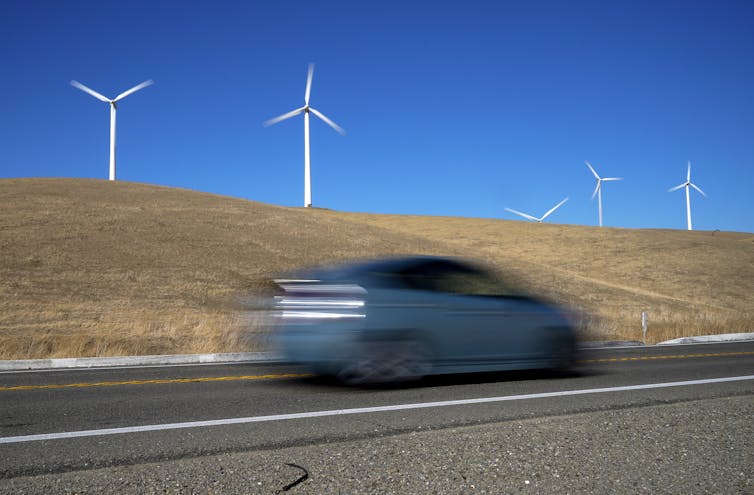
Panasonic’s new US$4 billion battery factory in De Soto, Kansas, is designed to be a model of sustainability – it’s an all-electric factory with no need for a smokestack. When finished, it will cover the size of 48 football fields, employ 4,000 people and produce enough advanced batteries to supply half a million electric cars per year.
But there’s a catch, and it’s a big one.
While the factory will run on wind and solar power much of the time, renewables supplied only 34% of the local utility Evergy’s electricity in 2023.
In much of the U.S., fossil fuels still play a key role in meeting power demand. In fact, Evergy has asked permission to extend the life of an old coal-fired power plant to meet growing demand, including from the battery factory.
With my students at Wellesley College, I’ve been tracking the boom in investments in clean energy manufacturing and how those projects – including battery, solar panel and wind turbine manufacturing and their supply chains – map onto the nation’s electricity grid.
The Kansas battery plant highlights the challenges ahead as the U.S. scales up production of clean energy technologies and weans itself off fossil fuels. It also illustrates the potential for this industry to accelerate the transition to renewable energy nationwide.
The clean tech manufacturing boom
Let’s start with some good news.
In the battery sector alone, companies have announced plans to build 44 major factories with the potential to produce enough battery cells to supply more than 10 million electric vehicles per year in 2030.
That is the scale of commitment needed if the U.S. is going to tackle climate change and meet its new auto emissions standards announced in March 2024.
The challenge: These battery factories, and the electric vehicles they equip, are going to require a lot of electricity.
Producing enough battery cells to store 1 kilowatt-hour (kWh) of electricity – enough for 2 to 4 miles of range in an EV – requires about 30 kWh of manufacturing energy, according to a recent study.
Combining that estimate and our tracking, we project that in 2030, battery manufacturing in the U.S. would require about 30 billion kWh of electricity per year, assuming the factories run on electricity, like the one in Kansas. That equates to about 2% of all U.S. industrial electricity used in 2022.
Battery belt’s huge solar potential
A large number of these plants are planned in a region of the U.S. South dubbed the “battery belt.” Solar energy potential is high in much of the region, but the power grid makes little use of it.

Our tracking found that three-fourths of the battery manufacturing capacity is locating in states with lower-than-average renewable electricity generation today. And in almost all of those places, more demand will drive higher marginal emissions, because that extra power almost always comes from fossil fuels.
However, we have also been tracking which battery companies are committing to powering their manufacturing operations with renewable electricity, and the data points to a cleaner future.
By our count, half of the batteries will be manufactured at factories that have committed to sourcing at least 50% of their electricity demand from renewables by 2030. Even better, these commitments are concentrated in regions of the U.S. where investments have lagged.
Some companies are already taking action. Tesla is building the world’s largest solar array on the roof of its Texas factory. LG has committed to sourcing 100% renewable solar and hydroelectricity for its new cathode factory in Tennessee. And Panasonic is taking steps to reach net-zero emissions for all of its factories, including the new one in Kansas, by 2030.
More corporate commitments can help strengthen demand for the deployment of wind and solar across the emerging battery belt.
What that means for US electricity demand
Manufacturing all of these batteries and charging all of these electric vehicles is going to put a lot more demand on the power grid. But that isn’t an argument against EVs. Anything that plugs into the grid, whether it is an EV or the factory that manufacturers its batteries, gets cleaner as more renewable energy sources come online.
This transition is already happening. Although natural gas dominates electricity generation, in 2023 renewables supplied more electricity than coal for the first time in U.S. history. The government forecasts that in 2024, 96% of new electricity generating capacity added to the grid would be fossil fuel-free, including batteries. These trends are accelerating, thanks to the incentives for clean energy deployment included in the 2022 Inflation Reduction Act.
Looking ahead
The big lesson here is that the challenge in Kansas is not the battery factory – it is the increasingly antiquated electricity grid.
As investments in a clean energy future accelerate, America will need to reengineer much of its power grid to run on more and more renewables and, simultaneously, electrify everything from cars to factories to homes.
That means investing in modernizing, expanding and decarbonizing the electric grid is as important as building new factories or shifting to electric cars.
Investments in clean energy manufacturing will play a key role in enabling that transition: Some of the new advanced batteries will be used on the grid, providing backup energy storage for times when renewable energy generation slows or electricity demand is especially high.
In January, Hawaii replaced its last coal-fired power plant with an advanced battery system. It won’t be long before that starts to happen in Tennessee, Texas and Kansas, too.
James Morton Turner, Professor of Environmental Studies, Wellesley College
This article is republished from The Conversation under a Creative Commons license. Read the original article.