 How to resolve AdBlock issue?
News
- Details
- Written by: Elizabeth Larson
Lake County has enjoyed several sunny days with warmer temperatures, a pattern forecast to hold on Thursday.
The National Weather Service said the warmer seasonal conditions will give way to “widespread
light rain and gusty south wind Friday afternoon into the weekend. Warmer weather will return mid next week.”
The Lake County forecast calls for rainfall amounts of up to an inch for Friday and Saturday, with slighter chances of rain on Sunday.
Gusting winds of about 10 miles per hour are in the forecast for Friday and Saturday.
Temperatures from Friday to Sunday will range from the high 50s during the day to the low 40s at night.
From Monday through Wednesday, temperatures will be on the rise again, reaching the high 60s during the day while at night lingering in the low 40s.
Email Elizabeth Larson at
- Details
- Written by: Joyce Hahn and Lauren Medina
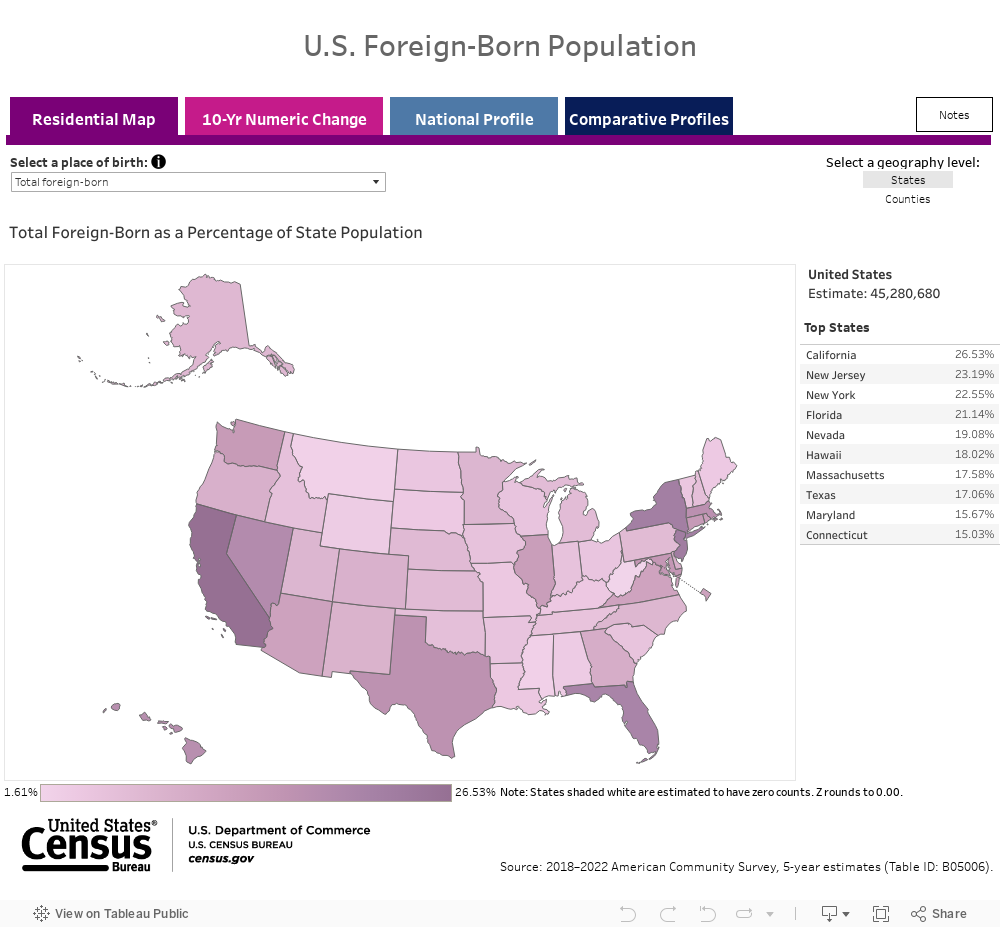
We compare estimates for the 2018-2022 period to the 5-year ACS period a decade earlier (2008-2012) when there were 39.8 million foreign-born people, or 12.9% of the population.
A new Census Bureau visualization explores where immigrants lived in the United States and how it changed between the two five-year periods at the national, state and county level.
It also features select indicators of socio-cultural and economic integration at the national level. Data users can look at the foreign-born population overall or select a specific place of birth, including regions (e.g., Africa), sub regions (e.g., Eastern Africa) and countries (e.g., Ethiopia).
The foreign-born population consists of anyone living in the United States who was not a U.S. citizen at birth, including naturalized U.S. citizens, lawful permanent residents (immigrants), temporary migrants such as foreign students, humanitarian migrants such as refugees and asylees, and unauthorized migrants. Estimates in the data visualization exclude those born at sea.
Highlights of the foreign-born population in 2018-2022 compared to 2008-2012:
• Immigrants made up over a fifth of the population in four states: California (26.5%), New Jersey (23.2%), New York (22.6%) and Florida (21.1%). Their numbers grew in all four states over the 10-year span.
• California, Florida, New Jersey and Texas had the largest increases, with Florida and Texas each gaining more than 850,000 foreign-born people.
• New Mexico was the only state whose foreign-born population decreased during that period.
Harris County, Texas, had the largest increase, followed by Miami-Dade County, Florida, and King County, Washington.
• The top 10 states where immigrants lived did not change, led by California, Texas and Florida in 2018-2022.
• Nine of the top 10 counties did not change, with Broward County, Florida, joining the group and Maricopa County, Arizona, leaving.
• Almost half (49.1%) of all immigrants in the United States entered the country before 2000.
More than half (52.3%) were naturalized U.S. citizens.
• Nearly a quarter of the foreign-born population 25 years and older had a bachelor’s (18.7%) or graduate or professional degree (14.9%), compared to 21.4% and 13.1% for the native-born population.
• An estimated 63.5% were employed, with over a third of the civilian employed foreign-born population (16 years and older) in management, business, science and arts occupations.
Joyce Hahn is a demographic statistician in the Foreign-Born Population Branch in the Census Bureau’s Population Division. Lauren Medina is chief of the Foreign-Born Population Branch in the Census Bureau’s Population Division.
- Details
- Written by: Matthew Farrer, University of Florida
Parkinson’s disease is a neurodegenerative movement disorder that progresses relentlessly. It gradually impairs a person’s ability to function until they ultimately become immobile and often develop dementia. In the U.S. alone, over a million people are afflicted with Parkinson’s, and new cases and overall numbers are steadily increasing.
There is currently no treatment to slow or halt Parkinson’s disease. Available drugs don’t slow disease progression and can treat only certain symptoms. Medications that work early in the disease, however, such as Levodopa, generally become ineffective over the years, necessitating increased doses that can lead to disabling side effects. Without understanding the fundamental molecular cause of Parkinson’s, it’s improbable that researchers will be able to develop a medication to stop the disease from steadily worsening in patients.
Many factors may contribute to the development of Parkinson’s, both environmental and genetic. Until recently, underlying genetic causes of the disease were unknown. Most cases of Parkinson’s aren’t inherited but sporadic, and early studies suggested a genetic basis was improbable.
Nevertheless, everything in biology has a genetic foundation. As a geneticist and molecular neuroscientist, I have devoted my career to predicting and preventing Parkinson’s disease. In our newly published research, my team and I discovered a new genetic variant linked to Parkinson’s that sheds light on the evolutionary origin of multiple forms of familial parkinsonism, opening doors to better understand and treat the disease.
Genetic linkages and associations
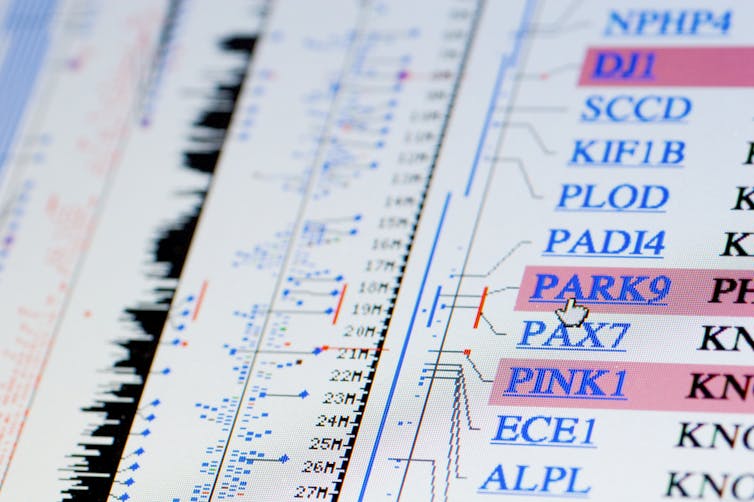
In the mid-1990s, researchers started looking into whether genetic differences between people with or without Parkinson’s might identify specific genes or genetic variants that cause the disease. In general, I and other geneticists use two approaches to map the genetic blueprint of Parkinson’s: linkage analysis and association studies.
Linkage analysis focuses on rare families where parkinsonism, or neurological conditions with similar symptoms to Parkinson’s, is passed down. This technique looks for cases where a disease-causing version of the gene and Parkinson’s appear to be passed down in the same person. It requires information on your family tree, clinical data and DNA samples. Relatively few families, such as those with more than two living, affected relatives willing to participate, are needed to expedite new genetic discoveries.
“Linkage” between a pathogenic genetic variant and disease development is so significant that it can inform a diagnosis. It has also become the basis of many lab models used to study the consequences of gene dysfunction and how to fix it. Linkage studies, like the one my team and I published, have identified pathogenic mutations in over 20 genes. Notably, many patients in families with parkinsonism have symptoms that are indistinguishable from typical, late-onset Parkinson’s. Nevertheless, what causes inherited parkinsonism, which typically affects people with earlier-onset disease, may not be the cause of Parkinson’s in the general population.
Conversely, genome-wide association studies, or GWAS, compare genetic data from patients with Parkinson’s with unrelated people of the same age, gender and ethnicity who don’t have the disease. Typically, this involves assessing how frequently in both groups over 2 million common gene variants appear. Because these studies require analyzing so many gene variants, researchers need to gather clinical data and DNA samples from over 100,000 people.
Although costly and time-consuming, the findings of genome-wide association studies are widely applicable. Combining the data of these studies has identified many locations in the genome that contribute to the risk of developing Parkinson’s. Currently, there are over 92 locations in the genome that contain about 350 genes potentially involved in the disease. However, GWAS locations can be considered only in aggregate; individual results are not helpful in diagnosis nor in disease modeling, as the contribution of these individual genes to disease risk is so minimal.
Together, “linked” and “associated” discoveries imply a number of molecular pathways are involved in Parkinson’s. Each identified gene and the proteins they encode typically can have more than one effect. The functions of each gene and protein may also vary by cell type. The question is which gene variants, functions and pathways are most relevant to Parkinson’s? How do researchers meaningfully connect this data?
Parkinson’s disease genes
Using linkage analysis, my team and I identified a new genetic mutation for Parkinson’s disease called RAB32 Ser71Arg. This mutation was linked to parkinsonism in three families and found in 13 other people in several countries, including Canada, France, Germany, Italy, Poland, Turkey, Tunisia, the U.S. and the U.K.
Although the affected individuals and families originate from many parts of the world, they share an identical fragment of chromosome 6 that contains RAB32 Ser71Arg. This suggests these patients are all related to the same person; ancestrally, they are distant cousins. It also suggests there are many more cousins to identify.
With further analysis, we found RAB32 Ser71Arg interacts with several proteins previously linked to early- and late-onset parkinsonism as well as nonfamilial Parkinson’s disease. The RAB32 Ser71Arg variant also causes similar dysfunction within cells.
Together, the proteins encoded by these linked genes optimize levels of the neurotransmitter dopamine. Dopamine is lost in Parkinson’s as the cells that produce it progressively die. Together, these linked genes and the proteins they encode regulate specialized autophagy processes. In addition, these encoded proteins enable immunity within cells.
Such linked genes support the idea that these causes of inherited parkinsonism evolved to improve survival in early life because they enhance immune response to pathogens. RAB32 Ser71Arg suggest how and why many mutations have originated, despite creating a susceptible genetic background for Parkinson’s in later life.
RAB32 Ser71Arg is the first linked gene researchers have identified that directly connects the dots between prior linked discoveries. The proteins encoded bring together three important functions of the cell: autophagy, immunity and mitochondrial function. While autophagy releases energy stored in the cell’s trash, this needs to be coordinated with another specialized component within the cell, mitochondria, that are the major supplier of energy. Mitochondria also help to control cell immunity because they evolved from bacteria the cell’s immune system recognizes as “self” rather than as an invading pathogen to destroy.
Identifying subtle genetic differences
Finding the molecular blueprint for familial Parkinson’s is the first step to fixing the faulty mechanisms behind the disease. Like the owner’s manual to your car’s engine, it provides a practical guide of what to check when the motor fails.
Just as each make of motor is subtly different, what makes each person genetically susceptible to nonfamilial Parkinson’s disease is also subtly different. However, analyzing genetic data can now test for types of dysfunction in the cell that are hallmarks of Parkinson’s disease. This will help researchers identify environmental factors that influence the risk of developing Parkinson’s, as well as medications that may help protect against the disease.
More patients and families participating in genetic research are needed to find additional components of the engine behind Parkinson’s. Each person’s genome has about 27 million variants of the 6 billion building blocks that make up their genes. There are many more genetic components for Parkinson’s that have yet to be found.
As our discovery illustrates, each new gene that researchers identify can profoundly improve our ability to predict and prevent Parkinson’s.
Matthew Farrer, Professor of Neurology, University of Florida
This article is republished from The Conversation under a Creative Commons license. Read the original article.
- Details
- Written by: Lake County News reports
This will be the fourth meeting for the Federal Advisory Committee to provide the Forest Service with recommended updates for the Northwest Forest Plan Amendment.
The meeting will take place at the Redding Rancheria Trinity Health Center, 81 Arbuckle Court, Weaverville.
The secretary of agriculture established this committee to support ongoing efforts to amend the Northwest Forest Plan.
The Federal Advisory Committee brings together representatives with diverse perspectives, experiences and expertise — including community, tribal, government and other interest groups from across the Northwest Forest Plan landscape to inform the plan amendment.
This group is helping the agency identify ways to effectively conserve key resources while considering social, ecological, and economic conditions and needs.
FAC meetings are open to the public with an opportunity to submit comments. Details on meetings, including how the public can provide information to the committee is posted on the regional website.
The Federal Advisory Committee does not replace the public involvement process or the public’s opportunity to engage directly with the Forest Service regarding Northwest Forest Plan amendment efforts during the planning process.
The Northwest Forest Plan covers 24.5 million acres of federally managed lands in northwestern California, western Oregon, and Washington. It was established in 1994 to address threats to threatened and endangered species while also contributing to social and economic sustainability in the region.
After nearly 30 years, the Northwest Forest Plan needs to be updated to accommodate changed ecological and social conditions.
Of note, forests in California included in the NWFP FACA planning are:
1. Klamath National Forest and Butte Valley National Grassland;
2. Lassen National Forest;
3. Mendocino National Forest;
4. Modoc National Forest;
5. Six Rivers National Forest;
6. Shasta-Trinity National Forest.
Additional information about the Northwest Forest Plan is available here.
For more about USDA Forest Service, visit www.fs.usda.gov/r6.