How to resolve AdBlock issue?
Refresh this page
How to resolve AdBlock issue?
Refresh this page
Lake County News,California
  • Home
    • Registration Form
  • News
    • Education
    • Veterans
    • Community
      • Obituaries
      • Letters
      • Commentary
    • Police Logs
    • Business
    • Recreation
    • Health
    • Religion
    • Legals
    • Arts & Life
    • Regional
  • Calendar
  • Contact us
    • FAQs
    • Phones, E-Mail
    • Subscribe
  • Advertise Here
  • Login
How to resolve AdBlock issue?
Refresh this page

News

For millions of Americans, high-speed internet is unavailable or unaffordable − a telecommunications expert explains how to bring broadband to the places that need it the most

Details
Written by: Christopher Ali, Penn State
Published: 26 April 2024


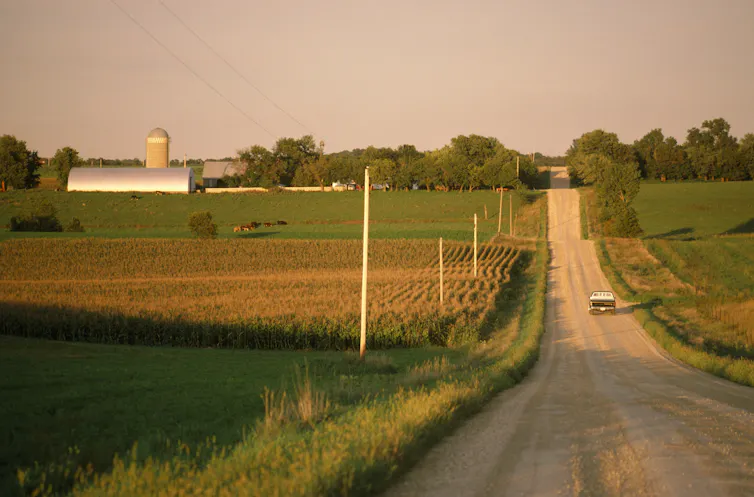
Broadband is noticeably missing in rural, remote or Indigenous areas. Grant Faint/The Image Bank via Getty Images

Millions of Americans still don’t have access to high-speed internet. Christopher Ali, a professor of telecommunications at Penn State University, discusses who lacks access to broadband and how the federal government – with a US$65 billion commitment – is trying to bring more people online.

Christopher Ali discusses the challenges in bringing high-speed internet to underserved America.

The Conversation has collaborated with SciLine to bring you highlights from the discussion that have been edited for brevity and clarity.

What is broadband internet?

Christopher Ali: Broadband internet, often just called broadband, is the technical term for high-speed internet connectivity.

The Federal Communications Commission, which is in charge of setting an official definition for broadband in the country, defines broadband as an always-on internet connection of 100 megabits-per-second download and 20 megabits-per-second upload.

But what high-speed internet fundamentally means to Americans is do we have the connectivity necessary to go about our digital lives. Can we stream Netflix? Can we go on Zoom? Can we file our taxes? Can we do our homework? Can we do our jobs? Can we game?

What can you tell us about disparities in broadband access?

Christopher Ali: One of the really frustrating things is, despite millions – tens of millions – of dollars spent on broadband mapping, we are still unsure of who is underconnected throughout the country.

Right now, the FCC reports that 7.2 million people lack access, but the commission numbers have been historically suspect. As a result, there are no doubt many more who are unserved and undercounted. In fact, the FCC repeatedly receives challenges to its broadband map.

Back in 2021, for instance, when the FCC reported that about 14 million people lacked internet access, an independent review found that 42 million people lacked access. That’s a huge discrepancy.

But one thing is certain: Broadband deserts are most often found in rural, remote and Indigenous areas.

It’s also clear that cost is part of the issue. Here in the U.S., we pay a tremendous amount of money – the most for internet access monthly than almost any other country in the developed world.

A program called the Affordable Connectivity Program subsidizes broadband for low-income families, and 50 million families across the country are eligible.

Without robust broadband access, communities risk being sidelined in the 21st century economy.

What benefits does broadband access provide?

Christopher Ali: Broadband access can aid with economic development. It can be a game changer when it comes to telehealth, especially for rural, remote and Indigenous communities, which often don’t have enough doctors and nurses. With telehealth, you can suddenly connect with a health care professional.

It aids in education. Some studies have found that access to broadband can impact grades and SAT scores, although there is disagreement about this. But the opportunities for students with broadband are undeniable – like applying online for college and student aid.

It contributes to civic engagement, allowing voters to contact local officials online. It impacts public safety, both in terms of our own safety as members of the public but also by allowing first responders to communicate online with their dispatch.

Broadband also helps sometimes with cultural enrichment, and we see this a lot with Indigenous communities, which can stream cultural and traditional events.

And it improves quality of life. Everyone enjoys being able to FaceTime with family and friends and go shopping online. These things were particularly essential during the COVID-19 pandemic.

The Broadband Equity, Access, and Deployment Program, passed as part of the 2023 infrastructure bill, allocates $42 billion in federal funds to expand broadband infrastructure. How can communities maximize its impact?

Christopher Ali: The money from the BEAD program is going to be managed by the states and not by the federal government. Each state receives a chunk of money, depending on the number of people who are unconnected. Texas, with more than 1 million unserved or underserved locations, will get $3.3 billion, the most of any state. Pennsylvania will get about $1.2 billion.

What states have done a particularly good job expanding broadband access?

Christopher Ali: Minnesota has done some amazing work over the past decade. As I discuss in my book “Farm Fresh Broadband: The Politics of Rural Connectivity,” Minnesota was one of the earliest states to create a broadband grant program – the Border-to-Border program – and has set really ambitious targets. Back in 2016, for instance, the state set up a goal of universal coverage at 100Mbps/20Mbps by 2026.

Another state is Virginia, which really got a wake-up call during the pandemic, and it mobilized a lot of the federal money that came down the pipes to empower counties, cooperatives and local ISPs.

Vermont has done something called communication union districts. They’ve allowed communities to come together to use public funding to deploy broadband networks.

Public networks are going to be a game changer because they empower communities to connect themselves and direct their own digital futures – either with municipally funded networks, or cooperatives, or some sort of public-private partnerships.

Watch the full interview to hear more.

SciLine is a free service based at the American Association for the Advancement of Science, a nonprofit that helps journalists include scientific evidence and experts in their news stories.The Conversation

Christopher Ali, Pioneers Chair in Telecommunications & Professor of Telecommunications, Penn State

This article is republished from The Conversation under a Creative Commons license. Read the original article.

CHP seeks leads on October Highway 29 homicide

Details
Written by: Elizabeth Larson
Published: 25 April 2024
LAKE COUNTY, Calif. — The California Highway Patrol said it is investigating the October death of a Lake County man that investigators have ruled a homicide.

The CHP’s Clear Lake Area office identified the murder victim as Andrew Cleofaus-Paul Gurrola, 33, a father of three from Hidden Valley Lake.

At approximately 8:43 p.m. Oct. 17, the CHP received a report of a pedestrian on the side of Highway 29, north of Hofacker Lane near Lower Lake.

The agency had received reports that the pedestrian — later identified as Gurrola — appeared to have blood on his face and was attempting to flag down passing motorists.

The CHP, the Lake County Sheriff’s office and medical personnel responded, officials said.

The initial reports on the incident said Gurrola was found unresponsive, lying on the east shoulder of northbound Highway 29.

Gurrola was pronounced dead at the scene from what the CHP said were “apparent gunshot wounds.”

The CHP’s Northern Division Investigative Services Unit is leading the homicide investigation.

Anyone with information about Gurrola’s death is asked to call the CHP at 530-722-4300 or send an email to This email address is being protected from spambots. You need JavaScript enabled to view it..

Email Elizabeth Larson at This email address is being protected from spambots. You need JavaScript enabled to view it.. Follow her on Twitter, @ERLarson, or Lake County News, @LakeCoNews.

Work crew finds body along road in Clearlake

Details
Written by: Lake County News reports
Published: 25 April 2024
CLEARLAKE, Calif. — Police said the body of a man was found along the road by city workers in Clearlake on Wednesday afternoon.

The Clearlake Police Department did not release the name of the man, said to be in his 40s, pending the notification of next of kin.

Lt. Ryan Peterson said that at 1:30 p.m. Wednesday, Clearlake Public Works employees were conducting vegetation removal in the area of Old Highway 53 and Cache Creek Way when they discovered the body.

They contacted the police department and officers responded to the scene, Peterson said.

The investigation is ongoing, and Peterson said the cause of the person’s death will be pending the completion of an autopsy.

However, there was no evidence to indicate any signs of foul play, Peterson said.

CDPH urges Californians to dispose of unneeded medications on Prescription Drug Take Back Day

Details
Written by: Lake County News reports
Published: 25 April 2024
The California Department of Public Health is encouraging Californians to take part in National Prescription Drug Take Back Day on Saturday, April 27.

Hundreds of free take-back events will take place in communities across the state, where unused or expired prescription drugs or vaping devices — which are used to deliver a number of non-medical substances — can be disposed of safely.

"Keeping unused or expired prescriptions at home is dangerous because of their potential to be accidentally ingested, stolen, or misused," said CDPH Director and State Public Health Officer Dr. Tomás Aragón. “National Prescription Drug Take Back Day offers a simple solution for Californians to get rid of unneeded prescription drugs and vaping devices responsibly, which could save lives and helps protect the environment."

The Lakeport Police Department is participating in the United States Drug Enforcement Administration National Prescription Drug Take Back Day on Saturday, April 27, from 10 a.m. to 2 p.m.

The event will be held at the front lobby entrance of the police station at 2025 S. Main St.

Prescription medications in the form of pills, patches, and sealed liquids can be dropped off with no questions asked.

Similarly, vaping devices (minus batteries) and cartridges – which can be used to deliver nicotine, cannabis (THC, CBD), may also be discarded. Sharp objects (sharps) like needles or syringes will not be accepted.

For information on how to safely dispose of sharps waste, please visit the Safe Needle Disposal website.

During the National Prescription Drug Take-Back event in April 2023, federal, state and local law enforcement partners across the country collected 332 tons of unwanted prescription drugs. Of that, Californians disposed of more than 40,000 pounds of unwanted drugs.

In Lakeport alone, the police department has collected over 1,257 pounds of prescription drugs since it began participating in this program in January 2019.

According to the 2022 National Survey on Drug Use and Health, 8.5 million individuals misused prescription pain relievers, 4.3 million misused prescription stimulants, and 4.8 million misused prescription tranquilizers or sedatives in 2022.

The survey revealed that the majority of misused prescription drugs were obtained from family and friends, often sourced from home medicine cabinets. Removing unwanted and unneeded drugs from the house is an important way to keep loved ones safe.

National Prescription Drug Take Back Day is part of the state’s larger efforts to connect Californians with resources and information to prevent and reduce drug overdoses and deaths.

Last year, Gov. Gavin Newsom announced California's Master Plan for tackling opioids and launched a comprehensive opioid website that gives Californians a single source of prevention, data, treatment, and support information.
  1. Cannabis legalization has led to a boom in potent forms of the drug that present new hazards for adolescents
  2. Kelseyville Unified Board postpones discussion on Indigenous peoples proclamation
  3. Habitat restoration project receives $2.5 million
  • 702
  • 703
  • 704
  • 705
  • 706
  • 707
  • 708
  • 709
  • 710
  • 711
How to resolve AdBlock issue?
Refresh this page