How to resolve AdBlock issue?
Refresh this page
How to resolve AdBlock issue?
Refresh this page
Lake County News,California
  • Home
    • Registration Form
  • News
    • Education
    • Veterans
    • Community
      • Obituaries
      • Letters
      • Commentary
    • Police Logs
    • Business
    • Recreation
    • Health
    • Religion
    • Legals
    • Arts & Life
    • Regional
  • Calendar
  • Contact us
    • FAQs
    • Phones, E-Mail
    • Subscribe
  • Advertise Here
  • Login
How to resolve AdBlock issue?
Refresh this page

News

Lady of the Lake: What’s in a name? How Clear Lake got its name

Details
Written by: Angela De Palma-Dow
Published: 28 April 2024
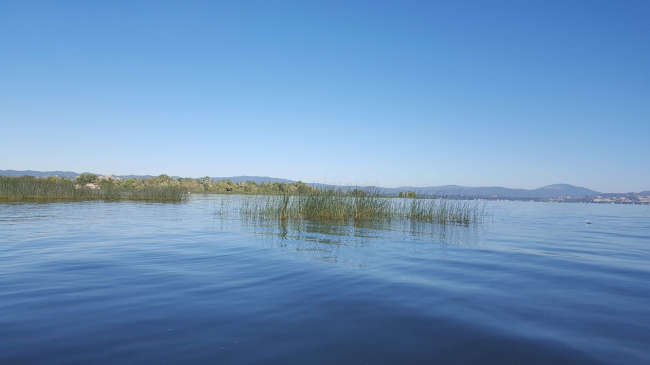
Air quality in Lake County is ranked the best out of all California counties when comparing pollutants like particulate matter, making the argument that Clear Lake was named after clarity of the air and not the water. P: A. DePalma-Dow.

Dear Lady of the Lake,

How did Clear Lake get its name? Was the Lake clear at one point? Will it be clear again?

Thank you for your column!

— Susan C, Seeking clarity about Clear Lake

Hello Susan,

Thanks for asking those very interesting questions. I actually get asked this quite a bit, it's a very popular quandary and I wish there was a simple answer!

I have done some extensive research into both Lake County and Napa County histories, as Lake County was a part of Napa County until it was designated as its own county in 1861. So until 1861, Clear Lake was actually a lake within Napa County.

According to research recorded in 1960 by Lake County historian Henry K. Mauldin, the origins of the vernacular “Clear Lake” are unknown (Book 1, pg 12). Both Mauldin and the United States Geological Survey Geographic Names Information System list previous names and variants, as reported by European settlers, hunters, or explorers, to include “Big Lake,” “Lagoona,” “Laguna,” “Laguna Grande” and “Laguna Grande de Napa”, “Kah Shoh.”

Academic studies, such as a 1950 thesis written by the geographer Fredrick J. Simoons indicated that European settlements started as early as 1840, with agricultural settlements starting in 1854, with a dramatic increase in the basin population occurring around 1866-1870. References within this time frame do refer to the lake as “Clear Lake”, so we can surmise that this was the time period where the current lake name originated.

While Clear Lake is the name the lake goes by now, let’s remember that the indigenous residents that lived here for an estimated 20,000 years before european influences and settlements arrived, and these native peoples had their own name and references to Clear Lake.

Clear Lake has been known as Ka-ba-tin [Xa’Batin] or Hok-has-ha, meaning “Big Water'' in some native Pomo languages. Be aware that pronunciation, names and labels vary by region and dialect through space and time.

For example, the meaning and pronunciation of Kabatin vs Xa’Batin: Ka means spider, but the sound for Xa is more of a sound for “H”, think of the sound when you say the name “Howard.” Some people associate the sound with a “K”, which in many instances wrote the name as Kabatin which would actually mean big spider. A good way to sum it up is as follows: Xa = Water, Ka=Spider, Batin=Big, Giant or Tall.

Additionally, I offer this strong Note on the general use of “Pomo” as describing the collective native peoples within Lake County, that this term generally disregards the regional variation among tribes and groups.

So, while the federal government and linguists recognize “Pomo” (or variations such as “Kula Kai Pomo,” “Ballo Kai Pomo”) as the descriptor for the local Indigenous native peoples, some local tribes, have historically self-identified, linguistically, as “Hinthil,” “Gowk Xabatin” or “Kulanapo,” “Kulanapan” or other terms that originated from the distinct tribes, villages or regional collection of peoples within different areas of the Clear Lake basin.

Clear Lake is not clear and probably never was

So now that we have some history for the origins of the name “Clear Lake,” let’s address your second and third question Susan, regarding the clarity of the Lake.

In the majority of the warm summer and fall months, Clear Lake’s water column usually develops an opaque, green color, and in some areas a thick mat of plants or cyanobacteria will develop, sitting (and sometimes stinking!) in the sun. This phenomena definitely encourages some confusion when a lake is named “Clear.”

However, it does not appear that cyanobacteria, also referred to as blue-green algae, are a recent development in Clear Lake. Since water monitoring wasn’t occurring prior to the mid 20th century, the only way to gather information about the lake’s historical water quality, and clarity, is through the lake's sediment.

Sediment cores collected from the bottom of Clear Lake by the United States Geological Survey (USGS) indicate Clear Lake has been nutrient-rich (eutrophic) with high algal populations since the last ice age, which ended approximately 10,000 years ago.

Whatever was growing or floating in the water would end up sinking to the bottom, contributing to the composition of the cores.The sediments act as a time capsule, sequentially exposing the conditions of the lake from the past, through time.

Over the past 50 years there have been several cores studies, and some of the core studies reflect that last 300 years and some of the larger cores capture up to 175,000 years of in-lake information.

The algae pollen cores measured about 2.5 meters in length, and contained information on pollen, nutrients, and metals expanding 300 years from present day (of the 1980s, to be exact).

Generally, what these core contents reveal is that Clear Lake has historically always been green, full of life, and probably not too clear.

To learn more, you can view the Algae Pollen Graph, extracted from the core study, which shows the change in algae pollen over time from a core extracted from the Upper Arm.

During the summer when the lake looks brown, or green, a discrete water sample collected at the surface can still look relatively clear and small green organisms, or phytoplankton, can be seen floating in the sample. P. A. De Palma-Dow.

Historic reporting to Congress about Clear Lake from 1870s

Livingston Stone, a fisheries “expert” and biologist, visited Lake County in 1873 and reported to the U.S. Congress that Clear Lake had significant algal populations at the time. In addition to a detailed month-by-month account of fish in the lake and streams, Stone characterized the eutrophic, nutrient-rich and productive nature of Clear Lake, describing surface blooms and scums during the warmest months of the year.

And excerpt from his written passage is quoted below:

“It is a singular fact, illustrating the inaptness with which names are often given to natural objects, that the water of Clear Lake is never clear. It is so-cloudy, to use a mild word, that you cannot see three feet below the surface. The color of the water is a yellowish brown, varying indefinitely with the varying light. The water has an earthy taste, like swamp-water, and is suggestive of moss and water-plants. In fact, the bottom of the lake, except in deep places, is covered with a deep, dense moss, which sometimes rises to the surface, and often to such an extent in summer as to seriously obstruct the passage of boats through the water.”

During Stone’s seasonal accounts, he describes the water conditions in September:

“The water this month is in its worst condition. It is full of the frothy product of the soda-springs. A green scum covers a large part of the surface, and it is not only uncleanly to look at, but unfit to drink; and yet, strangely enough, this lake, which one would think uninhabitable by fish, fairly teems and swarms with them.”

It would seem, that even in the 1870s, that Clear Lake was not Clear in the summer and fall months, and even then, as now, it seems fitting that the reference to “clarity” does not apply to Clear Lake waters.

You can read the full text of Stone’s Clear Lake, and other California accounts, here: https://penbay.org/cof/cof_1873-1875_xx.pdf or at the Lake County Water Resources website here.

Remember that water clarity in lakes and reservoirs is also influenced by the organic materials floating in the water, the total depth, the temperature, and the composition and content of the surrounding landscape.

More information about what makes Clear Lake colors change throughout the year, from blue, to brown, to green, can be found in my previous column, (February 2022) Brown Water Got you down?

Clear – Air – of Clear Lake

Many newspaper articles and local legends state that Clear Lake was named after the air quality of the valley in which its basin is formed, and not given to the Lake to describe its water quality.

However, in my research I could not find this original reference, only generalized statements within gray literature, without reference to the original source or sources.

This is interesting when you consider how lake names are created across the country. According to a study conducted by Continental Limnology research group, 83% of all the lakes in the US are unnamed, with about 80% of those lakes being smaller than 4 hectares (9.9 acres). Of the 83,000 lakes that did have associated names, the majority of the lakes were named to reflect people’s everyday lives, to inspire creativity, and to incorporate regional indigenous languages.

The most common lake name in the U.S. is “Mud.”

Lake names also vary regionally, with co-dominant terms being given to lakes based on region within the US. For example, besides the term “lake,” Arizona, New Mexico and Texas use the term “tank” to refer to lakes or reservoirs, while the Eastern seaboard predominantly refers to lakes as “ponds.” Here in California? We use both Lake and Reservoir pretty consistently throughout the state. 

Most common names for lakes, reservoirs, ponds, and tanks, within the conterminous U.S. Wordcloud image: Sorranno et. al. 2020. “What Is in a “Lake” Name? That Which We Call a Lake by Any Other Name“ https://aslopubs.onlinelibrary.wiley.com/doi/full/10.1002/lob.10355


Regardless, Lake County, and especially the valley of which Clear Lake is located, has some of the best air quality in the state, which makes a strong argument for the name bestowed upon the lake.

According to the National Institute of Health Air Pollution Tables, Lake County ranks the best in air quality when comparing the amounts of particulate matter in the air (measured by 2.5 micrograms per liter). In 2019, Lake County recorded the lowest amount at 3.1 mg/L PM2.5 compared to the state average of 7.1 mg/L PM2.5.

And if you want to track current air quality, you can use OpenAir.

IQ Air provided current air quality and pollution indices, along with current wind and wildfire and smoke conditions. <>

I hope this column helped to “clear” the air about how the name Clear came and didn’t come to be. Susan, I also hope that you will join me in being slightly thankful that our beautiful lake didn’t end up being called Mud Lake, am I right?

Sincerely,

Lady of the Lake

Angela De Palma-Dow is a limnologist (limnology = study of fresh inland waters) who lives and works in Lake County. Born in Northern California, she has a Master of Science from Michigan State University. She is a Certified Lake Manager from the North American Lake Management Society, or NALMS, and she is the current president/chair of the California chapter of the Society for Freshwater Science. She can be reached at This email address is being protected from spambots. You need JavaScript enabled to view it..

If you would like to talk to the Lady of the Lake in person, you can stop by her booth at the Big Valley Small Farms Tour, Saturday, May 11, at Ripe Choice Farm, 10 a.m. to 3 p.m.


Homelessness and Mental Health Resource Fair planned May 1

Details
Written by: Lake County News reports
Published: 28 April 2024
LAKE COUNTY, Calif. — The city of Lakeport, in collaboration with the Lakeport Police Department and Lake County Behavioral Health Services, will host “Pathways to Stability,” a homelessness and housing resource fair aimed at connecting community members with vital resources and support services.

Scheduled for Wednesday, May 1, from 5:30 to 7:30 p.m., “Pathways to Stability” will take place at Xabatin Community Park at 800 N. Main St.

The event aims to raise awareness of the variety of resources available to individuals facing homelessness or housing insecurity in the Lakeport area.

“Pathways to Stability” will feature informational booths and representatives from organizations including the city of Lakeport, Lakeport Police Department, Lake County Behavioral Health Services, Redwood Community Services, Nation’s Finest, Adventist Health and Sutter Lakeside Hospital.

Attendees will have the opportunity to learn about housing assistance programs, mental health services, and substance use disorder services available in our community.

they can also provide feedback and learn about the recently launched low-barrier navigation center study currently underway in the city of Lakeport.

The project team will be present to discuss what a low-barrier navigation center is and have interactive displays where community members can provide feedback on the concept of a navigation center.

In addition to valuable information, attendees will be treated to a complimentary dinner, provided by the Kiwanis Club of Lakeport.

The event is open to all members of the Lake County community and surrounding areas, whether you are seeking assistance or looking to learn more about resources available in our community.

For more information about “Pathways to Stability,” please contact Megan Morgan at This email address is being protected from spambots. You need JavaScript enabled to view it..

Large retailers don’t have smokestacks, but they generate a lot of pollution − and states are starting to regulate it

Details
Written by: Johnathan Williams, University of Northern Iowa
Published: 28 April 2024


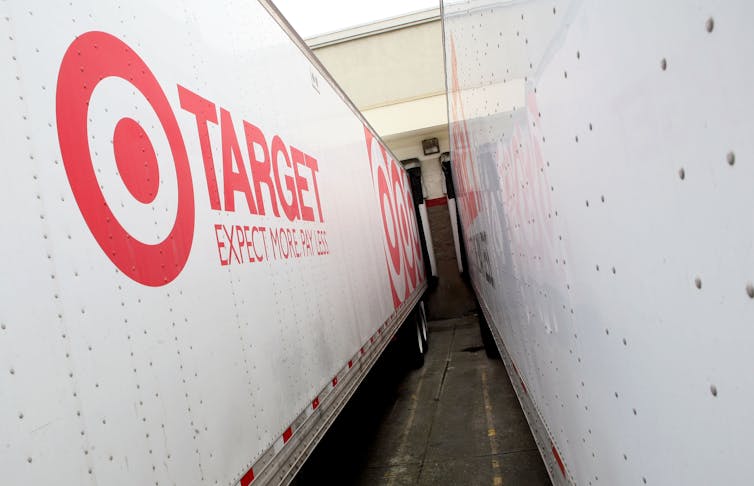
One of many trucks that move Target goods nationwide. Justin Sullivan/Getty Images

Did you receive a mail-order package this week? Carriers in the U.S. shipped 64 packages for every American in 2022, so it’s quite possible.

That commerce reflects the expansion of large-scale retail in recent decades, especially big-box chains like Walmart, Target, Best Buy and Home Depot that sell goods both in stores and online. This has led to the growth of distribution centers that fulfill these orders. While mail-order commerce is convenient, these centers also have harmful impacts, including traffic congestion and air and water pollution.

I study environmental history, and I am part of a group of scholars examining the environmental impacts of big-box stores like Walmart, Target, REI and Bass Pro Shops. Sustainability is a hot topic in the retail sector, but my research on the history of Target – the sixth-largest retailer in the U.S. – shows how retail companies have largely escaped the kinds of environmental regulations that affect other sectors such as manufacturing.

California is leading efforts to regulate harmful impacts of retail distribution centers.

Indirect pollution sources

Doing business on Target’s scale, with US$108 billion in sales in 2022, creates a big physical footprint. The company has nearly 2,000 stores in the U.S. that cover over 240 million square feet of retail space, not including parking lots. Its 55 supply chain facilities add an additional 60 million square feet. For perspective, 1 million square feet is slightly larger than 15 football fields.

Target, which originated as a dry goods company in 1902, has been a leading retail voice for over a century. The company played a prominent role in the 1970s as Congress expanded federal power to regulate air pollution nationwide under the Clean Air Act of 1970.

Target stores offer a diverse range of products, from clothing to home goods, groceries and electronics. About 75% of Americans live within 10 miles of a Target store.

This law gave the Environmental Protection Agency broad authority to identify and regulate air pollutants and to set air quality standards that would protect public health. To meet those standards, in the mid-1970s lawmakers and regulators considered adopting transportation controls that could address indirect pollution sources – entities that did not generate air pollution themselves but attracted large numbers of sources, such as cars and trucks, that did. Examples included airports, highways, sports stadiums and shopping centers.

Target’s parent company, Dayton Hudson, operated numerous shopping centers and other retail chains. One of its executives, George Hite, was a leading spokesperson against regulating indirect pollution sources.

From 1974-1977, Hite testified on behalf of large retail trade groups during a series of congressional hearings, arguing that the proposed regulations were unfair and would undercut sound planning. Hite asserted that because shopping centers were one-stop destinations for consumers, they actually reduced air pollution from consumers’ trips.

Ultimately, indirect source regulations did not become part of the Clean Air Act amendments of 1977. As a result, retail continued to expand, unconstrained by major federal environmental laws.

People walk toward a baseball park. A sign over the entrance reads 'Target Field,' with the Target Corporation's red bullseye symbol.
Fans enter Target Field in Minneapolis, Minn., before a game on Aug. 15, 2021. Target is based in Minneapolis-St. Paul and was the Twin Cities’ largest employer for many years. Joe Robbins/Icon Sportswire via Getty Images

Big-box boom

Big-box discount stores like Kmart, Walmart and Target began outcompeting shopping centers in the 1980s because of their low prices and convenience. The biggest chains expanded nationally, driving many smaller local stores out of business.

These companies relied on a new type of warehouse: the distribution center, which used computer technology to make supply chains more efficient. Compared with earlier warehouses, distribution centers were larger and focused on efficient movement of goods rather than storage.

In the 1990s, communities across the country began organizing to slow the expansion of big-box stores. Most efforts focused on opposing individual stores and ignored the rising number of distribution centers. One exception was in the Wisconsin town of Oconomowoc.

Located along I-94 between Madison and Milwaukee and surrounded by glacial lakes, Oconomowoc was a former vacation destination for wealthy Midwesterners that evolved into a commuter town. When Target announced in 1993 that it had selected Oconomowoc as the site for a new, million-plus-square-foot regional distribution center, residents quickly organized to preserve the area’s pastoral setting.

State and local officials refused to reconsider the deal they had reached with Target, which included grants and other tax subsidies. In response, opponents filed multiple lawsuits.

Plaintiffs cited the planned center’s environmental impacts, including potential threats to groundwater and air emissions from long-haul, diesel-fueled trucks. However, state and federal courts ultimately dismissed their cases. Judges ruled that the Clean Air Act did not attribute delivery truck emissions to the distribution center, and the Clean Water Act did not cover a retention pond that was planned to collect runoff from the center’s parking lot.


Probing retail’s environmental costs

Today, retail supply chain infrastructure is moving into urban areas. Target and other retailers are meeting new opposition, including pushback from environmental justice groups, which argue that these companies’ operations increase traffic and degrade air quality.

In a 2024 report, the nonprofit Environmental Defense Fund and ElectrifyNY, a coalition working to electrify transportation in New York state, found that 1 in 4 people statewide lived within half a mile of a retail distribution center, and that these facilities generated over 170,000 truck trips per day. The report endorsed proposed state legislation that would classify storage and distribution centers over 50,000 square feet as indirect pollution sources and require them to reduce transportation-related air emissions.

In Southern California, the powerful South Coast Air Quality Management District, which regulates regional air quality, has taken this step with Rule 2305. This regulation is the first in the U.S. to address emissions generated by trucks traveling to and from large warehouse facilities.

The rule focuses on reducing ozone, a major contributor to smog, and fine particulate matter. Both of these pollutants are formed from chemicals in diesel exhaust and are harmful to human health.

Rule 2305 was adopted in 2021 and survived a legal challenge from trucking companies in 2023. To avoid fines of up to $10,000 per day, hundreds of warehouse operators must earn points for taking steps from a list of actions to reduce local air pollution.

Options include using low-emission or electric vehicles and installing charging stations on-site, or placing air filters in local buildings. Point targets are based on each facility’s size, number of truck trips and other factors.


Shopping carts vs. smokestacks

Big-box retailers maintain that they can manage their facilities’ environmental impacts without government intervention or structural change. For example, Target touts investments to make its facilities more energy efficient and place solar panels on its stores and distribution centers. Yet, Target’s indirect emissions dwarf these gains.

For example, in 2022 the company generated nearly 6 million metric tons of carbon dioxide-equivalent greenhouse gas emissions in transporting goods from its distribution centers to consumers. Including emissions generated when suppliers shipped these goods to Target’s distribution network more than doubled this figure.

In comparison, the company estimated that the electricity it purchased to power its facilities in 2022 generated just over 1.5 million metric tons of carbon dioxide-equivalent emissions. Using this number as a base, I estimate that Target’s claim the same year of using 60% of electricity from renewable resources offset emissions by some 2.25 million metric tons.

And Target is only one of numerous retailers. According to a 2022 report by the World Retail Congress and Boston Consulting Group, this sector as a whole “has some way to go before it can claim truly green credentials. … Most [large retailers] have yet to put in place comprehensive sustainability agendas.”

The goods that consumers buy, and the ways in which they buy them, drastically affect the environment. In my view, the retail sector’s impacts on air, water, waste generation and Earth’s climate call for national-level responses. Big-box stores may not look like smoke-belching factories, but their companies’ operations affect the environment in ways that have become too big to ignore.The Conversation

Johnathan Williams, Assistant Professor of History, University of Northern Iowa

This article is republished from The Conversation under a Creative Commons license. Read the original article.


Helping Paws: ‘Beau’ and the dogs

Details
Written by: Elizabeth Larson
Published: 28 April 2024
LAKE COUNTY, Calif. — Lake County Animal Care and Control has many great dogs wanting to meet you this week.

Dogs available for adoption this week include mixes of Alaskan husky, Anatolian shepherd, Australian shepherd, border collie, Chesapeake Bay retriever, Chihuahuas, German shepherd, hound, Labrador Retriever, mastiff, pit bull terrier, Rottweiler and terrier.

Dogs that are adopted from Lake County Animal Care and Control are either neutered or spayed, microchipped and, if old enough, given a rabies shot and county license before being released to their new owner. License fees do not apply to residents of the cities of Lakeport or Clearlake.

The dogs available this week include “Beau,” an Australian shepherd mix who went to the Board of Supervisors meeting last week.

Those dogs and the others shown on this page at the Lake County Animal Care and Control shelter have been cleared for adoption.

Call Lake County Animal Care and Control at 707-263-0278 or visit the shelter online for information on visiting or adopting.

The shelter is located at 4949 Helbush in Lakeport.

Email Elizabeth Larson at This email address is being protected from spambots. You need JavaScript enabled to view it.. Follow her on Twitter, @ERLarson, or Lake County News, @LakeCoNews.


Kennel#14's preview photo
Kennel#14

Kennel#9's preview photo
Kennel#9

Kennel#15's preview photo
Kennel#15

Kennel#20's preview photo
Kennel#20


A#124
Kennel #13's preview photo
Kennel #13

Kennel#25's preview photo
Kennel#25

Kennel #18's preview photo
Kennel #18

Kennel#4's preview photo
Kennel#4

Kennel#8's preview photo
Kennel#8

Kennel#24's preview photo
Kennel#24

 
Kennel#10's preview photo
Kennel#10

Kennel#12's preview photo
Kennel#12

Kennel#27(a)'s preview photo
Kennel#27(a)

Kennel#32's preview photo
Kennel#32

Kennel#17's preview photo
Kennel#17

Kennel#16(Beau)'s preview photo
Kennel#16(Beau)

Kennel#2's preview photo
Kennel#2

Kennel#5's preview photo
Kennel#5

Kennel#22's preview photo
Kennel#22

Kennel#29's preview photo
Kennel#29

Kennel#31a's preview photo
Kennel#31a

Kennel#31b's preview photo
Kennel#31b

Kennel#11a(Lucy)'s preview photo
Kennel#11a(Lucy)

Kennel#11b's preview photo
Kennel#11b


Kennel#19(Patron)'s preview photo
Kennel#19(Patron)

Kennel#3's preview photo
Kennel#3

 
Kennel#34's preview photo
Kennel#34
 
  1. Space News: The Mars Sample Return mission has a shaky future, and NASA is calling on private companies for backup
  2. RCD Day on the Creek offers fun and education for young students
  3. Clear Lake boating restrictions lifted due to decreased lake levels
  • 699
  • 700
  • 701
  • 702
  • 703
  • 704
  • 705
  • 706
  • 707
  • 708
How to resolve AdBlock issue?
Refresh this page