How to resolve AdBlock issue?
Refresh this page
How to resolve AdBlock issue?
Refresh this page
Lake County News,California
  • Home
    • Registration Form
  • News
    • Education
    • Veterans
    • Community
      • Obituaries
      • Letters
      • Commentary
    • Police Logs
    • Business
    • Recreation
    • Health
    • Religion
    • Legals
    • Arts & Life
    • Regional
  • Calendar
  • Contact us
    • FAQs
    • Phones, E-Mail
    • Subscribe
  • Advertise Here
  • Login
How to resolve AdBlock issue?
Refresh this page

News

Space News: The Mars Sample Return mission has a shaky future, and NASA is calling on private companies for backup

Details
Written by: Chris Impey, University of Arizona
Published: 28 April 2024


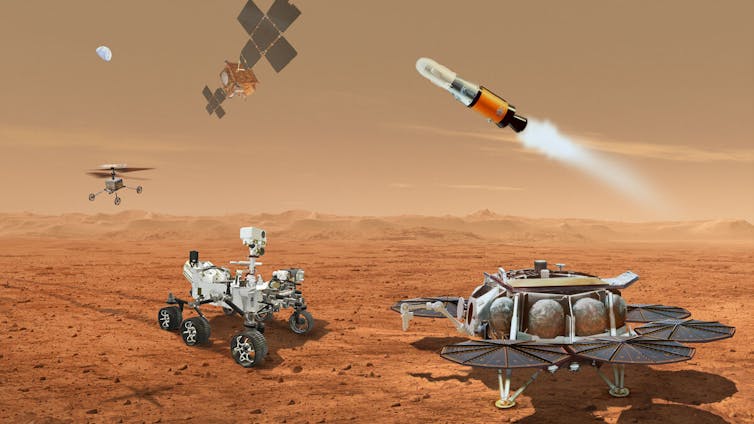
The equipment planned to help bring samples back from Mars. NASA/JPL

A critical NASA mission in the search for life beyond Earth, Mars Sample Return, is in trouble. Its budget has ballooned from US$5 billion to over $11 billion, and the sample return date may slip from the end of this decade to 2040.

The mission would be the first to try to return rock samples from Mars to Earth so scientists can analyze them for signs of past life.

NASA Administrator Bill Nelson said during a press conference on April 15, 2024, that the mission as currently conceived is too expensive and too slow. NASA gave private companies a month to submit proposals for bringing the samples back in a quicker and more affordable way.

As an astronomer who studies cosmology and has written a book about early missions to Mars, I’ve been watching the sample return saga play out. Mars is the nearest and best place to search for life beyond Earth, and if this ambitious NASA mission unraveled, scientists would lose their chance to learn much more about the red planet.

The habitability of Mars

The first NASA missions to reach the surface of Mars in 1976 revealed the planet as a frigid desert, uninhabitable without a thick atmosphere to shield life from the Sun’s ultraviolet radiation. But studies conducted over the past decade suggest that the planet may have been much warmer and wetter several billion years ago.

The Curiosity and Perseverance rovers have each shown that the planet’s early environment was suitable for microbial life.

They found the chemical building blocks of life and signs of surface water in the distant past. Curiosity, which landed on Mars in 2012, is still active; its twin, Perseverance, which landed on Mars in 2021, will play a crucial role in the sample return mission.
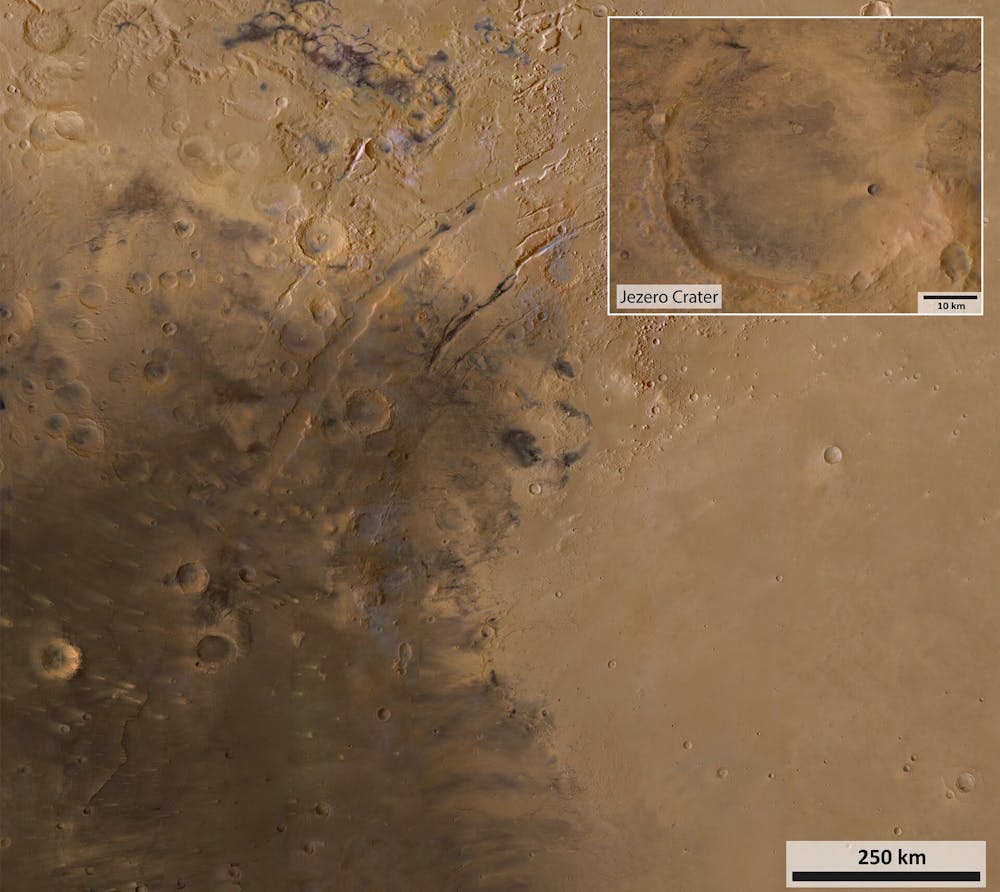
An overhead view of a sandy crater.
The Mars Jezero Crater, which scientists are searching for signs of ancient bacteria. ESA/DLR/FU Berlin, CC BY-SA

Why astronomers want Mars samples

The first time NASA looked for life in a Mars rock was in 1996. Scientists claimed they had discovered microscopic fossils of bacteria in the Martian meteorite ALH84001. This meteorite is a piece of Mars that landed in Antarctica 13,000 years ago and was recovered in 1984. Scientists disagreed over whether the meteorite really had ever harbored biology, and today most scientists agree that there’s not enough evidence to say that the rock contains fossils.

Several hundred Martian meteorites have been found on Earth in the past 40 years. They’re free samples that fell to Earth, so while it might seem intuitive to study them, scientists can’t tell where on Mars these meteorites originated. Also, they were blasted off the planet’s surface by impacts, and those violent events could have easily destroyed or altered subtle evidence of life in the rock.

There’s no substitute for bringing back samples from a region known to have been hospitable to life in the past. As a result, the agency is facing a price tag of $700 million per ounce, making these samples the most expensive material ever gathered.

A compelling and complex mission

Bringing Mars rocks back to Earth is the most challenging mission NASA has ever attempted, and the first stage has already started.

Perseverance has collected over two dozen rock and soil samples, depositing them on the floor of the Jezero Crater, a region that was probably once flooded with water and could have harbored life. The rover inserts the samples in containers the size of test tubes. Once the rover fills all the sample tubes, it will gather them and bring them to the spot where NASA’s Sample Retrieval Lander will land. The Sample Retrieval Lander includes a rocket to get the samples into orbit around Mars.

An animation showing the Mars Sample Return mission’s plan, as designed by the Jet Propulsion Laboratory.

The European Space Agency has designed an Earth Return Orbiter, which will rendezvous with the rocket in orbit and capture the basketball-sized sample container. The samples will then be automatically sealed into a biocontainment system and transferred to an Earth entry capsule, which is part of the Earth Return Orbiter. After the long trip home, the entry capsule will parachute to the Earth’s surface.

The complex choreography of this mission, which involves a rover, a lander, a rocket, an orbiter and the coordination of two space agencies, is unprecedented. It’s the culprit behind the ballooning budget and the lengthy timeline.

Sample return breaks the bank

Mars Sample Return has blown a hole in NASA’s budget, which threatens other missions that need funding.

The NASA center behind the mission, the Jet Propulsion Laboratory, just laid off over 500 employees. It’s likely that Mars Sample Return’s budget partly caused the layoffs, but they also came down to the Jet Propulsion Laboratory having an overfull plate of planetary missions and suffering budget cuts.

Within the past year, an independent review board report and a report from the NASA Office of Inspector General raised deep concerns about the viability of the sample return mission. These reports described the mission’s design as overly complex and noted issues such as inflation, supply chain problems and unrealistic costs and schedule estimates.

NASA is also feeling the heat from Congress. For fiscal year 2024, the Senate Appropriations Committee cut NASA’s planetary science budget by over half a billion dollars. If NASA can’t keep a lid on the costs, the mission might even get canceled.

Thinking out of the box

Faced with these challenges, NASA has put out a call for innovative designs from private industry, with a goal of shrinking the mission’s cost and complexity. Proposals are due by May 17, which is an extremely tight timeline for such a challenging design effort. And it’ll be hard for private companies to improve on the plan that experts at the Jet Propulsion Laboratory had over a decade to put together.

An important potential player in this situation is the commercial space company SpaceX. NASA is already partnering with SpaceX on America’s return to the Moon. For the Artemis III mission, SpaceX will attempt to land humans on the Moon for the first time in more than 50 years.

However, the massive Starship rocket that SpaceX will use for Artemis has had only three test flights and needs a lot more development before NASA will trust it with a human cargo.
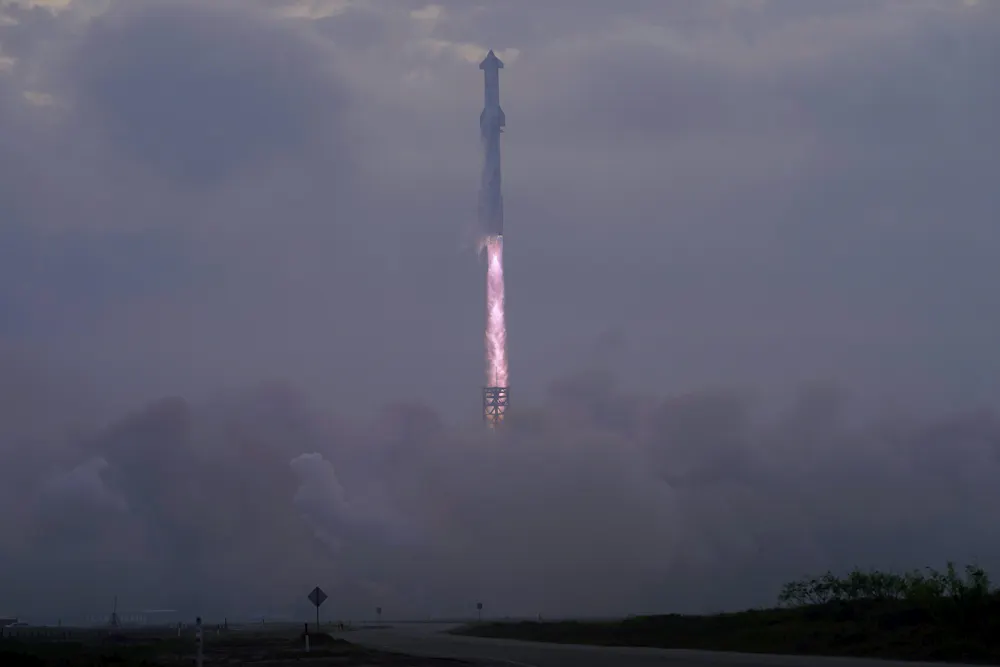
A long, cylindrical rocket with a plume of flame coming from its end launches into the cloudy sky.
SpaceX’s Starship rocket, the most powerful commercial rocket. AP Photo/Eric Gay

In principle, a Starship rocket could bring back a large payload of Mars rocks in a single two-year mission and at far lower cost. But Starship comes with great risks and uncertainties. It’s not clear whether that rocket could return the samples that Perseverance has already gathered.

Starship uses a launchpad, and it would need to be refueled for a return journey. But there’s no launchpad or fueling station at the Jezero Crater. Starship is designed to carry people, but if astronauts go to Mars to collect the samples, SpaceX will need a Starship rocket that’s even bigger than the one it has tested so far.

Sending astronauts also carries extra risk and cost, and a strategy of using people might end up more complicated than NASA’s current plan.

With all these pressures and constraints, NASA has chosen to see whether the private sector can come up with a winning solution. We’ll know the answer next month.The Conversation

Chris Impey, University Distinguished Professor of Astronomy, University of Arizona

This article is republished from The Conversation under a Creative Commons license. Read the original article.

RCD Day on the Creek offers fun and education for young students

Details
Written by: ROBERTA LYONS
Published: 27 April 2024
Harry Lyons, president of the Lake County Resource Conservation District and former ecology teacher at the Clearlake campus of Yuba (now Woodland) Community College, taught fourth graders about the many native trees here in Lake County, California. Photo courtesy of Lake County Resource Conservation District.

SOUTH LAKE COUNTY, Calif. — The Lake County Resource Conservation District, or LCRCD, held its annual “Field Day on the Creek,” on Earth Day, April 22, giving scores of young Middletown and Cobb area students the opportunity to enjoy hands-on nature experiences.

Students learned about local birds and their feeding behaviors, native trees to Lake County, fish that live in Putah Creek, and the unique geology of this area.

A highlight of the day was the discovery of a Lamprey, caught in Putah Creek by California Department of Fish and Wildlife Biologist, Ben Ewing. He demonstrated how CDFW sends a mild current of electricity into the water in order to bring the fish to the surface. Other fish observed included suckers, minnows and sculpens.

CDFW biologist Ben Ewing identifies interesting stream fish for students. Photo courtesy of Lake County Resource Conservation District.


Students had a good time testing the fire hose, courtesy of U.S. Forest Service personnel and also learned about the quagga mussel and why it is a concern from the Water Resources Department – County of Lake.

The Resource Conservation District has held a Day on the Creek for almost 20 years. Students attend from Coyote Valley, Minnie Cannon, and Cobb elementary schools along with teachers and parent volunteers.

Also participating in this year’s event were the Redbud Audubon Society, geologist Dean Enderlin, Forest Service Hydrologist Hilda Kwan, the Tribal EcoRestoration Alliance, or TERA, and LCRCD board members, who encouraged citizen science.

Student Jack Montage learning about how bird's beaks impact what foods they eat. Photo courtesy of Lake County Resource Conservation District.

The Lake County Resource Conservation District is a non-regulatory special district of the State of California formed to promote conservation and sustainable use of natural resources.

It is a descendent of the Soil Conservation Districts that were founded in 1937 in response to the Dust Bowl crisis.

Your local RCD is involved with promoting locally-led programs aimed at conservation of natural resources and agriculture and also provides technical assistance to local landowners to support their conservation efforts through a variety of grant programs.

Students on Putah Creek. A 20-year project of the Lake County Resource Conservation District. Photo courtesy of Lake County Resource Conservation District.

Donna Mackiewicz, president of the Redbud Audubon Society taught students about how a bird's beak governs the types of food it will eat at her “Bird Beak Cafe.” Photo courtesy of Lake County Resource Conservation District.

Clear Lake boating restrictions lifted due to decreased lake levels

Details
Written by: Elizabeth Larson
Published: 27 April 2024
LAKE COUNTY, Calif. — The Lake County Water Resources Department, Lakebed Management and Lake County Sheriff’s Department Marine Patrol said Friday that boating restrictions previously imposed due to high lake levels have been lifted.

Ordinance 3065 mandates idle speed when boating within one-quarter mile or less from the shore.

As Clear Lake has dropped below the required level of 8.0 feet on the Rumsey scale — the special measure used for Clear Lake — for more than 24 hours, Ordinance 3065 is now lifted, officials reported.

Boaters are no longer required to operate at idle speed and can resume normal boating activities, effective immediately.

For specific regulations and details on normal boating operations, please refer to the Chapter 15 – Recreation Ordinance on the Municode website.

The agencies reminded all boaters to continue exercising caution while on Clear Lake. Floating and submerged debris hazards, resulting from winter atmospheric river storm events may still be present.

These hazards include trees, branches, floating docks, abandoned or detached boats, trash, and other objects that can pose a risk to boaters.

Boaters are encouraged to remain vigilant, be aware of their surroundings, and maintain a safe speed when navigating Clear Lake, especially during this time of year.

For any inquiries regarding this update or to report hazards such as debris, floating docks or missing or found hazard buoys, please contact the Water Resources Department at 707-263-2344 or email at This email address is being protected from spambots. You need JavaScript enabled to view it..

Nearsightedness is at epidemic levels – and the problem begins in childhood

Details
Written by: Andrew Herbert, Rochester Institute of Technology
Published: 27 April 2024


Nearsightedness is also known as myopia. Witthaya Prasongsin/Moment via Getty Images

Myopia, or the need for corrected vision to focus or see objects at a distance, has become a lot more common in recent decades. Some even consider myopia, also known as nearsightedness, an epidemic.

Optometry researchers estimate that about half of the global population will need corrective lenses to offset myopia by 2050 if current rates continue – up from 23% in 2000 and less than 10% in some countries.

The associated health care costs are huge. In the United States alone, spending on corrective lenses, eye tests and related expenses may be as high as US$7.2 billion a year.

What explains the rapid growth in myopia?

I’m a vision scientist who has studied visual perception and perceptual defects. To answer that question, first let’s examine what causes myopia – and what reduces it.

A closer look at myopia.

How myopia develops

While having two myopic parents does mean you’re more likely to be nearsighted, there’s no single myopia gene. That means the causes of myopia are more behavioral than genetic.

Optometrists have learned a great deal about the progression of myopia by studying visual development in infant chickens. They do so by putting little helmets on baby chickens. Lenses on the face of the helmet cover the chicks’ eyes and are adjusted to affect how much they see.

Just like in humans, if visual input is distorted, a chick’s eyes grow too large, resulting in myopia. And it’s progressive. Blur leads to eye growth, which causes more blur, which makes the eye grow even larger, and so on.

Two recent studies featuring extensive surveys of children and their parents provide strong support for the idea that an important driver of the uptick in myopia is that people are spending more time focusing on objects immediately in front of our eyes, whether a screen, a book or a drawing pad. The more time we spend focusing on something within arm’s length of our faces, dubbed “near work,” the greater the odds of having myopia.

So as much as people might blame new technologies like smartphones and too much “screen time” for hurting our eyes, the truth is even activities as valuable as reading a good book can affect your eyesight.

Outside light keeps myopia at bay

Other research has shown that this unnatural eye growth can be interrupted by sunlight.

A 2022 study, for example, found that myopia rates were more than four times greater for children who didn’t spend much time outdoors – say, once or twice a week – compared with those who were outside daily. At the same time, kids who spent more than three hours a day while not at school reading or looking at a screen close-up were four times more likely to have myopia than those who spent an hour or less doing so.

In another paper, from 2012, researchers conducted a meta-analysis of seven studies that compared duration of time spent outdoors with myopia incidence. They also found that more time spent outdoors was associated with lower myopia incidence and progression. The odds of developing myopia dropped by 2% for each hour spent outside per week.

Other researchers have reported similar effects and argued for much more time outdoors and changes in early-age schooling to reduce myopia prevalence.

‘Why so many people need glasses now.’

What’s driving the epidemic

That still doesn’t explain why it’s on the rise so rapidly.

Globally, a big part of this is due to the rapid development and industrialization of countries in East Asia over the last 50 years. Around that time, young people began spending more time in classrooms reading and focusing on other objects very close to their eyes and less time outdoors.

This is also what researchers observed in the North American Arctic after World War II, when schooling was mandated for Indigenous people. Myopia rates for Inuit went from the single digits before the 1950s to upwards of 70% by the 1970s as all children began attending schools for the first time.

Countries in Western Europe, North America and Australia have shown increased rates of myopia in recent years but nothing approaching what has been observed recently in China, Japan, Singapore and a few other East Asian countries. The two main factors identified as leading to increased myopia are increased reading and other activities that require focusing on an object close to one’s eyes and a reduction in time spent outdoors.

The surge in myopia cases will likely have its worst effects 40 or 50 years from now because it takes time for the young people being diagnosed with nearsightedness now to experience the most severe vision problems.

Treating myopia

Fortunately, just a few minutes a day with glasses or contact lenses that correct for blur stops the progression of myopia, which is why early vision testing and vision correction are important to limit the development of myopia. Eye checks for children are mandatory in some countries, such as the U.K. and now China, as well as most U.S. states.

People with with high myopia, however, have increased risk of blindness and other severe eye problems, such as retinal detachment, in which the retina pulls away from the the back of the eye. The chances of myopia-related macular degeneration increase by 40% for each diopter of myopia. A diopter is a unit of measurement used in eye prescriptions.

But there appear to be two sure-fire ways to offset or delay these effects: Spend less time focusing on objects close to your face, like books and smartphones, and spend more time outside in the bright, natural light. Given the first one is difficult advice to take in our modern age, the next best thing is taking frequent breaks – or perhaps spend more time reading and scrolling outside in the sun.The Conversation

Andrew Herbert, Professor of Psychology, Visual Perception, Rochester Institute of Technology

This article is republished from The Conversation under a Creative Commons license. Read the original article.
  1. Space News: Hubble celebrates 34th anniversary with a look at the Little Dumbbell Nebula
  2. Lake County jobless rate drops in March
  3. Thompson, Huffman address California insurance crisis
  • 700
  • 701
  • 702
  • 703
  • 704
  • 705
  • 706
  • 707
  • 708
  • 709
How to resolve AdBlock issue?
Refresh this page