How to resolve AdBlock issue?
Refresh this page
How to resolve AdBlock issue?
Refresh this page
Lake County News,California
  • Home
    • Registration Form
  • News
    • Education
    • Veterans
    • Community
      • Obituaries
      • Letters
      • Commentary
    • Police Logs
    • Business
    • Recreation
    • Health
    • Religion
    • Legals
    • Arts & Life
    • Regional
  • Calendar
  • Contact us
    • FAQs
    • Phones, E-Mail
    • Subscribe
  • Advertise Here
  • Login
How to resolve AdBlock issue?
Refresh this page

News

Boggs Mountain Demonstration State Forest’s 75th anniversary to be celebrated in June 22 event

Details
Written by: Lake County News reports
Published: 16 June 2024
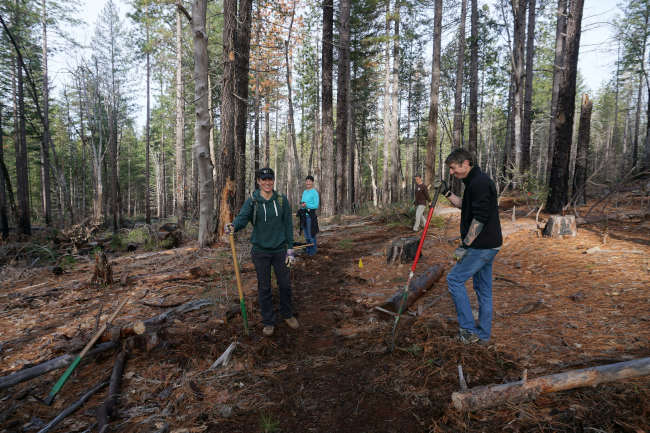
Volunteers hard at work to improve trails at Boggs Mountain Demonstration State Forest in Cobb, California. Photo courtesy of Friends of Boggs Mountain.

UPDATE: Event organizers reported that all slots for the hike and lunch are filled.

COBB, Calif. — Friends of Boggs Mountain will celebrate the 75th anniversary of Boggs Mountain Demonstration State Forest in Cobb on Saturday, June 22.

The event will take place at the forest’s Calso Camp.

It will begin at 9 a.m. with a hike, to be followed at 11:30 a.m. by lunch.

Enjoy a leisurely two to two and one half hour guided hike on trails restored by Friends of Boggs Mountain.

Assistant Forest Manager Richard Bucher will relate the history and current management practices being utilized in the forest, which was devastated by the 2015 Valley fire.

After the hike enjoy a delicious lunch catered by “Fire and Feast,” a raffle for prizes and music provided by local Cobb area musicians.

Children under 18 must be accompanied by an adult. Please no dogs.

Lunch will be provided free of charge and beverages will be for sale.

RSVP for both the hike and the lunch at This email address is being protected from spambots. You need JavaScript enabled to view it..

For more information contact David Thiessen at 707-295-5972.

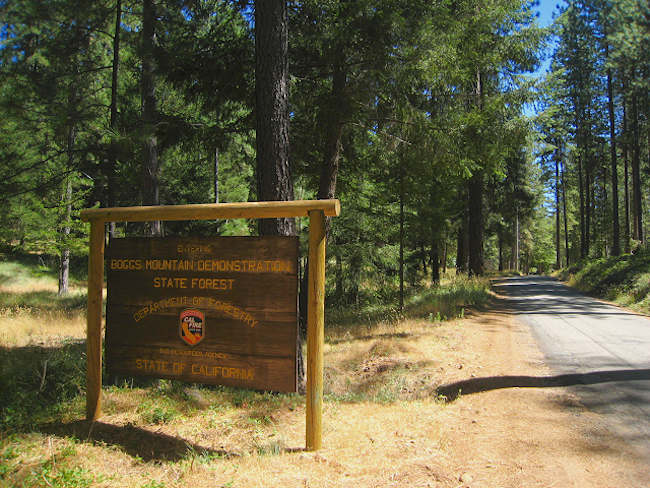
The entrance to Boggs Mountain Demonstration State Forest in Cobb, California, before it was severely damaged in the 2015 Valley fire. Photo courtesy of Friends of Boggs Mountain.

Gov. Newsom proclaims Juneteenth Day of Observance

Details
Written by: GOVERNOR’S OFFICE
Published: 16 June 2024
Gov. Gavin Newsom on Saturday issued a proclamation declaring “Juneteenth National Freedom Day: A Day of Observance” in the state of California.

The text of the proclamation and a copy can be found below.

PROCLAMATION

America does not only celebrate our independence on July 4. Each year on June 19, we look back to this day in 1865, on which Union General Gordon Granger led troops into Galveston, Texas, to announce the end of the Civil War and the insidious institution of slavery. Thousands of enslaved people in Texas, among the last to learn of their independence, were finally freed – more than two years after President Lincoln signed the Emancipation Proclamation.

Over the next several decades, Black Americans who journeyed out of the South seeking better lives brought Juneteenth celebrations with them. The thousands who settled in California, especially in Los Angeles and the San Francisco Bay Area, taught our state that America’s struggle for freedom did not end in 1776 or 1865, but continues to this day.

California is proud to recognize Juneteenth as an official state holiday, honoring the centuries of struggles and triumphs that have brought us to this moment. Amid misguided efforts to rewrite our nation’s history, California is committed to confronting the dark chapters of our past to continue moving forward in pursuit of a more perfect union.

This Juneteenth, I urge all Californians to reflect on the ongoing cause of freedom for Black Americans – remembering that, though General Granger’s announcement in 1865 called for “absolute equality,” that vision was, and remains, far from complete. Let us celebrate how far we have come and take stock of how far we must go to truly realize our nation’s founding ideals.

NOW THEREFORE I, GAVIN NEWSOM, Governor of the State of California, do hereby proclaim June 15, 2024, as “Juneteenth National Freedom Day: A Day of Observance.”

IN WITNESS WHEREOF I have hereunto set my hand and caused the Great Seal of the State of California to be affixed this 14th day of June 2024.

GAVIN NEWSOM
Governor of California

ATTEST:
SHIRLEY N. WEBER, Ph.D.
Secretary of State

The US is losing wetlands at an accelerating rate − here’s how the private sector can help protect these valuable resources

Details
Written by: Steph Tai, University of Wisconsin-Madison and Michael Vandenbergh, Vanderbilt University
Published: 16 June 2024


Roads divide what once was a larger wetland into four smaller pools in east-central North Dakota. AP Photo/Charlie Riedel

Wetlands aren’t the most eye-catching ecosystems. They include swamps, bogs, fens and other places where soil is covered by water most of the time. But they perform a huge range of valuable services, from soaking up floodwaters to filtering out pollutants and providing habitat for thousands of species of mammals, fish, reptiles, insects and birds.

In a high-profile 2023 ruling, Sackett v. Environmental Protection Agency, the U.S. Supreme Court greatly limited federal power to protect wetlands. According to one estimate, this ruling stripped federal protection from up to 90 million acres of wetlands across the U.S.

Today, the U.S. is losing wetlands, mainly to development and agriculture, at an accelerating rate. With Congress polarized and gridlocked, new federal wetland protection laws are unlikely to be enacted in the next several years.

Some states have stepped up to fill the gap, but others have instead chosen to roll back their existing protections. This comes despite the fact that even before the Sackett ruling, people across the U.S. strongly favored more protection for wetlands.

The Supreme Court’s 2023 Sackett v. EPA ruling left half of U.S. wetlands without federal protection.

We are environmental law scholars who recently conducted a study, to be published in a forthcoming issue of the Minnesota Law Review, that explores how private environmental governance can protect wetlands. This approach uses private agreements, certifications and other practices such as monitoring and dispute resolution to foster sustainability.

Relying on private action is not a substitute for regulation, but it can act as a stopgap while other legislative and regulatory efforts are developed. And it can complement new laws and regulations once those measures are in place.

Certifications and supply chain leverage

Corporations and nongovernment organizations have a variety of ways to encourage protection of wetlands.

First, certification bodies can develop standards for wetland-friendly goods, much like fair trade labels for products that promote safe working conditions, environmental protection and living wages for producers. Greater use of such standards can allow customers, investors and lenders to vote with their wallets. An example might be a label that identifies products made from ingredients grown on farms that preserve wetlands.

For construction, a gold standard already exists for the environmental certification of buildings: Leadership in Energy and Environmental Design, or LEED, certification. LEED already incorporates some wetland protections, and its requirements can be bolstered to ensure protection of wetlands exposed as a result of the Sackett ruling.


Next, corporate pressure can use supply chain contracting to influence the sectors most likely to fill in wetlands: farming, construction and forestry. Corporations could require suppliers to agree not to damage wetlands exposed by the Sackett decision, in the same way that companies already use contracts to address other environmental issues.

For example, Whole Foods Market requires suppliers to follow a code of conduct that includes minimizing their impacts on the environment, avoiding deforestation and seeking opportunities to conserve water. Similarly, Albertsons, the fourth-largest U.S. grocery store chain, requires suppliers to strive to reduce natural resource destruction and water contamination.

The role of banks and investors

Large institutional investors and lenders can also play a role. Those with sustainability policies can insist that developers seeking funds follow pre-Sackett wetland protections.

Major banks have already shown various degrees of commitment to sustainability. In 2003, 10 leading banks from seven countries adopted the Equator Principles, a set of principles designed to “serve as a common baseline and risk management framework for financial institutions to identify, assess and manage environmental and social risks when financing projects.”

This includes conducting environmental risk assessments of projects applying for financing, adopting measures to minimize and mitigate risks, and as a last resort compensating for unavoidable effects. We believe this list should be expanded to include assessing the risk of wetlands loss in project financing.

Several banks recently backed out of adhering to these principles but pledged generally to continue to follow them. Nongovernment organizations can help protect wetlands by tracking financing for proposed developments in vulnerable areas.

Former industrial salt ponds around San Francisco Bay are being turned back into wetlands in a large-scale, multiyear restoration project with federal, state and private funding. One goal is to protect shoreline communities from flooding.

Reducing flood risks

Insurance companies can also help fill the gap in wetland protection. Because wetlands are valuable buffers against floods, property insurers have a vested interest in reducing wetland losses.

Many California insurance companies facing rising costs due to climate change have stopped issuing new policies there. Similar decisions are occurring in other disaster-prone states such as Louisiana and Florida.

Without access to insurance, businesses will be less likely to invest in these states. Reducing flood risks due to wetland destruction could help reduce risk for insurance companies.

Private insurers could refuse coverage to properties that significantly degrade wetlands no longer protected after Sackett, or they could make coverage contingent on binding commitments not to degrade wetlands. And conservation groups could work with private insurers to develop climate-focused coverage for particularly sensitive wetlands left uncovered after Sackett.

In an example of this approach, The Nature Conservancy, an environmental nonprofit, bought insurance in 2022 to fund restoration of Hawaii’s coral reefs if they are damaged by hurricanes or tropical storms.

Retail customers, employees, community members and nonprofit groups can place economic pressure on companies to incorporate such protections into their operations. This kind of private pressure has already spurred companies to pledge to reduce their greenhouse gas emissions. Until states and Congress pass new laws to prevent wetlands from being destroyed, we see action by businesses and nongovernment organizations as the most promising substitute.The Conversation

Steph Tai, Professor of Law and Associate Dean, Nelson Institute for Environmental Studies, University of Wisconsin-Madison and Michael Vandenbergh, Professor of Law and Co-Director, Energy, Environment and Land Use Program, Vanderbilt University

This article is republished from The Conversation under a Creative Commons license. Read the original article.


Helping Paws: Bulldogs, shepherds and terriers

Details
Written by: Elizabeth Larson
Published: 16 June 2024
LAKE COUNTY, Calif. — Lake County Animal Care and Control has many great dogs waiting to meet you this week.

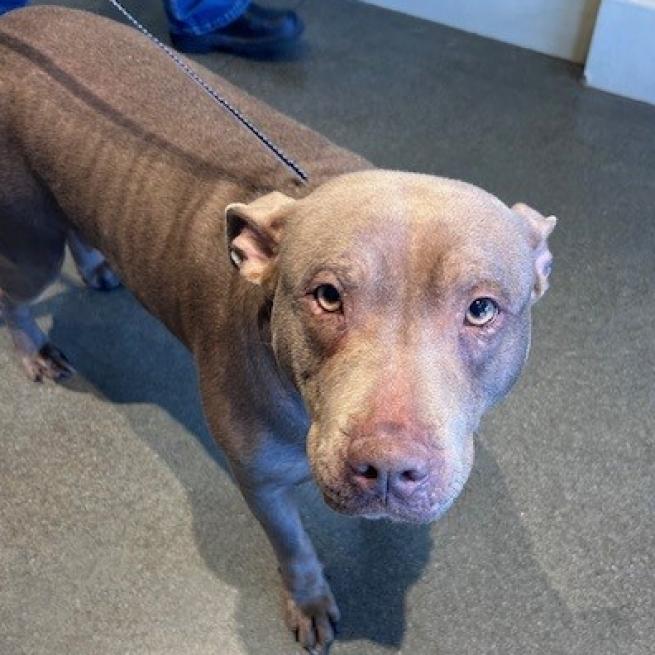
Dogs available for adoption this week include mixes of Australian cattle dog, Australian terrier, bulldog, Chihuahua, dachshund, French bulldog, German shepherd, hound, Labrador Retriever, mastiff, pit bull terrier, Rottweiler and terrier.

Dogs that are adopted from Lake County Animal Care and Control are either neutered or spayed, microchipped and, if old enough, given a rabies shot and county license before being released to their new owner. License fees do not apply to residents of the cities of Lakeport or Clearlake.

Those dogs and the others shown on this page at the Lake County Animal Care and Control shelter have been cleared for adoption.

Call Lake County Animal Care and Control at 707-263-0278 or visit the shelter online for information on visiting or adopting.

The shelter is located at 4949 Helbush in Lakeport.

Email Elizabeth Larson at This email address is being protected from spambots. You need JavaScript enabled to view it.. Follow her on Twitter, @ERLarson, or Lake County News, @LakeCoNews.

 
Foster#7134(Crusty)'s preview photo
Foster#7134(Crusty)

Kennel#28(Tucker)'s preview photo
Kennel#28(Tucker)

 
Kennel#2's preview photo
Kennel#2


Kennel#3(Jet)'s preview photo
Kennel#3(Jet)

Kennel#24(Rex)'s preview photo
Kennel#24(Rex)

Kennel#9's preview photo
Kennel#9

Kennel#10's preview photo
Kennel#10

Kennel#20(Piper)'s preview photo
Kennel#20(Piper)

 
Kennel#21(Coco)'s preview photo
Kennel#21(Coco)

Kennel#6's preview photo
Kennel#6

Kennel#8's preview photo
Kennel#8

Kennel#29a's preview photo
Kennel#29a

Kennel#32's preview photo
Kennel#32

Kennel#29c's preview photo
Kennel#29c


Kennel#34's preview photo
Kennel#34

Kennel#25's preview photo
Kennel#25

Kennel#30's preview photo
Kennel#30

Kennel#12's preview photo
Kennel#12

 
Kennel#19's preview photo
Kennel#19


Kennel#31(Domino)'s preview photo
Kennel#31(Domino)

Kennel#11's preview photo
Kennel#11

Kennel#15's preview photo
Kennel#15


  1. Space News: The rush to return humans to the Moon and build lunar bases could threaten opportunities for astronomy
  2. Lucerne man charged in Lake County’s first fentanyl homicide case
  3. Red flag warning set to begin Saturday night
  • 646
  • 647
  • 648
  • 649
  • 650
  • 651
  • 652
  • 653
  • 654
  • 655
How to resolve AdBlock issue?
Refresh this page