How to resolve AdBlock issue?
Refresh this page
How to resolve AdBlock issue?
Refresh this page
Lake County News,California
  • Home
    • Registration Form
  • News
    • Education
    • Veterans
    • Community
      • Obituaries
      • Letters
      • Commentary
    • Police Logs
    • Business
    • Recreation
    • Health
    • Religion
    • Legals
    • Arts & Life
    • Regional
  • Calendar
  • Contact us
    • FAQs
    • Phones, E-Mail
    • Subscribe
  • Advertise Here
  • Login
How to resolve AdBlock issue?
Refresh this page

News

Man accused of fentanyl homicide pleads not guilty

Details
Written by: Elizabeth Larson
Published: 18 June 2024
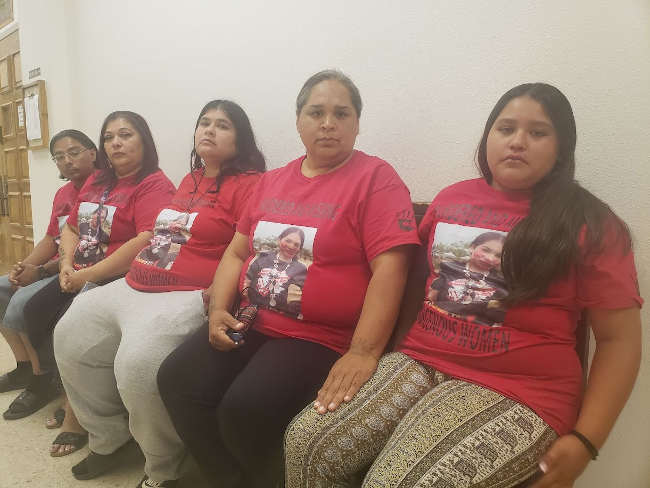
Members of Illeanna Frease’s family wait outside of the courtroom before the arraignment of Joe Boggs Jr., who is charged with second-degree murder for furnishing Frease with the fentanyl that killed her in November 2023. Photo by John Jensen/Lake County News.

LAKEPORT, Calif. — The Lucerne man arrested last week for Lake County’s first charged fentanyl homicide case was in court on Monday afternoon, pleading not guilty to killing a teenager in November.

Joe Nathan Boggs Jr., 27, made his first appearance for the death of 17-year-old Illeanna Makena Frease of Lakeport before Judge Andrew Blum.

Boggs was arrested on Friday morning following a seven-month-long investigation that concluded he was responsible for killing Frease on Nov. 10 through furnishing fentanyl, a dangerous drug that has led to an epidemic of deaths nationwide.

On Thursday, the day before his arrest, the District Attorney’s Office filed four felony counts against Boggs: second-degree murder; an adult using a minor as an agent to violate controlled substance law; sale, distribution or transportation of a controlled substance; and possession for sale of a controlled substance.

After Boggs indicated he could not afford an attorney and wanted one appointed, Judge Blum appointed Senior Public Defender Tom Quinn to be Boggs’ attorney.

Quinn then promptly entered not guilty pleas to all charges and special allegations on Boggs’ behalf.

Noting that he had spoken to Boggs on Sunday night for about an hour, Quinn told the court that Boggs would not waive time to a speedy trial, which requires that his preliminary hearing be set quickly.

Blum set that hearing for 8:15 a.m. Wednesday, June 26.

He also set Boggs’ bail at $1 million, keeping it at the level it was set at when Boggs was arrested last week. An additional $1,000 bail was put in place for a misdemeanor drug case Boggs also is facing.

Quinn asked that a bail review take place during the preliminary hearing on June 26.

In a Friday Facebook post, Frease’s mother, Michaela John, said Boggs had trafficked her daughter and poisoned her to death, calling him a “drug trafficking, predatory murderer.”

The family also approved the Lake County Sheriff’s Office releasing Frease’s name as part of the Friday statement on Boggs’ arrest.

Frease’s family members came to court on Monday prepared to make sure Frease isn’t forgotten in the judicial process.

Five of them wore red t-shirts with Frease’s picture on them. Red has become increasingly associated with the movement to bring attention to another epidemic — that of Missing and Murdered Indigenous People, or MMIP.

Frease was a member of the Elem Colony of Pomo. Boggs also is Indigenous. John said in her Facebook post that Boggs — who has a lengthy criminal record — “operated both on and off tribal lands openly, with no regard for the damage he was causing. Without accountability.”

As the Monday afternoon hearing ended, one of the women wearing a red t-shirt with Frease’s picture stood and called out to Boggs loudly from the courtroom gallery.

“See her face,” she said. “You see what you did?”

Email Elizabeth Larson at This email address is being protected from spambots. You need JavaScript enabled to view it.. Follow her on Twitter, @ERLarson, or Lake County News, @LakeCoNews.

Major wildland fire incidents burn in Sonoma and Colusa counties

Details
Written by: Elizabeth Larson
Published: 18 June 2024
The Sites fire as seen from Interstate 5 on Monday, June 17, 2024. Photo by Eileen McSorley.

NORTHERN CALIFORNIA — The summer fire season has arrived in Northern California, with two major incidents burning on either side of Lake County on Monday.

On Sunday just after 12:30 p.m., the Point fire began in Sonoma County.

Cal Fire said it’s located on Stewarts Point Road and Skaggs Springs near Geyserville.

By Monday night the fire had reached approximately 1,207 acres and 20% containment. Cal Fire said two structures have been destroyed and one firefighter injured.

Resources assigned include 400 personnel, 50 engines, 12 crews, 10 dozers, 10 water tenders and four helicopters, Cal Fire said.

Officials said crews overnight continued building and strengthening control lines, working under favorable conditions. The cause is under investigation.

Then, on Monday afternoon, a new fire began in neighboring Colusa County.

The Sites fire began at approximately 1:39 p.m. on Sites Lodoga Road and Wilson Creek, southeast of Stonyford, Cal Fire reported.

By 8 p.m., the fire was reported to have grown to 4,463 acres, with zero containment.

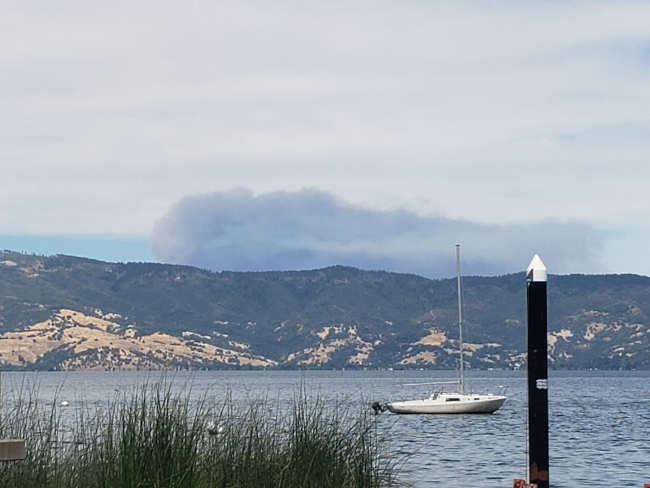
The fire put up a large plume of smoke that could be seen around Lake County.

Cal Fire said the fire is being influenced by north winds with speeds of up to 20 miles per hour, coupled with low relative humidity.

Those conditions had led to the National Weather Service issuing a red flag warning that remained in effect in Colusa County through 8 a.m. Tuesday.

Smoke from the fire moved into southeastern Lake County, causing the air quality index to rise there, according to the PurpleAir website.

Cal Fire said the Sites fire’s cause remains under investigation.

Email Elizabeth Larson at This email address is being protected from spambots. You need JavaScript enabled to view it.. Follow her on Twitter, @ERLarson, or Lake County News, @LakeCoNews.


The Sites fire as seen from Lakeport, California, on the afternoon of Monday, June 17, 2024. Photo by Elizabeth Larson/Lake County News.

Elder fraud has reached epidemic proportions – a geriatrician explains what older Americans need to know

Details
Written by: Laurie Archbald-Pannone, University of Virginia
Published: 18 June 2024


Be careful out there. ArtMarie/Getty Images

Americans age 60 and older lost more than US$3 billion to scammers in 2023, according to the FBI.

To put that whopping figure in context, Taylor Swift’s Eras Tour recently made news as the first concert tour ever to earn $1 billion.

As a geriatrician – a doctor who cares for people over 65 years of age – I believe elder fraud has reached an epidemic scale. My patients often tell me about being scammed.

The consequences can be worse than just losing money. The experience is traumatic for many, with some victims feeling deep shame and self-doubt in the aftermath. This can interfere with their relationships, erode their trust in others and harm their mental and physical health.

Teaching older Americans how to identify and avoid fraud – and how to report such crimes – could go some way to mitigating the impact of this modern epidemic.

Elder fraud is on the rise

A recent FBI report shows just how prevalent elder fraud is. In 2023, Americans over 60 submitted 14% more complaints to the FBI’s Internet Crime Complaint Center, or IC3, than they did the previous year. Estimated financial losses rose about 11% over the same period.

These numbers, grim as they are, only represent the tip of the iceberg. For one thing, only about half of the reports of internet crimes to the FBI included information about the victim’s age – which means reported incidents of elder fraud are an undercount.

What’s more, these figures don’t include the many scams that take place over the phone, by mail or in person. And many fraud victims never report their experiences – often because they’re embarrassed, afraid or unsure what to do.

While people of all ages are victimized by fraudsters, older adults can be uniquely vulnerable.

The FBI has suggested that older adults are often targeted because they tend to be more trusting and polite. They often have financial savings, own homes and have good credit – all of which make them more attractive to scammers.

Older adults may also be less comfortable with new technologies, which puts them at risk. Consider that someone who is 85 years old may have retired in the year 2004 – three years before Apple introduced the iPhone. While many forms of technology have permeated our personal lives, it’s often in the workplace that many people receive mandatory training – like how to avoid online scams.

The wide world of frauds

In 2023, tech-support scams were the most commonly reported type of elder fraud. Other common schemes include romance scams, online shopping swindles and investment frauds. While tech scams are the most common, investment scams are the costliest, accounting for nearly half of all reported losses from those over 60 last year.

Fraudulent call centers are also well known for targeting older adults. Such scams made up 40% of reported elder fraud cases in 2023, according to the FBI, accounting for at least $770 million in losses. Many make use of new technologies such as artificial intelligence to deceive people more effectively with voice-cloning scams or “deepfake” videos.

Call-center scammers tell all sorts of tall tales. In 2022, more than 600 people reported being victimized in a single timeshare-related fraud. They collectively lost nearly $40 million. And in the latter half of 2023, scammers posing as government officials and tech-support agents pushed victims to liquidate their assets or buy precious metals – with reported losses reaching more than $55 million.

Combating an epidemic of scams

As with any epidemic, “infection control” tools can help us limit the spread. Much like vaccines create immunity against viruses, prevention efforts can help people build up their defenses to avoid fraud. The main tool for preventing fraud is learning how to identify likely scams ahead of time. Here are a few FBI-approved tips to help you do that:

• If you believe there is an imminent danger to yourself or a loved one, call the police immediately.

• Be cautious of unsolicited phone calls, mailings and door-to-door service offers.

• Don’t click on any unsolicited links you receive via email or text – even if they seem to be from people you know. And never open an email attachment from someone you don’t know.

• If you’re in doubt about a person or business, search online for their name, email, phone number and addresses, as well as details about their proposed offers. These days, most legitimate businesses have some degree of web presence. And if it’s a scam, you might find others have already shared information about it.

• Never give or send anything to unverified people or businesses. This includes any personally identifiable information, money, jewelry, gift cards, checks or wire information.

• Make sure your computer antivirus and security software and malware protections are up to date.

• Bad actors can use pop-ups to spread malicious software. If you see a pop-up message, disconnect from the internet and shut down your device. You can enable pop-up blockers to avoid accidentally clicking on one.

• Don’t give anyone you don’t know remote access to “fix your computer” or other electronic devices. This could let them see personal information, including details about your financial accounts.

• If you’re told to lie to your bank about why you need to wire money or make a withdrawal, it’s probably a scam. A legitimate business won’t insist you keep secrets from family or friends, either.

• Resist pressure to act quickly. This is a big one: Scammers often create a false sense of urgency. A legitimate business will let you think through your financial decisions.

• Perhaps most importantly, trust your instincts.

What to do if you think you’ve fallen for a scam

Despite your best efforts, you might still be taken in by a fraudster. If that happens, know that you’re not alone – and that it’s possible to recover. Here is some advice for dealing with the aftermath:

• If a criminal gains access to your device or account, take action to protect your identity. If a bank is involved, immediately contact your financial institutions to place protections on your accounts, and monitor your accounts and personal information for suspicious activity.

• Contact your local FBI field office, or, if the crime was committed over the internet, submit a tip online.

• When reporting a scam, include as many details as possible. This can include names, dates of contact, methods of communication, phone numbers, email and mailing addresses, and websites used by the perpetrator.

• Also note methods of payment, where you sent any funds – including wire transfers and prepaid cards – and account numbers. Offer descriptions of your interactions with the scammer and any instructions you were given.

• Whenever possible, you should keep original documents, emails, faxes and logs of communications.

• Falling for a scam can be frightening and stressful. Talk with people who you know and trust to support you through this challenging time. Some support groups include the AARP Fraud Watch Network and the Cybercrime Support Network’s Peer Support Program.

• If your emotional response is overwhelming, consider talking with a counselor, therapist or your medical team.

Former FBI director William Webster discusses his experience with elder fraud.

If you or someone you love falls into a fraud scam, you aren’t alone. Not even law enforcement experts are immune. At the age of 90, former FBI director William Webster was targeted – an experience he bravely shared with the world.

I encourage my patients not to feel too embarrassed to report what happened. Talking about these experiences is an important step toward fighting this epidemic.The Conversation

Laurie Archbald-Pannone, Associate Professor of Medicine and Geriatrics, University of Virginia

This article is republished from The Conversation under a Creative Commons license. Read the original article.

Lake County Registrar of Voters Office plans outreach at farmers markets

Details
Written by: Lake County News reports
Published: 18 June 2024
LAKE COUNTY, Calif. — Over the next several months the Lake County Registrar of Voters Office will be conducting outreach at the Lakeport farmers market.

The elections office will be at the market, held at 200 Park St., from 10 a.m. to 1 p.m. on the following dates:

• June 18 and 25;
• July 2 and 16;
• Aug. 6 and 20;
• Sept. 3 and 17.

The agency will assist community residents to register to vote and provide additional resources.

Staff will be available to provide registration forms, poll worker applications and general informational fliers about voting in upcoming elections.

In addition, eligible voters that are 16 and 17 years of age can preregister and those 18 years and older can register to vote online at https://registertovote.ca.gov/ or at the Lake County Registrar of Voters Office at 325 N Forbes St., Lakeport.

For additional information phone 707-263-2372 or toll-free at 888-235-6730.
  1. Lakeport City Council to consider new budget, discuss curfew bell project
  2. Supervisors to consider ordinances to establish new rules for tobacco use, sales
  3. New Jail Literacy Program aims to support inmate learners
  • 644
  • 645
  • 646
  • 647
  • 648
  • 649
  • 650
  • 651
  • 652
  • 653
How to resolve AdBlock issue?
Refresh this page