How to resolve AdBlock issue?
Refresh this page
How to resolve AdBlock issue?
Refresh this page
Lake County News,California
  • Home
    • Registration Form
  • News
    • Education
    • Veterans
    • Community
      • Obituaries
      • Letters
      • Commentary
    • Police Logs
    • Business
    • Recreation
    • Health
    • Religion
    • Legals
    • Arts & Life
    • Regional
  • Calendar
  • Contact us
    • FAQs
    • Phones, E-Mail
    • Subscribe
  • Advertise Here
  • Login
How to resolve AdBlock issue?
Refresh this page

News

Clearlake Planning Commission to discuss airport redevelopment plan environmental study scope

Details
Written by: Elizabeth Larson
Published: 23 July 2024
CLEARLAKE, Calif. — The Clearlake Planning Commission is set to consider the scope of the environmental impact report that will study the city’s plans to redevelop its former airport site.

The commission will meet beginning at 6 p.m. Tuesday, July 23, in the council chambers at Clearlake City Hall, 14050 Olympic Drive.

The agenda can be found here.

The meeting will be broadcast live on the city's YouTube channel or the Lake County PEGTV YouTube Channel.

Community members also can participate via Zoom. The webinar ID is 869 1825 2016, the pass code is 681710. One tap mobile is available at +16694449171,,86918252016#, or join by phone at 669-444-9171 or 253-205-0468.

Submit comments and questions in writing for commission consideration by sending them to Administrative Services Director/City Clerk Melissa Swanson at This email address is being protected from spambots. You need JavaScript enabled to view it.. Identify the subject you wish to comment on in your email’s subject line.

To give the planning commission adequate time to review your questions and comments, please submit written comments before 4 p.m. Tuesday, July 23.

On Tuesday, the main agenda item is a public hearing to review and comment on the scope of the draft environmental impact report for the 47.5-acre site known as the Airport Redevelopment Project.

The site includes the city’s former Pearce Field airport. It’s bounded by 18th Avenue extension and Victor Street to the north, State Route 53 to the east, and Old Highway 53 to the south and west.

The city staff report said the project would develop the site with healthcare facilities, multifamily housing, commercial retail, restaurants, a park, a plaza, pedestrian routes, and a cross-over to the future transit center at State Road 53.

“The project would also include infrastructure improvements, including roads, utilities, storm water management, parking lots, streetlights, landscaping, bus shelters/pullouts, sidewalks, bicycle lanes, and multi-modal paths. Below is a summary of the potential uses and associated square footages,” the report said.

The city reported that the project will include up to 250 multifamily housing units, up to 140,000 square feet of hospital/medical offices, up to 400,000 square feet for general retail and commercial space, 1,928 parking spots and 3.83 acres of open space.

Email Elizabeth Larson at This email address is being protected from spambots. You need JavaScript enabled to view it.. Follow her on Twitter, @ERLarson, or Lake County News, @LakeCoNews.

Ridge fire containment rises

Details
Written by: Elizabeth Larson
Published: 23 July 2024
LAKE COUNTY, Calif. — Firefighters continue to make progress on the Ridge fire burning along the border of Lake and Colusa counties.

The fire, which began Saturday afternoon on Walker Ridge Road and Highway 20, was up 2,756 acres and 30% containment by Monday night.

Firefighters held the growth to 127 acres on Monday.

Cal Fire said crews working overnight Sunday did a good job of tying in and constructing containment lines on the north side of the fire.

On Monday, firefighters worked on completing control lines along that north branch.

Wilbur Springs became an area of concern on Sunday because of observed spotting, but Cal Fire said firefighters successfully defended structures and, so far, none of the 50 structures said to be threatened by the fire have been damaged or destroyed.

The smoke that came off the fire on Monday was the result of ignitions on vegetation within the control lines, Cal Fire said.

Resources assigned to the fire on Monday included 800 personnel, nine helicopters, 46 engines, eight dozers, 13 water tenders and 17 crews.

Lake County zones CLO-E070, CLO-E089, CLO-E022 and CLO-E083 have been reduced from evacuation orders to warnings. The evacuation warning for zone CLO-E104 has been lifted. Zones can be seen here.

Email Elizabeth Larson at This email address is being protected from spambots. You need JavaScript enabled to view it.. Follow her on Twitter, @ERLarson, or Lake County News, @LakeCoNews.

America faces a power disconnection crisis amid dangerous heat: In 27 states, utilities can shut off electricity for nonpayment even in a heat wave

Details
Written by: Sanya Carley, University of Pennsylvania and David Konisky, Indiana University
Published: 23 July 2024


When homes lose power, they lose cooling, too. Edmund Lowe Photography/Moment via Getty Images

An alarming number of Americans risk losing access to utility services because they can’t pay their bills. Energy utility providers in 2022 shut off electricity to at least 3 million customers who had missed a bill payment. Over 30% of these disconnections happened in the three summer months, during a year that was among the hottest on record.

In some cases, the loss of service lasted for just a few hours. But in others, people went without electricity for days or weeks while scrambling to find enough money to restore service, often only to face disconnection again.

As researchers who study energy justice and energy insecurity, we believe the United States is in the midst of a disconnection crisis. We started tracking these disconnections utility by utility around the country, and we believe that the crisis will only get worse as the impacts of climate change become more widespread and more severe.

In our view, it is time government agencies and utilities start treating household energy security as a national priority.

1 in 4 households face energy insecurity

Americans tend to think about the loss of electricity as something infrequent and temporary. For most, it is a rare inconvenience stemming from a heat wave or storm.

But for millions of U.S. households, the risk of losing power is a constant concern. According to the most recent data from the U.S. Energy Information Administration, 1 in 4 American households experience some form of energy insecurity each year, with no appreciable improvement over the past decade.

For many low-income households, the risk of a power shut-off reoccurs month after month. In a recent study, we found that over the course of a single year, half of all households whose power was disconnected dealt with disconnections multiple times as they struggled to pay their bills.

A woman sits on wooden steps outside a door. Two backpacks, one belonging to a small child, sit on the steps beside her.
A woman sits outside the NeedLink Nashville offices after filling out an application to avoid losing electricity in 2022. William DeShazer for The Washington Post via Getty Images

Energy insecurity like this is especially common among low-income Americans, people of color, families with young children, individuals who rely on electronic medical devices or those living in poor housing conditions. During the first year of the COVID-19 pandemic, we found that Black and Hispanic households were three and four times, respectively, more likely to lose service than white households.

Along with existing financial constraints, people are facing rising electricity rates in many areas, rising inflation and higher temperatures that require cooling. Some also face a history of redlining and poor city planning that has concentrated certain populations in less efficient homes. Taken together, the crisis is apparent.

Coping strategies can put health at risk

We have found that over half of all low-income households engage in some coping strategies, and most of them find they need multiple strategies at once.

They might leave the air conditioner off in summer, allowing the heat to reach uncomfortable and potentially unsafe temperatures to reduce costs. Or they might forgo food or medicine to pay their energy bills, or strategically pay down one bill rather than another, known as “bill balancing.” Others turn to payday loans that might help temporarily but ultimately put them in deeper debt. In our research, we have found that the most common coping strategies are also the most risky.
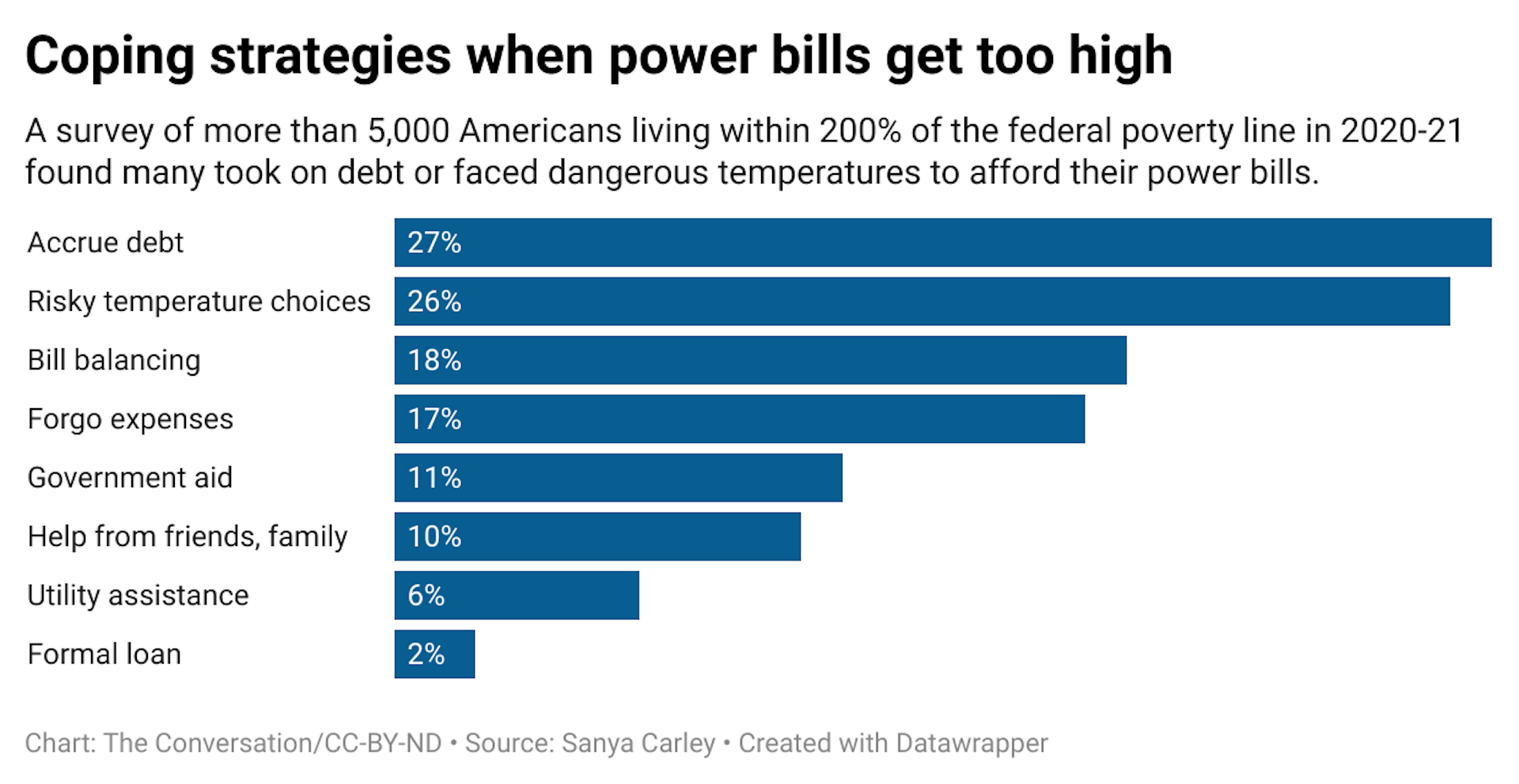
Once people fall behind on their bills, they are at risk of being disconnected by their utility providers.

The loss of critical energy services may mean that affected people cannot keep their homes cool – or warm during the winter months – or food refrigerated during any season. Shut-offs may mean that people with illnesses or disabilities cannot keep medicines refrigerated or medical devices charged. And during times of extreme cold or heat, the loss of energy utility services can have deadly consequences.

Where disconnection rates are highest

Our research team created the Utility Disconnections Dashboard, in which we track utility disconnections in all places where data is available.

In recent years, more states have required regulated utilities across the country to disclose the number of customers they disconnect. However, state regulations only apply to the utilities that they regulate. Public utilities and cooperatives, which serve over 20% of U.S. electricity customers, often aren’t covered. That leaves massive gaps in understanding of the full magnitude of the problem.
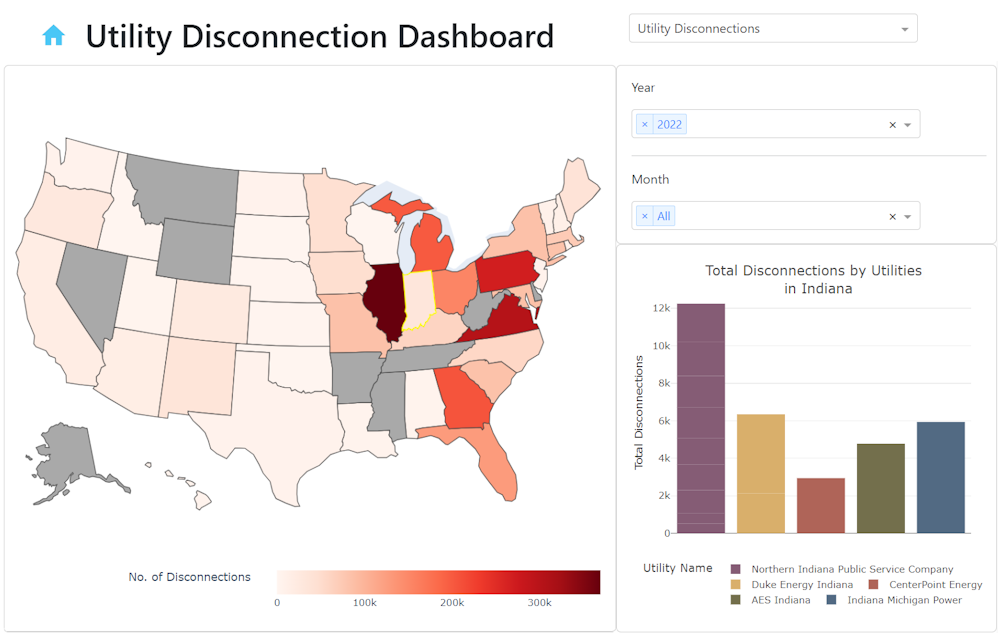
A screengrab of the Utility Disconnections Dashboard shows data from the state of Indiana, where five utilities had more than 2,000 disconnections each due to customers not paying bills on time. Indiana's total  was over 32,000 in 2022.
The Utility Disconnections Dashboard shows the number and rate of disconnections by utility in each state. Energy Justice Lab, CC BY-ND

The data we do have reveals that disconnection rates soar during the summer months and are typically highest in the Southeast. Large investor-owned utilities in Florida, Georgia, South Carolina and Indiana have averaged disconnection rates near 1% of customers, and some city utilities have been even higher.

Only 23 states restrict summer shut-offs

State public utility commissions place certain restrictions on the circumstances when utilities can disconnect customers, but summer heat is often overlooked.

All but a handful of states limit utilities from shutting off customers during winter months or on extremely cold days. Most have at least some medical exemptions.

Yet, more than half of the states do not place any limits on utility disconnections during summer months or on very hot days.

Only 23 states and the District of Columbia have such summer protections. They typically take the form of designating time periods or temperatures when customers cannot be disconnected from their service. Virginia became the most recent state with a such a policy, with protections going into effect on July 1, 2024.

We believe it is untenable for states to go without temperature protections in an era of climate change, as more parts of the country will increasingly experience excessive-heat days.

These state-level policies provide a baseline of protection. As we learned during the COVID-19 pandemic, moratoriums that prohibit utility disconnections can help alleviate energy insecurity.

But these policies are highly variable across the country. Moreover, details about customer protections can be difficult for people to find and understand.

Better rules and a new mindset on right to energy

As we see it, the U.S. needs more robust customer protections, with states, if not the federal government, mandating better disclosure of when and where disconnections occur to identify any systemic biases.

Most of all, we believe Americans need a collective change in mindset about energy access. That should start with a principle that all people should have access to critical energy services and that utilities should only shut off service to customers as a last resort, especially during health-compromising weather events.

The country cannot wait for deadly heat waves to prove how important it is to protect American households.

This is an update to an article originally published July 5, 2023.The Conversation

Sanya Carley, Presidential Distinguished Professor of Energy Policy and City Planning, University of Pennsylvania and David Konisky, Lynton K. Caldwell Professor, Indiana University

This article is republished from The Conversation under a Creative Commons license. Read the original article.

Coast to coast, millions of Americans are experiencing sweltering temperatures this summer, with seemingly little relief in sight. For people who struggle to access or afford air conditioning, the rising need for cooling is a growing crisis.

Ridge fire growth held in check

Details
Written by: Elizabeth Larson
Published: 22 July 2024
LAKE COUNTY, Calif. — Firefighters on Sunday managed to check the growth of the Ridge fire, which burned more than 2,300 acres within several hours of starting on Saturday.

The fire, which began on Saturday afternoon on the border of Lake and Colusa counties, grew to 2,629 acres on Sunday, an increase of just over 300 acres. Containment remained at 15%.

Cal Fire said 50 structures in the two impacted counties remain under threat.

Firefighters on Sunday worked to construct and tie in control lines around the fire, with a focus on the north perimeter, Cal Fire said.

Officials said they also had bolstered both air and ground resources on the fire Sunday to help keep the fire within its current perimeter.

Still in effect in Lake County are evacuation orders for zones CLO-E070, CLO-E089, CLO-E022 and CLO-E083, with an evacuation warning in place for CLO-E104. Zones can be seen here.

As of noon on Sunday, Highway 20 had been fully reopened east of Clearlake Oaks at Highway 53 in Lake County. The highway had been closed on Saturday.

Email Elizabeth Larson at This email address is being protected from spambots. You need JavaScript enabled to view it.. Follow her on Twitter, @ERLarson, or Lake County News, @LakeCoNews.
  1. Supervisors to consider appointments, mental health services contract
  2. Early week heat advisory issued for Lake County
  3. High cyanotoxin levels prompts guidance for residents using private intakes from Clear Lake
  • 606
  • 607
  • 608
  • 609
  • 610
  • 611
  • 612
  • 613
  • 614
  • 615
How to resolve AdBlock issue?
Refresh this page
