How to resolve AdBlock issue?
Refresh this page
How to resolve AdBlock issue?
Refresh this page
Lake County News,California
  • Home
    • Registration Form
  • News
    • Education
    • Veterans
    • Community
      • Obituaries
      • Letters
      • Commentary
    • Police Logs
    • Business
    • Recreation
    • Health
    • Religion
    • Legals
    • Arts & Life
    • Regional
  • Calendar
  • Contact us
    • FAQs
    • Phones, E-Mail
    • Subscribe
  • Advertise Here
  • Login
How to resolve AdBlock issue?
Refresh this page

News

Space News: What’s up for August 2024

Details
Written by: Preston Dyches
Published: 04 August 2024


What's up for August? A super close meetup of Jupiter and Mars, the outlook for the Perseid meteors, and see a stellar nursery in the Lagoon Nebula.

During the month of August, the Red Planet, Mars, speeds past our solar system's largest planet, Jupiter, in the a.m. sky. They have an extremely close pair-up, called a conjunction, on Aug. 14, when they'll appear just a third of a degree apart, which is less than the width of the full Moon.

The view from NASA's Eyes on the Solar System reveals the two planets arranged along the same line of sight, which is why they appear so close together in the sky at this time.

Mars quickly pulls away from Jupiter over the following mornings, but on the 27th, the crescent moon joins the two planets to form a captivating trio in the morning sky.

Saturn flies solo most of the month on the opposite side of the sky, though the Moon chases close behind the Ringed Planet on Aug. 20. The pair rise shortly after dark, and trek toward the west together until dawn.

The warm summer nights of August in the Northern Hemisphere make the Perseid meteor shower an annual favorite. This year's peak night for Perseids comes on Aug. 11, and into morning twilight on the 12th. Provided you have clear skies, viewing conditions will be favorable this year, as the Moon sets by around 11:30 p.m. local time.

Meteor activity picks up from then until dawn. From darker viewing locations, meteor counts of 50 to 75 per hour are pretty normal at the peak.

The Perseids appear to originate from a place in the sky that rises in the northeast, so lie back and face roughly in that direction, but try to take in as much of the sky as you can in your view, as meteors can appear all over.

All the stars in the sky share a common origin in giant clouds of gas and dust called nebulas. And one such stellar nursery, the Lagoon Nebula, is well placed to observe in the August sky.

The Lagoon Nebula will feel familiar to you if you've ever observed the Orion Nebula — with the latter being just a bit brighter. Being about three times wider than the full moon, it's still relatively easy to find, even under suburban skies, with binoculars or a small telescope.

The Lagoon Nebula is located in the constellation Sagittarius, which regular skywatchers will know is synonymous with the faintly glowing band of the Milky Way core. You'll find it here, just above the top of the star pattern known as the Teapot.

The nebula is located about 4,000 light years away. Its oblong structure is about 100 light years long by about 50 light years wide. It's a cauldron of intense star forming activity, with many young stars blazing brightly, causing the surrounding gas to glow. That glow is faint and colorless when peering at the Lagoon Nebula through binoculars, but long-exposure photos reveal its colorful nature.

The bright stars are also sculpting the nebula, creating voids and turbulent knots and streamers of gas. The nebula gets its name from one of these dense, dark clouds that stretches across its middle, looking something like a watery lagoon.

The Lagoon Nebula appears high overhead in August for those in the Southern Hemisphere, and quite low for those at higher northern latitudes, but it's visible throughout the lower 49 United States.

If you can locate the stars in the Teapot, you should be able to observe the nebula too. To find it, follow a line toward the west, twice the distance from the top of the Teapot's handle to the top of its lid.

Nebulas can be challenging to observe, even with a telescope. But with its large size and relative brightness, the Lagoon Nebula offers a great opportunity to see one of these star forges for yourself in August.

Preston Dyches works for NASA's Jet Propulsion Laboratory.

Middletown’s water tanks begin transformation with Pomo basketry-inspired art

Details
Written by: Lake County News reports
Published: 03 August 2024
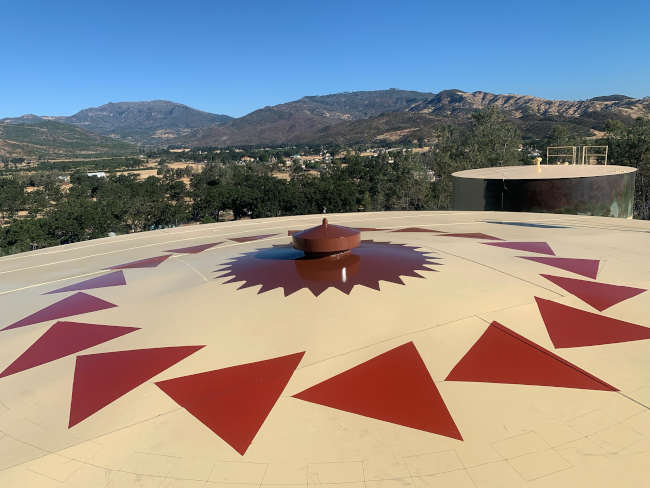
Top of the large tank in the painting process. Photo by Xavier Piña.

MIDDLETOWN, Calif. — The Middletown Art Center announced the commencement of the painting phase of the Water Basket project, a monumental effort to transform Middletown’s two water tanks on Rabbit Hill into vibrant 360-degree murals inspired by Pomo basketry.

This project celebrates the area’s history, people, and ecology through the lens of indigenous art, symbolizing the deep connection between the Pomo people and their land.

The project is a collaboration between Middletown Rancheria of Pomo Indians of California, Pomo artists, Callayomi County Water District and the Middletown Art Center.

It’s funded in part by an award from the National Endowment for the Arts, with additional funding from the Middletown Rancheria, the water district and public support.

The selection process for the mural designs was comprehensive and inclusive. After careful consideration of over 20 designs, a jury of 14 local stakeholders chose six designs, which were then presented for public voting at several locations.

One of the selected artists for this project is Trelasa Baratta from the Middletown Rancheria Band of Pomo Indians.

“I come from the Chappo and Knight families of Middletown Rancheria. My grandpa Mace was born and raised in Middletown, California,” said Baratta. “They tell me my great uncle Jimmy used to live up on Rabbit Hill, where the water tanks stand today.”

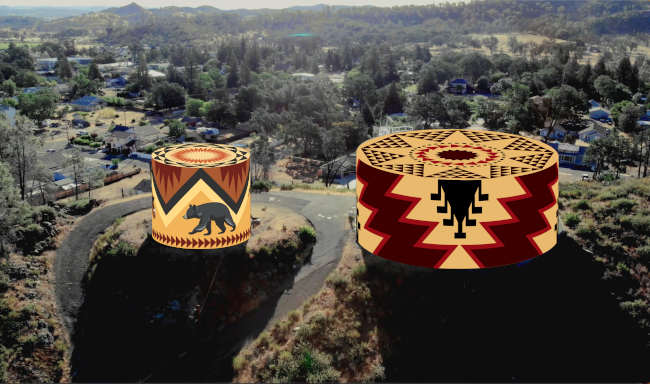
Baratta’s designs pay tribute to her cultural legacy, incorporating personal variations of traditional Pomo basketry patterns.

The second design selected is by Graphic Designer Lorraine Triana Rueda. Originally from Columbia, Lorraine has lived in California for six years and moved to Lake County recently.

Her design weaves together the community's respect for the land with its rich heritage, incorporating symbolic patterns and motifs that honor both the local environment and Pomo culture.

“Being involved in creating this project has not only allowed me to contribute to the community but has also enriched my understanding of the local cultural heritage and deepened my connection with the environment around me. I am grateful for the opportunity to have been part of something that brings the community together and celebrates our shared story."

Additional information about the details and symbols incorporated in Trelasa Baratta’s and Loraine Triana Rueda’s designs can be found at www.middletownartcenter.org/waterbasket.

Now, with the designs finalized, the painting phase has commenced under the skilled hand of Xavier Piña, owner of West Coast Painter.

Piña, who has been painting since 1999, moved to Lake County 20 years ago from Los Angeles. He has made significant contributions to the local art scene, including collaborating on painting the first two murals in Lake County 14 years ago, one of which still adorns the water tank in Clearlake Oaks.

“Water Basket is a daunting project, but years of experience give me the confidence to tackle such a feat,” said Piña.

He and his crew approach this project with a blend of enthusiasm and expertise. They have employed “Egyptian style” techniques, using ropes, radii and markers to lay out the intricate design.

Piña’s carpentry skills have been invaluable, as the project requires precise measurements and strong math skills to handle the many angles involved. Reflecting on this and other large-scale painting projects he has accomplished, he remarked, “It’s like they just naturally flow out of me.”

Despite the summer heat, the team follows the shade around the water tank to stay cool, noting that the tanks themselves are surprisingly cool to the touch. The entire project is expected to take two months to complete.

Pat Giacomini from the Callayomi County Water District Board of Directors shared her excitement about the project. “Art and cultural history will come together in this project on the CCWD water tanks. This project will be an outstanding statement to the uniqueness of our community.”

Middletown Art Center is a Lake County nonprofit dedicated to engaging the public in art making, education, and appreciation. Through exhibitions, performances, workshops and community events, the art center provides a platform for diverse voices and perspectives, striving to create an inclusive and accessible space for all.

To learn more or to donate to support Water Basket and other MAC programs, visit www.middletownartcenter.org or call 707-809-8118. The MAC is located at 21456 State Highway 175 in Middletown.

Three dimensional renderings of the selected Water Basket designs. Renderings by Loraine Trainna.

Lake County health officials report on more West Nile virus detections in mosquitoes, dead bird and sentinel chickens

Details
Written by: Lake County News reports
Published: 03 August 2024
LAKEPORT, Calif. – West Nile virus has been found in local mosquitoes, sentinel chickens and a dead bird from Lake County this year, officials said on Friday.

This week, West Nile virus was detected in mosquito samples from Cobb and Middletown.

This brings the total West Nile virus activity in Lake County this year to seven mosquito samples (Clearlake Oaks, Cobb, Kelseyville, Lower Lake, Middletown), two sentinel chickens (Upper Lake) and one dead bird (Kelseyville).

“Preventing mosquitoes prevents mosquito bites and illnesses like West Nile virus,” said Jamesina Scott, Ph.D., district manager and research director for the Lake County Vector Control District. “Take a short walk in your yard today and dump out any standing water you find. It can be a great activity for your kids — they’ll probably find water you didn’t know was there.”

Vector Control encourages residents to protect themselves with these steps:

• Eliminate mosquito habitat: Empty and clean any containers that hold water, such as tires, buckets, and planters.
• Maintain swimming pools. Just one neglected swimming pool can produce more than 1 million mosquitoes and affect people up to five miles away.
• Consider mosquito fish: For water sources that cannot be drained, such as ornamental ponds or unmaintained swimming pools, the Vector Control District offers free mosquito fish to help control mosquito larvae.
• Use insect repellent: Apply an EPA-registered insect repellent containing according to label instructions whenever outdoors.
• Wear protective clothing: When outside during peak mosquito biting times (dawn and dusk), wear long-sleeved shirts and pants.
• Report dead birds to the toll-free state hotline: 1-877-968-2473 or online at https://westnile.ca.gov/report.

“West Nile virus is a significant public health concern in California, primarily spread by mosquitoes,” explained Lake County Public Health Officer Dr. Noemi Doohan. “Since its first detection in the state in 2003, human cases have been reported annually. People are most often infected during the summer and early fall when mosquito activity peaks. While many infected individuals may exhibit no symptoms or experience flu-like symptoms such as fever, fatigue, and body aches, WNV can lead to severe and potentially fatal conditions in less than 1% of cases. This includes high fever, neck stiffness, vision loss, and paralysis. Individuals over 60, those with chronic diseases, or those with weakened immune systems are at a greater risk of developing serious symptoms. Currently, there is no vaccine or specific antiviral treatment for WNV; care is supportive and, in severe cases, may require hospitalization.”

Doohand added, “We are deeply appreciative of Dr. Scott's and the vector control team's continued vigilance in monitoring and managing the West Nile virus situation. Their dedicated efforts are crucial in protecting public health and mitigating the spread of this potentially severe virus. Their ongoing commitment ensures that our communities remain informed and safeguarded against this persistent threat.”

No other West Nile virus has been detected in Lake County in 2024.

In 2023, six Lake County residents fell ill and one died from West Nile. Statewide, five human cases of West Nile virus illness have been reported and 27 California counties have detected West Nile virus in mosquitoes, dead birds, sentinel chickens or horses.

The Lake County Vector Control District provides mosquito control services to our community. If you need help with a mosquito problem, including reporting a neglected pool or spa, or have an in-ground yellowjacket nest on your property that you want treated, please contact the Lake County Vector Control District at 707-263-4770, Monday through Friday, 7:30 a.m. to 4 p.m., or submit a service request on their website at www.lcvcd.org.

For more information about West Nile virus, visit https://westnile.ca.gov/. Information about mosquito repellents can be found on the US Centers for Disease Control and Prevention website at https://www.cdc.gov/mosquitoes/prevention/.

Diabetes and obesity can damage the liver to the point of failure – but few people know their risk of developing liver disease

Details
Written by: Madona Azar, UMass Chan Medical School
Published: 03 August 2024


Insulin resistance links MASLD to several other metabolic diseases. Kateryna Kon/Science Photo Library via Getty Images

Metabolic dysfunction-associated steatotic liver disease, or MASLD, is an umbrella term describing conditions related to a buildup of fat in the liver. Formerly known as nonalcoholic fatty liver disease, this condition affects 1 in 4 people worldwide. Among those with type 2 diabetes, insulin resistance, obesity or all three, the prevalence of MASLD increases to 3 in 4 people.

As a diabetologist, the possibility of liver disease is on my mind every time I see a patient. Understanding your risk of developing this common yet underrecognized condition is essential to treating it.

What is MASLD?

MASLD is a complex disorder with both environmental and genetic contributions. In its early stages, liver cells accumulate fat in a process called steatosis. Major sources of this fat include adipose tissue as well as fatty acids the liver makes in response to insulin resistance and excess caloric intake. This fat accumulation can enlarge the liver and interfere with its normal functioning.

Over time, fatty acids activate enzymes, which can produce toxic byproducts capable of causing liver cell injury, inflammation and scarring. This condition is better known as MASH, or metabolic dysfunction-associated steatohepatitis. Progression to MASH is more common in the presence of other risk factors such as type 2 diabetes, insulin resistance and metabolic syndrome.

Left unaddressed, MASLD and MASH can progress to liver scarring, failure and, in some cases, cancer. They also increase risk of death from cardiovascular disease and liver-related complications.

In the U.S., MASH is the leading cause of liver transplants due to hepatic cancer among women and in those 65 and older. It is also on track to overtake hepatitis B and C as the main reason people develop liver cancer and thus need a liver transplant.

Liver disease and type 2 diabetes

Three out of four people with type 2 diabetes have MASLD. Linking liver disease, type 2 diabetes and obesity is the key role insulin resistance plays in their genesis.

Obesity is associated with increased fat deposits around the internal organs and higher levels of fatty acids delivered to the liver. Accumulation of fat in the liver increases its resistance to insulin.

Normally, insulin suppresses glucose production in the liver when blood sugar is high. When the liver becomes resistant to insulin, it produces more glucose despite elevated blood sugar levels, which in turn contributes to the development of type 2 diabetes.

A 2015 meta-analysis found that people with MASLD have a nearly twofold greater risk of developing type 2 diabetes than those without the disease. MASLD is also more likely to progress to MASH in the presence of type 2 diabetes.

MASLD disproportionately affects certain ethnic groups. For instance, 1 in 5 people of Hispanic descent in the U.S. have MASLD, with or without diabetes. This is thought to be related to genetic mutations that affect how the liver cells process fat. One particular mutation more common in Hispanic people promotes steatosis by interfering with the cells’ ability to clear fat deposits.

Treating MASLD and MASH

The silver lining is that management of obesity and type 2 diabetes – such as through lifestyle changes – is very similar to management of MASLD. The most critical early interventions for type 2 diabetes can also help with MASLD, and this is not surprising given how closely interrelated these two conditions are.

The best way to reverse the early stages of MASLD is with weight loss through healthy eating habits and regular exercise. The aim is to shed at least 5% to 10% of initial body weight, maintain that weight loss through sustainable and realistic lifestyle choices, and avoid excess alcohol intake to limit additional liver injury.

New medications to treat diabetes, such as GLP-1 receptor agonists like Ozempic and Mounjaro, as well as SGLT2 inhibitors like Jardiance or Invokana, have also shown benefit in early stages of MASLD. These drugs promote weight loss, which in turn improves MASLD. In addition, studies have shown that Ozempic and Mounjaro could reverse MASH, even with inflammation and fibrosis.

Older medications used for diabetes, such as pioglitazone, typically can also help reduce the progression of MASH by reducing insulin resistance.

Liver disease progresses in stages of increasing damage.

In people with severe obesity or who have not had success with lifestyle changes and weight loss drugs, bariatric surgery is another highly effective option to treat MASLD, as it is associated with significant and sustained weight loss.

New drugs are also in the pipeline. The Food and Drug Administration recently approved a new medication called resmetirom to treat MASH with advanced liver scarring.

However, a cure for this chronic disease remains elusive. This is why it is essential to diagnose MASLD as early as possible and use proven measures that can be maintained long term. Treatments and lifestyle changes need to be deployed as early as possible, before inflammation and scarring have firmly set in. MASH gets trickier to treat in more advanced stages when liver damage becomes irreversible. For instance, while Ozempic may help treat early MASH, it doesn’t benefit patients with more advanced stages of liver scarring.

Ignorance is not bliss

Very few people are aware of MASLD and its health implications, including those living with it. While roughly over 35% of U.S. adults have MASLD, less than 5% are aware they have liver disease.

MASH can be difficult to diagnose because it either causes no symptoms or can be mistaken for other conditions. Patients may have the condition for years and not be aware that it is slowly and meticulously causing damage. In that sense, MASH is strikingly similar to type 2 diabetes or high cholesterol.

Child measuring blood sugar levels via finger prick on device held by a clinician
Recognizing MASLD is the first step to treating it. supersizer/E+ via Getty Images

Young people are increasingly being diagnosed with early-onset MASLD. Indeed, MASLD with MASH is the most common pediatric liver condition, affecting nearly 8% of children and adolescents and over 34% of children with obesity in the U.S. These children and adolescents are at high risk of developing type 2 diabetes and have a significantly increased lifetime risk of cardiovascular disease and cancer.

Health care costs for people with type 2 diabetes and MASH are estimated to reach US$55 billion over the next 20 years, accounting for 65,000 liver transplants, 1.37 million cardiovascular-related deaths and 812,000 liver-related deaths.

These grim statistics need not be if MASH is tackled early and aggressively.

If you are one of the millions of Americans with prediabetes or diabetes and are also overweight, you most likely have some degree of MASLD or MASH. Being aware of MASLD and getting checked is the first step to addressing it.

Promptly determining the best way to treat your MASLD or MASH is the next step. An early referral to a liver specialist will help you halt the progression of this challenging and common condition and take advantage of the treatment breakthroughs researchers have made in the past few years.The Conversation

Madona Azar, Associate Professor of Medicine, UMass Chan Medical School

This article is republished from The Conversation under a Creative Commons license. Read the original article.

Liver disease is frighteningly common worldwide.
  1. Clearlake Animal Control: ‘Hulk,’ ‘Archie’ and the dogs
  2. Space News: A new ‘guest star’ will appear in the sky in 2024 − a space scientist explains how nova events work and where to look
  3. Lake County Watershed Protection District to host Clear Lake Integrated Science Symposium Aug. 15-16
  • 593
  • 594
  • 595
  • 596
  • 597
  • 598
  • 599
  • 600
  • 601
  • 602
How to resolve AdBlock issue?
Refresh this page