How to resolve AdBlock issue?
Refresh this page
How to resolve AdBlock issue?
Refresh this page
Lake County News,California
  • Home
    • Registration Form
  • News
    • Education
    • Veterans
    • Community
      • Obituaries
      • Letters
      • Commentary
    • Police Logs
    • Business
    • Recreation
    • Health
    • Religion
    • Legals
    • Arts & Life
    • Regional
  • Calendar
  • Contact us
    • FAQs
    • Phones, E-Mail
    • Subscribe
  • Advertise Here
  • Login
How to resolve AdBlock issue?
Refresh this page

News

Middletown Area Town Hall to discuss roads and projects at Aug. 8 meeting

Details
Written by: Elizabeth Larson
Published: 06 August 2024
MIDDLETOWN, Calif. — The Middletown Area Town Hall, or MATH, will meet this week to discuss roads, projects and reports.

MATH will meet at 7 p.m. Thursday, Aug. 8, in the Middletown Community Meeting Room/Library at 21256 Washington St., Middletown. The meeting is open to the public.

To join the meeting via Zoom click on this link; the meeting ID is 869-1824-5695, pass code is 808449. Call in at 669-900-6833.

On the agenda is a state highway update from Caltrans and a county roads update from new Lake County Public Works Director Glen March.

MATH also will discuss whether to continue offering meetings via Zoom and consider the annual report to the Board of Supervisors, due in December.

In other business, MATH will discuss correspondence regarding the Guenoc Valley Project, the public comment period for its updated draft environmental impact report ending Sept. 3, as well as a letter from the Land Trust regarding Rabbit Hill and the general plan and area plan committee updates.

MATH — established by resolution of the Lake County Board of Supervisors on Dec. 12, 2006 — is a municipal advisory council serving the residents of Anderson Springs, Cobb, Coyote Valley (including Hidden Valley Lake), Long Valley and Middletown.

For more information email This email address is being protected from spambots. You need JavaScript enabled to view it..

Email Elizabeth Larson at This email address is being protected from spambots. You need JavaScript enabled to view it.. Follow her on Twitter, @ERLarson, or Lake County News, @LakeCoNews.

Twenty two communities become first to earn new Clean California designation

Details
Written by: Lake County News reports
Published: 06 August 2024


LAKE COUNTY, Calif. — A new statewide program has begun to encourage local engagement to make communities cleaner, safer and more sustainable, with a Lake County community among the first group in the state to join.

Gov. Gavin Newsom has announced the launch of the Clean California Community Designation Program.

The innovative program — in partnership with Caltrans, Keep America Beautiful, and Keep California Beautiful — is the latest feature of Clean California, the governor’s sweeping $1.2 billion, multiyear initiative led by Caltrans to clean up, reclaim, transform and beautify public spaces.

“For the past three years, Clean California has transformed littered areas around our state into cleaner, greener, and safer spaces. Now, more than twenty communities are stepping up and committing to do the same – becoming our state’s first Clean California Communities. We all deserve to be proud of the neighborhoods we live in, and with this program, we’re making that a reality for more Californians than ever,” said Newsom.

Last week, Newsom marked three years of Clean California. The Clean California program has created 18,000 jobs and hauled away more than 2.6 million cubic yards of litter — enough to cover nine lanes of Interstate 5 with an inch of trash from San Diego to the Canadian border.

The Clean California Community Designation Program highlights localities committed to a number of long-term, zero-litter policies designed to engage residents in supporting community beautification and environmental enhancement.

Each municipality must complete 10 of 15 specific criteria to earn the designation. So far, 22 communities have taken this first step.

Among that first group of communities is Clearlake Oaks.

Other communities in the first group are Carmel-by-the-Sea, Bakersfield, Fresno, Irvine, Palmdale, Riverside, San Jose, Needles, Los Angeles, Santa Cruz, Edwards AFB in Kern County, Goshen, San Diego, Sacramento, San Diego, Oakland, Los Angeles, Pacific Grove, West Athens in Los Angeles, San Jose and Yuba City.

Caltrans Deputy Director Mike Keever said the designation spotlights communities that are zero-litter leaders with a vision for a better tomorrow. These leaders understand the long-term benefits to clean communities, and we applaud them for their efforts.”

Clean California Designation Program criteria include a commitment from top local officials, a litter abatement plan, regular local cleanups and litter collection drives, establishing measurements tracking litter removal, and engaging local stakeholders and businesses.

In return, designated communities receive “Clean California Community” signage, educational resources, free cleanup kits, cross-promotional Clean California materials, and priority access to Keep America Beautiful national grant opportunities.

The program’s goal is to enlist 100 communities by June 2025. For more information or an application for the Clean California Designation Program, visit https://cleanca.com/designation/.

For other ways to help clean up your own community or to list a cleanup event, visit the volunteer page at https://cleanca.com/get-involved/.

Upper Lake Post Office to hold special unveiling of Dungeons & Dragons stamp

Details
Written by: Lake County News reports
Published: 06 August 2024
The new Dungeons & Dragons stamp panel. Image courtesy of the US Postal Service.

UPPER LAKE, Calif. — The Upper Lake Post Office is inviting customers to unleash their imaginations and celebrate the 50th anniversary of Dungeons & Dragons with a special pictorial cancellation and stamp unveiling.

The Postal Service in partnership with The Dragon’s Den game shop will host a special stamp unveiling event for customers to celebrate Dungeons and Dragons, purchase stamps, artwork and special commemoratives.

The event will take place from noon to 3 p.m. Saturday, Aug. 10, at the Dragons Den, 9490 Main St. in Upper Lake.

Attendees will have the opportunity to purchase Dungeons & Dragons First-Class stamps and receive a free pictorial cancellation with purchase.

Dungeons & Dragons brought a new type of game to tabletops all over the world, one in which players collaborate by telling an open-ended story guided by books, dice and their own imaginations.

By inviting participants to imagine themselves as wizards, warriors and other adventurers in exciting and treacherous fantasy worlds, the game opened doors to whole new universes of creativity for generations of players.

From its Midwestern roots as a niche pastime, Dungeons & Dragons has grown into a global phenomenon, with an estimated 64 million fans worldwide since its debut in 1974.

Greg Breeding, an art director for USPS, served as both art director and designer for the stamps.

The pane of 20 Dungeons & Dragons stamps features 10 different designs that highlight characters, creatures and encounters familiar to Dungeons & Dragons players.

The free pictorial cancellation will be available at the Upper Lake Post Office for 30 days.

Pictorial postmarks also may be obtained through the mail for anyone unable to attend through Sept. 10.

For one or more postmarks, affix the minimum of a First-Class stamp to an envelope or postcard, address the envelope or postcard to yourself or to others, insert a card of postcard thickness in the envelope(s), and tuck in the flap(s).

Place the envelope(s) or postcard(s) in a large envelope and mail to Upper Lake Post Office, ATTN: Upper Lake Postmaster, 9435 Main St., Upper Lake, CA 95485.

Stuck bridges, buckling roads − extreme heat is wreaking havoc on America’s aging infrastructure

Details
Written by: Suyun Paul Ham, University of Texas at Arlington
Published: 06 August 2024


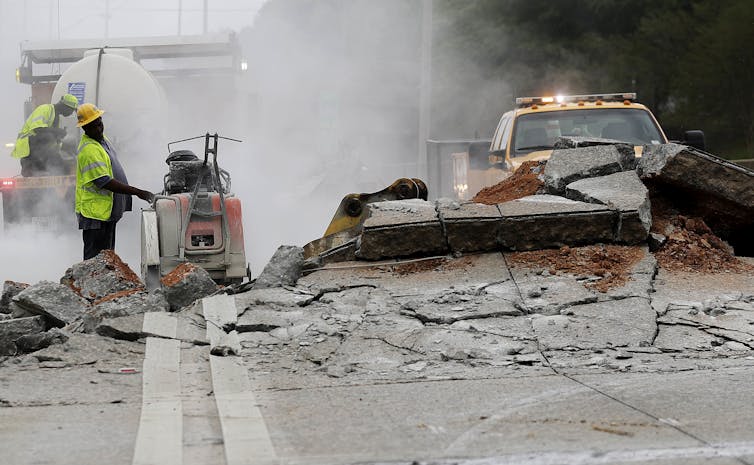
When highways buckle, the damage can happen quickly, putting drivers in danger and tying up traffic. AP Photo/David Goldman

Summer 2024’s record heat is creating problems for transportation infrastructure, from roads to rails.

New York’s Third Avenue Bridge, which swings open for ship traffic on the Harlem River, was stuck for hours after its metal expanded in the heat and it couldn’t close. Roads have buckled on hot days in several states, including Washington and Wisconsin. Amtrak warned passengers to prepare for heat-related problems hours before a daylong outage between New York and New Jersey; the risks to power lines and rails during high temperatures are a growing source of delays for the train system.

It doesn’t help that the worsening heat is hitting a U.S. infrastructure system that’s already in trouble.

The American Society of Civil Engineers gave U.S. infrastructure an overall grade of C- in its latest national Infrastructure Report Card, released in 2021. While there has been some improvement – about 7.5% of U.S. bridges were in poor condition, compared with over 12% a decade earlier – many bridges are aging, making them difficult to maintain. Forty percent of the road system was considered in poor or mediocre condition, and maintenance costs have substantially increased.

Firefighters try to cool down New York City’s Third Avenue Bridge after its metal expanded in the heat and the bridge couldn’t close. Even relatively young bridges – this one was partially rebuilt in 2004 – can struggle in high heat.

The rate at which a bridge or road deteriorates depends not only on the materials and construction methods used but also on the climate during the structure’s life span. Extreme heat, in particular, significantly affects transportation infrastructure. As climate change progresses, the frequency and intensity of heat waves are expected to increase, exacerbating these issues.

I lead the Smart Infrastructure and Testing Laboratory at the University of Texas at Arlington, where my team works on ways to better monitor the structural health of infrastructure. Here’s why infrastructure struggles in the heat – and how engineers are innovating to help extend its life.

Buckling highways pose a hazard for drivers

When a road is built, it is cut into segments to create space for the pavement to expand during high heat or to contract in the cold. Without that space, the pavement can buckle when the road material heats up. Buckling of concrete pavement has become a serious problem in several states.

Pavement becomes vulnerable to buckling for a number of reasons. The roadway’s design, the materials it is made out of, the climate when it was built and the weather during its lifetime can affect its life span, as can damage to the road and improper repairs.

Extreme temperatures and heavy precipitation can cause significant damage to roadways and jeopardize the structural integrity of rail systems. Additionally, sea-level rise is accelerating coastal erosion that can undermine roads and rail lines. The deterioration of pavement leads to traffic delays and damaged vehicles. And, most critically, it can cause traffic accidents.

Roads have been buckling across Wisconsin this summer.

Hot rails can expand and also buckle

Rail expansion is another significant concern, especially with continuous welded rails like the main lines that trains use.

When temperatures rise, rails expand due to the heat. This expansion can create high pressure and tension within the rail material. Combined with the forces exerted by moving trains, this pressure can cause the tracks to buckle to the side and become misaligned. It is sometimes referred to as a “sun kink.”

Buckling rails are a serious safety hazard that can cause derailments. That’s one of the reasons Amtrak slows its speed in extreme heat, often leading to schedule delays. Washington, D.C.’s Metro cuts its trains speed to a maximum of 35 mph once rails reach a temperature of 135 degrees Fahrenheit (57 degrees Celsius).

High heat caused thermal expansion of the rails, buckling this section of railway. U.S. Department of Transportation

Predicting these thermal stresses can be challenging. Rail temperature measurements alone are not enough, because there are many unknown factors related to the track’s structure and how it moves. This makes it difficult to accurately forecast how much the rails will expand or contract.

Engineers can reduce rail expansion risk by using heat-resistant materials, such as hypereutectoid rail steel and martensite rail steel, adjusting track design and ensuring timely repairs.

To prevent roadways from buckling, engineers also have protective measures, such as using single-cut sawed joints filled with sealant to provide flexibility while keeping water out. They can also implement cold weather concreting practices that avoid pouring concrete during low temperatures or on cold bases, and they can use stronger and more durable concrete. Performing timely repairs when pavement cracks and becomes damaged can also help avoid buckling.

Keeping infrastructure healthy

Infrastructure health is similar to human health: If doctors detect problems such as tumors or cancer only in the later stages, it is often too late. Like human bodies, infrastructure needs to be maintained from the beginning to reduce costs and increase the potential for effective rehabilitation.

One area my department works on is nondestructive evaluation methods for monitoring infrastructure without causing damage or requiring long road closures.

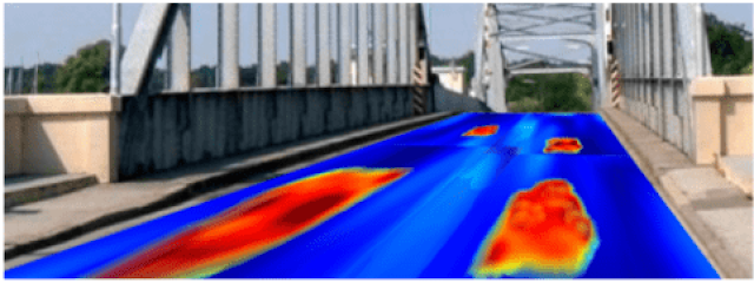
We use mobile scanning systems that are almost like portable MRI machines to look for weakness or defects in bridges, roads and runways. We are also developing advanced sensors that use mechanical and magnetic field phenomena to assess the condition of infrastructure, and we are using artificial intelligence to spot problems in the materials.
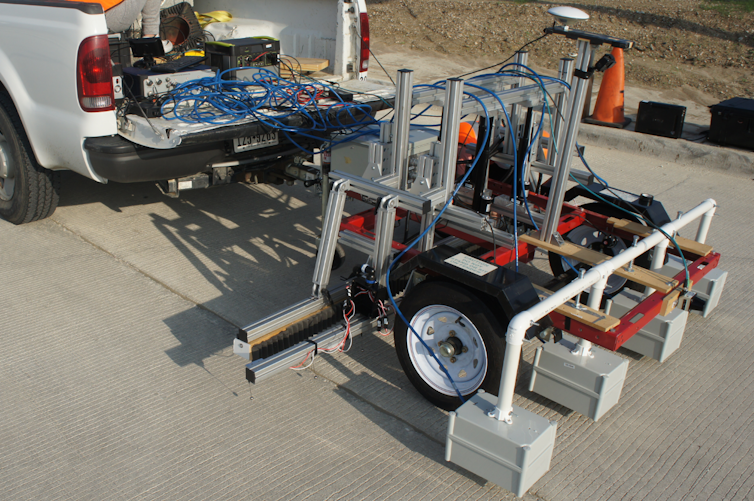
A truck with a row of four scanning devices spaced out behind. Each is about the size of a cinder block.
Devices attached to a vehicle can quickly scan a roadway for weaknesses and defects. They act like mobile MRI machines. Suyun Paul Ham/University of Texas, Arlington, CC BY-ND
What a scan looks like, with sections in red showing defects in the road lanes.
A scan of a bridge roadway shows areas with weaknesses. Smart Infrastructure and Testing Laboratory/University of Texas, Arlington

Infrastructure will face increasing challenges as the climate changes and roads, bridges and other infrastructure age. The large number of buckling roadways and other problems this summer highlight the urgent need for resilient infrastructure to stand up to the future.The Conversation

Suyun Paul Ham, Associate Professor of Civil Engineering, University of Texas at Arlington

This article is republished from The Conversation under a Creative Commons license. Read the original article.

  1. Lakeport City Council to host swearing-in of new police chief
  2. Supervisors to honor Rasmussen, discuss upcoming lake science symposium
  3. East Region Town Hall meets Aug. 7
  • 590
  • 591
  • 592
  • 593
  • 594
  • 595
  • 596
  • 597
  • 598
  • 599
How to resolve AdBlock issue?
Refresh this page