How to resolve AdBlock issue?
Refresh this page
How to resolve AdBlock issue?
Refresh this page
Lake County News,California
  • Home
    • Registration Form
  • News
    • Education
    • Veterans
    • Community
      • Obituaries
      • Letters
      • Commentary
    • Police Logs
    • Business
    • Recreation
    • Health
    • Religion
    • Legals
    • Arts & Life
    • Regional
  • Calendar
  • Contact us
    • FAQs
    • Phones, E-Mail
    • Subscribe
  • Advertise Here
  • Login
How to resolve AdBlock issue?
Refresh this page

News

New Lake County general plan update survey opens; additional outreach planned

Details
Written by: Elizabeth Larson
Published: 14 August 2024


LAKE COUNTY, Calif. — This week county residents are being invited to participate in a new survey and a webinar on the new Lake County general plan.

The Lake County 2050 process began earlier this year. It will update the county general plan and the area plans for each community.

A new community survey has been opened, and will be available through Sept. 2. The general plan team said input will help shape the future of Lake County.

The survey is here.

Survey participants will be asked to select their local area plan, or LAP, to access their community’s survey.

The local area plan areas are Cobb Mountain, Kelseyville, Lakeport, Lower Lake, Middletown, Rivieras, Shoreline Communities (Clearlake Oaks and Lucerne) and Upper Lake – Nice.

“Each survey seeks input on potential changes to land use designations, LAP boundaries, and/or community growth boundaries; potential policies to address key issues identified during the first round of engagement in April; as well as priorities to inform the Housing Action and Implementation Plan (HAIP),” according to the Lake County 2050 website.

There also will be a webinar and open house from 10 to 11 a.m. Thursday, Aug. 15. Find more information here.

Other upcoming opportunities to talk with the project team include all-day booths at the Blackberry COBBler Festival on Aug. 24 and Lake County Fair on Aug. 29.

An Aug. 12 webinar that offers an overview of the project is published on this page.

For more information and to sign up for updates, visit the Lake County 2050 website.

Email Elizabeth Larson at This email address is being protected from spambots. You need JavaScript enabled to view it.. Follow her on Twitter, @ERLarson, or Lake County News, @LakeCoNews.

Wildfires don’t just burn farmland − they can contaminate the water farmers use to irrigate crops and support livestock

Details
Written by: Andrew J. Whelton, Purdue University
Published: 14 August 2024


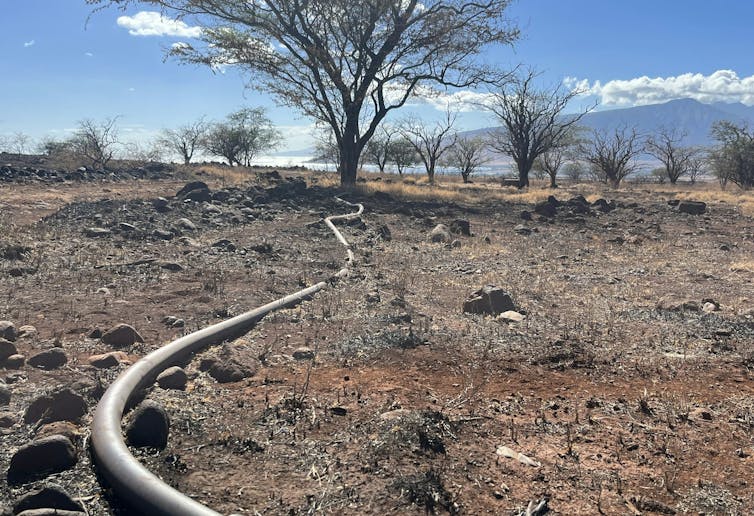
A water pipe that was used to carry water to livestock crosses land burned in the Maui fires in August 2023. Andrew Whelton/Purdue University, CC BY-ND

The wildfires that burned across Maui, Hawaii, in August 2023 became the deadliest conflagration in the United States in more than a century. While the harm to homes and tourism drew the most attention, agriculture was also heavily affected across the island, and the harm did not stop once the flames were out.

In some cases, fires smoldered underground for weeks. Water systems were destroyed, and some were contaminated in ways scientists are only beginning to understand.
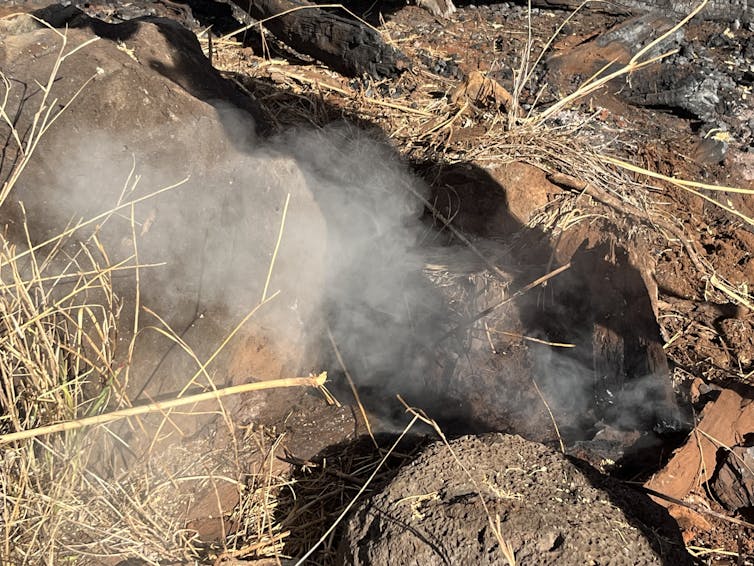
smoke comes from a burned area underground.
Two weeks after the Maui fires began, they were still smoldering below ground. Andrew Whelton/Purdue University, CC BY-ND

As an environmental engineer, I work with communities affected by wildfires and other disasters. I also led a team of university and public works professionals to assist in Maui’s response to the fires.

In a new study based on that effort, my team worked with the Hawaii Department of Agriculture to assess damaged water systems, including water pipes, wells and pumps that are essential for livestock and crops. It was the first study of its kind to examine wildfire damage to agriculture water systems.

The results show the types of damage that can occur when a fire burns through property, and they offer a warning to agricultural regions elsewhere. With the U.S. averaging over 60,000 wildfires and 7.2 million acres burned each year, it is clear that wildfires have become a whole-of-society problem.

Contaminated water infrastructure poses risks

Wildfires often knock out power, which can disable water pumps that farmers and ranchers rely on. They can also damage pipes in ways that can release toxic chemicals and have long-lasting effects.

Recent municipal water system studies by my team and others have shown that water sources and even the pipes and tanks can become unsafe to use. Studies in fire-swept areas have found levels of volatile organic compounds, or VOCs, such as benzene, a carcinogen, above hazardous waste limits. Exposure to this water can cause immediate harm to people.

When water pumps stop working or components are destroyed, municipal water systems lose pressure. When that happens, VOCs can enter from heated or burning plastics, structures and vegetation.
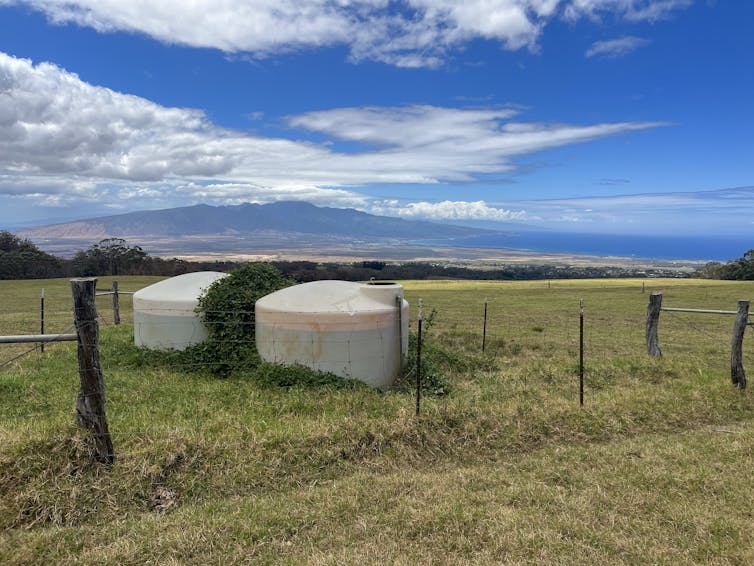
Two water tanks in a field.
Even when tanks are untouched by fire, the pipes serving them can be contaminated if they heat up. Andrew Whelton/Purdue University, CC BY-ND

An insidious challenge is that VOCs penetrate plastic water lines, gaskets and tanks like water going into a sponge. Even after bad water is flushed out, chemicals can leach from the plastic and make the water unsafe for weeks to months. Damaged components have to be replaced.

In the wake of the Maui fires, however, there was no immediate guidance on how farmers and ranchers should inspect and test their water systems.

Learning from Maui’s experience

Farms and ranches had many plastic water system components. On one ranch, fire destroyed more than nine miles of plastic water pipe. Much of the pipe ran above ground alongside fencing, which also burned.

Plastic irrigation systems were destroyed. Numerous other components melted, were leaking or lacked water. The loss of power sometimes prevented water pumps from keeping the pipes full of water.
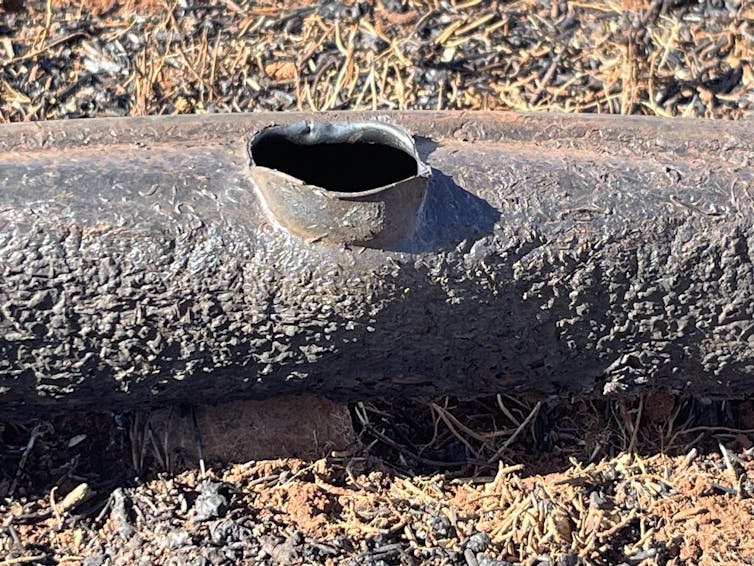
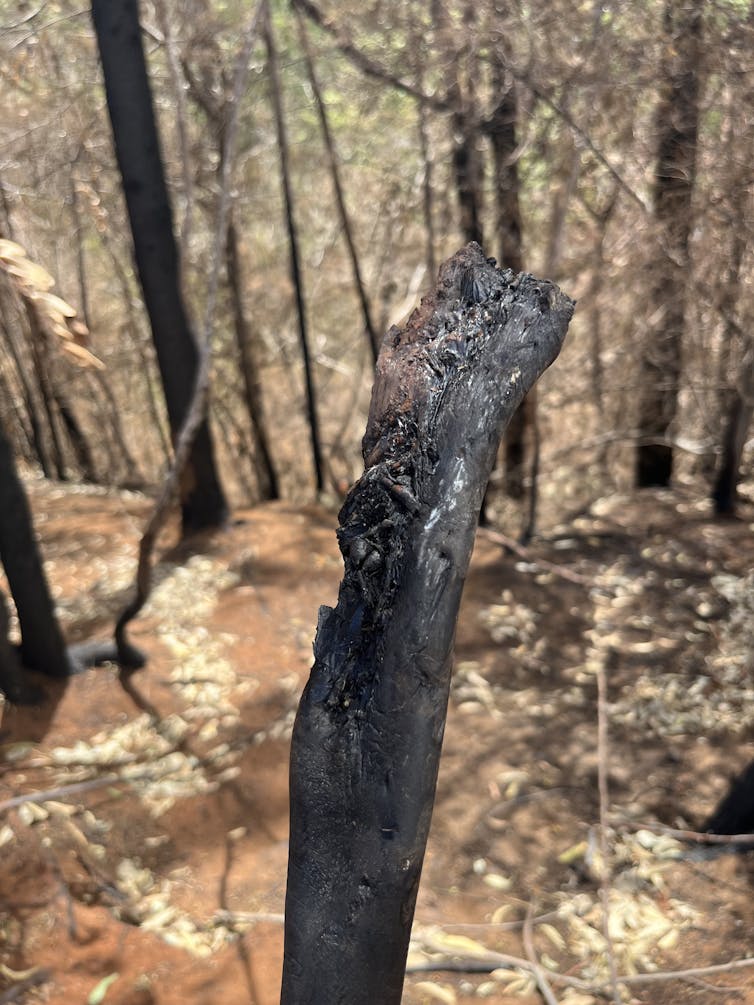
A melted pipe with a hole in it lays on the ground.
Some plastic water lines burst due to the temperature and water pressure during the fire. Andrew Whelton/Purdue University, CC BY-ND
A melted pipe in a wooded area.
More than 9 miles of plastic polyethylene water lines were destroyed by the fire. Andrew Whelton/Purdue University, CC BY-ND

While wells can become contaminated and well casings can burn, the wells themselves were not contaminated. This was mostly because the wells were set back from combustible materials and because firefighters and property staff helped to protect them.

Debris and particles from smoke, however, did enter animal troughs, buckets and waterers. These items had to be drained and cleaned for the safety of the animals. Water systems were repeatedly flushed with clean water after the fire, and VOC testing of the water supplies did not find lingering contamination.

Lots of questions still to answer

There are still many unanswered questions. Since there was no VOC testing procedure for agricultural water systems before the fires, there is no data to show the frequency and severity of this kind of contamination.

Not all municipal water systems that suffer fires become contaminated. Contamination is related to differences in the sites, systems and the fires themselves.
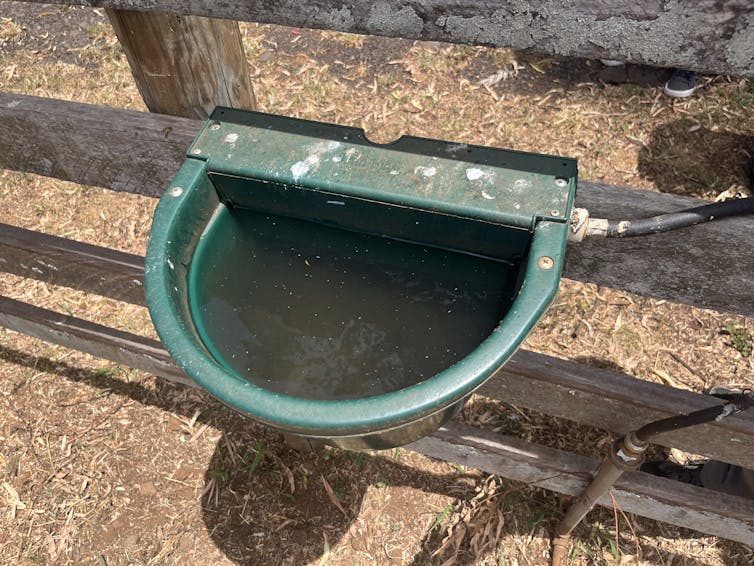
A plastic bowl attached to a fence with a water line coming into it.
Animal watering systems are often supplied by plastic pipes. Andrew Whelton/Purdue University, CC BY-ND

There is also no data on the degree to which this wildfire-contaminated water would harm animals and crops. Would animals avoid the water and become dehydrated? Can crops become contaminated? Will exposure affect the meat of livestock? Many of these unanswered questions will require the expertise of veterinary medicine and crop and soil scientists.

What are the solutions?

One thing that was clear is that farmers and ranchers lack adequate guidance to prevent wildfire-caused pollution of their water systems. Some practical lessons learned can help these community members bounce back:

  • Defensible space should be established by keeping equipment 30 feet away from combustible materials. Burying plastic components 3 feet underground helps protect them from fire.

  • Similar to municipal water systems after a fire, damaged agriculture water system components should be isolated. Pipes and tanks should be rapidly refilled and extensively flushed with water to help remove potential contamination.

  • Water delivery devices, including troughs, buckets and tire waterers, should be drained and cleaned. When contamination is a concern, chemical water testing should be conducted. In some cases, components will have to be replaced.
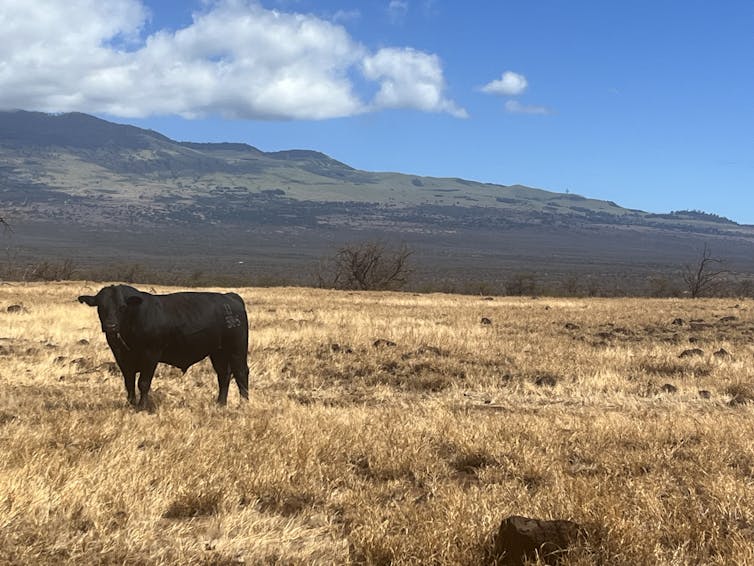
A cow in a field with burn landscape behind it.
Pipes and wells to get water to cattle can also be at risk in wildfires. Andrew Whelton/Purdue University, CC BY-ND

A 2024 survey of California farmers shows that the top three resources “relied on and wished for during wildfire” were generators, water pumps and water storage tanks. These items would help prevent water system pressure loss and contamination.

Who can help?

Wildfire risk to farms and ranches can be reduced. State and federal agriculture departments and insurance companies can provide financial assistance. Technical assistance is available from universities.

Lessening the impact of wildfires and expediting recovery can help farms and ranches do yeoman’s work to support health and the economy.The Conversation

Andrew J. Whelton, Professor of Civil, Environmental and Ecological Engineering, Purdue University

This article is republished from The Conversation under a Creative Commons license. Read the original article.

Firefighters work to contain Reservoir fire

Details
Written by: Elizabeth Larson
Published: 13 August 2024
LAKE COUNTY, Calif. — Firefighters are making progress on the effort to fully contain a wildland fire that began burning east of Clearlake Oaks on Monday afternoon.

The Reservoir fire is located along Indian Valley Reservoir Road and Walker Ridge Road, southeast of Indian Valley Reservoir in eastern Lake County.

Cal Fire said the fire began just after 2 p.m. Monday, and was burning on both sides of Indian Valley Reservoir Road.

By Monday night, Cal Fire said forward progress of the fire had been stopped, with crews to remain at the scene into the night to put out hot spots.

Cal Fire’s Monday night report put the fire at 68 acres with 10% containment. There were no reports of structures damaged or injuries.

Resources assigned include 150 personnel, 19 engines, three dozers, two water tenders and four crews.

Cal Fire said the Reservoir fire’s cause is under investigation.

Email Elizabeth Larson at This email address is being protected from spambots. You need JavaScript enabled to view it.. Follow her on Twitter, @ERLarson, or Lake County News, @LakeCoNews.

Clearlake City Council to discuss water consolidation, tribal consultation, updated property sale resolution

Details
Written by: Elizabeth Larson
Published: 13 August 2024
CLEARLAKE, Calif. — The Clearlake City Council will discuss water consolidation, tribal consolidation and a resolution to change the company name in a property sale when it meets this week.

The council will meet at 6 p.m. Thursday, Aug. 15, in the council chambers at Clearlake City Hall, 14050 Olympic Drive.

The agenda can be found here.

The meeting will be broadcast live on the city's YouTube channel or the Lake County PEGTV YouTube Channel.

Community members also can participate via Zoom. The webinar ID is 860 0557 5706, the pass code is 064173. One tap mobile is available at +16694449171,,86005575706#, or join by phone at 669-444-9171 or 253-205-0468.

At the beginning of the meeting, the council will meet one of August’s adoptable dogs, and there will be presentations by the Lake County Economic Development Corp. of the Lake County Comprehensive Economic Development Strategy and by the Lower Lake High School Future Farmers of America.

Under council business, staff will present a case study of the water district consolidation in the Ukiah Valley and seek direction from the council.

The council also will discuss and consider adopting city guidelines for tribal consultation on projects.

In other business, there will be consideration of a name change related to the purchase and sale agreement for property at 2890 Old Highway 53 to Danco Homes LLC.

City Manager Alan Flora’s report to the council explains that in 2021, the city council — acting as the successor agency to the City Redevelopment Agency — approved the sale of 29 acres of land to Danco Homes LLC for the purposes of developing a 22 lot subdivision.

The Clearlake Planning Commission approved the subdivision in December, which was a condition of escrow, Flora said.

Flora said that, during the escrow closing process, “Danco expressed an interest in creating a different LLC to take possession of the property.”

That different LLC is Danco Homes 2, which like Danco Homes is also under the control of Danco Communities.

Acting as the successor agency, the council is asked to approve the sale to Danco Homes 2, with the term of the purchase and sale agreement to be extended through Dec. 31, 2024.

On the meeting's consent agenda — items that are considered routine in nature and usually adopted on a single vote — are warrants; minutes; authorization of an on-call contract with California Engineering Co. in the amount of $82,669.10 for the Clean California Project; award of the contract with California Engineering in the amount of $134,075.21 for engineering design services for the Rumsey/Turner Road Rehabilitation Project; adoption of Resolution 2024-35, the first amendment to the fiscal year 2024-25 Budget (Resolution 2024-30), adjusting revenues and appropriations; continuation of director of emergency services/city manager proclamation declaring a local emergency for winter storms; and acceptance for filing the 2024 local agency biennial notice regarding amendments to the conflict of interest code.

Following the open portion of the meeting, the council will go into closed session to discuss the existing litigation against Highlands Mutual Water Co.

Email Elizabeth Larson at This email address is being protected from spambots. You need JavaScript enabled to view it.. Follow her on Twitter, @ERLarson, or Lake County News, @LakeCoNews.
  1. Dementia risk factors identified in new global report are all preventable – addressing them could reduce dementia rates by 45%
  2. CHP welcomes seasoned leaders to executive team
  3. Supervisors to consider appeal of cannabis grow next to Highland Springs, Scott Dam decommissioning study
  • 582
  • 583
  • 584
  • 585
  • 586
  • 587
  • 588
  • 589
  • 590
  • 591
How to resolve AdBlock issue?
Refresh this page