How to resolve AdBlock issue?
Refresh this page
How to resolve AdBlock issue?
Refresh this page
Lake County News,California
  • Home
    • Registration Form
  • News
    • Education
    • Veterans
    • Community
      • Obituaries
      • Letters
      • Commentary
    • Police Logs
    • Business
    • Recreation
    • Health
    • Religion
    • Legals
    • Arts & Life
    • Regional
  • Calendar
  • Contact us
    • FAQs
    • Phones, E-Mail
    • Subscribe
  • Advertise Here
  • Login
How to resolve AdBlock issue?
Refresh this page

News

Lakeport City Council to hear economic report, consider purchasing radar trailer

Details
Written by: Elizabeth Larson
Published: 19 August 2024
LAKEPORT, Calif. – The Lakeport City Council this week will hear presentations on efforts to improve the business climate and health of Lake County and discuss the purchase by police of a billboard and radar trailer.

The council will meet Tuesday, Aug. 20, at 6 p.m. in the council chambers at Lakeport City Hall, 225 Park St.

The agenda can be found here.

If you cannot attend in person, and would like to speak on an agenda item, you can access the Zoom meeting remotely at this link or join by phone by calling toll-free 669-900-9128 or 346-248-7799.

The webinar ID is 973 6820 1787, access code is 477973; the audio pin will be shown after joining the webinar. Those phoning in without using the web link will be in “listen mode” only and will not be able to participate or comment.

Comments can be submitted by email to This email address is being protected from spambots. You need JavaScript enabled to view it.. To give the city clerk adequate time to print out comments for consideration at the meeting, please submit written comments before 3:30 p.m. on Tuesday, Aug. 20.

On Tuesday, the Lake County Economic Development Corp. will give a presentation to the council on the 2024-2029 Comprehensive Economic Development Strategy, or CEDS.

The draft report can be found here. Public comments are due by Aug. 21.

The council also will hear from Sutter Lakeside Hospital regarding its efforts to establish a Lake County Hospital Business Improvement District to improve overall health outcomes in the county.

Under council business, Police Chief Dale Stoebe will ask the council to approve the purchase of a FAST-VSM 5-foot by 3-foot variable message board/radarr from TAPCO Inc. in the amount of $25,789.93.

Stoebe’s report to the council explains that the equipment will be paid for by a grant from the California Highway Patrol from its Cannabis Tax Fund Program which is meant “to conduct enforcement and training to reduce and mitigate the impacts of impaired driving in our community.”

Stoebe said the message board/radar trailer will be used during grant operations for educational purposes and messaging. “The board will also have speed radar capabilities that will be used for traffic calming purposes as well as to gather statistics on speed in the City of Lakeport. The message board may also be utilized by other departments as the need arises and/or for community events.”

On the consent agenda — items considered noncontroversial and usually accepted as a slate on one vote — are ordinances; minutes of the City Council’s regular meeting on Aug. 6; approval of application G2024-016, with staff recommendations, for the Eisenhut Celebration of Life; approval of application 2024-031, with staff recommendations, for the 2024 Dia de los Muertos event; authorization of the cancellation of the regular meetings of Oct. 1 and Nov. 5 to participate in the 2024 National Night Out Event and the 2024 Municipal Election Night, respectively.

The council will hold a closed session for labor negotiations with the Lakeport Employees Association.

Email Elizabeth Larson at This email address is being protected from spambots. You need JavaScript enabled to view it.. Follow her on Twitter, @ERLarson, or Lake County News, @LakeCoNews.

Supervisors to discuss housing plan for Probation clients, economic development strategy

Details
Written by: Elizabeth Larson
Published: 19 August 2024
LAKE COUNTY, Calif. — The Board of Supervisors this week will receive a presentation and consider a budget adjustment for housing for Lake County Probation clients and also discuss a new economic development strategy document.

The‌ ‌board will meet beginning ‌at‌ ‌9‌ ‌a.m. Tuesday, Aug. 20, in the board chambers on the first floor of the Lake County Courthouse, 255 N. Forbes St., Lakeport.

The‌ ‌meeting‌ ‌can‌ ‌be‌ ‌watched‌ ‌live‌ ‌on‌ ‌Channel‌ ‌8, ‌online‌ ‌at‌ ‌https://countyoflake.legistar.com/Calendar.aspx‌‌ and‌ ‌on‌ ‌the‌ ‌county’s‌ ‌Facebook‌ ‌page. ‌Accompanying‌ ‌board‌ ‌documents, ‌the‌ ‌agenda‌ ‌and‌ ‌archived‌ ‌board‌ ‌meeting‌ ‌videos‌ ‌also‌ ‌are‌ ‌available‌ ‌at‌ ‌that‌ ‌link. ‌ ‌

To‌ ‌participate‌ ‌in‌ ‌real-time, ‌join‌ ‌the‌ ‌Zoom‌ ‌meeting‌ ‌by‌ ‌clicking‌ ‌this‌ ‌link‌. ‌ ‌

The‌ ‌meeting‌ ‌ID‌ ‌is‌ 865 3354 4962, ‌pass code 726865.‌ ‌The meeting also can be accessed via one tap mobile at +16694449171,,86533544962#,,,,*726865#. The meeting can also be accessed via phone at 669 900 6833.

In an untimed item, the board will hear a presentation from Lake County Probation regarding a housing plan for “justice-involved individuals” as part of an agreement with Rural Communities Housing Development Corp., the same organization currently building an affordable housing complex for Behavioral Health clients on Collier Avenue in Nice.

Probation is requesting a budget adjustment of $5 million for the project, explaining that the funds come from the Community Corrections Partnership. The report indicates that locations of potential sites for a housing development are still to be determined.

In other business, at 9:45 a.m. the Lake County Economic Development Corp. will present the draft Lake County Comprehensive Economic Development Strategy.

The full agenda follows.

CONSENT AGENDA

5.1: Adopt proclamation designating Aug. 31, 2024, as International Overdose Awareness Day.

5.2: Approve Amendment One for coffee kiosk services by and between the county of Lake and MIX Lakeport LLC in the amount of $275 per month from Sept. 1, 2024, through Aug. 31, 2025, and authorize the chair to sign.

5.3: Approve school and special district resolution requesting the Lake County Board of Supervisors' approval of consolidation of each district's election with the Nov. 5, 2024, general election.

5.4: Approve resolution setting rate of pay for election officers for the Nov. 5, 2024, general election.

5.5: Approve first amendment to contract between county of Lake and Redwood Toxicology Laboratory Inc. for drug testing, in the amount of $35,000 from July 1, 2023, to June 30, 2024, and $30,000 per fiscal year from July 1, 2024, to June 30, 2026, and authorize the chair to sign.

5.6: Sitting as the Lake County Sanitation District Board of Directors, a) waive the competitive bidding process, pursuant to Lake County Code Section 2-38.4 Cooperative Purchases; b) authorize Special Districts Administrator/assistant purchasing agent to issue a purchase order not to exceed $160,350 to Sonsray Machinery for the purchase of a backhoe.

TIMED ITEMS

6.2, 9:03 a.m.: Pet of the Week.

6.3, 9:04 a.m.: Presentation of proclamation designating Aug. 31, 2024, as International Overdose Awareness Day.

6.4, 9:10 a.m.: Consideration of rescission of tax deed hearing for property located at 9802 Venturi Dr, Cobb, CA (APN 052-092-020-000).

6.5, 9:45 a.m.: Consideration of presentation on the draft Lake County Comprehensive Economic Development Strategy.

6.6, 10:15 a.m.: Public hearing, consideration of closing of the CDBG Economic Development – Microenterprise.

6.7, 10:20 a.m.: Public hearing, consideration of closing of the CDBG Lake County Business Assistance Revolving Loan Fund.

UNTIMED ITEMS

7.2: Sitting as the Lake County Air Quality Management District Board of Directors, reappoint Mark Burkdoll and Lowell Grant to the LCAQMD Hearing Board pursuant to Health and Safety Code.

7.3: Consideration of resolution authorizing the Behavioral Health director to sign the standard agreement and contractor certification clause between the county of Lake and the California Department of Health Care Services for provision of substance use disorder treatment organized delivery system services under the 1115 Medicaid Demonstration Waiver.

7.4: Consideration of (a) resolution amending the motion by the board approving the recommended budget for FY 2024-25 by adjusting revenues and appropriations in Budget Unit 2302 - Probation; (b) presentation of housing project plan with Rural Communities Housing Development Corp., or RCHDC; and (c) approval of memorandum of understanding and funding agreement between county of Lake and Rural Communities Housing Development Corp. and authorize the chair to sign.

7.5: Consideration of Amendment No. 2 to the agreement between county of Lake and Crestwood Behavioral Health for adult residential support services and specialty mental health services in the amount of $3,720,000 for fiscal years 2022-23, 2023-24 and 2024-25.

7.6: Consideration of agreement between county of Lake and Environmental Alternatives Inc. dba EA Family Services for specialty mental health services in the amount of $250,000 for Fiscal Year 2024-25.

CLOSED SESSION

8.1 Closed session item, conference with legal counsel: Existing litigation pursuant to Government Code section 54956.9(d)(1): Savok-Jimenez v. County of Lake.

Email Elizabeth Larson at This email address is being protected from spambots. You need JavaScript enabled to view it.. Follow her on Twitter, @ERLarson, or Lake County News, @LakeCoNews.

West Nile virus season returns − a medical epidemiologist explains how it’s transmitted and how you can avoid it

Details
Written by: Daniel Pastula, University of Colorado Anschutz Medical Campus
Published: 19 August 2024


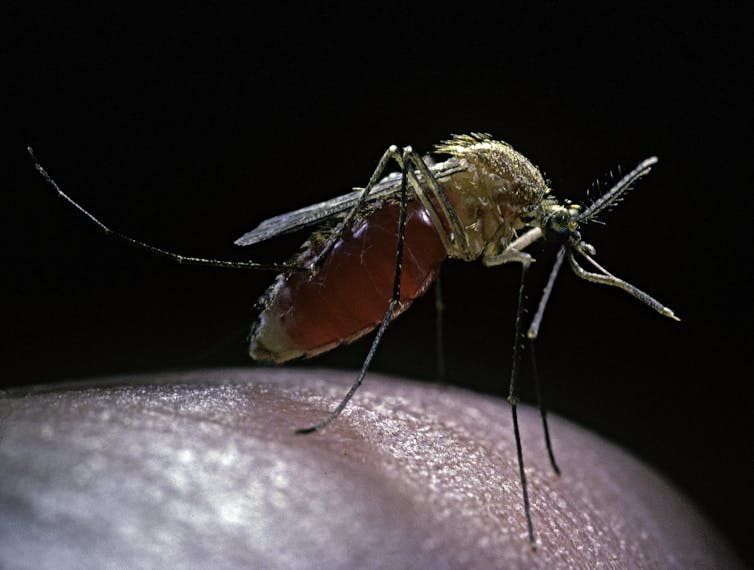
Mosquitoes are responsible for transmitting West Nile virus to humans. Paul Starosta/Stone via Getty Images

West Nile virus is the most common mosquito-borne illness in the continental U.S., with an average of 2,464 reported cases per year.

Every August, West Nile season ramps up, primarily in parts of the Southern and Western United States.

The Conversation U.S. asked neurologist and medical epidemiologist Daniel Pastula to explain what researchers know about West Nile and how to protect yourself from contracting the disease.

What is West Nile virus?

West Nile is a virus that was first identified in the West Nile region of Uganda in 1937 and subsequently caused outbreaks throughout Africa, the Mediterranean region and parts of Europe.

It arrived in the New York City area in late 1999, probably from an infected bird or mosquito. The virus has since spread and become endemic throughout the continental United States and other parts of North America.

How is West Nile virus transmitted?

West Nile virus is primarily transmitted to humans by mosquito bites. West Nile virus exists in a transmission cycle between various birds such as crows, robins and blue jays and primarily several Culex species of mosquitoes, which are very common across the U.S.

The mosquitoes become infected by feeding on infected birds with high levels of virus. Then the infected mosquitoes pass the virus to other birds by feeding on them.

Sometimes, an infected mosquito will bite a human, horse or other mammal, transmitting the virus to them. However, these animals do not develop a high enough viral level in their blood to keep the cycle going. In other words, they are “dead-end” hosts.
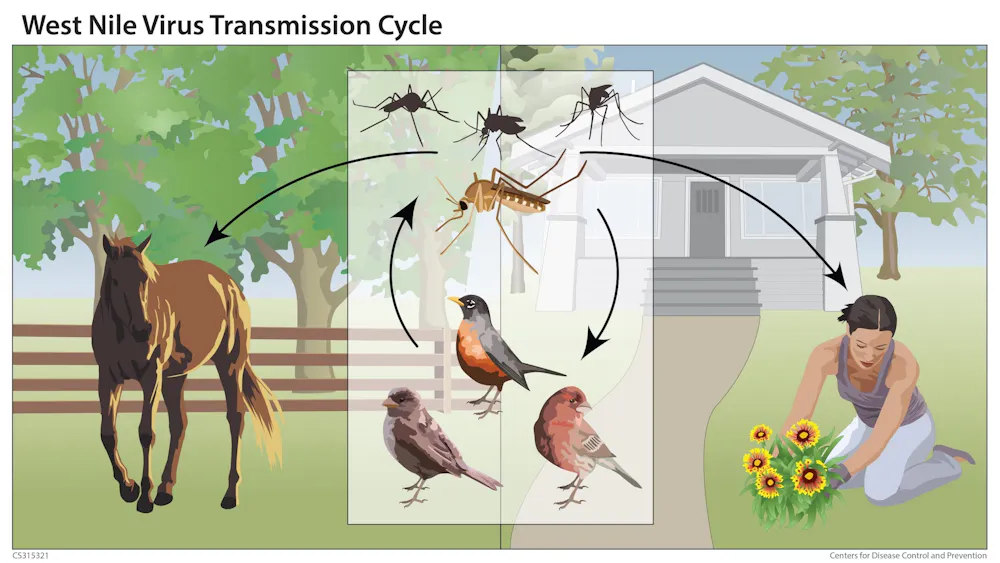
Arrows indicate how birds and mosquitoes pass West Nile back and forth, and infected mosquitoes may also bite humans or horses.
Mosquitoes and birds infect each other with West Nile virus, and occasionally infected mosquitoes transmit the disease to humans or horses. Centers for Disease Control, CC BY

Rarely, West Nile virus is transmitted in other ways, including through accidental laboratory exposures, blood transfusion or organ transplantation. Very rarely, it may be transmitted during pregnancy, delivery or through breastfeeding.

When and where does it show up, and is it seasonal?

In the continental U.S., most human cases of West Nile virus disease occur from July through September, or until the first hard freeze or snowfall. This is commonly called “West Nile season.” By this time of year, mosquitoes have had enough time to emerge, feed on infected birds and become infected themselves.

In more southern areas such as Arizona, Florida and Texas, mosquito transmission may occur earlier than July and later than September. For example, mosquitoes infected with West Nile virus were reported in Texas as early as May 2024.

While human cases of West Nile virus disease have occurred in the 48 continental states, the District of Columbia and Puerto Rico, the majority of cases over the past two decades have been in the Great Plains, Southern and Southwestern United States. This likely has to do with the types of mosquitoes, birds, bird migration patterns, temperature, rainfall and irrigation practices in these areas.

How dangerous is West Nile?

Approximately 80% of people infected with West Nile virus have no symptoms or very mild ones.

But about 20% of the time, people infected with West Nile virus can develop a sudden flu-like illness with symptoms such as high fever, headache, muscle and joint aches, stomach problems such as nausea, vomiting and diarrhea, rash and fatigue within two to 14 days after being bitten by a West Nile-carrying mosquito.

Most people recover from this “West Nile fever,” but the fatigue may last weeks to months.

In about 1% of cases, however, the virus can invade the covering of the brain, causing what is called meningitis; the brain itself, resulting in encephalitis; or the spinal cord, causing a polio-like syndrome. When the virus invades the nervous system like this, it is called “West Nile neuroinvasive disease.”

Approximately 10% of West Nile neuroinvasive disease cases are fatal, particularly in cases where the brain and spinal cord are directly infected. Many survivors are left with permanent neurological disability such as weakness, movement disorders or cognitive issues to varying degrees.

The risk of West Nile neuroinvasive disease is higher in people who are 60 or older, those who are immunocompromised and those with conditions such as cancer, diabetes or kidney failure.

The symptoms of West Nile virus are usually mild, but in some cases it causes serious illness.

Are there any treatments or vaccines?

While a variety of treatments have been investigated, there are currently no proven antiviral treatments for West Nile virus disease. Treatment remains largely focused on addressing symptoms.

Some patients may require over-the-counter medications for fever and headaches, fluids for dehydration, anti-nausea medications for nausea or vomiting, and rest. Some may require hospitalization and treatment for severe dehydration, organ dysfunction, seizures or brain swelling.

There are currently no West Nile vaccines licensed for use in humans, though some vaccine candidates and ideas are being studied.

How can you help prevent it?

Generally speaking, if you prevent mosquito bites, you prevent West Nile virus infection. There are several things you can do to prevent mosquito bites:

First of all, use an Environmental Protection Agency-registered insect repellent on exposed skin when you are outside in an area with mosquitoes. These are safe and effective when used as directed.

You can also wear long-sleeved shirts and pants when feasible. It is much harder – or even impossible, depending on the fabric – for mosquitoes to bite through clothing. You can also treat your clothing with permethrin, an insecticide, which further repels mosquitoes.

When possible, avoid being outside between dusk and dawn. This is when the West Nile-carrying mosquitoes are most active.

It’s also a good idea to get rid of any unneeded standing water in places such as birdbaths or kiddie pools around your property, as mosquitoes like to breed in standing water. When indoors, be sure that any unscreened windows are closed to keep mosquitoes outside. These simple precautions can greatly reduce the risk of getting severely ill.

In addition to these precautions for individuals, robust public health and vector control programs help to monitor and control the spread of West Nile virus by warning area residents of the presence of the virus and reducing infected mosquito populations when necessary.The Conversation

Daniel Pastula, Professor of Neurology, Medicine (Infectious Diseases), and Epidemiology, University of Colorado Anschutz Medical Campus

This article is republished from The Conversation under a Creative Commons license. Read the original article.

Lake County Museum plans ‘STEM Days’ series this fall

Details
Written by: Lake County News reports
Published: 18 August 2024
LAKE COUNTY, Calif. — The Lake County Museum is planning a “STEM Days” series at the Courthouse Museum and Gibson Museum this fall.

The free events will explore how science and history intersect.

Topics will include surface tension, oxidation, oxygen, borax, borax, emulsion and casein plastic.

The schedule for the drop-in STEM Days series, from noon to 2 p.m. on each of the dates — with the exception of a full day at the Dickens Fair — follows.

Courthouse Museum: 255 N. Main St., Lakeport

Saturday, Sept. 7: Surface tension — make giant bubbles and learn how surface tension helps fight fires.

Saturday, Sept. 21: Oxygen — make some elephant toothpaste and learn how oxygen effects items in the Museum Collection.

Saturday, Oct. 5: Borax — make and take home slime and learn about Lake County’s borax mines.

Saturday, Oct. 19: Oxidation — learn how this process affected Lake County pear farmers and what turns fruit brown.

Saturday, Nov. 2: Emulsion — learn more about this process and make your own butter.

Saturday, Nov. 23, Dickens Fair Booth, all day: Casein plastic — decorate an ornament out of this plastic that is made from milk.

Gibson Museum: 21267 Calistoga Road, Middletown

Saturday, Sept. 14: Surface tension — make giant bubbles and learn how surface tension helps fight fires.

Saturday, Sept. 28: Oxygen — make some elephant toothpaste and learn how oxygen effects items in the Museum Collection.

Saturday, Oct. 12: Borax — make and take home slime and learn about Lake County’s borax mines.

Saturday, Oct. 26: Oxidation — learn how this process affected Lake County pear farmers and what turns fruit brown.

Saturday, Nov. 16: Emulsion — learn more about this process and make your own butter.

Friday, Dec. 6: Casein plastic — decorate an ornament out of this plastic that is made from milk.
  1. Offensive names dot the American street map − a new app provides a way to track them
  2. Helping Paws: More puppies and shepherds
  3. Banana apocalypse, part 2 – a genomicist explains the tricky genetics of the fungus devastating bananas worldwide
  • 576
  • 577
  • 578
  • 579
  • 580
  • 581
  • 582
  • 583
  • 584
  • 585
How to resolve AdBlock issue?
Refresh this page