How to resolve AdBlock issue?
Refresh this page
How to resolve AdBlock issue?
Refresh this page
Lake County News,California
  • Home
    • Registration Form
  • News
    • Education
    • Veterans
    • Community
      • Obituaries
      • Letters
      • Commentary
    • Police Logs
    • Business
    • Recreation
    • Health
    • Religion
    • Legals
    • Arts & Life
    • Regional
  • Calendar
  • Contact us
    • FAQs
    • Phones, E-Mail
    • Subscribe
  • Advertise Here
  • Login
How to resolve AdBlock issue?
Refresh this page

News

What links aging and disease? A growing body of research says it’s a faulty metabolism

Details
Written by: Melanie R. McReynolds, Penn State
Published: 24 August 2024


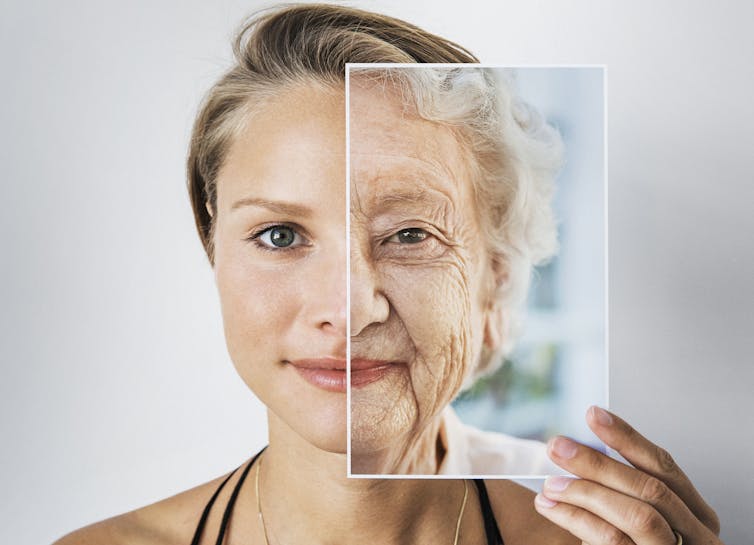
Aging is inevitable, but there are some ways to slow down decline. Dimitri Otis/Stone via Getty Images

Aging is a biological process that no one can avoid. Ideally, growing old should be a time to relax and enjoy the fruits of your labor. Aging also has a darker side, however, often linked to disease.

Every second, your cells perform billions of biochemical reactions that fuel essential functions for life, forming a highly interconnected metabolic network. This network enables cells to grow, proliferate and repair themselves, and its disruption can drive the aging process.

But does aging cause metabolic decline, or does metabolic disruption accelerate aging? Or both?

To address this chicken-or-egg question, you first need to understand how metabolic processes break down during aging and disease. I am a scientist and researcher, and my lab focuses on exploring the complex relationship between metabolism, stress and aging. Ultimately, we hope this work will provide strategies to promote healthier aging and more vibrant lives.

Link between metabolism and aging

Aging is the most significant risk factor for many of society’s most common diseases, including diabetes, cancer, cardiovascular disease and neurodegenerative disorders. A key factor behind the onset of these health issues is the disruption of cellular and metabolic homeostasis, or balance. Disrupting homeostasis destabilizes the body’s internal environment, leading to imbalances that can trigger a cascade of health issues, including metabolic disorders, chronic diseases and impaired cellular functions that contribute to aging and other serious conditions.

Disrupted metabolism is linked to many hallmarks of aging cells, such as telomere shortening, which is damage to the protective ends of chromosomes, and genomic instability, the tendency to form genetic mutations.

Metabolism can be divided into two broad processes: anabolism, or building up molecules, and catabolism, or breaking down molecules.

A dysfunctional metabolism is also linked to poorly functioning mitochondria; cellular senescence, or when cells stop dividing; imbalances in gut microbes; and cells’ reduced ability to detect and respond to different nutrients.

Neurological disorders, such as Alzheimer’s disease, are prime examples of age-related conditions with a strong link between dysregulated metabolism and functional decline. For example, my research team previously discovered that in aging mice, the ability of bone marrow cells to produce, store and use energy is suppressed due to increased activity from a protein that modulates inflammation. This energy-deficient state leads to an increase in inflammation that’s worsened by these aging cells’ reliance on glucose as their main fuel source.

Experimentally inhibiting this protein in the bone marrow cells of aging mice, however, revitalizes the cells’ ability to produce energy, reduces inflammation and improves plasticity of an area of the brain involved in memory. This finding suggests that some cognitive aging could be reversed by reprogramming the glucose metabolism of bone marrow cells to restore immune functions.

Repurposing drugs to treat Alzheimer’s

In our newly published research, my team and I discovered a new connection between disrupted glucose metabolism and neurodegenerative disease. This led us to identify a drug originally designed for cancer that could potentially be used to treat Alzheimer’s.

We focused on an enzyme called IDO1 that plays a critical role in the first step of breaking down amino acid tryptophan. This pathway produces a key compound called kynurenine, which fuels additional energy pathways and inflammatory responses. However, excessive kynurenine can have detrimental effects, including increasing the risk of developing Alzheimer’s.

Illustration of structure of IDO1
IDO1 is a key player in brain cell metabolism. Goultard59/Wikimedia Commons, CC BY-SA

We found that inhibiting IDO1 can recover memory and brain function in a range of preclinical models, including in cell cultures and mice. To understand why, we looked at the metabolism of brain cells. The brain is one of the most glucose-dependent tissues in the body. An inability to properly use glucose to fuel critical brain processes can lead to metabolic and cognitive decline.

High levels of IDO1 reduce glucose metabolism by producing excess kynurenine. So IDO1 inhibitors – originally designed to treat cancers such as melanoma, leukemia and breast cancer – could be repurposed to reduce kynurenine and improve brain function.

Using a range of lab models, including mice and cells from Alzheimer’s patients, we also found that IDO1 inhibitors can restore glucose metabolism in brain cells. Furthermore, we were able to restore glucose metabolism in mice with both amyloid and tau accumulation – abnormal proteins involved in many neurodegenerative disorders – by blocking IDO1. We believe repurposing these inhibitors could be beneficial across various neurodegenerative disorders.

Promoting healthier cognitive aging

The effects of neurological disorders and metabolic decline weigh heavily on individuals, families and the economy.

While many scientists have focused on targeting the downstream effects of these diseases, such as managing symptoms and slowing progression, treating these diseases earlier can improve cognition with aging. Our findings suggest that targeting metabolism has the potential to not only slow neurological decline but also to reverse the progression of neurodegenerative diseases such as Alzheimer’s, Parkinson’s and dementia.

Discovering new insights at the intersection of stress, metabolism and aging can pave the way for healthier aging. More research can improve our understanding of how metabolism affects stress responses and cellular balance throughout life.The Conversation

Melanie R. McReynolds, Assistant Professor of Biochemistry, Penn State

This article is republished from The Conversation under a Creative Commons license. Read the original article.

Clearlake Animal Control: ‘Kyra’ and the dogs

Details
Written by: Elizabeth Larson
Published: 24 August 2024
“Kyra.” Photo courtesy of Clearlake Animal Control.

CLEARLAKE, Calif. — Many dogs are waiting for their new families at Clearlake Animal control this week.

Among the 41 adoptable dogs available this week are several puppies.

This week’s dogs include “Kyra,” a female Labrador retriever mix with a chocolate-colored coat.

The shelter is located at 6820 Old Highway 53. It’s open from 9 a.m. to 6 p.m. Tuesday through Saturday.

For more information, call the shelter at 707-762-6227, email This email address is being protected from spambots. You need JavaScript enabled to view it., visit Clearlake Animal Control on Facebook or on the city’s website.

This week’s adoptable dogs are featured below.

Email Elizabeth Larson at This email address is being protected from spambots. You need JavaScript enabled to view it.. Follow her on Twitter, @ERLarson, or Lake County News, @LakeCoNews.

Science News: Creature the size of a dust grain found hiding in California's Mono Lake

Details
Written by: Robert Sanders
Published: 24 August 2024
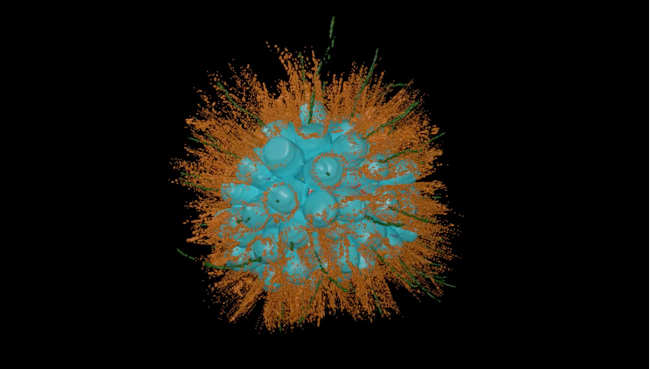
A 3D reconstruction of a spherical colony of 70 choanoflagellates from the newly-named species Barroeca monosierra discovered in Mono Lake. Colonies of these organisms consist of numerous identical cells (cyan), each with flagella (orange) that allow them to propel themselves through the water. This choanoflagellate colony hosts its own microbiome, something never before seen in these organisms. Image credit: Davis Laundon and Pawel Burkhardt, Sars Centre, Norway; Kent McDonald and Nicole King, UC Berkeley.

The choanoflagellate — a member of a group that is the closest living relative of all animals — has its own unique microbiome.

BERKELEY, Calif. — Mono Lake in the Eastern Sierra Nevada is known for its towering tufa formations, abundant brine shrimp and black clouds of alkali flies uniquely adapted to the salty, arsenic- and cyanide-laced water.

University of California, Berkeley, researchers have now found another unusual creature lurking in the lake's briny shallows — one that could tell scientists about the origin of animals more than 650 million years ago.

The organism is a choanoflagellate, a microscopic, single-celled form of life that can divide and develop into multicellular colonies in a way that’s similar to how animal embryos form. It’s not a type of animal, however, but a member of a sister group to all animals. And as animals’ closest living relative, the choanoflagellate is a crucial model for the leap from one-celled to multicellular life.

Surprisingly, it harbors its own microbiome, making it the first choanoflagellate known to establish a stable physical relationship with bacteria, instead of solely eating them. As such, it’s one of the simplest organisms known to have a microbiome.

"Very little is known about choanoflagellates, and there are interesting biological phenomena that we can only gain insight into if we understand their ecology," said Nicole King, a UC Berkeley professor of molecular and cell biology and a Howard Hughes Medical Institute (HHMI) investigator who studies choanoflagellates as a model for what early life was like in ancient oceans.

Typically visible only through a microscope, choanoflagellates are often ignored by aquatic biologists, who instead focus on macroscopic animals, photosynthetic algae or bacteria. But their biology and lifestyle can give insight into creatures that existed in the oceans before animals evolved and that eventually gave rise to animals. This species in particular could shed light on the origin of interactions between animals and bacteria that led to the human microbiome.

"Animals evolved in oceans that were filled with bacteria," King said. "If you think about the tree of life, all organisms that are alive now are related to each other through evolutionary time. So if we study organisms that are alive today, then we can reconstruct what happened in the past."

King and her UC Berkeley colleagues described the organism — which they named Barroeca monosierra, after the lake — in a paper published online Aug. 14 in the journal mBio.

A beautiful colony

Nearly 10 years ago, then-UC Berkeley graduate student Daniel Richter came back from a climbing trip in the Eastern Sierra Nevada with a vial of Mono Lake water he'd casually collected along the way. Under the microscope, it was alive with choanoflagellates. Aside from brine shrimp, alkali flies and various species of nematode, few other forms of life have been reported to live in the inhospitable waters of the lake.

"It was just packed full of these big, beautiful colonies of choanoflagellates," King said. "I mean, they were the biggest ones we'd ever seen."

The colonies of what seemed to be close to 100 identical choanoflagellate cells formed a hollow sphere that twirled and spun as each individual cell kicked its flagella.

"One of the things that's interesting about them is that these colonies have a shape similar to the blastula — a hollow ball of cells that forms early in animal development," King said. "We wanted to learn more about it."

At the time, however, King was occupied with other species of choanos, as she calls them, so the Mono Lake choanos languished in the freezer until some students revived and stained them to look at their unusual, doughnut-shaped chromosomes. Surprisingly, there was also DNA inside the hollow colony where there should have been no cells. After further investigation, graduate student Kayley Hake determined that they were bacteria.

"The bacteria were a huge surprise. That just was fascinating," King said.

Hake also detected connective structures, called extracellular matrix, inside the spherical colony that were secreted by the choanos.

Only then did it occur to Hake and King that these might not be the remains of bacteria the choanos ate, but bacteria living and grazing on stuff secreted by the colony.

"No one had ever described a choanoflagellate with a stable physical interaction with bacteria," she said. "In our prior studies, we found that choanos responded to small bacterial molecules that were floating through the water, or [that] the choanos were eating the bacteria, but there was no case where they were doing anything that could potentially be a symbiosis. Or in this case, a microbiome."

King teamed up with Jill Banfield, a pioneer in metagenomics and a UC Berkeley professor of environmental science, policy and management and of earth and planetary science, to determine which bacterial species were in the water and inside the choanos. Metagenomics involves sequencing all the DNA in an environmental sample to reconstruct the genomes of the organisms living there.

After Banfield's lab identified the microbes in Mono Lake water, Hake created DNA probes to determine which ones were also inside the choanos. The bacterial populations were not identical, King said, so evidently some bacteria survive better than others inside the oxygen-starved lumen of the choanoflagellate colony. Hake determined that they were not there accidentally; they were growing and dividing. Perhaps they were escaping the toxic environment of the lake, King mused, or maybe the choanos were farming the bacteria to eat them.

Much of this is speculation, she admits. Future experiments should uncover how the bacteria interact with the choanoflagellates. Past work in her lab has already shown that bacteria act like an aphrodisiac to stimulate mating in choanoflagellates, and that bacteria can stimulate single-celled choanos to aggregate into colonies.

For her, the Mono Lake choanoflagellate will become another model system in which to study evolution, just like the choanos that live in splash pools on the island of Curaçao in the Caribbean — her main focus at the moment — and the choanos in pools at the North and South Poles. It might be a challenge to get more samples from Mono Lake, however. On a recent visit, only six of 100 samples contained these energetic microorganisms.

"I think there's a great deal more that needs to be done on the microbial life of Mono Lake, because it really underpins everything else about the ecosystem," King said. "I'm excited about B. monosierra as a new model for studying interactions between eukaryotes and bacteria. And I hope it tells us something about evolution. But even if it doesn't, I think it's a fascinating phenomenon."

In addition to King, Banfield, Hake and Richter, UC Berkeley co-authors of the paper include former doctoral student Patrick West, electron microscopist Kent McDonald and postdoctoral fellows Josean Reyes-Rivera and Alain Garcia De Las Bayonas. The work is supported by HHMI and the National Science Foundation.

Robert Sanders writes for the UC Berkeley News Center.

New Marshalls store opens its doors

Details
Written by: Elizabeth Larson
Published: 23 August 2024
The newly opened Marshalls department store in Lakeport, California, on Thursday, Aug. 22, 2024. Photo by Elizabeth Larson/Lake County News.

LAKEPORT, Calif. — The new Lakeport Marshalls store opened its doors to the public on Thursday, welcoming a steady stream of customers throughout the day.

The store is located in one of three retail spaces in the former Kmart store building at 2017 S. Main St.

Tractor Supply is the other tenant of the space, with a third space still available.

A month ago, Marshalls announced the grand opening for the store, in the works since 2022.

The store offers a variety of items, including clothing, shoes, home decor and furniture, and kitchen supplies.

The city of Lakeport announced the store opening on its Facebook page, sharing pictures of customers lined up for when the doors opened.

Customers reported on Facebook that the store was so busy that they had waited in line for checkout for up to two hours.

By Thursday evening, while the parking lot remained full and the store was busy, the lines had grown smaller.

Store hours are Monday through Saturday, 10 a.m. to 9 p.m., and Sunday, 11 a.m. to 7 p.m.

Email Elizabeth Larson at This email address is being protected from spambots. You need JavaScript enabled to view it.. Follow her on Twitter, @ERLarson, or Lake County News, @LakeCoNews.
  1. Scotts Valley tribe’s Vallejo casino plan meets resistance from other tribes, elected officials
  2. Native American activists gather to urge support for bill to grant peace officer status to tribal law enforcement
  3. Gift card scams generate billions for fraudsters and industry as regulators fail to protect consumers − and how one 83-year-old fell into the ‘fear bubble’
  • 571
  • 572
  • 573
  • 574
  • 575
  • 576
  • 577
  • 578
  • 579
  • 580
How to resolve AdBlock issue?
Refresh this page