How to resolve AdBlock issue?
Refresh this page
How to resolve AdBlock issue?
Refresh this page
Lake County News,California
  • Home
    • Registration Form
  • News
    • Education
    • Veterans
    • Community
      • Obituaries
      • Letters
      • Commentary
    • Police Logs
    • Business
    • Recreation
    • Health
    • Religion
    • Legals
    • Arts & Life
    • Regional
  • Calendar
  • Contact us
    • FAQs
    • Phones, E-Mail
    • Subscribe
  • Advertise Here
  • Login
How to resolve AdBlock issue?
Refresh this page

News

Governor signs legislation to limit the use of smartphones during school hours

Details
Written by: Lake County News reports
Published: 24 September 2024
Building on his calls for school districts to restrict the use of smartphones on school campuses, Gov. Gavin Newsom on Monday signed Assembly Bill 3216, the Phone-Free School Act, to require every school district, charter school and county office of education to adopt a policy limiting or prohibiting the use of smartphones by July 1, 2026.

Authored by Assemblymembers Josh Hoover, David Alvarez, Josh Lowenthal and Al Muratsuchi, the bipartisan legislation will support the mental health, academic success and social wellbeing of California’s students.

“We know that excessive smartphone use increases anxiety, depression, and other mental health issues — but we have the power to intervene. This new law will help students focus on academics, social development, and the world in front of them, not their screens, when they’re in school,” Gov. Gavin Newsom.

“Reducing phone use in schools is essential for minimizing digital distractions and making space for stronger and more meaningful in-person connections. AB 3216 isn’t only about classroom instruction, it’s about protecting the mental health and social and emotional well-being of California’s kids,” said First Partner Jennifer Siebel Newsom.

In 2019, Gov. Newsom signed AB 272 (Muratsuchi) into law, which specified that school districts have the authority to regulate the use of smartphones during school hours. This legislation was considered a crucial first step in efforts to minimize distractions and foster a more conducive environment for our students to learn.

In June, the governor announced efforts to restrict the use of smartphones during the school day.

The development of the policies will involve significant stakeholder participation to ensure they are responsive to the unique needs and desires of the local students, parents and educators and must allow students to use their phones in the case of an emergency, or in response to a perceived threat of danger, or as allowed by a teacher, administrator, doctor or the student’s individualized education program.

Why this matters

Excessive smartphone use among youth is linked to increased anxiety, depression, and other mental health issues. A recent Pew Research Center survey found that 72% of high school and 33% of middle school teachers report cell phone distractions as a major problem.

Common Sense Media found that 97% of students use their phones during the school day for a median of 43 minutes. Combined with the U.S. Surgeon General’s warning about the risks of social media, it is urgent to provide reasonable guardrails for smartphone use in schools.

Supporting smartphone free classrooms

Assemblyman Josh Hoover: "I appreciate the leadership of Governor Newsom and our bipartisan coalition of legislators that worked together to make the Phone-Free Schools Act a reality. AB 3216 is a major victory for protecting and improving the mental health and academic outcomes of students across California,” said Assemblyman Josh Hoover. “Research continues to demonstrate the potential harms of smartphone use among children. The growing use of these devices in a child’s everyday life can contribute to lower test scores, anxiety, depression, and even suicide. I am proud our state is taking action to limit the use of smartphones during the school day and protect kids from these harms.”

Assemblymember Al Muratsuchi, chair of the Assembly Education Committee: “I thank the Governor for signing AB 3216. California school districts should place limits on student smartphone use on campus during school hours, unless approved by teachers or administrators for academic, emergency, or other purposes. In 2019, I authored Assembly Bill 272, to encourage school districts to consider such limits. Since then, growing research shows excessive smartphone use not only interfering with learning but also contributing to teenage anxiety, depression, and cyberbullying. All school districts should develop their own appropriate policy to balance appropriate student use of smartphones at school with curbing the impact of excessive smartphone use on a student’s educational, social, and emotional well-being.”

State Superintendent of Public Instruction Tony Thurmond: “AB 3216 represents an important opportunity to address the mental health of our students by restricting smartphones in schools. I have directly engaged with our students, parents, and educators as we have explored the need for this important change. I will continue to make sure that we hear the voices of our young people, their families, and our hardworking school staff as we implement smartphone restrictions across the state.”

Statewide efforts to support youth mental health

California is transforming its entire mental health and substance use disorder system, with a special focus on youth.

For the youngest Californians, Gov. Newsom developed the Master Plan for Kids’ Mental Health to provide every Californian aged 0-25 with increased access to mental health and substance use disorder supports.

The Master Plan also includes the Children and Youth Behavioral Health Initiative, a historic investment by the state of California that takes a “whole child” approach to address the factors that contribute to the mental health and well-being of our children and youth.

TRUTH in Labeling Act would heighten the warning for shoppers looking to cut sugar, salt and saturated fat intake

Details
Written by: Kimberly Baker, Clemson University
Published: 24 September 2024


Only about 40% of consumers frequently read the nutrition label. demaerre/iStock via Getty Images Plus

A bill known as the TRUTH in Labeling Act has been sitting before Congress since late 2023. If passed, it would require U.S. food manufacturers to add a second nutrition label to the front of product packages, in addition to the ones currently found on the back or side panel. It would also require the label to highlight any potentially unhealthy ingredients in the product, such as the amount of sugar, sodium and saturated fat it contains.

The proposed legislation would provide consumers with a standardized, easy-to-read and quick way to decide whether a product is a healthy choice. Should the bill, which is still in committee, become law, the front-of-package label would be regulated by the U.S. Food and Drug Administration.

The current nutrition facts label, typically featuring more detailed nutritional information and found on a product’s side panel, would remain unchanged.

Consuming more vitamin D, calcium, iron and potassium can reduce the risks of osteoporosis, anemia and hypertension.

As a food safety extension specialist who works with farmers, entrepreneurs, manufacturers and the government to help bring healthy food to shoppers, I believe that consistent front-of-package labeling would greatly benefit consumers by offering a straightforward way to compare multiple products, helping them make more informed choices.

Even if passed, it will take time for the FDA to interpret the law and standardize the design and format. And it might be years before all food manufacturers are required to use the new label. In the meantime, more than 175 million Americans are overweight or obese, and with each passing day, that number grows.

Why the change?

The newly proposed legislation is the latest effort by lawmakers to educate the public about smart food choices. Congress began requiring standardized nutrition labels on food packages through the Nutrition Labeling and Education Act of 1990.
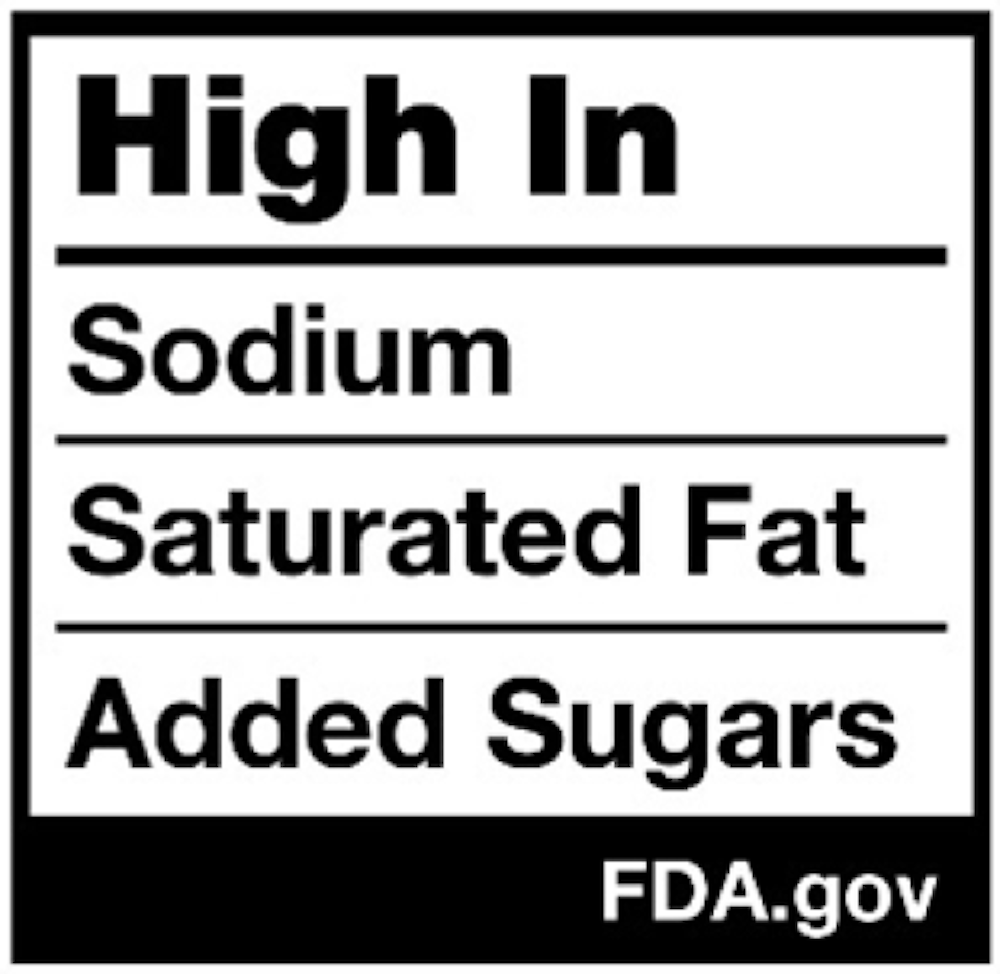
A black-and-white nutritional graphic that shows the sodium, saturated fat and added sugar content of a product is
The FDA has not made a final decision on the front-of-product label’s content and look, but it is testing a variety of designs, including this one. FDA

But in the 34 years since that first label appeared, the obesity rate has more than tripled; 40% of Americans are now obese. Another 31% are overweight, and diet-related chronic illnesses, including heart disease, stroke, cancer, hypertension and Type 2 diabetes are rampant. About 60% of U.S. adults – 130 million people – have at least one of these chronic illnesses.

All of these diseases are associated with consuming too much sugar, sodium or saturated fat – three key ingredients the front label will focus on.

Labels help shoppers make better choices

There’s another reason to require a second, easy-to-notice, easy-to-comprehend label. Only about 40% of Americans frequently read the existing nutrition facts label; some shoppers say they don’t understand it. A simpler label with a more direct message might help those consumers. In fact, some studies suggest front-of-package labels do assist shoppers in making smart choices.

Research shows that those who frequently read the current label tend to have healthier diets than those who don’t. For example, frequent readers are almost four times more likely than rare readers to meet the recommended daily fiber intake.

Now the bad news: Even the frequent readers met their fiber goals only about 13% of the time. That isn’t good, but it’s an improvement over the rare readers, who meet their goals a paltry 3.7% of the time.

For the record, the daily recommendation for fiber is 25 grams for women and 38 for men under 50; its slightly less for those over 50.

The existing nutrition facts label.
This is what the current nutrition facts label looks like. Note the serving size for this particular product is two-thirds of a cup. So if you have a 1-cup serving, you need to add 50% more to all the values listed below the serving size, including calories, fat and saturated fat. FDA

Some foods still exempt

It’s possible you’ve already seen some front-of-package nutritional labels on food products. But these labels are not regulated by the government. Known as the “facts-up-front” labeling system, it’s strictly voluntary and a choice of the individual food manufacturer, with label designs and formats provided by the Consumer Brands Association, a trade association representing the food industry. Only a small number of manufacturers have chosen to put these labels on their products.

That said, more research is needed to know how long-term behavior may change due to front-of-package labeling. But at least one food safety advocacy organization, while supportive of front-of-package labels, says the trade association’s facts-up-front system is less than optimal.

Even if the TRUTH in Labeling Act passes as currently written, some foods could remain exempt from the nutritional label requirement, including fish, coffee, tea and spices.

There is one caveat, however. If any product makes a nutritional or health claim on its package – including those that are normally exempt – then a nutrition facts label must be on it.The Conversation

Kimberly Baker, Food Systems and Safety Program Team Director, Clemson University

This article is republished from The Conversation under a Creative Commons license. Read the original article.

With rising rates of obesity in the U.S. and increasing attention being paid to the health harms of processed foods, it’s clear that far more could be done to help consumers make healthy food choices.

State unemployment up slightly in August; Lake County rate remains flat

Details
Written by: Elizabeth Larson
Published: 23 September 2024
LAKE COUNTY, Calif. — California’s jobless rate edged up slightly in August, while Lake County’s rate remained flat.

The California Employment Development Department, or EDD, said the state’s employers added 6,800 nonfarm payroll jobs in August while the unemployment rate moved to 5.3% after three consecutive months at 5.2%.

In Lake County, unemployment in August remained at 6.1% for the second month in a row, according to the report. Lake County’s jobless rate was 5.7% in June and 5.6% in August 2023.

On the national level, the Bureau of Labor Statistics reported that the unemployment dropped slightly in August, coming in at 4.2%, compared to 4.3% in July. The August 2023 nationwide jobless rate was 3.8%.

Total nonfarm jobs in California’s 11 major industries amounted to 18,091,000 in August, which the EDD said was a net gain of 6,800 from July. This followed an upward revised (+8,800) month-over gain of 29,900 jobs in July.

The report said total nonfarm jobs increased by 287,100 (a 1.6% increase) from August 2023 to August 2024 — which averages out to 23,925 jobs gained per month in that one-year period — compared to the U.S. annual gain of 2,358,000 jobs (a 1.5% increase).

On the state and local levels, the EDD reported the following numbers.

Employed: The number of Californians employed in August was 18,362,700, an increase of 8,700 persons from July’s total of 18,354,000, but down 27,800 from the employment total in August 2023. In Lake County, 27,160 were employed in August, compared to 26,690 in July and 27,420 in August 2023.

Unemployed: The number of unemployed Californians was 1,020,000 in August, an increase of 11,300 over the month and up 83,900 in comparison to August 2023. In Lake County, those who were unemployed totaled 1,760, compared to 1,730 in July and 1,620 the previous August.

Total farm jobs: The number of jobs in California’s agriculture industry decreased from July by 1,100 to a total of 416,500 jobs in August. The agriculture industry had 8,900 more farm jobs in August 2024 than it did in August of last year. In Lake County, farm jobs in August 2024 totaled 980, the same number as the previous August; farm jobs totaled 1,000 in July.

Five of California's 11 industry sectors gained jobs in August: Those industries were leisure and hospitality (+6,800), private education and health services (+4,900), other services (+3,900), professional and business services (+3,800); and trade, transportation and utilities (+2,900). For comparison, in Lake County, job sectors with growth were government, 350 jobs; durable goods, 10 jobs; and private education and health services, 10 jobs.

Sectors with job losses: On the state level, the information sector (-5,100) posted the largest job loss, partly due to losses in the motion picture and video production industry as it restructures after last year’s strike. Other sectors showing losses statewide were manufacturing (-4,700); construction (-3,300), government (-2,200) and mining and logging (-100). For Lake County, job losses came in total farm (-20); trade, transportation and utilities (-20); total private (-10); private service providing (-10); and professional and business services (-10).

In August, Lake County’s jobless rate ranked it No. 37 out of California’s 58 counties.

Lake’s neighboring county jobless rates and ranks were: Colusa, 9.2%, No. 56; Glenn, 6.8%, No. 45; Mendocino, 5.2%, No. 19; Napa, 4.3%, No. 6; Sonoma, 4.5%, No. 8; and Yolo, 5.4%, No. 25.

In related data that the EDD said figures into the state’s unemployment rate, there were 382,640 people certifying for Unemployment Insurance benefits during the August 2024 sample week. That compares to 400,294 people in July and 394,757 people in August 2023.

Concurrently, 39,023 initial claims were processed in the August 2024 sample week, which was a month-over decrease of 2,903 claims from July, but a year-over increase of 1,049 claims from August 2023, the EDD reported.

Email Elizabeth Larson at This email address is being protected from spambots. You need JavaScript enabled to view it.. Follow her on Twitter, @ERLarson, or Lake County News, @LakeCoNews.

Supervisors to consider final 2024-25 fiscal year budget, Spring Valley rate increase

Details
Written by: Elizabeth Larson
Published: 23 September 2024
LAKE COUNTY, Calif. — The Board of Supervisors is set to consider approval of the final budget for the 2024-25 fiscal year and consider a water rate hike for Spring Valley residents.

The‌ ‌board will meet beginning ‌at‌ ‌9‌ ‌a.m. Tuesday, Sept. 24, in the board chambers on the first floor of the Lake County Courthouse, 255 N. Forbes St., Lakeport.

The‌ ‌meeting‌ ‌can‌ ‌be‌ ‌watched‌ ‌live‌ ‌on‌ ‌Channel‌ ‌8, ‌online‌ ‌at‌ ‌https://countyoflake.legistar.com/Calendar.aspx‌‌ and‌ ‌on‌ ‌the‌ ‌county’s‌ ‌Facebook‌ ‌page. ‌Accompanying‌ ‌board‌ ‌documents, ‌the‌ ‌agenda‌ ‌and‌ ‌archived‌ ‌board‌ ‌meeting‌ ‌videos‌ ‌also‌ ‌are‌ ‌available‌ ‌at‌ ‌that‌ ‌link. ‌ ‌

To‌ ‌participate‌ ‌in‌ ‌real-time, ‌join‌ ‌the‌ ‌Zoom‌ ‌meeting‌ ‌by‌ ‌clicking‌ ‌this‌ ‌link‌. ‌ ‌

The‌ ‌meeting‌ ‌ID‌ ‌is‌ 865 3354 4962, ‌pass code 726865.‌ ‌The meeting also can be accessed via one tap mobile at +16694449171,,86533544962#,,,,*726865#. The meeting can also be accessed via phone at 669 900 6833.

At 10:30 a.m., the supervisors will hold a public hearing to consider the final recommended budget for fiscal year 2024-25 for the county of Lake and special districts governed by the Board of Supervisors.

The county’s proposed appropriations for the coming fiscal year total $407,134,710.

Also on Tuesday, at 2 p.m., the board will hold another public hearing — continued from Sept. 10 — to consider raising water rates for County Service Area No. 2 – Spring Valley Lakes.

The full agenda follows.

CONSENT AGENDA

5.1: Adopt proclamation declaring September 27, 2024, as Native American Day in Lake County.

5.2: Approve continuation of emergency proclamation declaring a shelter crisis in the county of Lake.

5.3: Approve continuation of proclamation of the existence of a local emergency due to pervasive tree mortality.

5.4: Approve continuation of proclamation declaring a Clear Lake hitch emergency.

5.5: Approve continuation of local emergency by the Lake County Sheriff/OES director for the 2024 late January, early February winter storms.

5.6: Approve continuation of proclamation of a local health emergency by the Lake County Health officer for the Boyles Fire.

5.7: Approve continuation of a local emergency by the Lake County Sheriff/OES director for the 2024 Boyles Fire.

5.8: Approve Amendment No. 2 to the agreement between the county of Lake and Crisis Support Services of Alameda County for after-hours crisis support services in the amount of $90,201.12 for fiscal year 2023-24, and authorize the chair to sign.

5.9: Approve the Community Development Department to apply for the U.S. Department of Housing and Urban Development PRO Housing Grant, and authorize the deputy community development administrator to sign.

5.10: Approve advanced salary step appointment of Cheryl Bennett to registered environmental health specialist senior, and approve advanced salary step appointment for environmental health specialist senior for Marc Benchimol.

5.11: Approve the agreement with the city of Clearlake for a road maintenance program for 40th Avenue, Davis Avenue, and Moss Avenue for fiscal year 2024-25 through fiscal year 2028-29, and authorize the chair to sign.

TIMED ITEMS

6.2, 9:03 a.m.: Pet of the Week.

6.3, 9:05 a.m.: Presentation of proclamation declaring Sept. 27, 2024, as Native American Day in Lake County.

6.4, 9:10 a.m.: Presentation of the Semi-Annual Employee Service Awards for the County of Lake to recognize years of service.

6.5, 9:45 a.m.: Hearing, consideration of excess proceeds claim TDLS 160 – APN 039-465-540.

6.6, 10:15 a.m.: Consideration of an update on approved projects and proposed modifications to American Rescue Plan Act (ARPA)/State and Local Fiscal Recovery Funds (SLFRF) funding allocations.

6.7, 10:30 a.m.: Public hearing, consideration of the final recommended budget for fiscal year 2024-25 for the county of Lake and special districts governed by the Board of Supervisors.

6.8, 1 p.m.: Consideration of a resolution amending the master fee schedule for services rendered by county departments.

6.9, 1:45 p.m.: Sitting as the Board of Directors, Lake County Watershed Protection District, consideration of reallocation of District 4 discretionary cannabis tax funds for advance planning in the Scotts Valley and Highland Springs watersheds.

6.10, 2 p.m.: Continued from Sept. 10, public hearing, consideration of an ordinance amending Section 1.1.A of Ordinance No. 2945 increasing the charges and fees for County Service Area No. 2 – Spring Valley Lakes.

6.11, 2:30 p.m.: Consideration of memorandum of understanding between the county of Lake and Lake County Community Foundation to streamline the process of receiving and administering disaster funds.

UNTIMED ITEMS

7.2: Consideration of the agreement between the County of Lake and the Lake County Office of Education for the Safe Schools Healthy Students Program for school-based specialty mental health services in the amount of $500,000 for fiscal year 2024-25.

7.3: Consideration of the agreement between the County of Lake and Drug Medi-Cal service provider Redwood Community Services Inc. for ASAM Level 1.0, 2.1, and 3.1 services in the amount of $1,000,000 for fiscal years 2024-2027.

7.4: Sitting as the Board of Directors, Lake County Watershed Protection District, Consideration of three joint funding agreements with the U.S. Geological Survey, U.S. Department of the Interior for stream monitoring in Kelsey, Clover and Scotts Creek, for a total amount not to exceed $138,170, and authorize the water resources director to sign.

7.5: Consideration of Change Order No. 3, Middletown Multi-Use Path Improvements Project, State Project No. ATPL-5914(102), Bid No. 22-05, in the amount of $247,258.81 for a total contract amount of $1,408,959.29, and authorize the chair to sign.

CLOSED SESSION

8.1: Closed session, conference with labor negotiator: (a) County negotiators: S. Carter, P. Samac, and D. Gearhart; (b) Employee organizations: LCEA and management employees.

8.2: Closed session, sitting as the Lake County Air Quality Management District Board of Directors – Conference with labor negotiator: (a) County negotiators: S. Carter, P. Samac, and D. Gearhart; (b) Employee organizations: LCEA and management employees.

Email Elizabeth Larson at This email address is being protected from spambots. You need JavaScript enabled to view it.. Follow her on Twitter, @ERLarson, or Lake County News, @LakeCoNews.
  1. What the jet stream and climate change had to do with the hottest summer on record − remember all those heat domes?
  2. California’s Youth Empowerment Commission launches to tackle key issues facing young people across the state
  3. Creating healthy habitat for hitch
  • 537
  • 538
  • 539
  • 540
  • 541
  • 542
  • 543
  • 544
  • 545
  • 546
How to resolve AdBlock issue?
Refresh this page