How to resolve AdBlock issue?
Refresh this page
How to resolve AdBlock issue?
Refresh this page
Lake County News,California
  • Home
    • Registration Form
  • News
    • Education
    • Veterans
    • Community
      • Obituaries
      • Letters
      • Commentary
    • Police Logs
    • Business
    • Recreation
    • Health
    • Religion
    • Legals
    • Arts & Life
    • Regional
  • Calendar
  • Contact us
    • FAQs
    • Phones, E-Mail
    • Subscribe
  • Advertise Here
  • Login
How to resolve AdBlock issue?
Refresh this page

News

Mendocino National Forest prepares for prescribed burning

Details
Written by: LAKE COUNTY NEWS REPORTS
Published: 13 November 2024
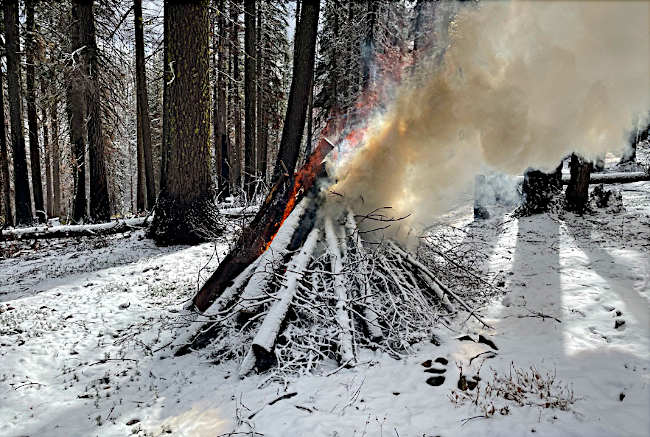
A burn pile at Snow Basin in the Mendocino National Forest. Photo courtesy of the Mendocino National Forest.

MENDOCINO NATIONAL FOREST, Calif. — Forest personnel are planning several prescribed fire operations at campgrounds and administrative sites this fall, winter and spring, as weather patterns shift to cooler temperatures and wetter conditions.

Grindstone District fire personnel are starting with pile burning in higher elevations and will be moving down to lower elevations as weather conditions permit.

On Wednesday, Nov. 13 and throughout the week, firefighters will be attempting to burn piles at Board Camp and Snow Basin. Pile burning may also occur at Letts Lake, Log Springs, Ides Cove, Paskenta station and Red Bluff Recreation Area.

In the coming weeks, Upper Lake and Covelo Ranger District fire personnel are planning to burn piles located along roadsides in various locations, including Bartlett Mountain, M1 Road, Pine Mountain, Horse Mountain and Packsaddle.

Pile burning may also occur at administrative sites, including Hammerhorn, Little Doe and Deer Valley campgrounds. Potential understory burning operations include Howard Mill, Westshore, Pillsbury Homesites and possible North Shore project.

Fire managers conduct prescribed fire activities during the safest possible “burn windows” in the coming months. Numerous factors including wind, humidity, air quality, fuel moisture and availability of fire crew personnel must be met before crews are authorized to move forward with burning.

Residents and visitors are asked to avoid areas where prescribed fires are being conducted. Some smoke may be visible. Fires are carefully monitored. Local fire and government authorities are notified prior to burn days and kept informed throughout operations.

Prescribed fire is a tool that uses fire under planned ignitions to mimic the natural role of fire in the environment. Without fire, hazardous fuels can build up and carry wildfire from the forest floor to tree canopies, creating extreme fire behavior that poses risk to firefighters, surrounding communities and natural resources.

All burning activities are weather dependent. Maps, locations, photos and updates on planned prescribed burn activities will be available on Inciweb.

Highlands Senior Center renovations complete; operations return to Bowers Avenue

Details
Written by: LAKE COUNTY NEWS REPORTS
Published: 13 November 2024
CLEARLAKE, Calif. — The Highlands Senior Center reported that it has moved back to its original location at 3245 Bowers Ave.

“The renovations are complete, and our doors are now open to welcome the community,” the center management said in a Tuesday announcement.

While the renovations were underway, the center was operating out of the Clearlake Masonic Lodge at 7100 S. Center Drive.

The center’s newly updated kitchen and storage allows the nonprofit to serve more seniors by enabling them to receive donations and purchase larger quantities for a cheaper price.

There is more to come. Next year the center will have landscaping installed — they are out to bid on the project at this time — and fresh paint on the inside.

Center management said the facility offers a warm, inviting atmosphere for all community members to enjoy, and they’re working to ensure it meets the evolving needs of seniors and supports the mission to provide a safe and enriching environment for all.

The Highlands Senior Center is dedicated to serving the senior population through various activities, programs and services that foster well-being, community connection and support.

“We look forward to welcoming both familiar faces and new friends into our revitalized space. Come visit us,” center management said.

The center invites everyone to stop by, take a tour and see the improvements firsthand. Staff and volunteers said they are eager to show community members around and share details about their programs and upcoming events.

For more information, contact the Highlands Senior Center at telephone 707-994-3051, email This email address is being protected from spambots. You need JavaScript enabled to view it. or visit the center’s website.

CHP secures federal grant to help boost child passenger safety campaign

Details
Written by: LAKE COUNTY NEWS REPORTS
Published: 13 November 2024
In a continued effort to protect California’s youngest passengers, the California Highway Patrol prioritizes child passenger safety through the “California Restraint Safety Education and Training,” or CARSEAT, campaign.

This $850,000 federal grant is dedicated to reducing injuries and fatalities among child passengers across the state.

The yearlong CARSEAT campaign will provide essential resources and education on child passenger safety.

Through community-focused events, the CHP will conduct presentations, training sessions, and child safety seat inspections, ensuring families know how to correctly install and use car seats.

The program also offers free child safety seats to families in need, helping make safety accessible to all.

“Ensuring the safety of our youngest passengers is a responsibility we take seriously. Child safety seats are essential in preventing injuries and saving lives,” said CHP Commissioner Sean Duryee. “This grant allows us to expand our efforts and educate parents and caregivers, empowering them to make safe choices for their children every time they’re on the road.”

California law requires that children under age 8 be secured in an appropriate child safety seat in the rear of a vehicle. Children under age 2 must ride in a rear-facing car seat unless they weigh 40 pounds or more or are at least 40 inches tall.

Contact your local CHP Area office for more information on child passenger safety, car seat installation, and seat belt regulations.

The Clear Lake Area office in Kelseyville can be reached at 707-279-0103.

This program is funded by a grant from the California Office of Traffic Safety through the National Highway Traffic Safety Administration.

Countries spend huge sums on fossil fuel subsidies – why they’re so hard to eliminate

Details
Written by: Bruce Huber, University of Notre Dame
Published: 13 November 2024


Fossil fuel subsidies keep gas prices low in many countries. AP Photo/Nam Y. Huh

Although many countries have explicitly promised to reduce fossil fuel subsidies to combat climate change, this has proven difficult to accomplish. As a result, fossil fuels remain relatively inexpensive, and their use and greenhouse gas emissions continue to grow.

I work in environmental and energy law and have studied the fossil fuel sector for years. Here’s how fossil fuel subsidies work and why they’re so stubborn.

What is a subsidy?

A subsidy is a financial benefit given by a government to an entity or industry. Some subsidies are relatively obvious, such as publicly funded crop insurance or research grants to help pharmaceutical companies develop new drugs.

Others are less visible. A tariff on an imported product, for example, can subsidize domestic manufacturers of that product. More controversially, some would argue that when a government fails to make an industry pay for damage it causes, such as air or water pollution, that also amounts to a subsidy.

Subsidies, especially in this broader sense, are widespread throughout the global economy. Many industries receive benefits through public policies that are denied to other industries in the same jurisdiction, such as tax breaks, relaxed regulations or trade supports.

Farmers arrive on their tractors at the Brandenburg Gate to protest against planned cuts to state subsidies that bring down their fuel costs on December 18, 2023 in Berlin.
German farmers drove tractors to Berlin in 2023 to protest a government plan to cut fuel subsidies. Michele Tantussi/Getty Images

Governments employ subsidies for political and practical reasons. Politically, subsidies are useful for striking bargains or shoring up political support. In democracies, they can mollify constituencies otherwise unwilling to agree to a policy change. The 2022 Inflation Reduction Act, for example, squeaked through Congress by subsidizing both renewable energy and oil and gas production.

Practically, subsidies can boost a promising young industry such as electric vehicles, attract business to a community or help a mature sector survive an economic downturn, as the auto industry bailout did in 2008. Of course, policies can outlive their original purpose; some of today’s petroleum subsidies can be traced to the Great Depression.

How are fossil fuels subsidized?

Fossil fuel subsidies take many forms around the world. For example:

  • In Saudi Arabia, fuel prices are set by the government rather than the market; price ceilings subsidize the price citizens pay for gasoline. The cost to state-owned oil producers there is offset by oil exports, which dwarf domestic consumption.

  • Indonesia also caps energy prices, then compensates state-owned energy companies for the losses they bear.

  • In the United States, oil companies can take a tax deduction for a large portion of their drilling costs.

Other subsidies are less direct, such as when governments underprice permits to mine or drill for fossil fuels or fail to collect all the taxes owed by fossil fuel producers.

Estimates of the total value of global fossil fuel subsidies vary considerably depending on whether analysts use a broad or narrow definition. The Organization for Economic Cooperation and Development, or OECD, calculated the annual total to be about US$1.5 trillion in 2022. Tche International Monetary Fund reported a number over four times higher, about $7 trillion.

Why do estimates of fossil fuel subsidies vary so dramatically?

Analysts disagree about whether subsidy tabulations should include environmental damage from the extraction and use of fossil fuels that is not incorporated into the fuel’s price. The IMF treats the costs of global warming, local air pollution and even traffic congestion and road damage as implicit subsidies because fossil fuel companies don’t pay to remedy these problems. The OECD omits these implicit benefits.

But whichever definition is applied, the combined effect of national policies on fossil fuel prices paid by consumers is dramatic.

Oil, for example, is traded on a global market, but the price per gallon of petrol varies enormously around the world, from about 10 cents in Iran, Libya and Venezuela – where it is heavily subsidized – to over $7 in Hong Kong, the Netherlands and much of Scandinavia, where fuel taxes counteract subsidies.

What is the world doing about fossil fuel subsidies?

Global leaders have acknowledged that subsidies for fossil fuels undermine efforts to address climate change because they make fossil fuels cheaper than they would be otherwise.

In 2009, the heads of the G20, which includes many of the world’s largest economies, issued a statement resolving to “rationalize and phase out over the medium term inefficient fossil fuel subsidies that encourage wasteful consumption.” Later that same year, the governments of the Asia-Pacific Economic Cooperation forum, or APEC, made an identical pledge.

In 2010, 10 other countries, including the Netherlands and New Zealand, formed the Friends of Fossil Fuel Subsidy Reform group to “build political consensus on the importance of fossil fuel subsidy reform.”

Yet these commitments have scarcely moved the needle. A major study of 157 countries between 2003 and 2015 found that governments “collectively made little or no progress” toward reducing subsidies. In fact, the OECD found that total global subsidies nearly doubled in both 2021 and 2022.

So why are fossil fuel subsidies hard to eliminate?

There are various reasons fossil fuel subsidies are hard to eliminate. Many subsidies directly affect the costs that fossil fuel producers face, so reducing subsidies tends to increase prices for consumers. Because fossil fuels touch nearly every economic sector, rising fuel costs elevate prices for countless goods and services.

Subsidy reform tends to be broadly felt and pervasively inflationary. And unless carefully designed, subsidy reductions can be regressive, forcing low-income residents to spend a larger percentage of their income on energy.

So, even in countries where there is widespread support for robust climate policies, reducing subsidies can be deeply unpopular and may even cause public unrest.

Police and soldiers intervene with tear gas to disperse the crowd gathered at Eagle Square, protesting against the rising cost of living following the removal of gasoline subsidies in Abuja,
Police and soldiers use tear gas to disperse a crowd protesting the rising cost of living following the removal of gasoline subsidies in Abuja, Nigeria, on Aug. 1, 2024. Emmanuel Osodi/Anadolu via Getty Images

The 2021-22 spike in fossil fuel subsidies is illustrative. After Russia’s invasion of Ukraine, energy prices surged throughout Europe. Governments were quick to provide aid for their citizens, resulting in their largest fossil fuel subsidies ever. Forced to choose between climate goals and affordable energy, Europe overwhelmingly chose the latter.

Of course, economists note that increasing the price of fossil fuels can lower demand, reducing emissions that are driving climate change and harming the environment and human health. Seen in that light, price spikes present an opportunity for reform. As the IMF noted, when prices recede after a surge, it “provide[s] an opportune time to lock in pricing of carbon and local air pollution emissions without necessarily raising energy prices above recently experienced levels.”The Conversation

Bruce Huber, Professor of Law, University of Notre Dame

This article is republished from The Conversation under a Creative Commons license. Read the original article.

Fossil fuels are the leading driver of climate change, yet they are still heavily subsidized by governments around the world.
  1. Lake Family Resource Center’s plan for new child care location to go to Lakeport Planning Commission
  2. Military veterans are disproportionately affected by suicide, but targeted prevention can help reverse the tide
  3. Middletown Area Town Hall to meet Nov. 14
  • 483
  • 484
  • 485
  • 486
  • 487
  • 488
  • 489
  • 490
  • 491
  • 492
How to resolve AdBlock issue?
Refresh this page