 How to resolve AdBlock issue?
News
- Details
- Written by: Jet Propulsion Laboratory
When NASA’s Europa Clipper reaches its destination in 2030, the spacecraft will prepare to aim an array of powerful science instruments toward Jupiter’s moon Europa during 49 flybys, looking for signs that the ocean beneath the moon’s icy crust could sustain life.
While the spacecraft, which launched Oct. 14, carries the most advanced science hardware NASA has ever sent to the outer solar system, teams are already developing the next generation of robotic concepts that could potentially plunge into the watery depths of Europa and other ocean worlds, taking the science even further.
This is where an ocean-exploration mission concept called SWIM comes in. Short for Sensing With Independent Micro-swimmers, the project envisions a swarm of dozens of self-propelled, cellphone-size swimming robots that, once delivered to a subsurface ocean by an ice-melting cryobot, would zoom off, looking for chemical and temperature signals that could indicate life.
“People might ask, why is NASA developing an underwater robot for space exploration? It’s because there are places we want to go in the solar system to look for life, and we think life needs water. So we need robots that can explore those environments — autonomously, hundreds of millions of miles from home,” said Ethan Schaler, principal investigator for SWIM at NASA’s Jet Propulsion Laboratory in Southern California.
Under development at JPL, a series of prototypes for the SWIM concept recently braved the waters of a 25-yard (23-meter) competition swimming pool at Caltech in Pasadena for testing. The results were encouraging.
SWIM practice
The SWIM team’s latest iteration is a 3D-printed plastic prototype that relies on low-cost, commercially made motors and electronics.
Pushed along by two propellers, with four flaps for steering, the prototype demonstrated controlled maneuvering, the ability to stay on and correct its course, and a back-and-forth “lawnmower” exploration pattern. It managed all of this autonomously, without the team’s direct intervention. The robot even spelled out “J-P-L.”
Just in case the robot needed rescuing, it was attached to a fishing line, and an engineer toting a fishing rod trotted alongside the pool during each test. Nearby, a colleague reviewed the robot’s actions and sensor data on a laptop. The team completed more than 20 rounds of testing various prototypes at the pool and in a pair of tanks at JPL.
“It’s awesome to build a robot from scratch and see it successfully operate in a relevant environment,” Schaler said. “Underwater robots in general are very hard, and this is just the first in a series of designs we’d have to work through to prepare for a trip to an ocean world. But it’s proof that we can build these robots with the necessary capabilities and begin to understand what challenges they would face on a subsurface mission.”
Swarm science
The wedge-shaped prototype used in most of the pool tests was about 16.5 inches (42 centimeters) long, weighing 5 pounds (2.3 kilograms). As conceived for spaceflight, the robots would have dimensions about three times smaller — tiny compared to existing remotely operated and autonomous underwater scientific vehicles.
The palm-size swimmers would feature miniaturized, purpose-built parts and employ a novel wireless underwater acoustic communication system for transmitting data and triangulating their positions.
Digital versions of these little robots got their own test, not in a pool but in a computer simulation. In an environment with the same pressure and gravity they would likely encounter on Europa, a virtual swarm of 5-inch-long (12-centimeter-long) robots repeatedly went looking for potential signs of life.
The computer simulations helped determine the limits of the robots’ abilities to collect science data in an unknown environment, and they led to the development of algorithms that would enable the swarm to explore more efficiently.
The simulations also helped the team better understand how to maximize science return while accounting for tradeoffs between battery life (up to two hours), the volume of water the swimmers could explore (about 3 million cubic feet, or 86,000 cubic meters), and the number of robots in a single swarm (a dozen, sent in four to five waves).
In addition, a team of collaborators at Georgia Tech in Atlanta fabricated and tested an ocean composition sensor that would enable each robot to simultaneously measure temperature, pressure, acidity or alkalinity, conductivity, and chemical makeup. Just a few millimeters square, the chip is the first to combine all those sensors in one tiny package.
Of course, such an advanced concept would require several more years of work, among other things, to be ready for a possible future flight mission to an icy moon. In the meantime, Schaler imagines SWIM robots potentially being further developed to do science work right here at home: supporting oceanographic research or taking critical measurements underneath polar ice.
More about SWIM
Caltech manages JPL for NASA. JPL’s SWIM project was supported by Phase I and II funding from NASA’s Innovative Advanced Concepts program under the agency’s Space Technology Mission Directorate.
The program nurtures visionary ideas for space exploration and aerospace by funding early-stage studies to evaluate technologies that could transform future NASA missions. Researchers across U.S. government, industry, and academia can submit proposals.
- Details
- Written by: Elizabeth Larson
LAKE COUNTY, Calif. — As Lake County’s fall rain total continues to rise, a flood watch is expected to remain in effect until Friday night.
The National Weather Service’s observation stations showed that over the 48 period ending at 2 a.m. Friday, some areas of Lake County had several inches of rain.
Rainfall amounts in that time frame range from 3.68 inches in Upper Lake to 5.64 inches in Lower Lake to 9.66 inches in Hidden Valley Lake and 10.68 inches in Whispering Pines.
The largest rainfall total, 11.32 inches, was recorded in northern Lake County near Lake Pillsbury.
Thursday’s rainfall topped Wednesdays. Rainfall totals in inches for the 24-hour period ending at 2 a.m. Friday are as follows:
• Hidden Valley Lake: 5.09.
• Indian Valley Reservoir: 2.01.
• Knoxville Creek: 3.77.
• Lake Pillsbury: 5.38.
• Lower Lake: 3.03.
• Lyons Valley: 3.08.
• Upper Lake: 1.16.
• Whispering Pines: 5.12.
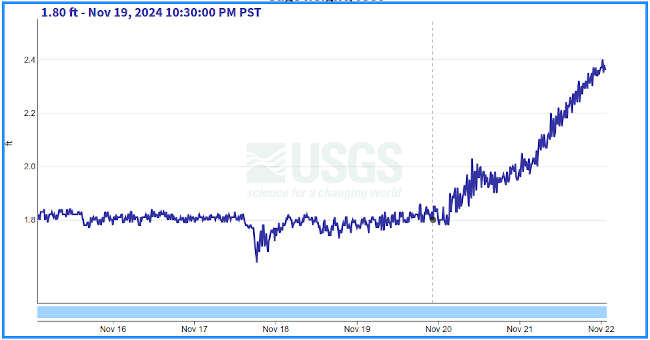
The rain has quickly pushed Clear Lake to the highest level for November since 2019, according to U.S. Geological Survey historical data.
As of 2 a.m., the lake had reached 2.36 feet Rumsey, the special measure for Clear Lake, up from 1.64 feet Rumsey on Nov. 18.
The flood watch issued by the National Weather Services remains in effect until 10 p.m. Friday.
Rain is expected through the weekend, during which time up to another 3 inches of rain are possible, based on the forecast.
There also are chances of rain in the forecast through most of next week.
Conditions are expected to begin to clear on Wednesday night, with Thanksgiving Day forecast to be sunny.
Email Elizabeth Larson at
- Details
- Written by: Elizabeth Larson
The elections office is now in the midst of the official canvass, which it has 28 days to complete.
As of Thursday, the registrar and her staff have 11,097 ballots left to count.
Those include:
• Vote-by-mail ballots: 9,170.
• Provisional/conditional ballots: 1,453.
• Vote-by-mail ballots that require further review for various reasons: 474.
The 11,097 ballots Lake County still has to count are among the 357,115 ballots remaining to be processed statewide, according to the Secretary of State’s Office.
The total number of ballots processed in California as of Thursday night was 15,813,078.
Of California’s 58 counties, only seven had completed counting ballots by Thursday, based on the Secretary of State’s unprocessed ballot count.
The Registrar of Voters Office must complete the canvass by Dec. 3. The Secretary of State’s Office will certify results on Dec. 13.
Email Elizabeth Larson at
- Details
- Written by: LAKE COUNTY NEWS REPORTS
Throughout 2023, CNAY gathered data from approximately 1,000 Native youth participants to better understand their needs and priorities in areas including culture, resource access, mental health and civic engagement.
Eight focus groups with 65 youth from different regions of the United States helped to center their perspectives and voices in the development of the report.
“During a time when we honor Indigenous history and celebrate the diverse cultural identities and continued resilience of Native peoples, it’s important to remember that Native youth perspectives are rarely prioritized in data collection and analysis,” said Katy Stewart, lead report writer and programs manager. “With this report, we attempt to do both.”
The organization said Center Us is an important step in preparing the next generation to be data sovereign, prioritize Indigenous-led research, and utilize Indigenous research methodologies to assist in the preservation of culture and identity.
The data collected throughout this process helped to shed light on the cultural strengths, resource access and priorities of Native youth across the country.
Key report insights include:
• Native youth who feel culturally educated are four times more likely to see themselves as capable of making a difference than those who do not.
• Lack of trust and a feeling that “nothing ever changes” leads to apathy towards voting in U.S. elections.
• Native youth in rural communities struggle to receive the funding resources necessary to make higher education seem plausible.
• Health care in tribal communities is preferred to healthcare in non-tribal communities.
“These findings emphasize the ongoing need to support Native youth through cultural engagement and improved access to resources in community, both of which are essential for fostering positive life outcomes,” said Cheyenne Brady-Runsabove (Sac & Fox Nation), report writer and associate director of youth programs. “It is our hope that all those whose work directly or indirectly influences Native youth will leverage this data to make informed, impactful decisions that benefit them and their communities.”
Download the full Center Us report and learn more about CNAY’s efforts to decolonize data.