How to resolve AdBlock issue?
Refresh this page
How to resolve AdBlock issue?
Refresh this page
Lake County News,California
  • Home
    • Registration Form
  • News
    • Education
    • Veterans
    • Community
      • Obituaries
      • Letters
      • Commentary
    • Police Logs
    • Business
    • Recreation
    • Health
    • Religion
    • Legals
    • Arts & Life
    • Regional
  • Calendar
  • Contact us
    • FAQs
    • Phones, E-Mail
    • Subscribe
  • Advertise Here
  • Login
How to resolve AdBlock issue?
Refresh this page

News

Lake County Adult School celebrates inspirational graduate Tom Willis

Details
Written by: LAKE COUNTY NEWS REPORTS
Published: 23 November 2024
Lake County Adult School Graduate Tom Willis with wife, Darlene and his daughter Renee, who recently graduated from the Lake County Adult School Program. Courtesy photo.

LAKE COUNTY, Calif. — The Lake County Adult School is proud to highlight the remarkable achievements of its students, including Tom Willis, who earned his high school diploma at the age of 71.

His story is a testament to the belief that it is never too late to pursue educational dreams.

Inspired by watching his daughter and granddaughter graduate last year from the Lake County Office of Education’s Lake County Adult School, Willis enrolled to achieve his own milestone.

"Everyone can learn and succeed, but not always on the same day or in the same way," said Lake County Superintendent of Schools Brock Falkenberg. "Tom's story is a shining example of what our adult education programs are all about: perseverance, growth, and new beginnings."

His hard work and dedication paid off, and his graduation brought tears of joy. "It's never too late to mark something off your bucket list," Willis said.

Looking forward, Willis plans to enroll in culinary classes at Woodland Community College, aiming to refine his baking skills.

His story exemplifies the school’s mission to provide opportunities for lifelong learning and personal growth.

“I am always amazed by the stories my students share with me, and I never get tired of listening to them,” said Lake County Adult School Teacher Jonah Wakefield about the determination of the student body. “This year, we've enrolled political refugees, single mothers, recent immigrants, and startup company COOs. It's a delightful cornucopia of people. I hope you enjoy hearing these stories as much as I do.”

Lake County Adult School, which opened in September 2023 at the Lake County Campus of Woodland Community College, offers a free, in-person high school diploma completion program for adults 18 and older.

The school has since expanded to also offer classes at the Lake County Campus of Mendocino College.

With a 130-credit graduation requirement, the program is designed to be flexible and accommodating, ensuring students can balance their education with other responsibilities.

The school has already celebrated several graduates and currently supports students from all corners of the county.

Its partnership with the local community colleges enables co-enrollment, expanding the horizons for students like Willis to pursue further education and career goals.

Since opening its doors in 2023, the Lake County Adult School has enrolled over 100 students, highlighting the strong community demand for this program.

For more information about Lake County Adult School or to enroll, visit the Lake County Office of Education website.

Lake County tribes among awardees for state affordable housing and homeless intervention grants

Details
Written by: Elizabeth Larson
Published: 23 November 2024
LAKE COUNTY, Calif. — Five Lake County tribes will receive a combined $11.4 million in state grants for housing projects aimed to address and prevent homelessness.

On Friday, Gov. Gavin Newsom announced that Native American tribes throughout the state will receive more than $91 million to address housing and homelessness, including $71 million from the first-ever awards from the state’s Tribal Homekey program and an additional $20 million through the state’s Tribal Homeless Housing, Assistance and Prevention Program, both administered by the California Department of Housing and Community Development or HCD.

“No community is untouched by housing challenges, and across the nation, Native Americans experience higher rates of homelessness and housing insecurity,” said Newsom. “These programs — developed in partnership with tribes across the state — are designed to help address the unique challenges and needs of Native communities in terms of housing and homelessness support.”

Tribal Homekey program

The Tribal Homekey program was created in partnership with California tribes to help overcome historical barriers to securing funding for affordable housing development.

The 10 awards totaling just under $71 million will fund 172 permanent, affordable rental housing units in rural California communities in the counties of Butte, Colusa, Del Norte, Fresno, Humboldt, Lake, Los Angeles, Mendocino and Sonoma.

In Lake County, the two Homekey awardees include Kuh-la-Napo, a project of the Big Valley Band of Pomo Indians, which was awarded $6,556,818. It will fund 20 permanent, supportive housing rental units that will serve homeless and at-risk of homelessness populations.

The second project, Scotts Valley Senior Community, will receive $3,038,659 for eight permanent affordable housing units for seniors.

The program is modeled on California’s successful Homekey program, which awarded its third round of funding this year to rapidly build housing for people experiencing or at risk of homelessness.

“Native American communities experience some of the deepest disparities of homelessness rates and unique housing challenges which require a thoughtful, coordinated approach,” said Business, Consumer Services and Housing Agency Tomiquia Moss. "I want to thank the Department of Housing and Community Development for partnering with tribes to catalyze development and build safe, affordable housing."

Tribal HHAP program

The state is also announcing $20 million in conditional Tribal Homeless Housing, Assistance and Prevention, or Tribal HHAP, program grants to help 37 federally recognized tribes in California implement unique, culturally responsive interventions to prevent and address homelessness.

In its first year under HCD administration, Tribal HHAP saw a 68-percent increase in applications over the previous round.

Tribes conditionally awarded Tribal HHAP grants are working closely with HCD and tribal technical assistance providers to finalize their program activities and budgets.

Once finalized and approved, tribes will receive their full award and begin this important work, with ongoing technical assistance available to support tribes throughout the implementation process.

“California tribes have faced historic inequities in accessing complex housing funding programs not designed with their unique needs in mind, and HCD is firmly committed to addressing this injustice,” said HCD Director Gustavo Velasquez. “Tribal Homekey reflects this promise. It was an honor to be able to dedicate the staff and resources to help meet the affordable housing needs of our tribal partners.”

Among the Tribal HHAP awardees are four Lake County tribes.

Those tribes and their awards are as follows:

• Big Valley Band of Pomo Indians: $525,145.04.

• Habematolel Pomo of Upper Lake: $552,445.55.

• Middletown Rancheria of Pomo Indians: $331,785.18.

• Robinson Rancheria: $402,772.09.

Creating more tribal housing

Earlier this year, the Governor signed measures to support tribal communities in developing more housing. AB 1878 by Assemblymember Eduardo Garcia (D-Coachella) establishes a Tribal Housing Advisory Committee within the Department of Housing and Community Development, composed of members from federally recognized tribal governments, to provide technical assistance for tribal housing programs and reduce the barriers tribes face when applying for funding. SB 1187 by Senator Mike McGuire (D-North Coast) creates the Tribal Housing Grant Program Trust Fund dedicated to supporting tribal housing projects.

When an atmospheric river meets a bomb cyclone, it’s like a fire hose flailing out of control along the West Coast

Details
Written by: Chad Hecht, University of California, San Diego
Published: 23 November 2024


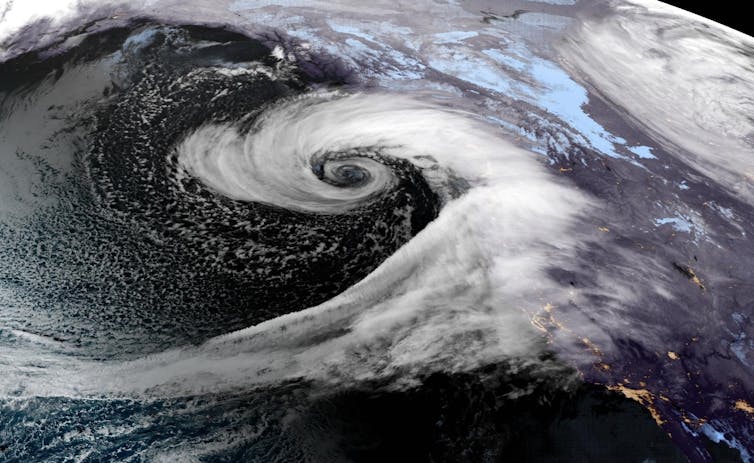
A satellite image shows an atmospheric river feeding into a bomb cyclone off the U.S. West Coast on Nov. 19, 2024. NOAA GOES

The West Coast’s rainy season has arrived in force, with an atmospheric river joining a bomb cyclone off the Pacific Northwest coast. Heavy, wet snow began falling in the mountains on Nov. 19, 2024, and rain has been blasting Oregon and Northern California, creating a risk of flooding and landslides in some areas. The atmospheric river was forecast to last for several days, hitting up and down the West Coast. Parts of Washington have seen more than 70 mph winds from the bomb cyclone.

When these two phenomena get together, the weather gets hard to predict, as meteorologist Chad Hecht of the Center for Western Weather and Water Extremes at the University of California, San Diego explains.

What happens when an atmospheric river meets a bomb cyclone?

An atmospheric river is exactly what it sounds like – it’s a long, narrow river of water vapor in the lower atmosphere. These rivers in the sky transport moisture from the subtropics to the mid-latitudes.

When an atmospheric river runs up against North America’s West Coast, the mountains and complex topography force the air to rise, cool, and the moisture to condense and precipitate. That can mean feet of snow at high elevations and rainfall elsewhere.

That’s not always a bad thing. Weaker atmospheric rivers help replenish reservoirs that are essential for supplying water during the dry season. California relies on atmospheric rivers for up to half of its yearly precipitation and streamflow.

This storm, however, is expected to be stronger and more unpredictable than unusual because of the bomb cyclone.

Atmospheric rivers explained.

Atmospheric rivers tend to form out ahead of cold fronts that are associated with low-pressure systems known as extratropical cyclones. These are air mass boundaries circulating around the area of low pressure. A bomb cyclone is a rapidly intensifying extratropical cyclone.

These two weather phenomena go hand in hand. A strong atmospheric river will feed moisture into the low-pressure system, providing fuel for the cyclone. The stronger the low-pressure system becomes, the stronger the atmospheric river becomes.

What will this combo mean for the West Coast?

This atmospheric river is impressive for its duration – it is forecast to continue hitting the coast with moisture for several days and spread precipitation into Southern California. Its integrated vapor transport – a measure of how much moisture is moving in the atmosphere – suggests that we’ll see a lot of rain and snowfall, with over a foot of precipitation expected in some areas.

On top of that, the bomb cyclone – one of the strongest we’ve seen along the coast – is bringing powerful winds.

While the atmospheric river is hitting the coast, the bomb cyclone will sit over the ocean off the Pacific Northwest and spin. As it spins, it sends small frontal waves through the atmosphere that push the atmospheric river inland. That creates a lot of uncertainty for forecasts.

If you picture the atmospheric river as a fire hose pointed at the coast, these frontal waves are essentially the fireman taking his hands off the fire hose and letting it go all wavy. It can move northward, and then back southward. The question is how far it will go before pivoting, then how quickly it will pivot back.
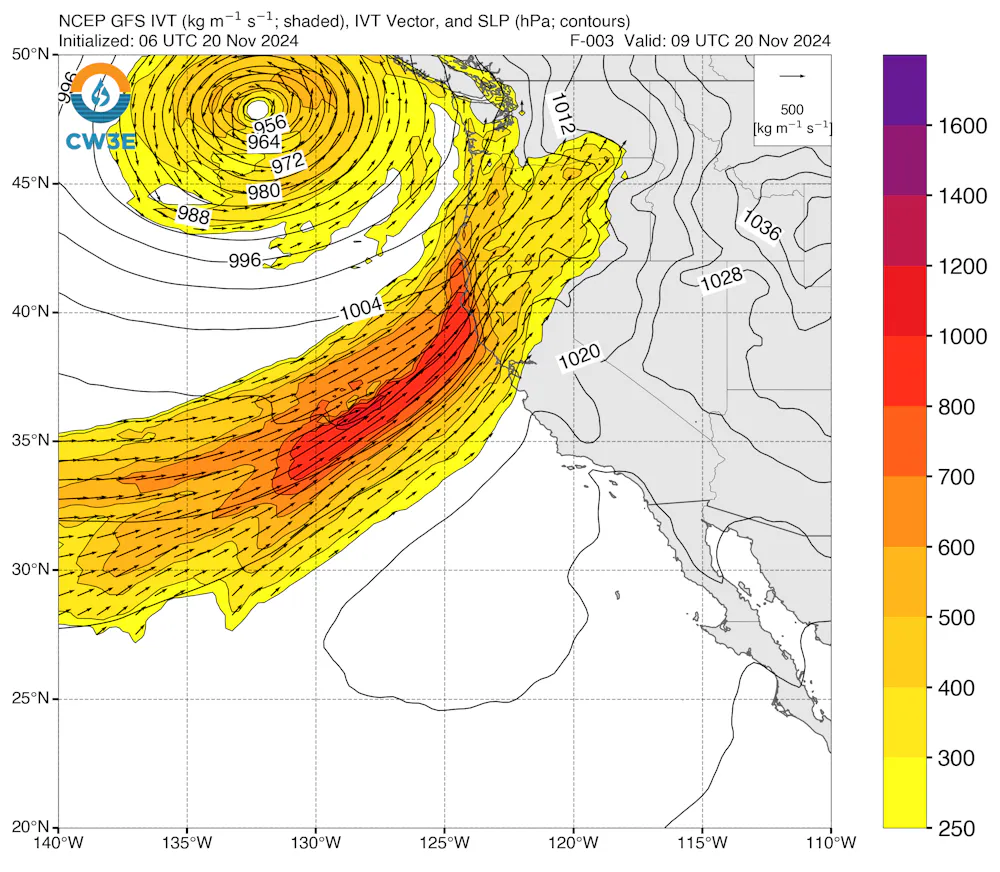
The amount of water vapor is strongest hitting Northern California. The chart shows the bomb cyclone's swirl above the atmospheric river.
A forecast for the storm’s vertically integrated vapor transport shows the direction and magnitude of the water flow, measured in kilograms per meter per second. Center for Western Weather and Water Extremes

So, how long specific parts of the coast will see rainfall and how intense that rainfall will be are the big questions.

The harder and longer it rains, the more impacts you’re likely to see.

The saving grace with this storm is that it’s early in the season, so the soils are relatively dry. That means they’ll be able to soak up more of the moisture. If a storm like this hit in winter, after the soils were already saturated, more water would run off, causing more widespread flooding than an early-season storm.

Are areas recently burned by wildfires in trouble?

With a storm this intense, the main concern in areas recently burned by wildfires is high-intensity precipitation.

When land burns, the surface can become impervious – almost hydrophobic. So, when that surface gets hit with high-intensity precipitation, the water runs off a lot faster than if vegetation or soil was able to absorb the water. Wildfire burn scars tend to be in hilly places, so that can lead to debris flows.

Map shows the strongest storm forecast from Monterey Bay, California, to the southern Oregon, but rain likely at some point during the week all along the coast.
The forecast for the atmospheric river hitting the West Coast, covering Nov. 20-27, 2024, shows a powerful storm. Much of Northern California is expected to experience a Category 4 strength atmospheric river, on a scale of 1 to 5. Center for Western Weather and Water Extremes

It’s really a matter of chance whether the burn scars get that intense precipitation. A strong cold front can form narrow cold-frontal rain bands that bring bursts of high-intensity rain. These small but powerful rain bands tend to form in dynamically robust storms. Meteorologists are seeing some signatures suggesting that these features could form.

The best advice if you’re in one of those areas is to pay attention to the National Weather Service’s watches and warnings.

Does this storm suggest a wet winter ahead?

Unfortunately, one really impressive storm doesn’t tell us anything about what’s ahead.

We’ve seen seasons with powerful early-season storms and then not much more. October 2021 is an example: A really strong storm hit that month, with record-breaking, 24-hour precipitation accumulations. But then the tap shut off, and California ended up with below-normal rainfall for the rest of the year.

An animation shows a stream of water vapor and how it is pushed toward the coast by the swirling bomb cyclone that sits off the Pacific Northwest.
An animation of satellite data shows how the atmospheric river draws moisture from the subtropics and is pushed toward the coast by the bomb cyclone. Cooperative Institute for Meteorological Satellite Studies, University of Wisconsin-Madison

There are tools that offer some indication of whether the season will be above or below normal, but those aren’t 100% accurate.

For example, the La Niña weather pattern that’s close to forming in the Pacific typically indicates drier than normal conditions across California. But looking at the past 10 years, we’ve had some really wet La Niñas – 2017 being the granddaddy of them all, with record-breaking precipitation in the northern Sierra.

Meteorologists typically have a good sense of what’s coming in the short term, about 10 days out. But what the rest of the season will look like is really an educated guess at this point.

This article was updated Nov. 21, 2024, with risk of flooding and landslides from the storm.The Conversation

Chad Hecht, Research and Operations Meteorologist, Center for Western Weather and Water Extremes, University of California, San Diego

This article is republished from The Conversation under a Creative Commons license. Read the original article.

Clearlake Animal Control: ‘Beast’ and the dogs

Details
Written by: Elizabeth Larson
Published: 23 November 2024
"Beast." Photo courtesy of Clearlake Animal Control.

CLEARLAKE, Calif. — Clearlake Animal Control’s kennels include new dogs added to those already waiting for new homes.

The shelter has 48 adoptable dogs listed on its website.

This week’s dogs include “Beast,” a male Siberian husky mix with a long black and white coat.

The shelter is located at 6820 Old Highway 53. It’s open from 9 a.m. to 6 p.m. Tuesday through Saturday.

For more information, call the shelter at 707-762-6227, email This email address is being protected from spambots. You need JavaScript enabled to view it., visit Clearlake Animal Control on Facebook or on the city’s website.

This week’s adoptable dogs are featured below.

Email Elizabeth Larson at This email address is being protected from spambots. You need JavaScript enabled to view it.. Follow her on Twitter, @ERLarson, or Lake County News, @LakeCoNews.


  1. Space News: NASA Ocean World Explorers have to swim before they can fly
  2. Heavy rain expected to continue; flood watch set to end Friday
  3. Lake County elections office reports on official canvass progress
  • 472
  • 473
  • 474
  • 475
  • 476
  • 477
  • 478
  • 479
  • 480
  • 481
How to resolve AdBlock issue?
Refresh this page