
How to resolve AdBlock issue?
Refresh this page
How to resolve AdBlock issue?
Refresh this page
Lake County News,California
  • Home
    • Registration Form
  • News
    • Education
    • Veterans
    • Community
      • Obituaries
      • Letters
      • Commentary
    • Police Logs
    • Business
    • Recreation
    • Health
    • Religion
    • Legals
    • Arts & Life
    • Regional
  • Calendar
  • Contact us
    • FAQs
    • Phones, E-Mail
    • Subscribe
  • Advertise Here
  • Login
How to resolve AdBlock issue?
Refresh this page

News

5 of the most frustrating health insurer tactics and why they exist

Details
Written by: Monica S. Aswani, University of Alabama at Birmingham and Paul Shafer, Boston University
Published: 18 December 2024


Many patients face significant upfront costs to getting health care. Peter Dazeley/The Image Bank via Getty Imagesw

The U.S. has made great progress in getting more people insured since the Affordable Care Act took effect in 2014. The share of uninsured Americans ages 18 to 64 fell from 18% before the ACA to 9.5% in 2022. And preexisting conditions no longer prevent coverage or lead to an increase in premiums.

Yet even for those with health insurance, coverage does not ensure access to care, much less high-quality and affordable care. Research shows that 1 in 3 Americans seeking care report delaying or forgoing treatment because of the “administrative burdens” of dealing with health insurance and the health care system, creating additional barriers beyond costs.

Some of these are basic tasks, such as scheduling appointments. But others relate to strategies that health insurers use to shape the care that their patients are able to receive – tactics that are often unpopular with both doctors and patients.

In addition, more than 40% of Americans under 65 have high-deductible plans, meaning patients face significant upfront costs to using care. As a result, nearly a quarter are unable to afford care despite being insured.

As scholars of health care quality and policy, we study how the affordability and design of health insurance affects people’s health as well as their out-of-pocket costs.

We’d like to unpack five of the most common strategies used by health insurers to ensure that care is medically necessary, cost-effective or both.

At best, these practices help ensure appropriate care is delivered at the lowest possible cost. At worst, these practices are overly burdensome and can be counterproductive, depriving insured patients of the care they need.

Claim denials

The strategy of denial of claims has gotten a lot of attention in the aftermath of the killing of UnitedHealthcare chief executive officer Brian Thompson, partly because the insurer has higher rates of denials than its peers. Overall, nearly 20% of Americans with coverage through health insurance marketplaces created by the ACA had a claim denied in 2021.

While denial may be warranted in some cases, such as if a particular service isn’t covered by that plan – amounting to 14% of in-network claim denials – more than three-quarters of denials in 2021 did not list a specific reason. This happens after the service has already taken place, meaning that patients are sent a bill for the full amount when claims are denied.

Although the ACA required standardized processes for appealing claims, patients don’t often understand or feel comfortable navigating an appeal. Even if you understand the process, navigating all of the paperwork and logistics of an appeal is time-consuming. Gaps by income and race in pursuing and winning appeals only deepen mistrust among those already struggling to get appropriate care and make ends meet.

Middle-aged couple sits on couch with bills and planner in front of them, a laptop in the foreground.
Patients receive a bill for the full amount after a claim is denied. Ridofranz/iStock via Getty Images Plus

Prior authorization

Prior authorization requires providers to get approval in advance from the insurer before delivering a procedure or medication – under the guise of “medical necessity” as well as improving efficiency and quality of care.

Although being judicious with high-cost procedures and drugs make intuitive sense, in practice these policies can lead to delays in care or even death.

In addition, the growing use of artificial intelligence in recent years to streamline prior authorization has come under scrutiny. This includes a 2023 class action lawsuit filed against UnitedHealthcare for algorithmic denials of rehabilitative care, which prompted the federal government to issue new guidelines.

The American Medical Association found that 95% of physicians report that dealing with prior authorization “somewhat” or “significantly” increases physician burnout, and over 90% believe that the requirement negatively affects patients. The physicians surveyed by the association also reported that over 75% of patients “often” or “sometimes” failed to follow through on recommended care due to challenges with prior authorizations.

Doctors and their staff may deal with dozens of prior authorization requests per week on average, which take time and attention away from patient care. For example, there were nearly two prior-authorization requests per Medicare Advantage enrollee in 2022, or more than 46 million in total.

Prior authorization can be a time-consuming, multistep process that slows down and often blocks patients from receiving care.

Smaller networks

Health insurance plans contract with physicians and hospitals to form their networks, with the ACA requiring them to “ensure a sufficient choice of providers.”

If a plan has too small of a network, patients can have a hard time finding a doctor who takes their insurance, or they may have to wait longer for an appointment.

Despite state oversight and regulation, the breadth of plan networks has significantly narrowed over time. Nearly 15% of HealthCare.gov plans had no in-network physicians for at least one of nine major specialties, and over 15% of physicians listed in Medicaid managed-care provider directories saw no Medicaid patients. Inaccurate provider directories amplify the problem, since patients may choose a plan based on bad information and then have trouble finding care.

Surprise billing

The No Surprises Act went into effect in 2022 to protect consumers against unexpected bills from care received out of network. These bills usually come with a higher deductible and an out-of-pocket maximum that is typically twice as high as in-network care as well as higher coinsurance rates.

Prior to that law, 18% of emergency visits and 16% of in-network hospital stays led to at least one surprise bill.

While the No Surprises Act has helped address some problems, a notable gap is that it does not apply to ambulance services. Nearly 30% of emergency transports and 26% of nonemergency transports may have resulted in a surprise bill between 2014 and 2017.

Pharmacy benefit managers

The largest health insurance companies all have their own pharmacy benefit managers.

Three of them – Aetna’s CVS Caremark, Cigna’s Express Scripts and UnitedHealthcare’s Optum Rx – processed almost 80% of the total prescriptions dispensed by U.S. pharmacies in 2023.

Beyond how market concentration affects competition and prices, insurers’ owning pharmacy benefit managers exploits a loophole in how much insurers are required to spend on patient care.

The ACA requires insurers to maintain a medical loss ratio of 80% to 85%, meaning they should spend 80 to 85 cents of every dollar of premiums for medical care. Pharmaceuticals account for a growing share of health care spending, and plans are able to keep that money within the parent company through the pharmacy benefit managers that they own.

Moreover, pharmacy benefit managers inflate drug costs to overpay their own vertically integrated pharmacies, which in turn means higher out-of-pocket costs based on the inflated prices. Most pharmacy benefit managers also prevent drug manufacturer co-pay assistance programs from counting toward patients’ cost sharing, such as deductibles, which prolongs how long patients have to pay out of pocket.

Policy goals versus reality

Despite how far the U.S. has come in making sure most Americans have access to affordable health insurance, being insured increasingly isn’t enough to guarantee access to the care and medications that they need.

The industry reports that profit margins are only 3% to 6%, yet the billions of dollars in profits they earn every year may feel to many like a direct result of the day-to-day struggles that patients face getting the care they need.

These insurer tactics can adversely affect patients’ health and their trust in the health care system, which leaves patients in unthinkably difficult circumstances. It also undercuts the government’s goal of bringing affordable health care to all.The Conversation

Monica S. Aswani, Assistant Professor of Health Services Administration, University of Alabama at Birmingham and Paul Shafer, Assistant Professor of Health Law, Policy and Management, Boston University

This article is republished from The Conversation under a Creative Commons license. Read the original article.

Lakeport becomes latest jurisdiction to approve new tobacco retailer regulations

Details
Written by: LINGZI CHEN
Published: 17 December 2024
LAKEPORT, Calif. — Retailers who sell tobacco in Lake County will soon have new rules to follow.

The Lakeport City Council approved a tobacco retailer licensing ordinance with a 4-1 vote on Dec 3, overcoming Councilmember Kenny Parlet’s emphatic dissent.

Parlet cast the sole opposing vote, declaring an “absolutely no” following hour-long deliberations against certain requirements and penalties in the ordinance. He also presented views on nicotine use and COVID that contradict those of public health authorities.

With its approval, Lakeport became the latest community to join the county’s tobacco prevention efforts, which seek to restrict youth access to tobacco products and improve public health.

“The primary push for this is trying to curb youth tobacco sales and enforce existing state laws in the community through the establishment of this ordinance,” Lakeport City Manager Kevin Ingram said at the council meeting.

The tobacco retailer licensing ordinance, or the TRL, alongside a smoke-free policy and enforcement measures, will take effect on Jan. 1, 2025, for unincorporated areas of the county, following the Board of Supervisors' final approval in September.

Clearlake adopted the TRL on Nov. 21 with unanimous support, leaving Lakeport as the final jurisdiction in the county to join the initiative. The cities’ ordinances also begin with the new year.

In September, the Lakeport City Council first reviewed the tobacco prevention program presented by Liberty Francis of Lake County Public Health, who’s also the project director of the county’s Tobacco Education and Prevention Program.

The council then moved forward with a 4-1 vote, with Parlet opposing it then as well.

Francis’ presentation showed Lake County’s “health ranking being very low” at 56 of all 58 counties in the state.

“One of those contributors to our health rankings is our very high smoking rates compared to the State of California,” said Francis at the September City Council meeting, describing the smoking rate of 26.6%, which almost doubled the state rate.

The situation of youth tobacco use is particularly concerning. While 49% of California high school students reported it was easy to access vapes from a store, 60% of ninth graders and 65% of 11th graders in Lake County said the same, according to Francis’ presentation.

Two months later on Nov. 19, four council members unanimously approved the ordinance during its first reading while Parlet was absent from the meeting.

Shortly after Lakeport’s final vote in December to adopt the ordinance, Lake County Health Services issued a statement to “celebrate success in tobacco prevention policy milestones,” marking years of efforts since 2017.

Youth access to tobacco is “a high level issue to address” for Lake County, Francis reiterated in an interview with Lake County News a week later. She believed that the new ordinance allows the state laws to be “upheld on a regular basis.”

Lakeport TRL and delay in enforcement

The new TRL ordinance requires Lakeport tobacco retailers to obtain and display a valid tobacco retailer license and prohibits selling of any flavored tobacco products.

It also bans selling tobacco to a person under 21 or placing any tobacco products within 5 feet of “youth appealing products” such as toys, snacks or non-alcoholic beverages.

Additionally, no smoking is allowed within 25 feet of any retail establishment licensed under this ordinance.

Violations carry penalties: a first offense results in a 30-day license suspension and a $1,000 fine, while a second offense within five years increases penalties to a 90-day suspension and a $2,500 fine.

While Councilmember Parlet strongly opposed the penalty codes as he did to the first presentation in September, “all three jurisdictions had voiced that they wanted a strong penalty and enforcement policy in order to make this policy,” Francis explained.

The ordinance designates the city manager as the principal enforcer but allows delegation to another agency. Ingram said the city now plans to partner with Public Health, which has secured funding for the program on enforcement.

Technically, the ordinance is enforceable by the city 30 days after the Dec. 3 approval. But the actual date that it can be enforced will likely differ.

“I don’t have staff at this time to have a comprehensive enforcement program of that ordinance,” Ingram told Lake County News in a followup phone interview, adding that it will take a couple more months to sign a memorandum of understanding with Public Health.

When asked for a more specific timeline, “I would say there is no timeline at this point,” Ingram responded.

Ingram noted that violations like selling tobacco to minors and flavored tobacco are already enforced under state law by the police department. The new TRL ordinance's requirements and penalties will take effect only after the city formalizes its partnership with the county’s public health department.

Francis said it will take some time to roll out the license application process and “extensive education” on the program.

“We’re hoping to have everybody licensed in this by the spring,” she told Lake County News. “Probably March is what we’re shooting for.”

Opposition during council comments

At the meeting, Councilmember Parlet voiced his strong objection to the ordinance during council comments, citing his experience of “five and a half decades in retail.”

Parlet appeared to be the single dissenting vote in Lakeport and one of the two in all three jurisdictions. District 4 Supervisor Michael Green was the other “no” vote during the Board of Supervisors’ consideration of the ordinance.

“I'm not going to get this onerous fine, because I can't go up and talk to the supervisors and say how asinine a first offense, $1,000 fine and a 30 day suspension,” Parlet said, raising his voice, adding that he believed such a penalty would push retailers “out of business.”

Parlet’s indignation peaked when he spoke about employees in retail making mistakes, for which the owner would be fined and the license suspended under the ordinance.

In 2012, Parlet’s business, Lakeview Supermarket & Deli in Lucerne, faced a fine and a “permanent disqualification” notice from the Supplemental Nutrition Assistance Program, or SNAP, by the USDA Food and Nutrition Services for “trafficking,” which means exchanging SNAP benefits for cash.

At that time, Parlet said it was one of his employees who had made several inappropriate transactions totalling $132.50. He faced a $5,000 fine.

Parlet was required to pay a $59,000 appealing fine to be reallowed into the program.

On the TRL ordinance, Parlet also fervently opposed “carding,” which means being required to verify customers’ government-issued photo ID at every purchase of tobacco products, as is done with alcohol purchases. Parlet believed it’s “insulting” and “laborious” for staff dealing with customers looking apparently over 21 years of age.

Francis responded that her son just turned 20 and he looked older than his actual age, suggesting that a lack of “positive identification” at the counter would jeopardize the purpose of protecting the youth against tobacco.

When IDs are checked, Francis said, “There's less of a failure rate when that happens all the time.”

Francis said that training and education resources will be made available to retailers throughout the process, to make sure retail employees are property trained.
Parlet’s objections also extended to the no-smoking policy within 25 feet of the TRL licensed premises because of the concerns over his employees not having a place to smoke nearby.

“None of my people can go out to the dumpster and smoke without getting a violation,” he said.

Before moving to the vote, Parlet expressed a lack of willingness to act in accordance with the ordinance.

“I can’t abide by almost any part of this. So you guys do what you need to do,” he said.

While Parlet accused the program of not involving and understanding tobacco retailers, Councilmember Kim Costa recognized the concern and posed the question to Francis.

“Was there a place anywhere in the process where the stakeholders, such as the retailers, were notified and had an opportunity to share their views?” Costa asked.

Francis said that the team went out to survey some stores and speak to store managers and owners, although not covering all the 75 retailers in Lake County.

“What I've heard from those store managers is ‘we want a policy that’s going to be enforced,’” Francis said and explained that retailers who follow the law felt they are not on a fair playing field.

“It sounds like due diligence was done on that, and I’m comfortable with the ordinance as written,” Costa said.

Health official disputes Parlet’s claims

Councilmember Parlet also claimed profound medical benefits for nicotine use in his argument against the tobacco ordinance.

“Nicotine is not the villain that everybody thinks it is. It actually works miracles in long COVID,” Parlet said. “Whatever it is, I’m not ever going to say it’s a virus. I don’t believe it. I think it’s a bio weapon.”

Parlet went on to add: “Nicotine has been prescribed and proven to treat all over the world conditions such as Parkinson's disease, Alzheimer's disease, multiple sclerosis, ulcerative colitis, arthritis, myocarditis, cancer, Autism Spectrum Disorder, Schizophrenia, diabetes, glioblastoma, turbo cancer.”

However, local and federal public health authorities said just the opposite.

“There is no standard practice of medicine in which commercially sold tobacco is used to treat cancers or long COVID. And nicotine itself as a substance, I’ve never heard of nicotine … being used for treating any [condition],” said Noemi Doohan, Lake County Public Health officer who is also a practicing physician, in a video call with Lake County News.

“You can find a benefit to any substance,” said Doohan from a scientific point of view, “but its risks greatly outweigh the benefits.”

While Parlet also said that nicotine is “not necessarily addictive,” Doohan responded, pointing to “decades’ worth of research showing, proving, without a doubt that nicotine is addictive.”

“I think that the public needs to decide: who do they trust?” Doohan said of the possible impact of inaccurate information on public health.

“We have science, we have data, we have evidence behind our position, and therefore it's really up to the public to believe who they have the most faith in terms of reliable information,” she said.

“It is very hurtful to those people in Lake County who died from COVID to say they didn't have COVID,” she added. “So as a physician, I hope, as the health officer, I hope that I am the trusted member to this community to say COVID is real, and tobacco smoking generates dependence on tobacco, which can lead to lung cancer.”

Federal public health agency Centers for Diseases Control and Prevention, or the CDC, explicitly states that cigarette smoking is a “major public health concern,” “harms nearly every organ of the body” and causes cancer, heart disease and stroke, lung diseases, diabetes, harmful reproductive health effects among other detrimental effects.

Smoking and secondhand smoke exposure cause over 480,000 deaths each year in the country, CDC data shows.

Doohan attended the council meeting and said she remembered Parlet saying he was against children smoking.

“I am completely in favor of eliminating the use of tobacco by children,” said Parlet in the meeting.

“Great! Because what we're talking about is upstream prevention of a generation of Lake County people being dependent on nicotine and tobacco products,” Doohan told Lake County News. “I'm really delighted to hear that, that part of it, he does not question.”

Email Lingzi Chen at This email address is being protected from spambots. You need JavaScript enabled to view it..

Lake County students learn about the dangers of fentanyl

Details
Written by: LAKE COUNTY NEWS REPORTS
Published: 17 December 2024
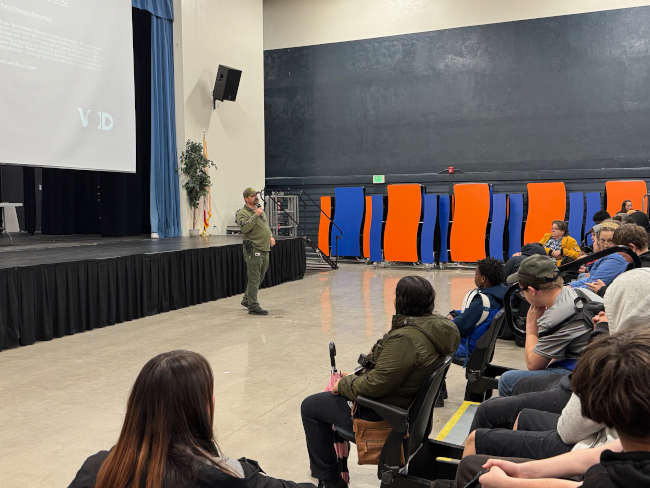
Lake County Sheriff’s Office Sgt. Gary Frace from the Lake County Sheriff’s Office talks about the dangers of fentanyl and other drugs to Obsidian Middle School students. Photo courtesy of the Lake County Office of Education.

LAKE COUNTY, Calif. — Last week, the Lake County Office of Education partnered with the Lake County Sheriff’s Office and Victims of Illicit Drugs, or VOID, to deliver essential presentations on the dangers of fentanyl and drug use.

These presentations reached over 4,500 middle and high school students in every school district across Lake County.

"Education is the most powerful tool we have to protect our children and their futures. By addressing this head-on, we are equipping our students with the knowledge they need to make safe choices and help save lives,” said Lake County Superintendent of Schools Brock Falkenberg.

This initiative brought together educators, law enforcement and community organizations to address the urgent issue of fentanyl-related overdoses among youth.

Lake County is not immune to the devastating impacts of this crisis. According to the Lake County Sheriff’s Office, data shows that 40 percent of all drug overdose deaths in Lake County are fentanyl-related.

The presentations featured Steve Filson and Chris Didier from VOID and Sgt. Gary Frace from the Lake County Sheriff’s Office.

Both speakers from VOID traveled to Lake County specifically for this initiative, bringing their stories, expertise and passion to educate and empower students.

"In my role as coroner, I’ve seen firsthand the devastating impact of fentanyl on families in our community. My goal is to save kids’ lives by providing them with the knowledge they need to stay safe,” said Sgt. Frace.

VOID is a nonprofit organization dedicated to combating substance abuse through education and outreach. Their commitment to prevention has made a significant impact on communities across the country.

“Fentanyl changes everything,” said Filson. “Fentanyl and other emerging synthetic drugs have forever changed the drug landscape. Counterfeit pills consist of nothing but a neutral filler, binder and Fentanyl. Fentanyl has eliminated the possibility of experimenting with drugs.”

While these presentations mark a significant step forward, the fight against fentanyl is far from over.

The Lake County Office of Education encourages parents, educators and community members to continue fostering open and honest conversations about the dangers of drug use.

“Together, we can build a safer and healthier future for Lake County’s students,” the agency said in a statement.

The community is invited to attend additional presentations this week.

On Tuesday, Dec. 17, from 5 to 7 p.m., there will be a presentation at Konocti Resort Casino. Another presentation will be held on Thursday, Dec. 19, at the Habematolel Pomo of Upper Lake Community Building.

For more information about Stop the VOID and its mission, visit https://stopthevoid.org/.

Lake County Sheriff’s Office Sgt. Gary Frace from the Lake County Sheriff’s Office talks about the dangers of fentanyl and other drugs to Obsidian Middle School students. Photo courtesy of the Lake County Office of Education.

Third annual community Christmas day dinner planned in Kelseyville

Details
Written by: LAKE COUNTY NEWS REPORTS
Published: 17 December 2024
KELSEYVILLE, Calif. — Angela Carter and Rob Brown invite community members to a Christmas day dinner in Kelseyville.

The couple, their family and friends — including Rosey Cooks catering service and members of the Kelseyville Presbyterian Church — are providing the free dinner.

They offer a special thanks to the Clear Lake Gleaners for the generous donation of turkey and other items.

Turkey, ham, potatoes, vegetables, rolls and dessert will be served at the Presbyterian Church at 4021 Third St. in Kelseyville from 3 to 5 p.m. on Christmas Day.

Those looking for a dinner and fellowship on Christmas Day, are welcome to drop by to enjoy a meal and good company at the Friendship Hall.

Piano music will be provided by Julianne Carter.

They can also bring the meal to your vehicle to take home and enjoy.

Contact them by phone at 707-349-2628 or by email at This email address is being protected from spambots. You need JavaScript enabled to view it. to reserve your meal.
  1. Blue Zones Project - Lake County supports 2024 Hope Rising Innovation Summit
  2. Supervisors to hold last meeting of the year
  3. Lakeport City Council to seat new members, consider housing fund
  • 446
  • 447
  • 448
  • 449
  • 450
  • 451
  • 452
  • 453
  • 454
  • 455
How to resolve AdBlock issue?
Refresh this page